Showing posts with label old house. Show all posts

Thursday, May 4, 2017

5/4/17 Report - Cut Beach. Another Mystery Find. Columbus' Anchor? T.H. Puzzle.


Written by the TreasureGuide for the exclusive use of treasurebeachesreport.blogspot.com.

Sweet Three Foot Plus Cut.
Photo by Dustin P.
That is one nice looking cut.  Notice the dense line of shells.  The bigger shells are higher up and then small pieces below.  That is definitely something that should be checked out.  The slope below the shells is interesting too.

It is north of the Treasure Coast.

Here is what Dustin said about the cut.  I took a walk on the beach over my lunch break today and was pleasantly surprised by how deep the cuts were. They are about 3 1/2 feet at the tallest and you can really see how much sand has been moved. There is hard packed sand the whole rest of the way down to the water line... This is actually deeper than the cuts that were made by the hurricane last Nov. For whatever reason I guess since its right on the point of the Canaveral beach furthest east the beach will cut every time the wind shifts. Usually not this much though...

Thanks Dustin!

---

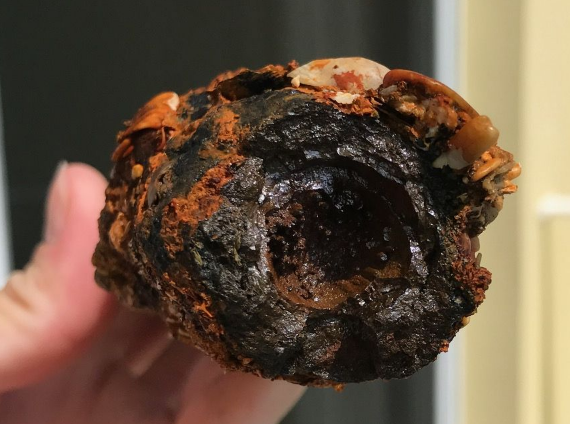
Here is another mystery find.  It is one of a few items found by Julie B. in the Vero area recently
Let me know what you think it might be.

Corroded Iron Mystery Object.
Photo by Julie B.

Another View of the Same Object.

Another View. Of Julie's Object.
Let me know what you think.

---

Darrell Miklos of the Cooper's Treasure TV show claims to have found the anchor of Christopher Columbus.  

...Analysis of the anchor, which was found off the Turks and Caicos islands, reveals that it dates to between 1492 and 1550. The overall size of the anchor and its estimated weight of between 1,200 and 1,500 pounds indicates that it was a “bower” anchor from a 300-ton vessel, the typical size of a Columbus-era ship.  (Now that is a more reasonable statement. TG)

The discovery will be revealed in the next episode of the Discovery Channel docuseries "Cooper's Treasure," which airs at 10 p.m. ET Tuesday. “That anchor is from Christopher Columbus,” says historical shipwreck discovery specialist Darrell Miklos, who led the Caribbean expedition, in a clip from Tuesday’s show. “I am telling you, stick around, this is just the beginning of an amazing story.”

Here is the link.

http://www.foxnews.com/tech/2017/05/02/experts-discover-christopher-columbus-anchor-at-caribbean-shipwreck-site.html

---

Here is a little puzzle.  There is no right answer - at least not one that I know is right for sure without testing it out.

Lets say you found an old house on blocks.  It is up off the ground by just enough for you to craw under without getting stuck, but maybe you can't get to all of the area because some places are too tight to get into.  You don't know what type of treasure might be under the house.  What type of equipment would you want to use and what tips would you give for how to conduct the search.

Send me your answers.  I'll assemble, summarize and discuss the ideas that I get on this.

---

I'm working on loosening up the Bausch and Lomb canister that I found, hoping to open it up without damaging it.  That is for me an unusual find.  I am wondering what the story is.  Who in the area had an old brass microscope, and how did it end up where it was found?

Objects have stories.  Sometimes the story remains lost and sometimes it is discovered.  I've said this before, but for me, much of the value is the story.

---

I hope you'll help with the identity of the mystery item and the search puzzle.  Also I posted a new poll.  I hope you'll respond to the poll.  I'll have a follow-up to that one when it is done.  We'll see how trustworthiness relates to enjoyment.

Happy hunting,
TreasureGuide@comcast.net

Tuesday, August 12, 2014

8/12/14 Report - Archaeology Site Closed. How To Decide When To Quit. More On Walls Full Of Silver Coins. No Cyclones.


Written by the TreasureGuide for the exclusive use of treasurebeachesreport.BlogSpot.com.

Treasure Coast Beach This Morning


I found this interesting article that raises some questions.  It is about an archaeological site that has been studied since Victorian days and was more recently excavated by numerous students and professionals until one archaeologist finally declared that there was 'nothing left except gravel and natural geology.'

Here is a brief excerpt from hat article.

The public is invited in for one last open day Saturday, when there will be tours, craft demonstrations, and displays of this year's best finds, including a red pottery bowl as immaculate as if made yesterday, a massive thumb ring with an enamel inlay, and a copper alloy bottle opener, which proved to be the folding handle of a Roman soldier's skillet – apart from the decoration, almost identical to a first world war mess tin handle.

Here is the link for the rest of the article.

http://www.theguardian.com/uk-news/2014/aug/08/silchester-roman-town-closes-natural-geology-archaeological-excavation-ends%20%20

One person wondered how long a site should be dug.   That to me is an interesting question.   This site was dug until they decided that there was nothing left but gravel and dirt.

That question of when to quit can be applied to metal detecting too.  When do you quit on a detecting site?   The answer depends on a lot of factors.  

If it is a site where there is continual replenishment of targets, such as a beach, then the answer might be never.

If you ask the question about a shipwreck site, for some the answer might still be never - at least not in their lifetime.   But for others the time to give up might come much sooner.  

The time to give up isn't necessarily when there is nothing left.  It might be much sooner when there are other more productive site.  You only have so much time to spend.

The decision about when to give up on a land site is often easier than a shipwreck site. 

Still the decision can be difficult.  Is the site really hunted out?  That might depend on you talk to. 

Will technology improve enough to make a site more productive again - perhaps in different ways?  That is another question.

Personally, I still am often surprised by how many times I can go over a land site and continue to find things.   That is especially true when you have used one detector or technique and then the next time use another detector or technique.  It is easy to think a site is cleaned out when there is still more to be found.

The goal is always one of the main considerations.   Without specific goals, you can't really evaluate success.  What do you want to find?  What types of things?   Is the goal to get everything, or only the best things?

In this study it seems that one of the most earth-shattering conclusions is that olives were eaten in England earlier than thought.   How important is it to know that?  To me it doesn't seem very important.   Not important enough to spend tons of time and money on.  But you never know what you will find before you begin.

Some people would say the fact that olives were eaten in England earlier than thought is or could be very important.  I'm sure those people are the ones that expect to get something out of the study - if not a salary, perhaps publications, recognition and professional advancement.  Good for them!  But is that why the site is being studied.  Judge for yourself.

It seems to me that archaeology is often practiced as if the primary purpose was to keep archaeologists employed. 

Lets not forget about the red pottery bowl, massive thumb ring and bottle opener that the pubic will get to view.  And whatever important information those objects might add.   But do the results justify the cost?  That is a question that should be answered.  Is it the best use of time and resources?

The same can be said of a metal detecting site.   Do the results justify the costs? 

In my opinion, that question should be answered in a very different way than a project that is being funded involuntarily by tax-payers. 

Metal detecting is voluntarily done by individuals at their own cost.  Many of the products are difficult to quantify -  recreation, exercise, lost items found and returned, and even occasionally but rarely, important discoveries that lead to archaeological investigations.

Whether you are talking about an archaeological project, shipwreck salvage (also archaeological but privately funded), or a simply metal detecting, there is a decision to be made.  In each of those three cases the decision should be made in a different way, but in all cases the decision has to be made. 

In all three cases, the decision has to be made without perfect knowledge.  You never quite know if you are quitting too soon or if there might be  better place to spend your time.  And in all three cases, there is a subjective element.  No matter how well you collect data and analyze what you have found, there is always the element of the unknown.  And that is a good part of what makes it so exciting.


More on the old house full of old coins. 

One city worker thought it might be finders keepers at first.

And they kept it quiet for months waiting to see if someone came foreward to claim the money.

Interesting.

Here is another article on the house with walls full of coins.

http://www.nydailynews.com/news/national/trash-cash-florida-workers-find-2-000-silver-coins-demolition-article-1.1897886


There is nothing tropical going on in the Atlantic.

On the Treasure Coast the surf is small.  At the beach above, the unusually big tides from the Super Moon didn't do anything good.

Happy hunting,
TreasureGuide@Comcast.net

Sunday, August 10, 2014

8/10/14 Report - 60 Pounds of Silver Coins Discovered! Great Bronze Shipwreck Spikes Found. Wreck of the Olivette Explored. Fine Watch. Big Tides.


Written by the TreasureGuide for the exclusive use of treasurebeachesreport.BlogSpot.com.


Bronze Spikes Found by UB
Photos submitted by UB
Here are some great finds.   Bronze spikes!   One is still in wood.  That is really neat. 

Also the one with the washer or ring around it is unusual.

Great finds and photos UB!


UB was wondering if anyone had seen one with something like this washer thing on it, and if anyone had any thoughts about their possible age or any other ideas they might be able to offer.

He was also wondering about how to conserve them.

UB has a proven technique for conserving wood, but was wondering how to conserve the combination of wood and bronze.


The Olivette, was an American steamer that was turned into a hospital ship, and was used in the Spanish American War to treat injured Spaniards as well as Americans.  It sank in 1918. 

Here is a nice video showing divers exploring the discovered wreck.

http://xfinity.comcast.net/video/USS-Olivette-Shipwreck/316563523637/Comcast/TopVideoClips/?cid=sf_vidtray


Source: Orlando Sentinel link.


This old house was condemned and demolished.  In the process 60 pounds of silver coins from the early 1900s were discovered in the walls.


Tek sent me the link to this article published in the Aug. 10 Orlando Sentinel.

Thanks Tek!


The link below will give you the entire story and a video on the treasure in the old house.

http://www.orlandosentinel.com/news/local/breakingnews/os-silver-dollars-chimney-st-cloud-20140808,0,1921056.story


Due to the poor beach conditions, I've been targeting modern jewelry at tebeach..  There has been a good bit of it at a few of the Treasure Coast beaches.

Here is the type of thing you can find, and no target ID meter would get it exactly right.


That is about the most attractive watch that I've seen.  And in great condition!


On the Treasure Coast the surf is very small, but the tides today were unusually big.  

There is a little weather just coming off of Africa that has about a 10% of becoming a cyclone in the next 48 hours.

That one is very far away yet, but could be worth watching.

Happy hunting,
TreasureGuide@Comcast.net