Showing posts with label photo. Show all posts

Tuesday, July 7, 2020

7/7/20 Report - Putting It Together: Waves, Liquefaction and Lenses. Kings Landing.


Written by the TreasureGuide for the exclusive use of treasurebeachesreport.blogspot.com.

Clark Little Photo of Wave.
Source: ClarkLittlePhotography.com.
They say a picture is worth a thousand words, but they say a lot of things - don't they.  In this case, it might not be too far off.

They also say appearances are deceiving.  It looks to me like there might be a bit of a fisheye effect in this photo, but it is still amazing and informative.  Even if there is a fisheye effect, and I'm not sure there is, it still seems to show the sand being picked up with the water.  The surface of the sand right in front of the wave seems to curve up into it.

I've posted other pictures showing something similar, but there is also a lot of geology science that talks about things like liquefaction of sand and soil and how that happens, so we have both the pictures and scientific principles, which seem to support each other.

Source: Pinterest.


Liquefaction can be created by vibrations, which it seems you'd have on a beach with all of the breaking waves, but if that were not enough, I showed an illustration about a week ago that illustrates how passing waves cause liquefaction and water lenses.  I also have referred to how dock piers are set by a pressure hose pushing sand and earth apart so the pier can be inserted.  Putting that altogether, it looks like liquefaction could be one big ingredient that hasn't been talked about much in the metal detecting community to explain how sand and objects move on a beach.  In the past, it seemed that people just talked like sand and objects were simply pushed around somehow.  If you put this all together, I think you'll have a lot more understanding of how sand and other objects can move on the beach.  You'll also want to add what I've called trigger points.

A lot of times things are simply uncovered or washed down from the dunes, but I think the best metal detecting days are when the waves crash from the low tide zone and work their way all the way up until they crash against the dunes.  We usually can't see through the turbulent water to see how everything is moving, but the above photo might give you a pretty good idea.

---

Find With Good Message.

I mentioned finding a cheap necklace not long ago.  It bears a good message.  It seems like every time out I've been finding some type of little turtle thingy.


---


Exclusive Kings Landing Development Coming to Fort Pierce.


King's Landing, a new exclusive community is planned for marina area of Fort Pierce. 

Homeownership ranges from the mid-$400,000s to $1 million+. 

Charleston homes are two-story, three-bedroom and 3 1/2 bath residences.

Homeownership begins in the high $500,000s.

I've read that they are all reserved in advance.

---

If I decided that the predominant culture in which I now live has evil roots and is pervasively evil and I should no longer support it and participate in it or what came from it, that would mean I'd no longer use the internet or computers, or the English language for that matter.  I'd have to burn my degrees and erase them from my vita.   And I'd have throw away antibiotics and other pharmaceutical products, to to China or someplace for medical care, give up hot dogs, Coca Cola, eye glasses, laser surgery, TV, airplane travel, air conditioning, Ford, Chevy and Tesla automobiles, the convenience of the water closet, my Wrangler jeans, and UF Gator shorts.  I'd even have to stop rooting for my football team, watching the NFL and basketball.  And that is just a beginning.

---


Not much on the National Hurricane Center map today.

Happy hunting,
TreasureGuide@comcast.net

Saturday, October 27, 2018

10/27/18 Report - On Moving Beaches: More Illustrations. Yosemite Tragedy.


Written by the TreasureGuide for the exclusive use of treasurebeachesreport.blogspot.com.

Old and New Photos of The North Fort Pierce Causeway Area.
Submitted by Dave J.
People often talk about how items sink and get moved on a beach.  Movement is a relative thing.

Beaches are dynamic.  Beach sand moves a lotHow the sand moves is often more important than how other items move.  That is often missed.

People often think that when an item or wreck suddenly shows up on a beach that it was washed up and when an item disappears, it sank.  Fact is that just as often the item moved little or not at all, but the sand moved.

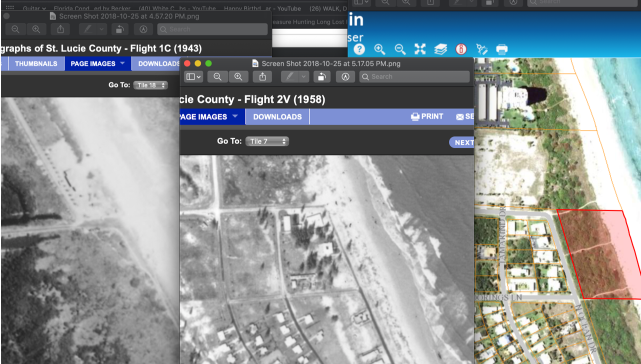
Yesterday I was talking about how the sand moves and showed the Fort Pierce inlet area as one example.  Dave J. got what I was saying and did some research on his own.  He sent the above pictures of the area just north of the inlet for comparison.

Dave said, I was just looking at the FP inlet and used some old 1948, 1958 pictures of the corner at north causeway and A1A. Attached is old vs new and looks like an entirely new parcel of land was created (red outline). 

Thanks Dave! That is a great illustration.  

As I said yesterday, the area to the north of the inlet is an area of accretion, while the beach to the south of the inlet tends to erode.  That means that items to the north of the inlet will tend to get covered, while items to the south will get exposed when the sand erodes.

New discoveries are often made south of inlets where the natural flow of sand is interrupted, while older items to the north get covered.  That is on the west coast where the prevailing long shore currents are north to south.

If you want to buy beach front property, you might want to think about an area to the north where the beach will increase, instead of in an area where the beach will be disappearing.

Here is another look at the photo I posted yesterday.

Fort Pierce Inlet.
Compare that with the picture of the Jupiter Inlet (below).

Jupiter Inlet.
Notice the similarity.  Notice how much more narrow the beach is towards the top of the photo.  That is not all perspective.

Once again, the beach to the south of the inlet would be even farther back if it wasn't for all of the beach renourishment projects.

If the Jupiter wreck scattered to the north, it could now be under the accreted sand.

---


This photo of a couple on a high ledge at Yosemite is real.  It looks like fantasy art, but it is not.  Yosemite has the most dramatic scenery of anywhere that I have been, and I'd recommend it to everyone, at least once.

Here is a link to a story about that.   Unfortunately a couple taking a selfie fell off.

https://sanfrancisco.cbslocal.com/2018/10/25/couple-fatal-fall-yosemite-parks-taft-point/

Many years ago I hiked up a trail that got VERY narrow and looked straight down hundreds of feet.  It was too much for me, and I turned around and went back down.  Once I got to the trail head, I looked back and saw a sign at the entrance that said, Trail Closed - Falling Rocks.  Didn't matter to me, because it was way too high and the path on the ledge way to narrow even if it was stable as the Rock of Gibraltar.

---

The tides on the Treasure Coast are nice and high.  There is a beautiful full moon.

There won't be any big surf for a while.

Happy hunting,
TreasureGuide@comcast.net

Thursday, October 15, 2015

10/15/15 Report - A Find's History May Be More Complex Than You Think. Million Dollar Historic Photo Found. 600-Year-Old Warship Found. Nine Foot Surf Coming.


Written by the TreasureGuide for the exclusive use of treasurebeachesreport.blogspot.com


Gold Snuff Box Held By Captain Jonah Martinez
Electrolysis Tank At The
Conservation Lab in Sebastian


---

The tendency is to over-simplify.  If you find an old item, the tendency is to believe that it was simply lost there.  That might be the case sometimes, but there are also times when things are moved two, three or more times, and they can be moved in ways that are seldom considered.

Years ago I found an escudo that the evidence suggests could have been lost and recovered three different times.  It seems it was once lost in a shipwreck, then salvaged and put on another ship, which sank and was lost again.  It was then salvaged by a salvage company and sold and then lost in the ocean at a resort and then found again.  That would be a remarkable sequence of events, but very possible.

It might not be possible to trace a specific coin's history like that very often, but I'm sure that many coins have a similarly interesting history.  When you find an item, don't assume that it was simply dropped where it was found.  A lot could have happened to it.

It is easy to think of a shipwreck dumping items in the ocean, but often forgotten is the mining of the gold and silver, transport of the raw materials to the mint, and the trip from the mint overland and by sea to the port where they were loaded onto the ship that eventually sank.  It is also easy to forget the chaos during the storms and sinking, and the first attempts at recovery, the movement along the beach to a salvage camp, and the movement of salvaged items.  And then there were the pirates, individual thefts, and salvaged by the natives.

I've read where gold chains from shipwrecks were hung in trees.  If you found one of those chains, it might be found alone and with no clue as to why it was found where it was.  You would know that it got there somehow and that would tell you to check for more items, but you probably wouldn't find much else - certainly nothing like if it was found at a shipwreck site or salvage camp site.

The point I am making is that items may have a more complex history than we think.  There are many ways that things can end up where they are found - especially when you consider a period of hundreds of years.  It isn't always a simple matter of things going down with the ship and then being washed onto a beach.  There are a lot things that can happen at different times. There are a lot of ways that items can be moved and lost and found again. Items that are lost are not always lost once.

I suspect that during salvage, items that were picked up were occasionally lost again.  Ropes slip, chains break, and things can be dropped.  That all contributes to the distribution pattern, and means that things can be found where they are not expected.

Even when it comes to modern items, things can be lost and found multiple times.  In the process they can be moved from one location to another - sometimes far away.  That sort of thing is perhaps most obvious at resorts where items are brought from around the world and lost at the resort.  For some items, such as foreign coins, it you might suspect that they have traveled long distances before being lost, but for many, you might never guess how many times they have been lost and found or how they have moved around the world.

I've found items that I lost and found again.  I remember one thin gold chain with a medallion (made in Italy by the way) that I dug up and put in my pocket.  It was probably a couple of miles back to the car and my pocket had a small hole in it and the chain was dropped about half way back to the car.  I walked back along the beach and was lucky enough to find it again.  But the point I am making, is that right there in a very small amount of time, the object was found after having been lost, moved, lost again and found again.

I have no doubt that some of the items I've found and returned have been lost again, or perhaps sold and resold or maybe given away.

Think about the journey that cobs and other items have made.  Think about where the silver or gold was mined and where the cobs were minted.  Think about the trip they made before they were loaded onto the ship.  Think about the chaos of a hurricane, and how things are spread around.  Think about the early recovery efforts and the attempt to assemble and store things before transporting them again.  And think about all of the things that could happen at any part of the process.

Just because you find an item at such and such a place doesn't mean that its journey was simple or that the object didn't take many side trips along the way.  We'll never know about many of those side trips, but it might be worth considering the various possibilities.

---

Among a group of photos purchased for $2 was a rare photo of Billy the Kid playing croquet, which is thought to be worth a million dollars or more.

https://www.yahoo.com/tech/s/rare-photo-bought-2-may-now-worth-millions-184506393.html

---

Aerial photography helps find a 600-year-old warship buried in river mud.

http://www.telegraph.co.uk/news/earth/environment/archaeology/11924909/600-year-old-Henry-V-warship-found-in-Hampshire-river.html

---


Still the big news for me is the predicted five to nine foot seas for the Treasure Coast this coming Monday.   That prediction has held steady for a couple of days.  That doesn't always happen.  We still have four days to go.

The wind is supposed to be mostly out of the north up until then and then get stronger and more easterly.  I'd rather they continue from the north.

Nonetheless, that is something to watch and be ready for.

Happy hunting,
TreasureGuide@comcast.net
Sunday, July 19, 2015

7/19/15 Report - Do Crashing Waves Throw Coins As They Break? 130 Year Old Winchester Found In Desert.


Written by the TreasureGuide for the exclusive use of treasurebeachesreport.blogspot.com.


Real Wave Photo.

Now this is really cool.  Believe it or not this is an actual photo.  Beside being a beautiful picture, it shows something very interesting.

I'm not positive but I think the photo is a Clarke Little photo.  He is a surfer turned photographer.

I lost track of the source, but here are more of Clarke Little's beautiful wave photos. 

http://clarklittlephotography.com/


Take a good look at that photo again.  Do you see what is happening?  Look at the brown sand or whatever being sucked up into the wave.  That is what I think is very interesting.  It wouldn't be that apparent if you were just watching it happen, but when it is frozen in time like that you can really see it.

In my 7/16 post I showed this illustration.  Notice how the waves move in circles.  I've told before about how if you are floating in the deeper water, you'll move in a circle as a wave goes by.

As the wave gets in more shallow water the circles get flattened and turn into  ovals.

What you are seeing in the top photo is the bottom of the circle where the sand is getting sucked back into the wave.  The circle isn't completed here because the water is too shallow and the wave is breaking.

Just think about what is happening there.  First the top sand is getting sucked out and then the wave comes crashing down with force just in front of that.  

When the sand gets sucked up into the wave, as you can see in the photo, it is lifted, and then when the crashing wave impacts the sand with considerable force.

That happens time and time again as the waves come in, and each time in just a little different place.

A report by the Naval Warfare Center (http://www.dtic.mil/dtic/tr/fulltext/u2/a495574.pdf) says, Overall, average impact pressures from the breaking waves are greater in magnitude than the impact pressures from the non-breaking waves and average impact pressures tend to increase with increased speed...

OK.  We knew that crashing waves have considerable force.  I recently posted about blocks weighing tons being moved.

Big waves, as is obvious, stirs up a lot of sand, but in addition to the effect of crashing, there is also the sucking that we see in the photo.   Add that to a near continuous flow running along with the long shore current on a steep beach and a lot of sand and stuff could be moved quickly.

Adding in any undertow or backwash, the net effect will depend upon a variety of factors, including the "trigger" and "drop" points for specific objects, as I've said before.  

I think my understanding of how coins and objects get covered and uncovered is fairly complete.   I've tracked and observed how objects move in many situations, but I have never been able track the movement of objects within big waves and during storms.  I think I'm getting pretty close to a complete understanding of that part of the process too, which will explain how coins and things wash up at times.

Looking at the picture at the top of the post and how the sand is getting sucked into the base of the wave, I wondered if coins or other objects could get sucked up into the wave and actually thrown ahead with the water in a breaking wave.  I don't know about that, but considering how easily coins flip (turn over) in relatively little current, I wouldn't be surprised if large breaking waves could throw some objects.  Certainly they are blasted, lifted and moved, but maybe not through the entire cycle of the breaking wave.

In the photo, you can see some of the sand moving ahead with the wave.

It would only happen when the waves and obects are in shallow water.  That is one condition.  When the water is deep relative to the size of the waves, the bottom and objects on the bottom are not affected.

When we have storms, some waves are breaking on a slope rather than a flat bottom like we see in the photo.  I

I didn't really want to introduce the complication of the different types of waves yet, but I unintentionally just stepped into it.

Besides breaking waves, there are other types, such as plunging waves and surging waves.

According to wikipedia

A plunging wave occurs when the ocean floor is steep or has sudden depth changes, such as from a reef or sandbar. The crest of the wave becomes much steeper than a spilling wave, becomes vertical, then curls over and drops onto the trough of the wave, releasing most of its energy at once in a relatively violent impact. A plunging wave breaks with more energy than a significantly larger spilling wave. The wave can trap and compress the air under the lip, which creates the "crashing" sound associated with waves. With large waves, this crash can be felt by beachgoers on land. Offshore wind conditions can make plungers more likely.

That is as much as I want to get into that for now.


I've known for a quite a few years that coins wash up onto the beach.  There is no doubt about that, but perhaps large crashing waves can move sand and objects in even more dramatic ways than I previously suspected.

For a relatively thorough explanation of waves, you might want to look at the following.

http://topex.ucsd.edu/ps/trujillo_waves.pdf

-----

132 year-old Winchester rifle was found propped up against a tree in the desert.  Nobody knows what happened to the owner or how it got there.

Interesting story.

http://www.foxnews.com/us/2015/01/15/132-year-old-winchester-rifle-found-propped-under-desert-tree/

---

It seem that the Treasure Coast is in for a couple more weeks of one-foot surf.  How long can this last?

Happy hunting,
TreasureGuide@comcast.net

Sunday, January 26, 2014

1/26/14 Report - Cameras and Detectors Work Together OR Photography for Dectectorists


Written by the TreasureGuide for the exclusive use of treasurebeachesreport.blogspot.com.

Photography is a valuable tool for the detectorist.  The older I get, the more I appreciate and make use of that fact.

Stack of Find Photos From the Past.
The Top Photo On The Stack Shows Finds For One Particular Day.
Almost everyday you see a photograph of something someone found in this blog.  It is easy to share photos these days.  For the detectorist that means sharing finds and thrills.  It also means being able to get the opinions of others about your finds, which is very useful when you don't know exactly what an item is or where it came from.

I often post unidentified finds in my blog hoping to get some information, and I often send photos of finds to experts in different fields.

Beyond the most obvious benefits of sharing photos of finds, there are some other good reasons to photograph finds.  One good reason is to document the item.  That could be done for insurance purposes, for example.

If you take your good finds to a bank safe deposit box, as I always recommend, it is especially helpful to have good photos that you can refer to at home.

I recommend taking photos of finds on a periodic basis.  If you hunt everyday and make frequent finds you might take photos once a week, or example.

Photos aren't enough if you want to really document finds.   Keep additional information: where items were found, when they were found, and any relevant circumstances that might be helpful, such as was the beach eroded, or whatever.

It is probably best to keep photos of individual items or groups in time sequence, or at least make sure the time is marked on the photo.

Sometimes multiple photos are necessary.  You might want close-ups of specific details, such as hallmarks, or various views or sides of an item.

It is good to take before and after photos of items that need to be cleaned and preserved.  Once an item is cleaned, you might want to be able to see what it looked like before it was cleaned.

It can also be helpful to take a photo of the beach where you hunted and found the items.

Just like detectors, different cameras are different, so you might end up getting more than one.

Also like detectors, if you are going to take photos in the field, it can be worth having a water-proof or water-resistant camera, or at least some method of protecting it.

Also a submersible camera can be really useful if you dive.  You can take pictures of things you aren't allowed to remove.

I've enjoyed my new Celestron Microscope camera, and I've shown a number of close-ups that I've taken with it.

There are times when you might notice a mark or something on an item in a good close-up that you never noticed before.  With different editing programs you can change the contrast, sharpness and other details.

I'm not a person that likes to spend a lot of time on equipment, so I like to make sure that whatever I get, it can be used well with very few adjustments.

You might think that you'll remember your finds and all the details surrounding them, but the more you find and the longer you hunt, the easier it is for things to fade out of memory.

When I look at my old photos of finds, it brings a lot of memories back.  Surprisingly often when I look at old finds, there are many that I can remember exactly how I felt as they came out of the sand or  water.  A photo can really help to bring the details back.

A Sample of Photos Showing Groups of Finds

When I looked at the photo shown at the top of this post, I remembered that day.  It was a four-hour hunt.  Two hours followed by a necessary interruption, and then I returned to hunt two more hours at the same location.  I knew there were a lot more items remaining to be dug when I had to leave after the first two hours.  I remember exactly where I was and how the items were in a line.  I remember a lot about that day.  The photo set off that series of memories.

I can go through that stack of photos and remember time after time after time.  You might think your memory is good, but sometimes it might need some help.  Photos can help.

It also can be really helpful to take pictures of your favorite beaches from time to time so you can compare sand levels and different things.  It will help you identify the right times and conditions for finding different items.  You can also mark on the photo where items are found in the past.  One thing GPS won't give you is a picture of the spot where the item was located at the specific time it was dug.


Here is a web site showing photos of unusual things washed up on beaches.  Actually they aren't real unusual, but you might enjoy looking.

http://www.weather.com/sports-rec/outdoor-beach-marine/strangest-things-washed-beaches-20130617?pageno=12


I've notices some changes in how people take photos of finds since I started this blog.  Back at the beginning everybody was including a coin for size comparison.  Now it seems that a lot of people are holding the item when they take the photo.  The hand has become the item for size comparison.
Of course, when size is critical a ruler or something is better.

Cameras are different now too.  With so many people using their smart phone or whatever, more people are taking photos in the field and find it easier to hold the item to get it framed well.


On the Treasure Coast, we'll be having an increasing surf for a week or so.  However the surf won't get big enought to cause a real change in beach detecting conditions in that time period unless the current predictions are wrong.


Happy hunting,
TreasureGuide@comcast.net

Friday, December 27, 2013

12/27/13 Report - Microscopic Inspection of Dug Coins and Cobs and Comparison of Two Half Reales


Written by the TreasureGuide for the exclusive use of treasurebeachesreport.blogspot.com.

I got some new equipment that can be used to take good photos of coins and other small objects.

Here is an example of one of the first photos that I took of a coin using the Celestron microscope.

I plan to use the microscope to study and photograph beach cobs as well as other things.

If you look at the penny shown here you can see the steps, you can see the figure of Lincoln between the two center columns, and you can see the surface of the coin pretty well.  There is some glare that obscures some of the details.

What I found is that the resolution of the microscope far exceeds that of my computer monitor so if I want to see more detail, I'm going to have to get a higher resolution screen.  Some of the lack in detail in this photo is due to lighting too.

Nonetheless, as is, I expect the microscope to be useful and I expect you'll see the results in future posts.

Here are a couple more of my first attempts with the new device.

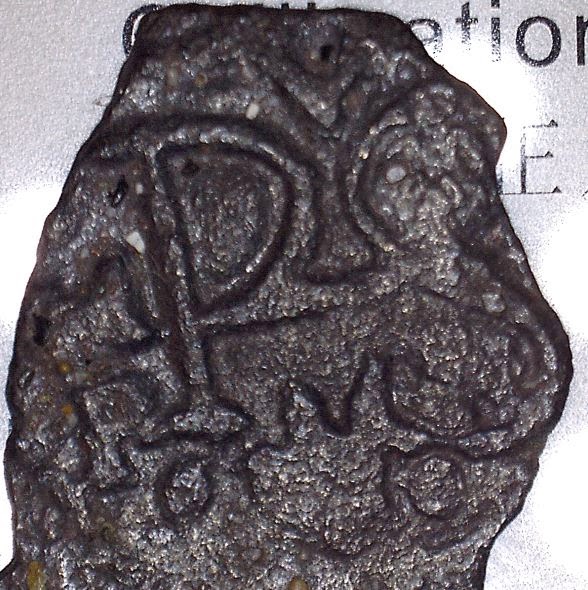
Here is a photo of a half reale that was recovered from a Treasure Coast beach in November of 2013.  I posted a photo of it before, but that photo wasn't nearly this good.

In this photo you can see the P assayer mark more clearly (to the left of the bottom of the large P).

You can also clearly see the M mint mark above that, indicating the Mexico mint.

Notice other details, such as the circles and the figure below and between the big P and S.

I think it makes a nice photo even with the limitations in computer screen resolution.

You can also see a few grains of sand still attached to the surface of the cob.

Below is a photo of another half reale found in November of 2013 at the same beach.  I think you can clearly see that this cob was made by another die.

Not only were there many different dies, but dies also were reworked as they wore out and needed to be sharpened up.

Unfortunately this cob does not show the assayer mark.  It does however show part of the M mint mark.

Look just to the left of the big P about half way down the P.  You can see the right side of the M.

So this cob is also a Mexico minted cob.  You could also tell that by looking at the style of cross on the other side of the cob.

You can see the part of the figure below and between the P and S on both cobs - representing a pomegranate, I believe.

One of the big differences I see between the two cobs is the V above and between the P and S.

On the top cob it is complete and entirely between the P and S.  On the bottom cob, it appears to overlap with the S.

I will be using this microscope to make good photos of coins and finds.  Too bad screen resolution is such a limiting factor.  I think the photos look good nonetheless.


Today on the Treasure Coast the surf is around five feet today, but will be diminishing over the next week or so, so don't expect any improvement in beach detecting conditions real soon.

Thats all for now.
Happy hunting,
TreasureGuide@comcast.net


Saturday, October 16, 2010

10/16 Report - Jupiter Beach & Miscellaneous


Photo of Jupiter Beach. Submitted by Tom Guidus.


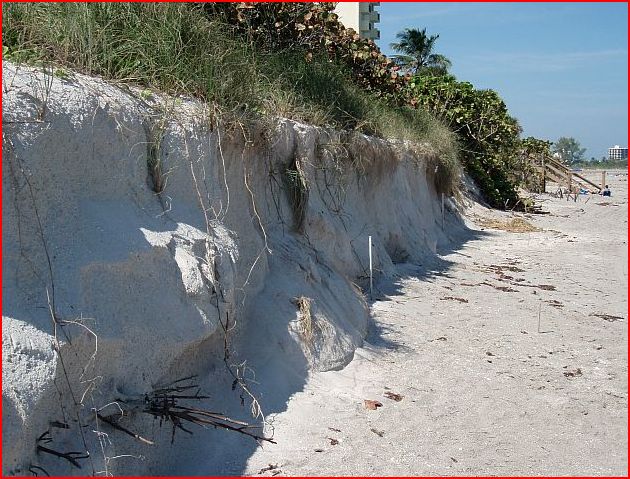
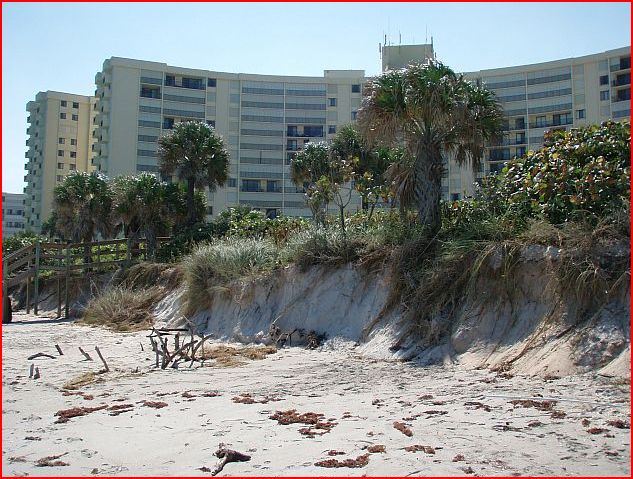
Tom Guidus of Wreckovery Salvage, regularly works the Jupiter wreck, and sent some photos of Jupiter Beach, pointing out the loss of sand and shells at the base of the cliff. He said much of the renourishment sand is gone and some of the old stuff is starting to reappear.

The best time to hit it would be just after the water has hit the cliff and caused some erosion. Cobs as well as old US coins sometimes come out of that cliff when the old dunes erode.


Another View of Jupiter Beach from Tom Guidus.

I always appreciate receiving photos from around the Treasure Coast and Florida, especially from places that I don't get to a lot.

I often get email from people from out of state asking about where you can go to the beach. One thing I can say about most of the Treasure Coast is that there is no shortage of beach accesses. Thank goodness it isn't like some places where you can hardly find a place to see the beach without paying high parking fees.

St. Lucie and the other counties have done a good job of maintaining many fine beach accesses. All you have to do is drive along A1A and watch for a beach access, then pull into the free parking area and take a look at the beach. If you want, you can find either busy beaches with facilities or quiet out of the way places.

One thing you can do when beach conditions are not good, is explore some new beaches.

The SedwickCoins Auction begins October 21. The first lot contains a number of gold cobs from the 1715 Fleet.

You might find it instructive to browse through the shipwreck artifacts.

Here is the link.

http://www.sedwickcoins.com/treasureauction8/artifacts1.htm

I certainly wish I knew more about artifacts years ago. People find a lot of things and don't know what they are. It really helps to be able to recognize artifacts when you see them.

The stock of Odyssey Marine (synbol OMEX) is now up to around $2 per share. That is a nice return from recent lows. They appealed a claim made by Spain to one of the salvaged wrecks on the other side of the Atlantic and are still holding the salvaged coins and artifacts.

As I've mentioned, Spain is making an attempt to find and and claim any sunken ships that might be their's. They are using their navy for the job, and it seems are having very limited success in terms of really identifying shipwrecks.

Forecast and Conditions.

It's that time of year when we often get some cold fronts moving in from the the north. Things should be improving sometime this fall.

Now the seas are calm but will be increasing to near four feet tomorrow, but only for the day. That probably won't be enough to improve things yet.

There is no tropical activity that will affect us soon.

Happy hunting,
TreasureGuide@comcast.net


Geoglyphs or what?

http://news.discovery.com/archaeology/geoglyphs-peru-slide-show.html