Showing posts with label scoop. Show all posts

Friday, June 5, 2020

6/5/20 Report - Road to Sevilla de Oro Found. One More Mistake to Avoid. Seminole Silver.


Written by the TreasureGuide for the exclusive use of treasurebeachesreport.blogspot.com.

1977 Silver Jubilee One Crown.
Reminder of Mistake.
---

Aurania Resources Ltd. is pleased to report that vestiges of an old road have been found in the central part of its Lost Cities – Cutucu Project (“Project”) in southeastern Ecuador.  The road was discovered by Aurania’s field teams while searching for Sevilla de Oro which was one of two gold mining centres described in historic manuscripts from Ecuador, Peru, Spain and the Vatican.  These records describe the Colonial Spanish operating the two gold mines between approximately 1565 and 1606.  The road discovered by Aurania’s exploration teams is believed to be the one that linked Sevilla de Oro to the other gold mining centre ‘Logroño de los Caballeros’ as described in the historic manuscripts...

Aurania’s Chairman and CEO, Dr. Keith Barron commented, “The historical record names the Treasurers of the “Caja Reales” – the Royal Treasuries – in Sevilla and Logroño, so we know that the gold produced was cast into crude ingots for transport to Quito...

Here is the link for more about that.

https://resourceworld.com/aurania-finds-first-field-evidence-of-colonial-spanish-activity-at-its-lost-cities-project-in-ecuador/


---

A couple days ago I mentioned that I had been thinking back over some of the mistakes I made.  I was thinking of mistakes that were made after the item was located, and in some cases recovered. I talked about one of those and plan to talk about the others.

We all know that we should be careful when digging up an item, but we can still get careless.  We can get careless because we dig up a lot of coins that don't matter much, and we can get in a hurry, and a single scratch can dramatically reduce the value of a fine coin.  

In my first year of metal detecting, I found one very nice coin that would be graded in near mint condition if it did not have a single big scratch that I caused with my scoop.

It was in the habit of hurriedly digging up modern coins, when I was surprised by seeing a silver 1977 Isle of Man Silver Jubilee crown (shown above) in my scoop.  It isn't anything real valuable, but it was the most interesting coin that I had dug up to that time.

That was back in the day when I was trying to find as many coins as I could.  I showed some of my records from those days in this blog before, and remember telling Jerry at the Pot of Gold, the store where I bought my detector, that I more than paid for my Fisher Aquanaut with the modern coins I found in just a few months.  I was finding a lot of coins, but I never expect to find something like the silver crown and still wonder what it was doing on Hollywood Beach.  Judging by the conditions, it couldn't have been there very long.

For those of you who know Hollywood Beach, it was found just a few feet away from the shower in front of the Pizza shop by the handball courts.  The handball courts weren't there then, but that is where this coin was found.  It was such surprise for me at the time that I remember it well to this day.

The coin is almost perfect except for that one big scratch from my scoop, which to my surprise, doesn't seem to show in the photo.  I still have that coin,, which should act as a reminder, but I'll probably still get careless at times.  I've scratched more and better coins since that one.

My main point today is that you never know what you might be digging up, so be careful while doing it.  A pin-pointer is a good idea, but a pin-pointer won't guarantee not scratching or breaking finds.

I could tell a lot of stories about items ruined by careless digging - not all of them by me.  For example, in Fort Pierce at the site of the old fort, Kevin Reilly (now deceased) of Reilly's Treasured Gold, stuck his digger right through a nice silver Seminole head band.

See http://www.nativetech.org/seminole/silverwork/index.php  to see some nice examples of Seminole silver ornaments.

A lot of items are damaged when the detectorist get in a hurry, but hopefully this reminder will save one or two good finds.

---

We had a strong south wind yesterday.  Today the wind is calm and the surf is down around two feet.  However the tides are nice and big.

The weather forecast is showing only a 40% chance of precipitation today.


Happy hunting,
TreasureGuide@comcast.net

Sunday, June 2, 2019

6/3/19 Report - Tips For Scooping in Shallow Water. Jars Give Good Dates. A Storage Solution.


Written by the TreasureGuide for the exclusive use of treasurebeachesreport.blogspot.com.


Scooping Tips.


If you work in shallow water, there will probably be times when you have trouble getting an item scooped up.  There can be various reasons for that.  One is strong currents.

When you lift a scoop, that will create currents that will cause sand and objects that are not firmly in the scoop to fall out, with or without strong cross currents.

Lifting your scoop more slowly can help.

Gold chains can be very difficult to get in your scoop.  Even when you get some of a chain in the scoop, there can be enough hanging out, to pull the entire chain out as you lift the scoop.

Of course light objects can also get swept away as you lift your scoop.

Too much sand in the scoop will cause more sand and other objects to fall out as you lift. Be careful to not over-fill your scoop.

Here is something I have found helpful.  When you stick your scoop in the sand, tilt the handle farther back so the front of the scoop is angled up more, but don't lift yet.  Before lifting, vibrate your scoop.  Shake it in very short quick strokes.   That will allow some of the sand to sift through and the object will fall deeper into the scoop before you lift.

In three words, it is tilt - sift - lift.

---

Among the more common bottles you will find are Bromo Seltzer and Vaseline.  I've found a lot of embossed Vaseline bottles.  I usually don't keep bottles with screw tops, but the Vaseline bottles are so heavily embossed that I did keep some of them.

Embossed Vaseline Bottle.

This bottle is not one of the older Vaseline bottles that I've found.

The first known reference to the name Vaseline was by Robert Chesebrough in 1872 (U.S. patent 127,568).

As you would suspect, the first containers for Vaseline were not screw top bottles.

As always, doing your research can make your finds more meaningful.  I found out, for example, that the bottles for Vaseline were made in a factory where my father worked in his early teen years.  It is possible that he actually packed the bottle above.  I'll have to do some additional research.

Like anything that has success, there are copies.  Moroline was a competitor to Vaseline.

Embossed Moroline Bottle.

Surprisingly, Vaseline bottles have been thoroughly studied and inspection of the bottle can provide a very good estimate of the age of a site.

A Tour Through Time in Vaseline Bottles is a 30 page document with references written by John Lockhart and presented on the Society for Historical Archaeology web site.

Here is the link.

https://sha.org/bottle/pdffiles/Vaseline2015.pdf

---

I've been trying to store my bottles more compactly and safely.  Here is something I'm trying, and it seems like it should work.

Large Plastic Container That Once Held Animal Crackers.
I looks like I'll be able to store three layers of ink or other siunukarkt small bottles in this plastic container.

Cardboard strips separate the layers.

---

It looks like we'll have at least another week of one foot surf on the Treasure Coast.

Happy hunting,
TreasureGuide@comcast.net


Thursday, February 22, 2018

2/22/18 Report - Little Known Danger and Secret Technique for Working Crowded Swimming Areas. Mystery Solved.


Written by the TreasureGuide for the exclusive use of treasurebeachesreport.blogspot.com.

Identified!

Ding! Ding! Ding!  Yesterday's mystery item was identified by Mitch King.  He said,

Its Plate money from Sweden. Fredrick the 1st 1720 to 1751.

You can see other similar examples by using the following link.

http://www.swedishcoppers.com/PlateMoney.html
Thanks Mitch!

---

I'm going to add to what I said the other day by giving some other examples of items found and returned and also a technique that I developed and refined over the years for working in crowded swimming areas. 

In my previous post on that subject, I mentioned things like keys and eye-glasses.  Today I'll give some jewelry examples.

It is always easier when you see someone looking for something just after they lost it.  They probably have a good idea of where the item was lost.

Class rings are common jewelry finds.  On one occasion I was hunting in the shallow water at a South Florida swimming beach and two young girls approached me.  One said she lost her sister's class ring, and she wasn't supposed to have it.  It didn't take me too long to find it.  The younger sister sure was happy.

On another occasion when I was shallow water hunting, I came to an area where kids were obviously trying to find something.  One of them said somebody lost their class ring and offered them $20 if they found it.  It didn't take me long to find that one either.  No mention was made of the reward.  None was offered.

The same thing happened at another location in more shallow water.  Kids were diving and making a lot of commotion looking for something.  In this case it was a gold emerald ring that  a young lady lost.  There are times when you have to get people to clear out so you can detect an area properly.  I got the kids to move back and out of the way so I could use my detector without them getting in the way.  Again I found the ring pretty quickly.  This was one time when I received a reward.  That was very unusual in my experience.  There were plenty of times when I didn't even receive a thank you, which amazed me.  But on this occasion, after I presented the ring to the young lady, she ran up to where her blanket was, and then back down, she stuck a twenty into my shirt pocket.  She just as quickly ran off again, so that was one reward I kept.

It is always a good idea to clear people out of the search area and explain that you need room to conduct a proper search.  You want to be able to swing your coil without anyone in the way, but there is another good reason to make everybody get back. Mark out boundaries and ask people to stay outside those boundaries while you hunt.

You also want to recover the item and inspect it before anyone else sees it.  I have on multiple occasions had people attempt to claim a ring that did not belong to them, and it is not uncommon to find something other than the specific item you are looking for.   That is why you must have a good description of the item before you hunt, and why you should inspect the item for identifying information before you return it.

When I was in the water and dug an item while people were close by, I had a method of keeping the find hidden until I had a chance to take a look at it.  Immediately after getting the scoop up out of the sand but while the scoop was still under water, I vigorously shook the scoop.  That created a cloud of sand that made it impossible to see the object in the scoop.  I would then quickly stick my hand in the scoop and by feel remove it.  Of course you can quickly tell by feel if it is a ring or coin.  With the item still in your closed hand, quickly slip the item in your pocket, turn your back and distance yourself from onlookers.  When you get a chance, take a look at it, but not before you are sure no one else sees it.  It is important to get the item returned to the just owner instead of some crook.

One time when I was not yet so experienced, I was hunting in shallow water and was being followed by some kids who saw me dig what turned out to be a couple of big tokens.  They yelled at the top of their lungs so everyone on the beach heard, "He found some kind of big coins."

I actually liked nice kids being interested and would show them what I was doing and would even let them participate to some extent, but there are also obnoxious unrestrained kids that can be a problem.  You have to judge the situation.

Those are just a few examples.  I could give many more, such as the young man who did a handstand in shallow water and lost his gold chain, which was quickly detected and returned, but I wanted to give some tips.

Always be aware of your surroundings and who is around you.  The only thing I don't like about using a snorkel when hunting in shallow water is not being as aware of what is going on around me.

I've heard of some detectorists being harrassed onlookers, but that wasn't been much of a problem for me.  I avoided people to a large extent, often hunting when there weren't many people around.  I also had a stainless steel scoop that looked like it was capable of making melon balls of human flesh.

Of course there were also times when I failed to find items that were reported lost.  A New York fireman told me where he lost his NYFD ring.   He was going back to New York and gave me his address.  I looked for it several times, but never found it.

I should also mention that there are finds that the owner might not want to acknowledge for one reason or another.  One New York Yankees World Series ring was found on the Treasure Coast.  The name was in the ring.  When the player's phone number was called, the wife answered and asked where the ring was found.  When told, she said she thought to fellow lied to her and went to St. Lucie to see his girlfriend.  There are times when the owner doesn't want to acknowledge or claim an item.

---

The weather is beautiful and there are lots of snow birds on the Treasure Coast beaches.

The surf continues to run in the two to four foot range.  The tides are moderate and the wind is east/southeast.

Happy hunting,
TreasureGuide@comcast.net

Tuesday, November 29, 2016

11/29/16 Report - Detecting Surf and Turf. Button Finds. Digging Egyptian Movie Artifacts in California.


Written by the TreasureGuide for the exclusive use of treasurebeachesreport.blogspot.com.

Tis the season to be jolly.  Anytime you can be jolly is the season to be jolly, but for beach hunters, the winter months are generally better than the summer months, unless there is a summer storm that shakes things up. From my personal experience, October to April is the best time to find cobs on the beach, with Nov. to February usually being the best of those.  It is the opposite of the salvage season around here, which relies on the smoother summer surf.  More likely than not we'll have some good opportunities to find cobs on the beach in the next couple of months.

Dan B. was hunting in South Carolina.  Here is what he had to say about that.

I spent a solid week of research before heading to SC this year. I was surprised at how difficult things can be if they are not in one's own back yard. Going to unfamiliar territory is strangely challenging. Surprised that anything could stand in my way, I found that everything did. Satellite photos of streams were bulging rivers. The ground and roots in some places combined with many inches of leaf litter reminded me of how nice it is to dig in sugar sand.  Trees were down everywhere and shotgun shells seem to be more of an issue than pop tops. Overall, I had a nice time in the woods and learned to appreciate my neck of the woods more. I was able to pull a nice variety of different buttons.

It is nice to be able to hunt various types of locations and do different types of detecting.  It is difficult though - especially if you are accustomed to one type of location and one type of hunting.

Most of us beach hunters know the beaches that we hunt.  We figured out what type of detector we need and are prepared for the sand and surf.  In other locations our equipment might not be so well suited to the environment.

Sifting sand through a scoop is one thing, but digging in rocks or clay is another.  You might choose both a different detector and a different type of recovery tool.  It can be difficult to see a coin covered with clay, or dig through rocks and pebbles without destroying the coin, or find a target in a pile of leaves.  Those are all things I have to do when I detect my favorite site in West Virginia.

A different search strategy might be required too.  You don't have the surf to sift and sort things when you are not on the beach.  You might have some sifting and sorting though, as I described in a recent post.  You have water runoff, and you have erosion in some spots, so there are some similarities.

Buttons Found by Dan B. During A  Land Hunt In S. C.
Here is what Dan said about the button finds.

Large flatty with no front design and broken shank. Looking closely you can see "plated" on the second.  The last two don't appear as old.

Thanks Dan.

---

Los Angeles, CA)—Artifacts from the epic movie "The Ten Commandments" are starting to surface from underneath the Guadalupe-Nipomo Dunes in California...

A giant sphinx was found in the dunes earlier this year and it's currently on display at the nonprofit Dunes Center in Guadalupe. More remains are expected to be found from a "lost city" that boasted a huge temple, four more sphinxes, massive statues, a 750-foot-long wall, and amenities.

Hamilton said roughly 2,500 people lived in the camp for several months during the film's production...


Here is the link for the rest of that story.

http://www.breakingchristiannews.com/articles/display_art.html?ID=17132

---

That is all for today.

Happy hunting,
TreasureGuide@comcast.net


Wednesday, July 13, 2016

7/13/16 Report - Scoops and Other Recovery Techniques For Various Difficult Situations.


Written by the TreasureGuide for the exclusive use of TreasureBeachesReport.blogspot.com.

Alternate Scoop Design For Deeply Buried Targets In Shallow Water.


A couple days ago I mentioned a target that was too deep for me to recover. Deep targets in the water and near the water can be difficult to recover.  Most people live and die by the scoop even though there are other good tools and techniques that can be effective.

The scoop on scoops is that the technology hasn't changed much in decades. There are some that are bigger and there are some that are stronger, but they really haven't changed much.

There are a variety of types of scoops, but they all work pretty much the same.  The scoop can be bigger or smaller and maybe shaped a little differently, but that is about it.

Years ago I described the benefits of having a wood handle and the disadvantages of metal handles. You don't see many scoops with wood handles, but a few manufacturers now offer scoops with wood handles.  I'm surprised more people don't use them.

It can be very difficult to recover deeply buried targets in soft or silty sand especially when there are currents.  Sometimes a scoop just won't work.

One method that will work at times is using your scoop like a hoe and fanning with it.  You can put down your detector, turn your scoop over and frantically hoe with it.  It can be tiring but you can really move a lot of sand that way.

If you are working in loose sand or silt and currents, trying to get too much sand in your scoop can actually work against you.  If you lift a heavy scoop full of sand out of a depression quickly, it will cause currents that suck the surrounding sand back into the hole.  Lifting a full scoop quickly will also cause the some of the sand and possibly the target to fall off the front or top and back into the hole. There are techniques to reduce that effect.  I've discussed those before.

After assessing the situation and getting a good idea of where the target is, you might choose another technique that often works well.   Put down the detector and scoop, get down on your knees and work your hand down through the sand and feel for the target.  This often also works very well on the beach when the target is under the water table.  This technique is not as easy when there is a layer of shells.  Be careful not to cut your hand on glass or other sharp things. You might be surprised by how easy it is to work your hand down to feel the target.

One technique I prefer is foot fanning.   You can move a lot of sand, as well as shells and rocks and other things - even when the bottom is packed rock.  Foot fanning, is one of my favorite techniques when a lot of sand needs to be moved to get to the target in water.  It can be tiring.

Some of the best hunting you might ever find occurs when there is a rock bottom.  Most other techniques can be nearly impossible when that happens.  Fanning will pick the sand up from between the rocks, and then the loosened rocks will come up.

Again you have to be careful.  A fishing lure can pop up and stick in your foot.  Therefore it is best to have some type of foot wear.

In every case, determining the targets location, depth and size, will help a lot.

If you are wading and have a long handled scoop, use the handle to support yourself, and then frantically fan with one foot until you have moved enough sand.

One challenge for recovering deep targets with a scoop in moving shallow water is getting the scoop to penetrate into the sand far enough.  I've found that I can wiggle the scoop as I push it in and continue working the scoop down down through the sand.  It will then be tough to pull the scoop out, but it can be done, and if done correctly can get targets from deeper layers.

Just pushing a scoop into the sand doesn't get you very far.  And the hole can refill nearly as quickly as you dig out the sand.

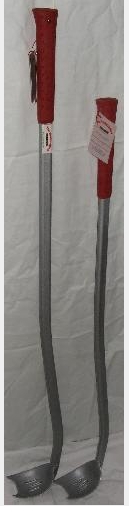
Rock hounds use another type of scoop.  You can see it here to the left.  These are about three feet long.

These are called treasure scoops, but as you can see, they don't have much of a scoop and aren't made for sifting.  They are good for collecting surface finds, but they would also be useful in other situations, such as reaching in under bushes, roots or rocks.

It is difficult to get a regular scoop pushed down through the sand to deeper layers. The type of scoop shown here will penetrate more easily and deeper, but you really have to pinpoint very accurately to be able to pull a small target out.

I won't discuss things like dredging or air lifts now, since detectorists usually can't use those techniques, but I've played with a few different designs specifically designed for recovering deeper targets in difficult situations.

At the top of the post is a illustration showing a tube, much longer than a typical scoop, that can be pushed down into the sand.  I've imagined a screw type mechanism to move the sand and articles up and through the tube, but haven't worked that out.  Probably a more practical method would be to leave the back of the tube open until the tube is suspected to be around the target, then the back of the tube closed before the tube is withdrawn.  That might pick up the material in the tube.  I can think of a couple other ways to try to make that work too.   I'll have to do a little testing.  I have some other ideas I won't mention at this time.

By the way, a rake or tool with tines can work better than a scoop when the target is a chain.

For now, my best overall technique in shallow water, and one that requires no additional equipment, is foot fanning.  Like with every technique, there are some tricks that you can learn to make it more effective.  It is almost always effective, but can require a lot of energy.

---

I hope you will respond to the blog post that you will find on the main blog display.

---

It sure has been hot.  I'd like to see something change.

Happy hunting,
TreasureGuide@comcast.net


Thursday, December 3, 2015

12/3/15 Report - Treasure Traps and Trapping Treasure. Sifting In Wet Sand. Bigger Surf Coming.


Written by the TreasureGuide for the exclusive use of treasurebeachesreport.blogspot.com

We all know that treasure moves.  From the time it is spilled into the ocean or onto the beach it moves.  It doesn't move continually though.  There will be times of relative stability, and there will be times when it can move quickly.

If you've ever dug a coin while standing in a rushing backwash of any magnitude and drop a coin before getting it firmly in your pocket, you know how quickly a coin can move yards in the matter of a second or two.

And if you ever dropped a coin in the ocean and watched it fall, you probable say it going one way or the other instead of falling straight down

The longer an item is out there on the beach or in the water, the more likely it is that it has reached a point of relative stability where it will not move much again until something fairly dramatic happens such a good storm or hurricane, for example.   The longer it has been out there, the more it will take to get it to move again.

I remember reading over twenty years ago how a one fellow constructed a trap on the beach to trap gold rings.  I think I read about that in Carter and Trevillian's book, Diamonds in the Surf.  If I correctly recall, the fellow constructed the trap out of stones.

After reading that story I made sure to check under and around rocks for gold rings and found a few that way.

If you think about it, treasure is trapped in all kinds of traps.

There was one time when I dug five silver dimes in one scoop.  They had settled at the bottom of a fallen palm tree after they washed out of a dune and down a slope.

I often focus my detecting around one type of trap or another.  Groins, seawalls dips and rocks and even clay or mud can create treasure traps.

You will observe natural treasure traps at work when you are detecting.  I detected one treasure trap day after day for months.  It was an area in front of a sea wall and behind a conrete goin.  It seemed like every night there would be a new supply of coins and jewelry there.

It is possible to construct your own treasure traps.  The first thing to know is how treasure moves. Just like anyone who traps wild animals, it helps to know how and where the game moves.

Although I have managed to construct some small traps and obtained some results, constructing highly effective treasure traps on an ocean beach does not seem practical.  I'll still keep thinking about it.

---

One thing I've noticed lately is that most people do not use their scoops to sift wet sand when detecting in the wet sand.  Many people dump the wet sand on the ground and spread it out with a foot.  They either then see the target or pinpoint it with their detector.

It is difficult to sift wet sand.  That made me think about constructing a different type of digger for compact wet sand.

You can always use the moving water to sift the wet sand through your scoop, but the risk is that if the item is very small and falls through the screen or otherwise falls out of the scoop, you can easily lose it in the moving water.  That can cause time and perhaps the item.  That technique can still be used if you are careful.  You might be able tell if the item is large enough to sift in moving water without going through the screen of your scoop.  You will still need to be careful that the item doesn't fall out of your scoop.

---

The surf on the Treasure Coast was small today.  Saturday it will increase.  The peak surf will be late Saturday night.

We'll have a north or northeast wind for a few days.  It was out of the north today.

Happy hunting,
TreasureGuide@comcast.net


Thursday, August 6, 2015

8/6/15 Report - A Different Way To Use Your Scoop Very Effectively. Swimming Beach Finds Today. Intuition Experience By One Reader.


Written by the TreasureGuide for the exclusive use of treasurebeachesreport.blogspot.com.

This Mornings Finds.
I went out to the nearest swimming beach this morning to test out new ear phones.  I spent about an hour.

You want to have things in tip top shape or when we get a change in detecting conditions.  It is a good time for testing and experimentation.

You can usually find something at that beach, but usually cheap stuff.  That is the type of beach it is.

As in real estate, metal detecting is very much about location, location, location.

I did a post on metal detecting math one time.  That is very relevant here.  This beach is the type of place where the quantity is OK but the quality is poor.

Anyhow, the water was nice.  Good visibility. Gentle swells that increased a little after the sun got a little higher.

After hunting a little while, I turned my threshold down to silent.  That may have cost me a smidgen of depth, but nothing to be much concerned about.  I just liked the silence.  It was very pleasant with the gently rolling swells.

The shells that were visible on the sand were in little depressions.  The water movement was sufficient to move the sand where the water increased as it flowed around the shells, but was not sufficient to move shells of a certain size,

There were a lot of dive boats out today, as well as divers going in from the beach.   Lobster season began today.

Most people use their scoop something like a shovel.  I often use it more like a hoe.  In the water today the hoe method was uncommonly effective for some reason - I assume the currents.   It seemed to be working better than digging in and lifting.


If you have a deeper target and a decent size hole and still have not retrieved the object from the hole, you might try this method.

Put your scoop upside down in the far side of the hole.  Push down on the scoop with your foot.  And pull the scoop back towards you.

That was working uncommonly well this morning.  You might think that the object would fall out of the scoop but the sand and currents and upward movement tend to keep it in.  Even when it does not stay in the scoop, the object will probably end up outside the hole where it can easily be retrieved with the next scoop.

Also, if you need a really deep hole and can let go of your detector, use both hands on the scoop, and hoe like crazy.  That will get you a big deep hole in a hurry.  It combines fanning and scooping.

--

At the beach I was at today, there are some spots where you can usually find some things.  One of the best spots is right in front of the central life guard station, the other is down at another walkway.

You can usually find recent drops in the wet sand and in the water at those locations.  The wet sand coins can be a tip off to where the better water spots might be.  That does not always work, but sometimes it does.

---

Chattanooga (WDEF) - Federal Judge Curtis Collier sentenced two East Tennessee men to jail time for digging up Civil War artifacts.

39-year old Kenneth Fagin, Jr. from South Pittsburg and 61-year old Terry Tate from Manchester will serve 30 months in federal prison.


They were convicted of illegal archaeological excavation on federal property...


Here is the link for more of that story.

http://www.wdef.com/news/story/Men-Get-Jail-Term-For-Digging-Up-Civil-War/hGD8jydVg0uD3nYfogozpA.cspx

---

The other day I talked about intuition and such things and asked people to send in any personal stories.  Larry sent in this one.


One afternoon after working at home, I asked myself, "what must I do to find a gold ring within the next hour?". It was a positive intention such as I had never felt in my gold hunting experience before.

I pulled up google maps, centered it over my favorite park field, wherein I had already found 4 gold rings. I cleared my mind of all thoughts while simultaneously moving my hand over the monitor. My purpose was to lose all conscious thought of my hand. It was almost like going to sleep, as directed thought slips out of your control and you start to dream. At that point my hand stopped, seemingly without conscious intervention. I triangulated the spot with trees and light poles, all of which I was intimately familiar with already.

I walked directly to the spot, checked the landmarks just for confirmation, found a signal, dug a hole, and pulled out a nice gold band with 3 diamonds about .2 carats each. I went right home. I'd been in the field no more than maybe 5 minutes.

Was this supernatural? Had I willed the find to occur? Had the remote digital dousing actually "worked" by means that we are not aware of? Or was it all just the random lining up of all those events in a way that humans are evolved to interpret as connected and meaningful by assigning causation to hidden, metaphysical "forces"?

I think the later is true, though I prefer believing the former.

Larry
Btw, I later found gold ring #6, no dousing involved.

Thanks Larry.

---

Expect another week with the same kind of beach detecting conditions along the Treasure Coast.

Happy hunting,
TreasureGuide@comcast.net

Thursday, June 11, 2015

6/11/15 Report - Small Finds and Recovery Techniques. Book Treasures. A Little More On The Seminoles Wars.


Written by the TreasureGuide for the exclusive use of treasurebeachesreport.blogspot.com.


Treasure Coast Beach This Morning.
This is what the beach looked like this morning.  There is still sand accumulating on the front beaches.

The surf was calm, there were however some surfable waves.

Notice anything about that beach? No people!  And I'm showing one of the busiest beaches along a twenty mile stretch.

I heard one South Florida guy whining about all the competition down there.  There is a reason there are a lot of detectorists down there.  There are tons of people that lose good things down there. Even a monkey will quit pulling the a if he never gets anything for it. If you have enough people in the water wearing good stuff - especially active people or people not accustomed to or prepared for the water - there are always some recent drops to be found.  It doesn't take much skill to do that.

Here is a quick video clip showing the surf on the Treasure Coast today.


Most all of the people I did see on the beach this morning were kids trying to learn to surf, along with a few fishermen.

Just noting the differences.  You always have to analyze the situation and make adjustments.

Below are a couple of my small finds this morning.  Both are the type of thing that will slip right through the holes in your scoop.

Two Very Small Jewelry Finds Made This Morning
At The Beach Shown Above.
If you don't know what you are doing, you can waste a lot of time trying to scoop up small items like that.

It is important to first get a good estimate of size and depth.  Familiarity with your detector and testing can help with that.

Once you have pinpointed the item and know about how deep it should be, put the point of your scoop right behind it and try not to dig any deeper than necessary.  Try to get the scoop just deep enough to get the scoop under the target and no more.

I've talked about recovery techniques for deep targets and won't get into that again now.

Good visibility can help with targets like this.  Watch the sand as your scoop comes up.  Watch for any sign of the object as your raise the scoop.  You might see it fall out or off to the side.  Don't get too much sand in the scoop.  If it slides through the hole quickly and you have good visibility, give the sand a toss to the side and watch for any glint from the object on the surface of the sand.

A snorkel mask can be helpful.  Also, very small targets can often be found by feel if the sand doesn't have shells and the sand is pretty stable on the bottom.

In the wet sand today, there was a couple inches of fine sand over top of a layer of shells on the front beach.

In the shallow water, the wave period was long.  I think you'll see that when you watch the video.  The wave would break and then come in over the sand in the shallow water, hit the beach, and then flow back out, so the current would come in over the sand and a few seconds later back out again.  The result was that the top sand in the shallow water would move a little one way and then the other.

I won't get in to other details about how that affects using your scoop.  Some other time maybe.

Sometimes its easier in deeper water,  For one thing you sometimes don't get as much current on the bottom in deeper water.

---


I received a couple of great emails last night.  They were jam packed with good information.

Here is the first.  It is from S. W.

There are a couple of original copies of "War in Florida" on ebay. They are going for about $1200.00. There are not too many books that cover the Seminole War. Mostly a page or two in an old book here or there. Did you know one of the main reasons for the Second Seminole War was because the whites would not let the Indians take their slaves west with them and would not pay them for them when left behind. I have one of the best private collections of antique books from the war of 1812 through the Mexican War. Things from this era are not easy to find and are getting out of my price range. ...

I've always liked old books myself.  The market for old books has changed a lot in the past decade or so.  Before old books were as available on the internet as they are today, you could easily sell almost any book that was near a hundred.  Now most old books sell for very little if at all, however there are books that do bring higher prices, like the one S. W. mentioned.

I once was asked by a librarian at one of the local state colleges to look at a private collection that was once donated to them.  They were going to discard all of those books.  There were some very nice and valuable books in the collection, including things like a Mark Twain first edition, many 19th century books, and even an 18th century book.  They had no idea what they had.  I told them those books should be saved.

On the topic of books, here is a rare one.  A copy of The Hobbit (shown above) was recently sold at auction by Sotheby's for 137,000 British pounds, which would be around 200,000 U. S. dollars.

There are very very few fiction books worth that amount.  Most old books are not first editions and most authors do not have a cult following like Tolkien. 

Old non-fiction books can be valuable.  They can be valuable sources of information.
It is fortunate we can access as many as we can for free on the internet.  

Too me, old books, both fiction and non-fiction are loved collectibles.

The issue about the Seminoles owning slaves is very interesting to me because I hadn't heard anything about that until very recently.  Maybe I just missed it somehow, but it seems to me that we usually get a sanitized white-washed politically correct version of history in many modern history books and in our schools.  Only part of the story is told.  That is one reason why it is good to go back and read books that were written by the people that were closer to the actual events.  They have their own perspective, biases, etc. but seeing how they looked at things and wrote about them adds something.  Even the old style of language adds another dimension.

---


Happy hunting,
TreasureGuide@comcast.net

Saturday, May 30, 2015

5/30/15 Alternative Recovery Techniques For Special Situations.


Written by the TreasureGuide for the exclusive use of treasurebeachesreport.blogspot.com.

Some guys carefully grid every inch of an area.  Other guys wander around randomly.  Some believe that they have a sense for where things might be.  Some believe in a sixth sense.  You might call it insight or intuition or ESP.  They feel drawn to finds.  Some believe in various forms of dowsing.

Where you stand on these things might have something to do with how you've been doing lately.  It is hard to believe in a sixth sense when you are in a dry spell and can't make a find to save your life.  Maybe you just wonder what happened to your ESP.

For everybody there are hot spells and dry spells.  The more you become accustomed to finding a lot, the less it takes to feel like you are in a dry spell.  When you become accustomed to a lot of finds, any pause or break can be perceived as a dry spell.  Everything is relative.

As you increase your skill and finds, you expect more.   Your standards increase.  You are less easily satisfied.  Even though you might find ten times as much as you did ten years ago, it doesn't seem like you're finding anything anymore - at least not anything that impresses you much.

That is good in some ways.  It pushes you to work harder, more intelligently and be more productive.  But don't let that take the fun out of it for you.

When you hit a dry spell, and you will to one degree or another as conditions change or areas are hunted out, that is an opportunity.  It is an opportunity to make some changes and explore.  It might push you to get a new detector, which is seldom the solution but can be beneficial, or explore new areas, do some research or learn new things.

One thing you should know is that there is always more to be found.  There are always other places to hunt.  There are always new treasures to seek.  There is always a lot to learn.

The key is patience.  Turn that dry spell into something positive.  Think about other ways to approach the problem.  Redefine the problem.  What is it you really want to do?  Break down old barriers and habits.

I'll give you one small example showing what I mean about making a change and doing thing differently.  Lets say you are detecting and come across a dense hole of targets.  It seems there is a target of some sort on every square inch.  Your meter is going crazy. You are having trouble pinpointing because there are so many targets and they are so close together.  What would you do?

If you are stuck in a habit you might try as hard as you can to dig each target separately like you normally would.  But let me ask you a question.  Is there another better way?  Why try to pinpoint and dig each target separately in this situation?  Why not just dig the entire area and then sift?   A sifter might work better than a scoop in that situation.  Or a dredge, if that is practical in that situation.

The tendency is to treat situations the same even when there might be a better alternative.

Have you ever heard of the Merkitch sifter?  It is a sifter with two large wheels that you pull through the sand to sift the top few inches.  That is an alternative to detecting.  It is a heck of a lot of work, but it works, and in some situations is more effective than using a detector and scoop.

I have one very large scoop that can be fitted with a 30 foot pole.  It provides another alternative for working dense or high probability holes in creeks, rivers or lakes.

When I recenly watched a video of a fellow trying to detect individual targets in a creek at a spot that was covered with junk as well as some good targets, I wondered why he didn't just sweep the top inch or so of cover (there was only an inch or so over bedrock) and sift it out.  It would have been a lot quicker than trying to pinpoint each and every target and pick them up one at a time.  There were a lot of things going for sifting.  One was running water.  Another was little soil cover.

If you've ever used anything like a Merkitch sifter, you know how quick it is to visually spot targets in a sifter even if there are a lot of junk targets.  It is almost like laying them out on a table.  Sifting can be especially good for situation when there are either a lot of good targets, or a lot of good and junk targets.

You probably know some places that are too junky to detect.  They might be covered with pull tabs, nails or whatever.  It might be worth sifting sites like that.

My main point today is that different situations call for different solutions.  When you are in a dry spell, that dry spell might be just the right time to do some thinking about alternate approaches.

Happy hunting,
TreasureGuide@comcast.net


Tuesday, May 12, 2015

5/12/15 Report - Time Saving Metal Detecting Tips. Modern Coins Abound On One Treasure Coast Beach.


Written by the TreasureGuide for the exclusive use of treasurebeachesreport.blogspot.com.

Beach This Morning Near Low Tide
Same Beach Looking South
People sometimes mention using discrimination as a way to save time.  The obvious theory is that you will save time by not digging junk.  I've shown before that discrimination does not always save time.  I looked at one video and using the video timer actually counted how many seconds it took the person to get a reading before deciding if the item was junk or if he would dig it.  The amount of time spent reading the display and making the decision often took longer than it took him to retrieve the item.  I think he would have been surprised to see that the number of seconds he took reading the display was greater than the number of seconds he took to recover the item.

If you have good retrieval skills and are working where you can do a quick sift, such as in dry sand or in the water, recovering a typical item should not take more than a few seconds.  Of course you still might save frustration and effort by discriminating even if you don't really save much time.

In any case, there are other methods for saving time.   One comes from learning to use your detector well enough that you can get a very good idea of an item's location and depth without switching to a pinpoint mode or reading a display screen.  The better you know your detector, the quicker you will be able to pinpoint the item and get a good idea of the depth of items from the auditory signal alone,  That can save you seconds on typical items.

Accurate pinpointing and depth analysis will save you time by cutting down on scooping or digging too.  Don't dig a deeper hole than necessary.  Very often items will be in the top few inches of sand.  When you can tell that is the case, digging a deeper hole will cost you time.  The more sand you get in your scoop, the more you will have to sift, unless of course, you don't get the item and have to dig again.  There is a skill to it.

Here is another time saver.  When digging on the beach, especially in wet sand, don't move the sand farther than necessary.  Keep it close to the hole.  That makes it easier and quicker to kick the sand back into the hole.

When working on a slope in wet sand, I like to have the sand right next to the hole just to the uphill side.  That makes it very easy to kick the sand back in the hole.

I've noticed that a lot of people don't sift when working in wet sand.  As you know, wet sand doesn't sift quickly.   They just dump the sand on the ground and spread it out so they can see the item.

If the water is moving nearby, let the moving water rush through your scoop.  Be careful to do it so the item is not washed out of the scoop.  That means not over-filling the scoop, and having the scoop oriented so the rushing water goes into the open end of the scoop.  Put the tip up a bit. A little shaking will help the item settle into the scoop.

Small items can wash through the holes of the scoop and into the water.  Again, it helps to be able to read the detector signal so you have a good idea if the item might be small enough to wash through the scoop.

I was reminded of most of those things recently when I was digging a lot of coins in wet sand.

Some Coins Dug In Wet Sand One Morning.
I was actually getting tired of digging coins.  There were a few other items.  All of the coins were recent.  Some were not discolored despite being in the wet salt sand.

Very Small Item Dug Same Morning.
This is the type of item I was talking about.  It appears to me to be a bead.  It would easily slip through most any scoop.  It is small enough to sit on Roosevelt's face on a dime.  I picked it up somewhere between the coins shown above,

Some of the ear rings these days are huge.

Here are a couple of those that were dug along with the coins and bead.

The largest one would fit around a child's neck.

Both of these ear rings are junk.

I need to get some good photos of the better finds.

----

Here is a good bargain.  You can get a 24 pack of AA batteries very inexpensively at Harbor Freight, if you have one of those near you.  In fact you can get a 24-pack free with any purchase May 22 to May 55.

----

I've been taking my time perfecting use of a detector that I got this year.  I never took that much time and really studied a detector to that extent before.  I'm thinking of when we finally get some good conditions and want to really exactly what it will do.

On the Treasure Coast it looks like the surf tomorrow will be about the same as today's.  By Thursday and Friday it will start to increase a bit.  Nothing exciting though.

Happy hunting,
TreasureGuide@comcast.net

Wednesday, September 17, 2014

9/18/14 Report - How To Make A Very Portable Inexpensive Multi-purpose Sifter & Good Surfing This Morning


Written by the TreasureGuide for the exclusive use of treasurebeachesreport.blogspot.com

Basic Portable Sifter With
One of Two Removable Floats.

There are times when sifting is better than detecting.  For example when targets are packed so densely that it is a waste of time to pinpoint and dig each target individually.   Sifting is also good when you are hunting non-metallic items, such as shells, sea glass or fossils.

Another time when sifting can be good is when there is a lot of junk, shells or stones or something like that, which can make finding small targets in a scoop difficult.  Just dump the contents in the sifter so you can spread it all out.


I made the sifter shown in the photo and have used it on various occasions.

You'll see other articles giving instructions on how to make a sifter, but this one is a little different from most of those.  Most sifters that you'll see are heavy and rigid and can not be so easily modified for different situations.

I prefer a light-weight flexible sifter, rather than one of those heavy rigid jobs.  This one can easily be rolled up and easily carried a good distance along with your other equipment.

Another reason I prefer this one is I can hold the sides where the boards are and by repetitively pulling the boards apart in short bursts, the sifter bounce the material which will sift more quickly that way.

The floats aren't always needed but can easily be attached or removed depending upon your preferences and the situation.  The sifter will actually float without them.  It just depends upon how much flotation you want.

The floats can be easily attached, either above or below the boards, very quickly and easily by using three plastic slip ties.  Just clip them if you want to remove them again.

A simple rope can be used to tie the sifter to a tree or some other stationary object while you detect or dig.

As you can see, I simply got some 1/4 inch chicken wire.  Cut it into a square.   Then put a small board above and below the edge of the wire, and nailed the boards together to hold the wire, and did the same thing on the opposite side.

I only did this on two sides because that allows me to roll up the sifter, and it also gives me more control over the sifter and how I use it.

I found a couple of those floats along the road one day.   I could cut them to the exact length of the boards but didn't find that necessary.

When working in very shallow water, the floats just get in the way.

The sifter can be used by one person, but if you have a partner and make it a two-person operation you'll seldom need the floats.

If you use the floats, attach them either above or below the boards, depending upon how high you want the sifter to float.  The boards make good handles.

If you plan on dumping a shovel full of heavy material onto the sifter all at once or are working alone in deep water, you'll probably want to use the floats and add boards to the two open ends

But if you are working shallow water, which is where I was the last time, you won't need that.

I'll should make a video or at least take a few pictures of the sifter in operation.


Well, it didn't look to me like we got the predicted 4 - 6 foot surf yesterday, but I found some good swells and waves this morning.  The waves were forming nicely and there were a lot of surfers.  The beaches were awful mushy though.   Very poor detecting where I was.   It seems the northern end of the Treasure Coast got more surf than the southern end, but I didn't see that.

I did see a nice old piece of shipwreck wood down by where an anchor was found either last year or the year before.  I'll have a picture of that for you by tomorrow.

There aren't any storms to watch now.

The surf is supposed to decrease the next two days.  And the tides are pretty flat now.  They aren't going down very much.

I'll have to get out to check some more beaches to see if I can find any of the effects of today's slightly higher surf.

I also need to get around to taking some more find photos.

There is one big project that I can't wait to show you, but I can't talk about it yet.  Really fun and amazing.  Someday I'll be able to show you all of those finds.

Happy hunting,
TreasureGuide@Comcast.net


Thursday, March 20, 2014

3/20/14 Report - Treasure Coast Gold Ring, Working A Steep Slope In Rushing Water and Satellite Images


Written by the TreasureGuide for the exclusive use of treasurebeachesreport.blogspot.com.

Treasure Coast Gold For Today

I had some things I had to do today and didn't know if I'd have time to get to the beach.  As it turned out I got to stop and take a look at three spots this morning.  The timing was not good.  It was just before high tide.

Under the circumstances I forgot to take my camera.  Too bad.  There were a few things that I could have used as illustrations.

If a picture is worth a thousand words, I'm only going to be able to convey a small fraction of one picture in this post.

The first beach I looked at was a 1715 Fleet beach.  It was where we had a cut a week or so ago and where the gold nugget was found.  Tons of new sand had piled up on that beach.  You would never guess that it had been cut a few days ago.  I didn't bother to take my detector out of the car.

The high tide had been pretty high and the swells were pretty big, hitting the beach directly from the East.  That all adds up to sand piling high and deep on the beach.

The second beach I took a quick look at was similar.  I didn't bother to take my detector out of the car again.

The third beach that I  looked at was tourist swimming beach.  There were a good number of people out.

This beach was completely different.  Due to man-made structures. it has been eroding for several weeks on and off.  Too bad the erosion, as you might suspect, was in renourishment sand and there is still tons of that.

The slope on the front of this beach was steep.  The beach curves sharply as it goes north to south.   After surveying the lay of the land I quickly went to the sharpest part of the curve where the force of the water onto the beach was greatest.  The water there was funneled higher up onto the slope.

I quickly went to the sharp point of the curve and immediately began to find coins.  It was a classic coin hole, but very high up on the beach.

The hole was created by the force of water being focused towards this part of the curve.

There were big swells with a primary period of about 11 seconds and a secondary of about 7 seconds.  That is important for what I am going to tell you about.

Sorry if this is confusing.  I should have taken my camera.  It would have been much easier.

After hitting the first coin in the coin hole I slowed down, stayed and worked the coin hole.  When the hole seemed worked out I checked north and south to see if there were any more coin holes to be worked, but I found no others.

If I could have chosen, I would have picked a time closer to low tide.  It wasn't easy working down the slope where the swells were being focused.

I mentioned the swells and the periods.  I tried to work low on the beach between swells as much as possible.  I was hurrying down the slope mostly in between swells or sets.  There was a lot of water coming and going over the coin hole that I was working.

I had several seconds between waves to work my way down the slope, detect the target, dig it and get it out before the next wave hit.  Of course I could work through swells sometimes, but  had to be careful when trying to recover a target in rushing water.

When the water went out, I hurried down behind it while swinging the coil.  But here is when it gets tricky.   If you get a signal on a steep slope either between waves or while the water is coming or going, you have to get it very securely in the scoop.  If you take a scoop of sand but the target is either very small, still on the slope and not covered by enough sand to hold it in place, or on the edge of sand in the scoop, or if the target falls out of the scoop, it is very possible that the water will quickly sweep the target away.

If you do not get the target in the first scoop and a lot of water is coming, one thing you can do is put your foot on the target to hold it so it won't get washed away.  Then dig again in between waves.

When you get the target in the scoop, move quickly up the slope and either sift or dump it on safe ground.

Sifting over swiftly moving water is dangerous if the item is small enough to fall through the holes in the scoop, or if the target is dropped or washes out of the scoop.

If I can tell from the signal that the object will not likely fall through the holes and if it is not in sand that will fall off the front of the scoop, then I'll use the water rushing down the slope to wash the sand through the holes in the scoop.  Keep the opening of the scoop facing up the slope.

My scoop is big and if I get a scoop full of wet sand, it can be very heavy for easy shaking and sifting.  Let the water returning down the slope go through the scoop and do the sifting for you.  Be careful though that the item is not on the edge where it can be washed out or can go through the holes.

It wasn't the easiest coin hole to work but it paid off in a short time.  In not even a half hour several coins were dug as well as the above ring.


Remains of the missing Malaysian airliner has possibly been found by using satellite images provided by Digital Globe, a commercial satellite company based in Colorado.  They provide high resolution satellite images via three satellites.  The images were made available so that individuals could search for debris from the airliner.

Here is what the following web site said.

DigitalGlobe used its satellites to capture some 3,200 square km of the area where the flight could have gone down--since then the area has updated to 24,000 square km--and it asked the community to help look through all of it to identify and flag anything of note. 

It took just a couple of days for 2 million or so volunteers to tag 645,000 items. The way the systems works is that it shows the same images to many different people, and if enough people tag the same little square on the grid, an expert will review that area to see if the item of interest is worth investigating.

Read more: http://hothardware.com/News/DigitalGlobe-Powers-Crowdsourced-Hunt-For-Missing-Malaysian-Flight-370/#ixzz2wXD4xnAr


http://www.chicagotribune.com/news/chi-missing-malaysia-plane-20140320,0,1370580.story

Of course these same images could be used for identifying archaeological sites or treasure.

You can log in to the digital globe images by using the following link.

https://www.mydigitalglobe.com/myDigitalGlobe/#LOGIN

Use the user name "public" and password "view."

I think everybody in the world is doing that today so you might have trouble getting access.

In these days with massive data, it takes a lot of eyes and brains to analyze the data.  That is where the public came in.   I've expressed my opinions about that concerning the NSA data collection before.

I hurried this post, but that is it for today.


Happy hunting,
TreasureGuide@comcast.net

Sunday, August 11, 2013

8/12/13 Report - Using a Scoop Like a Hoe and Harvesting Dense Target Areas


Written by the Treasureguide for the exclusive use of treasurebeachesreport.blogspot.com.


Erosion on Treasure Coast
Submitted by Micahel E.
Here is one of the few eroded spots on the Treasure Coast.
This one was at Jensen Beach a couple a few days ago.  And this one, like the other eroded spots that I've seen recently, are in renourishment sand.   That is an important fact that makes a big difference.

It doesn't take much to erode renourishment sand.  Often it isn't even the right texture to hold.  But most importantly, it is out of place and will be taken quickly.


Not too long ago I showed you how to convert to a wood handled scoop.  And then a short time after that I told you about foot fanning.  Today I'll talk a little more about another way of using a scoop.

One alternative, and one that I very frequently use both on land and in the water, is to hoe.  When I first mentioned that to an old timer many years ago, he said he didn't use it because it created currents.  Actually the currents created by using a scoop like a hoe can be an advantage.

This technique will not work with all scoops.  It works best with scoops that point out at roughly ninety degrees from the handle.

Below is a simple illustration.  Simply turn the scoop down, as shown in the illustration below.  Use your foot to push the scoop down and into the sand and then bring the scoop back towards you and up.  This can be done with one hand on the handle of the scoop.

If you need to move a lot of material quickly, for example when waves are coming up over the hole, or when there are significant currents, let go of the deterctor, use two hands on the handle and hoe very vigorously, almost like fanning.  When using two hands to hoe, you have to put your detector down or tether it.  Not only will the scoop move a lot of sand, but if you are in water, the currents you create will also move sand.


You can easily detect the moved material to see if the target is in the moved sand since it is moved towards you.

As you probably know long and heavy gold chains tend to slide off of the front of the scoop in water.  Using this technique makes it easier to retrieve chains.

Hoeing works very well when you detect a target in the loose sand or on the face of a small cliff of shell sand at the edge of the water.

If you use this or any technique such as foot fanning that moves a lot of sand, be sure to detect the lowest area where the sand was moved from as well as the slopes.

If you are hitting rocks or large shells that make penetration difficult, move the top of the handle in a circular motion, and try to feel where the large objects are, and try to get the lip of the scoop under one edge of the rock or shell or whatever.  Then apply a lot of force to move the stubborn object.  You need a strong handle for this.  Once you manage to dislodge the large object, that will unpack the material to some extent, making it much easier to remove the remaining material.

Below is an illustration showing three targets buried in sand.  After moving sand to recover target A, the hole is detected again revealing target B near the slope of the hole.  It is now more easily detected because sand was moved to recover target A.  Target B is pinpointed and removed, and the depression detected again, now revealing target C, which was lower than both A and B.

If you are working in an area with a high density of targets, keep detecting the depression.  In some cases  more targets will be revealed as the depression grows larger and larger.  In one case years ago, a depression in an area with a packed rock bottom was the source of hundreds of targets that were recovered  as the depression continued to deepen and expand.  If you are in an area like that, it doesn't hurt to foot fan even when you don't have any more signals and then detect for new signals.  Either foot fanning or hoeing or a combination of both will work well.


Gold Bracelet Find.

One of the readers of this blog, Jim M.,  has the following Garrett Sea Hunter Mark II for sale.


On the Treasure Coast we're getting mostly east and southeast winds.  The surf is a little rougher than it has been lately, around 2 - 3 feet.  That might help the beach fronts a little.

Nothing special with the tides right now, and no storms brewing in the Atlantic.

Happy hunting,
TreaureGuide@comcast.net

Thursday, August 1, 2013

8/1/13 Report - How to Convert to a Wood Scoop Handle.


Written by the TreasureGuide for the exclusive use of treasurebeachesreport.blogspot.com.


Example of Stainless Steel Scoop
With Replacement Wood Handle
There are many situations in which a long-handled scoop can be handy.  Most long-handled scoops come with a metal handle.  Although they are widely sold and used, I don't like metal handles for multiple reasons.  The first reason is that some are not strong enough to stand up to long term heavy usage.   I've broken some almost right away.   That is what first caused me to consider alternate types of handles.

Besides durability, another reason to consider a wood handle is the fact that a long metal handle can easily get too close to the detector coil and cause an annoying loud signal or cause the detector to rebalance.  The wood handle makes it easier to carry and manipulate the scoop without getting it too close to the detector coil

A third reason is that a wood handle will float nicely, preventing loss and allowing you to let loose of the handle while the scoop floats upright.  That is handy when using the technique I mentioned yesterday for working rough water.

A fourth reason, is that wood is easy to cut, drill, sand and shape according to your specific preferences.

The wood handle shown here was attached to the stainless steel scoop using two U-bolts.  That is a simple, inexpensive and effective method that anyone can use.  I have a similar handle that was used heavily for over a decade before breaking.

This handle is 1 x 1.  The length is variable and can easily be cut to the length you prefer.  You can use an old shovel handle, wheel barrow handle or even wood oar.  It will all work.

I prefer a square handle rather than a round rod.  A square handle is easier to manipulate accurately with one hand. 

A round metal rod is especially hard to precisely manipulate if you get suntan lotion or something on it.  That is no problem at all with this shape of wood.

When visibility is poor and you can't see the position of the scoop in the water you can tell exactly where the scoop is pointing by looking at where the edges of the square handle are pointing. 

The hole that I suggest drilling in the handle below will help you tell which is the front or back from the sides of the handle when visibility is nonexistent and conditions are rough.

If you want, you can shave or sand the corners of the handle where your hands will normally go.

There are a number of possible variations.   You can, for example, angle the bottom by sawing the bottom as shown by the angled line in the picture above.  That is more important if you mount the bottom of the handle so that the bottom of the handle is at the bottom of the scoop.  In that case, leaving it square would result in the back bottom corner getting in the way when using the scoop to dig unless you angle the bottom.

You can also mount a strong magnet at the bottom of the handle if the bottom of the handle is flush with the bottom of the scoop.  You can then use the magnet to quickly and easily pick up ferrous junk items, in many cases without any digging at all.

Some people mount a magnet in the scoop.  That works well to attract any small ferrous items in the scoop, but that is not the way I prefer to do it.  With the magnet at the bottom of the scoop, I can easily extend the handle and quickly pick up ferrous junk without bothering to dig.

The most common length for the handle would probably be around four to five feet.  Of course that is easily modified to suit your needs and preferences.

Basic Materials for Creating a Long Handle.

You'll need two U-bolts of the correct size.  Something use something close to 1-inch U-bolts.  You need to select the size of U-bolts that work with the size of your handle and the position of the holes in the scoop.

The angled black line shows where to cut the handle to angle the bottom of the handle if that is what you want to do.

The parallel black lines show where the handle should be grooved to accommodate the U-bolts.  Be careful to align the grooves for the U-bolts with holes in the back of the scoop.  Extend the grooves around the corners, cutting into the handle at the corners away from the scoop so the U-bolts do not protrude too much from the back of the handle when tightened into place.

Handle Showing Grooves for U-bolts.

Another good idea is drilling a hole at the top where you can attach a bungy cord.  Notice black dot where you might drill that hole.

I'll add another illustration later, but that is it for now.  I've been real busy.

I'll have the poll results summarized soon too.


Happy hunting,
TreasureGuide@comcast.net