Showing posts with label screws. Show all posts

Wednesday, March 25, 2020

3/25/20 Report - Ancient Florida Coin Finds. Screws and How To Tell How Old They Might Be.


Written by the TreasureGuide for the exclusive use of treasurebeachesreport.blogspot.com.

Fake Ancient Greek Coin Find.

Not long ago I had a few posts on some very old Spanish coins found on the Treasure Coast.  Back then I was thinking of shipwreck coins and which might have been among the oldest.  I neglected to think of the silver and gold  ancient coins I found while metal detecting while I lived in South Florida, but I'm sure that some have been found on the Treasure Coast as well.

It doesn't mean that Florida was visited by the Knights Templar or King Arthur as some might conclude, but ancient coins are found in Florida, and I'm sure must have been found on the Treasure Coast.

The one shown above is a fake that was mounted in a piece of jewelry.  I saw it this morning and that is what reminded me of the real ancient coins that have been found.  I think I might have posted a few real examples before, but am not sure.

Of course there are those who collect ancient coins.  Occasionally they get stolen or are taken by children for show-and-tell and get lost somehow.  But just as often they are mounted in necklaces, bracelets, rings or earrings that get lost.  Often you can see marks on a coin that show how it was once mounted in jewelry.

When I started thinking of the ancient coins I found, I remember a "widow's mite" that I found and gave to my parents for a gift long ago.  I'm going to ask my mother, who turned 94 yesterday, if she knows where it is.

Anyhow, I was reminded of all of those ancient coins, and am sure some must have been found on the Treasure Coast.

---

There was a time that if I found a screw on a beach I immediately assumed it was modern and  tossed it into the trash bag.  That was a mistake. I should have at least looked to see if it was old.

Screws have been made and used since the 1600s and earlier.  Screws were laboriously handmade until a machine was patented in 1780 for the process.   Experts use screws to help identify the age of antiques, such as furniture.  Despite my research I still find it very difficult to tell how old a screw might be.  You might ask who cares, but screws, no matter how small and inconsequential, just like any other object can provide clues for the treasure hunter.

Below is a little of what I've been able to put find on the sugject.  It is not easy to find photos of old screws that have been dated.  DJ did find some for me.  Thanks DJ!

Here are a couple of examples from an article, Observations on the Development of Wood Screws in North America by the Museum of Fine Arts, Boston.  DJ sent me those.

---

Source: Boston Museum of Fine Arts article.
---

The screw shown above is one of the oldest I've seen.  It is circa 1780 but was handmade like earlier examples.

One sign of an old screw that seems to be the easiest to recognize is the off-center groove on the head.  It was simply cut with a hacksaw or something.

Another common characteristic of 18th century and earlier screws is evidence that the screw began as square nail stock.  That typically shows on the uncut area on the shank just above the threads which might still show a flat side or two.

The threads were cut made with a file or hacksaw or a cutting tool with some type of lathe, often treadle driven.  Filing or using a hacksaw to cut the threads often left easy to identify tell-tale marks.

Remember, early screws were handmade and vary according to the ingenious methods employed by the individual that made them.

Here is another handmade example from the Museum of Fine Arts article.  It dates a little later, but was still handmade.


One of the easier to identify characteristics of very old screws is a blunt point.  Here is a good example of that from Pinterest.


Can you imagine having to make a screw?

Here is another illustration I located, but don't remember where it came from.  That gives clues for dating.
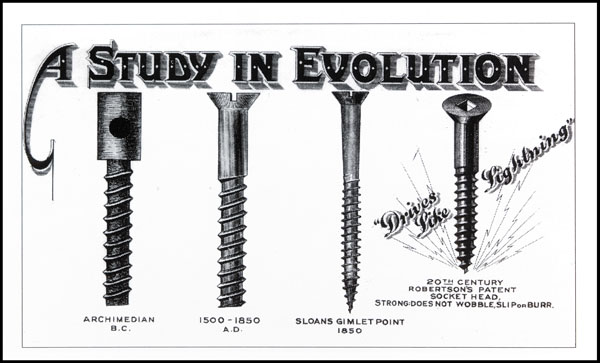


Unfortunately, like every other item made of iron and found on a beach, the clues to a screws age can be erased by time and corrosion.  Here is a found screw along with a brand new screw.


The older of the two has very rounded rather than sharp threads.  I don't know if they were made that way or if they got stripped or corroded down.

I'm not always able to figure out the age of a found screw, but I learned a lot, especially how screws were made centuries ago.  I guess that one point to remember is that not all screws are modern.

---

According to some sources, more than half of the confirmed coronaviruse cases are in the New York metro area.  But instead of being in lock-down, many New Yorkers are leaving and spreading the problem.  Many are coming to Florida, which will undoubtedly get a big bump in cases as a result.   If they won't stay in their own state, they are not going to self-quarantine.   You might say New York is now the US Wuhan, except it wasn't shut off in time.  It looks so much like the science fiction movies - the New Yorkers with means escaped to other areas and spread the disease while the poor are left at home unable to do much of anything else.

Indian River County, according to this morning statistics, has twelve cases, of which half are travel related.

You can track it on the Florida Surveillance Dashboard.

St. Lucie County, has six total, and Okeechobee has none.

Here is the link to the Florida coronavirus dashboard that will allow you to check the most current statistics for each county.

https://experience.arcgis.com/experience/96dd742462124fa0b38ddedb9b25e429

---

Friday the surf is supposed to get up around three to five feet.  That will be a slight increase.

Happy hunting,
TreasureGuide@comcast.net

Tuesday, October 29, 2019

10/29/19 Report - Seagrape Trail Beach Today. Conquistadors Explore Catawba Territory. More on Chisels, Spikes and Screws.


Written by the TreasureGuide for the exclusive use of treasurebeachesreport.blogspot.com.


Seagrape Trail Beach Tuesday Afternoon.

Literally just in.  I received these photos from Seagrape Trail from DJ as I was in the process of posting.

Thanks DJ.

---


About 450 years ago, Spanish soldiers on an expedition from Florida took over the native Catawba town of Joara, about 60 miles East of Asheville. 

Fort San Juan is the earliest known European settlement in the Southeastern US, established about 40 years before the English arrived in Jamestown.  That made Spanish the first European language spoken in Appalachia...  
https://www.bpr.org/post/exploring-southern-appalachia-conquistadors-and-catawba#stream/0


---

I hoped to find a way to easily tell if an item might be a chisel or not.  I failed.

From what I've determined, chisels are typically flat on one side of the point and angled on the other, like the wood-working chisels shown below.


But there are chisels for working materials other than wood, such as hot metals and stone.  Among the chisels meant for working stone, there are bull-point chisels, for example, which are angled on both the top and bottom.

While I'd expect wood-wood working chisels to be most common on centuries old sailing ships, there could be other types for black-smithing or mining.

Who was it that said "The more I learn, the more I don't  know?"

I'd also expect wood-working chisels to have handles, which, like spikes, could also be broken off.

I planned on getting close-up views of several spikes and chisels, but couldn't find the ones I wanted to photograph when I went looking for them.

John C. sent this photo of a broken spike with the email message I posted from him yesterday.

Broken Spike Find.
Find and photo by John C.
At this point, I'm still thinking that Troy's find is more than likely a spike rather than a chisel.

Let me know if you agree or disagree.

---

Jerry P. sent me the following email and photos.

What a great post on screws! There's no coincidence that I find a lot of screws on the beach adjacent old shipwrecks. So much so I had to purchase Witold’s book yeas ago and it definitely solidified it for me. If you don’t know don’t throw, these old screws are shipwreck history and excellent artifacts!! 


Old Screws Found by Jerry P. Along With A Copy of  Witold's Book on Screws and Screwdrivers.


Thank Jerry.  Of course they can also be good clues for the detectorist.

---

Happy hunting,
Treasureguide@comcast.net


Monday, October 28, 2019

10/28/19 Report - Wabasso Beach. Chisels, Wedges and Spikes. How To Date Screws? Mystery Item Positively Identified.


Written by the TreasureGuide for the exclusive use of treasurebeachesreport.blogspot.com.

Wabasso Area Beach Sunday Afternoon.
Photo by Scott B.

Along with the beach photo shown above, Scott B. sent a picture of an old screw he found in that general area about a month ago.  The screw is just under two inches long.  He wondered how long screws have been around.

Old Screw Found by Scott B.

Thanks for the photos and question Scott.

Witold Rybczynski's book on the history of screws and screwdrivers, One Good Turn: A Natural History of the Screwdriver and the Screw, says screws as we know them with threads and heads shaped for a driving tool used to attach two pieces together were used as far back as the 15th century.
On what I believe to be some of the oldest screws that I've found, you can tell that the threads are irregular, unlike those on more modern machine made screws.  The next time I run across one of those I'll try to remember to take a good closeup photo of the threads.
According to an article in AntiqueTrader.com handmade old handmade screws started out pretty much like square nails. 

... But the form used for the screw was a more or less round shallow depression into which the top of the shaft was hammered flat, producing a screw head. The slot for the bladed screwdriver was cut with a hacksaw.

So far so good. We’ve got the column and the head but what about the ramp, also known as the worm or the threads? Lacking a cold hardened steel die with which to cut the thread, the craftsman had to cut it himself by hand. This was usually done in laborious fashion with a file. When the smith had the length he thought was needed for the job, he simply cut or snipped the threaded shaft.

This entire hand-done process leaves a multitude of clues on the handmade screw, just waiting for our inspection. Starting with the top of the screw, the head, evidence of handwork is abundant. In most cases the head is not perfectly round and is not centered perfectly on the shaft. The hand cut slot is seldom perfectly centered on the off-center head. Below the head, on the smooth portion of the shaft above the threads, is the most likely place to find areas that still show a flat side of the original iron nail stock. This portion of the shaft is almost never totally round or totally smooth.

But the most obvious clue to the handwork is the thread. The pitch, the angle of the thread to the shaft, will vary considerably from thread to thread as will the depth of the cut into the shaft that produces the thread.

The edges are often flat since they were filed into shape, and the tip is invariably blunt since the smith just cut it off. And the overall shape of the entire screw is cylindrical rather than tapered, as is the case in modern screws. Because of the individual nuances and variables in the handwork process, no two handmade screws are identical.

Screws with these characteristics were produced until early in the 19th century. Around 1812 a machine was introduced that made screws on a lathe but the War of 1812 slowed its distribution and development. After the War, the new machine went right to work, turning out virtually identical screws with sharp even threads, but the heads still had to be hand forged and the slots were still cut with a hacksaw, producing slight variations caused by this last bit of handwork.

These new machine-made screws also resembled their ancestors in that they were still almost perfectly cylindrical and had a blunt tip.

The introduction in 1848 of the completely machine-made gimlet screw, with a tapered shaft and a pointed tip, marked the beginning of the modern era in screw production.


Source: https://www.antiquetrader.com/articles/furniture-detective-screws-give-valuable-clues-when-in-search-of-antique-furniture-origins/
---

Yesterday I posted a find made by Troy C.  He thought it might be a chisel.  Here it is again.

Item Found by Troy C.

I asked for opinions on the find, and John C. wrote the following.

Possibly a bronze spike, Just missing the head, It's very hard to find an intact spike of this size, usually 5 1/2 to 6"in, They seem to be very brittle,  Most of the ones that I've found over the years are Broken, midway, Or 3/4, But occasionally they do break at the head, as shown in the photo. One thought is, Maybe Someone attempted to removed the spike from a plank, many years ago when much of the wreck was still somewhat intact and only removed the head in the process?


I think John could be right.  The tip doesn't look like it is shaped to remove material.  It is pretty blunt now, but it does look to me like the tip was intentionally angled both up and down at the same angle.  The shape isn't graduated like I'd expect of a wedge.

In the small amount of research I did, I found that it can be more complicated than I expected.  That is often the case.  The more you learn the more complicated it becomes.  For example, there are hot chisels and cold chisels.

Hunker.com presents the following distinction between hot and cold chisels, which might not be as familiar as wood-working chisels.


A cold chisel is a metal working chisel with a solid, hardened steel cylindrical shaft about 6 inches long. The tip is shaped to about a 60-degree angle on both sides to form a wedge-shaped point. It is is designed to cut steel and other metals that have either not been heated or have previously cooled down. The chisel is typically used in conjunction with a steel hammer, such as a ball-peen hammer, or 3-pound sledge.


A hot chisel is exclusively used in blacksmithing. It is used to cut and shape red-hot steel pieces. Since heated steel is many times softer than cold steel, these chisels are not typically hardened or tempered. They are of roughly the same size and shape as cold chisels, but feature a blade that is cut at a 30-degree angle, making them virtually useless for other cutting tasks.


The tip on Troy's has an angle on both sides.  It would be nice to be able to take a close look at the  head to see if you can tell if the head looks like it was broken off or if it has been struck as you'd expect of any chisel that has been used at all.

If it looks broken, I think I'd lean more in the direction of Troy's find being a broken spike, but I'm still wouldn't be certain.

Thanks John!

---

I posted a mystery object yesterday, and DJ positively identified it.

Here is what he found.

Helena Rubenstein Lipstick Case.
Photo submitted by DJ.

That is what it is for sure.

One thing that was confusing me on this one is that I couldn't get it open.  Now I know how it is supposed to open so maybe I'll be able to get it open without breaking it.

---

Happy hunting,
TreasureGuide@comcast.net


Tuesday, September 15, 2015

9/15/15 Report - Seven Foot Surf Predicted For Next Week. Screws As Clues. Religious Medallion. Uprooted Skeleton.


Written by the TreasureGuide for the exclusive use of treasurebeachesreport.blogspot.com.

Sixth Century Christian Medallion.
Source: See link below.

Here is a sixth century religious medallion that was recently found.

It can be difficult to identify items.  We all know that.  But that is part of the fun of it.

Context can help a lot.  As do any markings.  But when you have neither, that is a real challenge.

Beach found items have no real context that you can rely upon.  Even well known shipwreck sites can be mingled with other shipwrecks and items from other times and centuries.

One problem with beach found items is that the corrosion and heavy wear can remove markings and other important features.  Encrustation can also disguise things.  An encrusted religious medallion can look just like a coin until it is cleaned off.  I've made that mistake before.  One old religious medallion was in a bucket of old encrusted coins that were going to be tumbled.  After tumbling, I could see that it was a religious medallion.  An old one at that.  I was sorry I tumbled it.

Make a good effort to identify items before starting with a cleaning method that might do damage.

I personally often have trouble identifying items from the 19th Century.    We don't have big collections of artifacts from the 19th Century sites locally for comparison.  There are definitely some - mostly from old home sites, but we also have some 19th century wrecks along the coast.

Sometimes it is the little things such as the fasteners that can provide an important clue.  For a long time I thought that screws were a modern invention and didn't pay much attention to them.  It turns out that screws have been used longer than I knew.

...screws were widely used in putting firearms together in the early 16th century.  The threads provided a snugger fit that could survive the vibrations from the firing gun.  Screws were also widely used in assembly armor.  When screws are inserted into metal their threads must be fairly accurate in order to fit properly into the receiving threads.  These screws were created by first hammering out a head and shank and then cutting the thread using a die called a screw plate...
Although screws were in use as fasteners by the mid-fifteenth century, factory production of screws didn’t start until the mid-1700’s. 

Here is a link for more about that.

http://info.craftechind.com/blog/bid/301958/8-Little-Known-Facts-about-the-History-of-the-Screw

You can learn to tell the difference between the older screws and modern screws.  The old screws can be a bit irregular, even to the eye.  Although you might not be interested in things like old screws, they can provide a good clue to the possible presence of other older items.

Concerning the medallion at the top of this post.  You don't see any hole or provision for hanging. There are traces of wood on the other side that suggests that  it was attached to something rather than hung. 

“One of the mosaics in the Basilica of San Vitale shows a church altar in a time of service. The altar table’s cover features round medalliions in which the central images are equal-arm crosses just like that of the medallion from Cape Foros."  


Here is the link that that will tell you more about that.  The link also provides the source of the photo and above quote.

http://archaeologyinbulgaria.com/2015/09/11/archaeologists-discover-early-christian-medallion-in-burgos-poros-fortress-in-bulgarias-black-sea-city-burgas/

---

An uprooted tree brought up more than roots.  In the roots was the top half of a medieval skeleton.  The bottom half of the skeleton was still in the ground.

Here is the link for that story.

http://news.discovery.com/history/archaeology/medieval-bones-burst-from-ground-when-tree-topples-150914.htm

I normally check uprooted trees to see if anything was exposed.

---

nhc.noaa.gov
Things have been popping up and then disappearing in the Atlantic.  There are two disturbances out there now, both with a 60% chance of becoming a hurricane in the next forty eight hours.

We'll have a bump up in the surf to around three feet on Thursday then it will decrease again.  If the predictions are correct, we'll have a six or seven foot surf next week.

You know how that goes.  Sometimes it doesn't pan out.  If it happens it will be the first surf of that size we've had for a long time.

Happy hunting,
TreasureGuide@comcast.net