Showing posts with label how to. Show all posts

Wednesday, March 25, 2020

3/25/20 Report - Ancient Florida Coin Finds. Screws and How To Tell How Old They Might Be.


Written by the TreasureGuide for the exclusive use of treasurebeachesreport.blogspot.com.

Fake Ancient Greek Coin Find.

Not long ago I had a few posts on some very old Spanish coins found on the Treasure Coast.  Back then I was thinking of shipwreck coins and which might have been among the oldest.  I neglected to think of the silver and gold  ancient coins I found while metal detecting while I lived in South Florida, but I'm sure that some have been found on the Treasure Coast as well.

It doesn't mean that Florida was visited by the Knights Templar or King Arthur as some might conclude, but ancient coins are found in Florida, and I'm sure must have been found on the Treasure Coast.

The one shown above is a fake that was mounted in a piece of jewelry.  I saw it this morning and that is what reminded me of the real ancient coins that have been found.  I think I might have posted a few real examples before, but am not sure.

Of course there are those who collect ancient coins.  Occasionally they get stolen or are taken by children for show-and-tell and get lost somehow.  But just as often they are mounted in necklaces, bracelets, rings or earrings that get lost.  Often you can see marks on a coin that show how it was once mounted in jewelry.

When I started thinking of the ancient coins I found, I remember a "widow's mite" that I found and gave to my parents for a gift long ago.  I'm going to ask my mother, who turned 94 yesterday, if she knows where it is.

Anyhow, I was reminded of all of those ancient coins, and am sure some must have been found on the Treasure Coast.

---

There was a time that if I found a screw on a beach I immediately assumed it was modern and  tossed it into the trash bag.  That was a mistake. I should have at least looked to see if it was old.

Screws have been made and used since the 1600s and earlier.  Screws were laboriously handmade until a machine was patented in 1780 for the process.   Experts use screws to help identify the age of antiques, such as furniture.  Despite my research I still find it very difficult to tell how old a screw might be.  You might ask who cares, but screws, no matter how small and inconsequential, just like any other object can provide clues for the treasure hunter.

Below is a little of what I've been able to put find on the sugject.  It is not easy to find photos of old screws that have been dated.  DJ did find some for me.  Thanks DJ!

Here are a couple of examples from an article, Observations on the Development of Wood Screws in North America by the Museum of Fine Arts, Boston.  DJ sent me those.

---

Source: Boston Museum of Fine Arts article.
---

The screw shown above is one of the oldest I've seen.  It is circa 1780 but was handmade like earlier examples.

One sign of an old screw that seems to be the easiest to recognize is the off-center groove on the head.  It was simply cut with a hacksaw or something.

Another common characteristic of 18th century and earlier screws is evidence that the screw began as square nail stock.  That typically shows on the uncut area on the shank just above the threads which might still show a flat side or two.

The threads were cut made with a file or hacksaw or a cutting tool with some type of lathe, often treadle driven.  Filing or using a hacksaw to cut the threads often left easy to identify tell-tale marks.

Remember, early screws were handmade and vary according to the ingenious methods employed by the individual that made them.

Here is another handmade example from the Museum of Fine Arts article.  It dates a little later, but was still handmade.


One of the easier to identify characteristics of very old screws is a blunt point.  Here is a good example of that from Pinterest.


Can you imagine having to make a screw?

Here is another illustration I located, but don't remember where it came from.  That gives clues for dating.
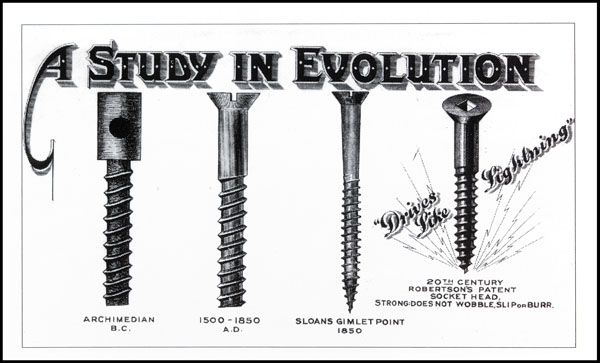


Unfortunately, like every other item made of iron and found on a beach, the clues to a screws age can be erased by time and corrosion.  Here is a found screw along with a brand new screw.


The older of the two has very rounded rather than sharp threads.  I don't know if they were made that way or if they got stripped or corroded down.

I'm not always able to figure out the age of a found screw, but I learned a lot, especially how screws were made centuries ago.  I guess that one point to remember is that not all screws are modern.

---

According to some sources, more than half of the confirmed coronaviruse cases are in the New York metro area.  But instead of being in lock-down, many New Yorkers are leaving and spreading the problem.  Many are coming to Florida, which will undoubtedly get a big bump in cases as a result.   If they won't stay in their own state, they are not going to self-quarantine.   You might say New York is now the US Wuhan, except it wasn't shut off in time.  It looks so much like the science fiction movies - the New Yorkers with means escaped to other areas and spread the disease while the poor are left at home unable to do much of anything else.

Indian River County, according to this morning statistics, has twelve cases, of which half are travel related.

You can track it on the Florida Surveillance Dashboard.

St. Lucie County, has six total, and Okeechobee has none.

Here is the link to the Florida coronavirus dashboard that will allow you to check the most current statistics for each county.

https://experience.arcgis.com/experience/96dd742462124fa0b38ddedb9b25e429

---

Friday the surf is supposed to get up around three to five feet.  That will be a slight increase.

Happy hunting,
TreasureGuide@comcast.net

Friday, April 13, 2018

4/13/18 Report - Beach Access Petition. Cheating Die. Gilt Ring. How To Find Out What Facebook Has On You.


Written by the TreasureGuide for the exclusive use of treasurebeachesreport.blogspot.com.

Copper Alloy Ring With Very
Slight Amount of Gilt Remaining.
Most of the gilt was present before cleaning, but most came off.  There are no markings on the ring that I've been able to see.

---
"Over 30 dice from the Middle Ages have been found in Bergen over the years so the discovery of a dice in itself is not very surprising. This dice is, on the other hand, special," wrote a team of archaeologists from the Norwegian Institute for Cultural Heritage Research on its website. 
A normal dice has only one number (usually represented by a dot) on each of its six sides, ranging from 1 to 6. But not this dice.
"The dice from Vågsbunnen has two fives and two fours, instead of the numbers one and two. It is therefore very likely that this has been used to cheat in games," the archaeologists wrote...


It seems remarkable to me how die found in many distant places and coming from many different time periods are so similar.
---

As I explained before, there is a lot of confusion around the beach access issue.  I posted parts of one article that shows how the media is to some extent responsible for that.  I also explained that I am not I'm not going to try to explain any bills or anything like that.  I will post other peoples opinions and positions on the beach access matter.  Sherry Y. had the following to say.


Well, my representatives have not bothered to return my emails, and I can't say that I'm surprised. .I am a registered voter in Brevard County, so the surprise may be on them when they are up for re-election.  
There is now an internet petition concerning public beach access.  Here is the link if anyone is interested:


It already has nearly 30,000 signatures.  We may not be able to get this particular bill repealed, but those clowns in Tallahassee might think twice before they try to pass another law restricting public access to our beaches.

Thanks and keep up the good work!
Sherry Young

It seems that most of the representatives have not responded to comments and inquiries.  Maybe a lot of them do not understand the impact or care about it.  For some reason many of them are not responding to the public.

As I said before, I think it is good to let your representatives know your feelings about the importance of public beach access regardless of what any particular bill would or wouldn't do.

---

One reader of this blog is selling the largest lot left on ocean in all Flagler County.  I don't do advertisements but am making this one time exception.

The price is 1.4 million for the entire lot - 168 feet wide x 250 deep. Direct ocean front. Or 1/2 of it for 700k .......84 feet wide x 250 deep. It is 5 miles North of Flagler Beach Pier and in the County. City water,sewage, cable, etc....No HOA. County zoned. It has no seawall currently but could be applied for through DEP.  Contact btboice@gmail.com.

---

I don't know if you watched Zuckerberg being interviewed by Congress, but if you are interested in finding out what Facebook knows about you, check out this link.

https://www.howtogeek.com/346197/ever-wonder-how-much-facebook-knows-about-you-here%E2%80%99s-how-to-see/

As I've said, I don't do Facebook.

---

I may have found the first gold coin from one 20th century site that I've been seeking.  Maybe more on that some day soon.

---

Don't expect any big changes at the beach this weekend.

Happy hunting,
TreasureGuide@comcast.net

Saturday, November 4, 2017

11/4/17 Report - How to Find Older Coins. Metal Detector Sandals. Big Money in Old News.


Written by the TreasureGuide for the exclusive use of treasurebeachesreport.blogspot.com.


Tired of finding zinc pennies? Want to find older coins and items like those shown above?  These were found at one site a couple days ago.

You know what they say about insanity -  it is doing the same thing and expecting a different result.  Your finds are the result of what you do or don't do.  You might want to try something different.

I often consider different ways of finding things.  If you've been reading this blog very long, you know that one other method I've talked about is sifting.  That is the way the archaeologists do it.

It isn't easy, and it is time consuming, but if you select the right location, it can be worthwhile.

Back in the old days there was what was called the Merkitch sifter.  It was a sifter that you pushed or pulled through the sand like a lawn mower.  I made one myself and used it on the beaches down south.  It worked, but it wasn't easy.

One reader of this blog sifts land sites.  Above you can see what he found on one hunt a couple of days ago.  How long has it been since you found coins like that?

Here is what he had to say.

I know sometimes you like to show finds that were unearthed in unconventional ways. I found these coins and marbles yesterday with a sifter on the mainland. The coins I find with the sifter almost never look as nice as these, since I am usually in high trash areas and the coins have been impacted by another metal, usually iron. However, at this particular site the layer of trash was very distinct and the coins were below in nice sandy soil. By my estimate, the half dollar was 3-4 inches down in an area that I'd been over numerous times with a detector.  It was one of my better sifting days for sure.

I still intend to get you a thorough accounting of my first sifting lot. The results were astounding to me. It will take a while to take the photos and write up, but I will get to it...


Sifting doesn't mean that you can't or shouldn't use a metal detector.  In this case, the detectorist had been over the same spot numerous times with a detector.  The coins were terribly deep, but he missed those coins when he used his detector.  There was a layer of trash over the coins.  

You can go over an area numerous times and continue to find things you missed the first time.  I've outlined a multiple-step approach to hunting such sites.  One thing you should do is change the direction you walk when you go over an area again.

The detector might miss certain targets, but it will still help you identify areas that you might want to sift.  There is little reason to take the time to sift an area where you are convinced there will be nothing.  There are other areas, however, where there was a lot of activity, perhaps a lot of trash, but some indication that there might be deeper targets.

You'll also come up with some non-metallic targets when you sift.  Notice the nice old clay marble. 

Those are some nice finds.  Thanks for the photo and email!

---


Sandals With Built-In Metal Detector Coil.
Source: Popular Mechanics (See link below)
This is half serious, but to me, mostly funny.  These sandals and the control box you wear on your ankle detect metal.  The Popular Mechanics article says, We were also disappointed at the sandal's rather weak metal-detecting strength. Despite the claim of a two-foot range, you pretty much have to bring metal objects right up against the sole of the foot for them to work. This is especially true with smaller objects, such as coins and paper clips. It had a slightly easier time picking the larger items we tested it with, such as pliers and scissors. But if you're looking for lost wedding rings and extra quarters, it's not the best solution.

What would you expect?  At least somebody was thinking - just not too well.  You would look weird if you tried to grid an area by dragging one foot around.

---

There's money in old news.  Four old newspapers containing accounts of the wrecking of the 1715 Fleet, the first published in November of 1715, received an auction bid of over four thousand dollars in the recently concluded Sedwick auction.

Here is the lot description directly from the auction catalog.

Unique set of newspapers with accounts on the sinking and salvage of the Spanish 1715 Treasure Fleet, consisting of four issues of The Post Boy (London) from 1715-16. 

Four very rare, complete issues of The Post Boy, a major London newspaper, from November 19, December 8 and 19, 1715 and July 3, 1716, each issue a single 14” x 8” sheet (“broadsheet”) of high-quality rag stock printed on both sides, and in Fine to Very Fine condition. In all probability these papers are the only ones in private hands. 

These four historic newspapers provide accounts of the legendary disaster and Spain’s frantic attempts to recover the hundreds of millions of dollars of gold and silver coins and precious jewels carried by eleven Spanish galleons, accompanied by a French warship that was the only ship to escape the hurricane on July 30, 1715, as the treasure-laden Fleet attempted to sail from Cuba to Spain. Hundreds of seamen and passengers drowned in the vicious storm with the survivors going to St. Augustine or Havana. Although much of the treasure was salvaged over the next few years—and present-day salvors have uncovered millions of dollars in coins and jewels—more treasure remains unclaimed in the Atlantic Ocean off the east coast of Florida. Several whole ships have yet to be found. 

The first report of the disaster in the November 19, 1715 issue reads: “Letters from the Havana, of the 17th of September, advise that the Flotilla, consisting of Ten Ships, met with such a violent Storm, upon the 31st of July, that they were forced to run ashoar upon the Coasts of Florida, 50 Leagues from Cape S. Augustin, and 20 from Cape Canaveral; and that only one Ship, v.z. the Flying-Hart, escaped: That upon this News, several Ships were immediately sent from the Havana to fish up the Gold and Silver; that good Part of it was already recover’d and particularly that on board the Urza de Lima; and that it was hoped, most of the rest would likewise be got up. They add, that 4 or 500 Men were drown’d, and among them several Passengers. This News was brought to Rochelle by the S. Francis, whose Cargo is very rich, consisting of 500000 Pieces of Eight besides Merchandizes.” 

Further details from the December 8 issue are more positive (possibly to buoy public opinion on the disaster). Some of the reporting stated: “We have receiv’d better News concerning the Flota of New Spain…that only two Ships of it were cast away; Some others were indeed run aground upon the Coast of Florida; but all the Gold and Silver, and most of the Merchandizes were taken out of them.” The King then sent four ships to Florida, “…and shall take on board those of the Flota, which amount to 12 Millions of Crowns in Gold and Silver only.” 

From the December 17, 1715 issue came the following: “Letters from Cadiz, of the 28th past, say, that all possible Diligence is used in fitting out the Men of War, which are to go and take on board the Cargoes of the Galleons run aground upon the Coast of Florida. By a Vessel arrived from thence they heard, that the Galleons could not be put a float again; but the Chests of Gold and Silver had been all taken up, and great part of the Merchandizes; so that only the Cochineal will be lost.” 

Finally, after just over six months of salvage attempts, the July 3, 1716 issue reported the following gleaned from letters from Havanna at the end of March: “…they had recover’d out of the Capitana, a thousand Chests of Silver, and seven hundred and fifty out of the Admirante (Almiranta), but no Merchandizes out of those two Ships, whereas all those of the Urca de Lima had been fish’d up; that some English Barques being come in Sight of Palmaer, five (Spanish) Barques were fitted out at the Havana to observe them; that nevertheless the English seiz’d some Part of the Plate above specify’d whereupon a Deputy was order’d from the Havana to the Governor of Jamaica to complain of that proceeding….” 

These newspapers represent highly important accounts of the disaster and the subsequent attempts to salvage the enormous treasure Spain and other European countries were counting on for their economies. In our time, ironically, these newspapers are vastly rarer than the treasure itself!


---

The surf is going to be around two to four feet for several days.  The tides are nice and high now.

Happy hunting,
TreasureGuide@comcast.net

Thursday, May 22, 2014

5/22/14 - How To Track Gold On The Front Beach, Google Street View Beaches and Naples Florida Canals


Written by the Treasureguide for the exclusive use of treasurebeachesreport.blogspot.com.


Sample Google Street View Image Showing Beach at Rio Mar With Navigation Icons.
Memorial Day is coming up and people will be hitting the beaches.  In fact, there have been good numbers at some of our Treasure Coast beaches lately, but if you want to visit a new beach or two and want to get a preview of what it looks like before you make the drive, you can take a look at it by using Google Maps Street View.  That will give you a 3-D view of the beach and will allow you to use the navigation tools to look and move in all directions to get a good idea about what is there, including facilities, lay of the land, parking, etc.

Bill M. wrote and brought this to my attention.  He said,  Google just activated street view for every inch of beach in Florida.

This means you can now get a step by step view of any stretch of Florida beach.

For example, if you wanted to see what the beach in front of RioMar country club looked like, you can go to Google Maps, pull up Vero, zoom into RioMar, click the street view icon, and drag it onto the blue line at the beach.


Then you can use your mouse to rotate, zoom, or move up and down the beach.

This isn't a real time view, but it is useful when doing research - especially for those out of the way or secluded beaches that may be difficult to reach.

Thanks Bill!

It is important to remember that Google Maps  is not a real-time view.  That means that you can not get an up-to-date idea about beach conditions, but you can get an good overall view.

I was talking about rut busters the other day, and this is a tool that can help you get an idea about some new beaches you might try. 


Here are some very up to date views of Treasure Coast beaches.

I visited three different beaches just yesterday around low tide.

The surf at this beach was down around two feet and the beach had filled more since my last photos.

I didn't bother to detect at this beach. It just didn't look worth it. 

There were a few shells here, and small sea glass.

Below is another beach a few miles away.   That is a more busy beach.

You can see the flat area below the slope.   I detected this beach briefly to give it a test.

There were a modern coins running for quite a distance near the bottom of the slope.  Not a huge amount of coins, but enough to keep it interesting. 

The modern coins here were a few inches deep. The signals weren't real loud and could easily be missed if you were moving too fast.

The first target I picked up was a fractional zinc penny.  It was so corroded only about half of it remained.  It obviously wasn't a recent drop.  Although totally worthless as a find, it was a quick indicator that helped me determine where I would continue the hunt.  By evaluating where it was found I got an idea of which direction to go to find better targets. 

Always try to determine if a find is part of a pattern.  If it is not a recent drop and is in the wet sand, it probably is. 

If it is a light target, such as a zinc penny, move up or down the slope slightly (most often down) as you proceed along the beach to see if you get into heavier or lighter targets.  (I've discussed the zig zaz pattern in the past.)

Make a mental map of where you are finding lighter and heavier targets, noting particularly the transition zones, both East and West and North and South.  Of course, moving from light to heavy target areas and continually evaluate and redefine the different areas according to what you find.

The next find was a green encrusted dime.  I was moving in the right direction.  Then a few more mixed coins.   I then know I'm in the zone and continuing to get a better idea of how things are distributed in the area.  Following the trail and moving towards where I would guess from an evaluation of the scatter pattern the heavier items are located, confirmation comes as a small gold ring pops up.

After checking for a possible cluster and not finding evidence of one, I moved on.

I showed the following beach a few times in the last few days.  It is the one that had some nice cuts that have been disappearing and which have now almost totally disappeared. 

I didn't bother detecting this treasure beach.

Overall, I'd say beach detecting conditions are poor for the treasure beaches, but some of the busier tourist and swimming beaches will produce a few coins and jewelry.  A little patience will pay off.


Naples Florida was the site of a network of canals dating back to around 1000 AD.

Here is the link to that story.


 On the Treasure Coast the surf will be decreasing down to around one foot.  We'll have a nearly flat ocean for a week or so if the surfing web sites are correct.  I'd try water or wet sand hunting at the swimming beaches.
 
Happy hunting,


Monday, March 24, 2014

3/24/14 How To Detect Fake Bullion Coins, Another Gold Ring & 18th Century Spanish Colonial Platinum


Written by the TreasureGuide for the exclusive use of treasurebeachesreport.blogspot.com.


Gold Diamond and Pearl Ring.

As I've been showing, there are some holes that continue to produce gold along the Treasure Coast.  Old finds on the beach are rare now though.  This ring came from one hole that has been producing on a regular basis.

Today was a good day to get down low on the beach.


Whether you have found or bought bullion coins you should know that for bullion coins, like virtually everything else of value, there are fakes or counterfeits.  I found the following linked web site for bullion coin collectors that makes a clear distinction between fakes and copies.  According to their definitions, fakes are made of the wrong metal while copies are made of the correct metals.

A fake silver bullion coin, for example, might be made of silver-plated copper, while a copy of the same coin would be made of he correct purity of silver.

Copies are therefor made when the value of the coin is considerable greater than its melt value, such as with rare coins.

Here is the link to that article.  http://rscott.org/bullion/counter.htm

The article also explains that gold and platinum are very dense metals, and fake bullion coins are usually made of lighter metals, therefore the fake coin will usually be either too light or too big.  That makes it fairly easy to detect fake gold or platinum bullion coins.

Here is a list of some known fake bullion coins as described in the above linked article.

Silver Pandas. Around 2005, fake pandas started being distributed, apparently from China, and apparently made out of silver-plated copper.

2002 1/10 oz platinum eagle. This fake coin was made of a copper-colored alloy, with a white platinum colored coating, and is lighter than a genuine coin (2.13g versus 3.112g).  

Canadian Maples. There are likely many counterfeit Canadian maples, probably all fakes (wrong metal), but most likely all the 1oz size.

Krugerrands. There are likely many counterfeit Krugerrands, probably all fakes (wrong metal), but most likely all the 1oz size.

1994 Australian Nuggets/Koalas. These are actually replicas that were created for Monex to show what the coins look like. They appear nearly identical to the genuine coin (even the hard plastic holder is nearly identical), except the reverse is blank. It is believed that only 1 oz and larger (10 oz and 1 kilogram) sizes were made.


There is a device that will help you check bullion coins such as those listed above.  It is called a "Fische."   Here is a link where you can learn more about that.

http://www.thefisch.com/index.html?content=home


If you've been reading this blog you know that I recently discovered a series journal articles that describes what appears to be the earliest discovery and refinement of platinum.  Documentation from the Archives of the Indies talks about early attempts to separate and refine platinum at the Bogota mint by assayer Sanchez in the first third of the 18th Century.

At first platinum was considered nothing other than a nuisance.  However before long they had learned to refine platinum into a malleable form and were able to manufacture items made of platinum.  Apparently the first refinement of platinum was actually an alloy.

One of the first "uses" of platinum was to debase gold and cobs.  It was easier to overlook some of the inexpensive metal than to remove it.

Those who had learned how to work platinum were told not to disclose their methods.   The king wanted Spain to have a monopoly on the new noble metal.

The king wanted platinum to be shipped to Spain but tried to keep the desirability of the metal from being discovered so that he could get it cheaply.  However, miners and others got the idea that it might have value since the king was not only wanting it but was willing to pay for this metal that was previously being tossed into the river or otherwise discarded.  They illegally stockpiled the metal and the price increased.

Several orders of platinum were requested and sent to Spain via Cartegena during the 18th Century.  The first documented official shipment was in January of 1766.  Some was shipped earlier.

Treasure clues can be found in this literature, including shipments, storage and disposal of the metal.  Specific locations are mentioned where platinum was dumped into rivers or valleys.

Below is a paragraph that illustrates the kinds of things you can learn from the historical articles published in various issues of Platinum Metals Review.

The success Chabaneau had achieved in producing malleable platinum in some quantity immediately prompted the Spanish government to order the Viceroy of New Granada - now Antonio Caballero y Gongora - to collect all the platinum he could obtain while keeping its new value a secret. About 150 pounds of native metal were shipped to Spain, this time the miners being paid two or three reales
a pound. Further shipments necessitated the price being raised to four reales a pound, and the authorities in Madrid recommended the importation of many more negro slaves to work the deposits and approved a scheme for the importa­tion of tools for sale to the workers in the hope of increasing output. In 1788 it was decreed that platinum was to be sold only to the crown and penalties were established for anyone detected in hoarding the metal. By the end of that year more than three thousand pounds of platinum had been despatched from the Chocó to Cartagena for shipment to Spain, but great quantities were still smuggled out.

And here is the link to one of a number of articles that I have found in the journal on the subject of early platinum separation and refinement in 18th Century.

http://www.platinummetalsreview.com/pdf/pmr-v38-i3-126-133.pdf

It is known that by the mid-18th century a few articles had been made of platinum.  I also feel rather certain that platinum could be found in gold coming from Bogota, some of it included unintentionally and some unintentionally.


The surf on the Treasure Coast is down around two feet today.  The tide is fairly flat.  The surf will be increasing tomorrow to up around three of four feet and staying that way for a while.

The wind seems mixed.  It will be from the North now and then but only for short times.

Happy hunting,
TreasureGuide@comcast.net


Monday, February 28, 2011

2/28/11 Report - The Easy Way to Find a Lot of Gold Metal Detecting


Some Class Ring Metal Detector Finds.

Everybody wants to know the easy way to find a lot of gold with their metal detector. That isn't surprising, is it? Truth is, if there is an easy way to find a lot of gold, I don't know what it is. I do know how to find a lot of gold, but it's not easy. I think the easy ways have been worked out.

Finding a little gold now or then can be easy. Just wander around the beach waving your detector long enough and sooner or later - probably later - you'll find some gold, but it is an entirely different matter to find gold on a regular basis.

It is certainly possible to find a lot of gold, but it is not easy. At least I've never found it to be easy. It takes a lot of effort.

Have you ever noticed in those stories you read about someone's first treasure coin find, that they often talk about finding a way to get on a beach just after a hurricane. That is not easy. Generally you can only get over to the barrier islands after a hurricane if you own property over there. You have to show ID and still might not be able to get over right away. Power lines are down and the bridges and parks are closed. It's not easy. It isn't the same picture that some people have in their head of leisurely detecting a beach on a nice sunny day and digging up the Queen's jewels.

I know that some people detect as a leisure activity, and they enjoy the exercise on the beach on a nice day. That is one thing, but it is not what the guy dead-set on finding beach shipwreck treasures is about. The most successful beach treasure-coin hunters are not out for a nice walk in the park.

Don't get me wrong. There is nothing wrong with leisurely detecting for fun, exercise and social activity. But that is not what will get you a lot of big finds.

The people who are very successful are spending a lot of time, and doing what it takes to get the job done. It is not easy.

You do have a chance of finding something if you leisurely detect the beach on sunny days, but it is most likely going to take a long time and good finds are not likely to happen frequently.

The same thing goes for hunting modern jewelry. If you want to find a lot of gold, you are going to have put in more time, more effort, learn more, and do things that 99% of the detectorists aren't willing or able to do.

Here is one thing I often say to people who say they want to find a lot of gold with their detector. "If you don't want to do it, do it."

That statement is cryptic and could be taken wrong, but what I am saying is that the best finds are very often made under difficult circumstances. They are not generally made on a nice sunny 70 degree day. They are more often made when the wind is blowing so hard that the sand is stinging your face, and the rain is making it difficult to see, and the waves are knocking you off of your feet and the rocks won't let you use your scoop, etc. etc.

There is a lot that I'm not telling you here, but my main point is, that if you want to detect a lot of gold, you're going to have to do what 99% of the detectorists aren't willing to do.

I've been giving you a few scattered hints lately. One was to go out and find and hunt beaches that few others are detecting. I know it takes time to discover new productive beaches. But that is one thing that will separate you from the hundreds of other guys hunting the same old beaches over and over again.

Those places that aren't hunted by hardly anyone else are generally not hunted for a reason. But that doesn't mean they won't be productive. And if they are, you'll have it all to yourself.

Some beaches just don't look like anybody would go there. Maybe they are too rocky, over grown, muddy, small or something. That doesn't mean they won't be productive.

Some beaches that aren't used today were well used at one time. I mentioned some examples of that in another post recently.

And some are difficult to work. I said difficult, not impossible.

If you watched the Gold Rush Alaska TV show, you saw that it was not easy. The same thing applies to finding gold on the beach or in the shallow water. You might be able to get a few pieces easily, but to get a lot, is not easy.

On the TV program they were digging down to bedrock to find where the gold settled under an old waterfall in an ancient creek bed. It was no longer a creek bed and was now covered with sediment. The same thing happens on beaches. Gold settles over time until it is trapped. It often settles in pockets where several pieces can be found together.

It is not easy to find those pockets and it is not usually easy to dig the gold out of those pockets.

I feel like I've said enough about that for today.

Just to sum up, in metal detecting the easy path is seldom the most productive path.


You can learn a lot by watching that TV program. It applies to other types of treasure hunting too.


Forecast and Conditions.

Pepper Park Beach Recent Photo.

Photo submitted by Timothy T.

This beach has been like this for quite a while now. As you can see there is a broad low beach-front to detect at low tide. There are very few good targets here presently though.

Ho, HO, HO!

You have one of those beautiful days for walking the beach today. The wind is from the south/southeast and the sun is shining. Just beautiful! But look at the predictions.

The calm seas will continue for a couple of days, and then the seas will increase up to 7.5 feet. That really sounds good. I hope it actually happens. And it lasts for a few days. Not just a day. This could get good if the surf web site predictions are correct and the wind hits at a good angle.

I'm hoping this is the change we've been waiting for - not so patiently I might add.

I've mentioned before how the surf web site prediction models have a problem, so I'm just hoping they are right this time.

We'll have to wait and see. Get your equipment in order.


Happy hunting.
TreasureGuide@comcast.net