Showing posts with label space debris. Show all posts

Sunday, July 28, 2019

7/28/19 Report - 200 Pounds of Found Ancient Coins. Space Debris. Finger Rings From Spanish Colonial Sites: Some Generalities.


Written by the Treasureguide for the exclusive use of treasurebeachesreport.blogspot.com.

Source: See Vietnamplus link below.

Over two-hundred pounds of ancient coins (some shown above) were found and confiscated by police.  They date back to 118 BC, but also included coins made between 621 and 1233.

Here is the link.

https://en.vietnamplus.vn/over-100kg-of-ancient-coins-discovered-in-yen-bai/156763.vnp

---
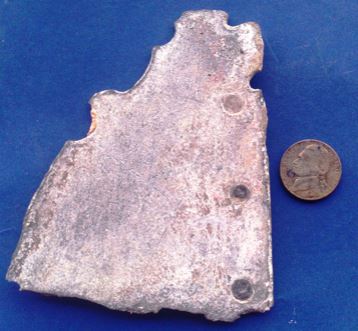

Jim F. found the above item and sent the following email.

Hi TG.

Was out detecting the beach up here in Cocoa a few days ago and got a whopping coin signal on the beach. Came up a 12-45, 12-47 on my Minelab E-Trac and was a good repeatable target...the kind you always dig no matter what. I was surprised when what came up was a very light piece of metal about 3-inches square, with some flush aerospace-type rivets installed along one side and melted carbon fiber on the back. A rather jagged piece of what I think is a piece of Aluminum-Lithium aeroshell from a Space-X Falcon 9 spacecraft. The ship was aborted in 2015 at 200,000 feet running a bit over Mach 2. Hundreds of thousands of pieces were blown to the four winds almost directly over Cape Canaveral. I've found bent and twisted fragments of Berylium Copper (used in rocket engine plumbing and cooling) when the tide is right. Not long ago the beach was "re-nourished" with tons of offshore sand, and I think this may have come from deeper waters. Never know what you are going to find at the beach. I think a lot of people would have thrown this away, not knowing what it really is.Like you always say, don't toss something away until you are really sure what it is! I found the clad nickle used for scale purposed not far from it...convenient.

Cheers!

Thanks Jim.  Nice find!

---

Earlier this year I mentioned the Orlando KellyCo store closing.  I just got a KellyCo brochure in the mail.  It seems they are now located in Knoxville TN.


You can find them online.

---

I've mentioned this before, but I often receive photos of old silver rings and people wonder if they might be from a shipwreck.  As I've said more than once, one of the very top long-time treasure salvage guys said that a silver rings have not been found on 1715 Fleet wreck sites.  Gold rings are not unusual from the same wrecks, as you undoubtedly know.

Silver rings have been found in good numbers on 18th century Spanish colonial archaeological sites though.  The lack of silver rings on the wrecks seems very strange to me.  Why would silver rings be fairly common from 18th century Spanish colonial sites, but not found on the 1715 Fleet wrecks?  I have a few theories, but get into my theories now.

I was looking at Kathleen Deagan's book, Artifacts of the Spanish Colonial Colonies of Florida and the Caribbean, 1500 - 1800, Volume 2, and wanted to post some interesting statements about jewelry from Spanish colonial archaeological sites.  Here it is.

Apart from glass beads, finger rings are the most frequently reported jewelry items on Spanish Colonial sites.  Simple bands of glass, jet, or metal (anillos) and rings with settings (sortijas) are present throughout the colonial period.  Precious finger rings of the sixteenth century were carefully sculpted and enameled, with high, decorated box mounts (Bury, 1984:7): however, this was not the case with the early finger rings from archaeological sites, which tend to be quite humble in both design and material.


You might recall that yesterday I mentioned finding a gold enameled ring on a Treasure Coast beach. At the time I didn't think of it possibly being Spanish colonial and didn't pay much attention to it.

Deagan also mentions that the earlier rings from Spanish colonial sites were humble in both design and material.  Here is a sample of some of those shown in the Deagan book.

Source: Deagan book cited above.

That isn't the best picture, but I think you can tell that they are rings are not really very different from many inexpensive rings that you might find from later centuries.   If you would find one on a beach, you might not think much of it.  There is very little to suggest that those rings are centuries old.

Here is one of many that I could have selected that isn't very different from those shown above.  In fact it is similar to the one on the extreme right in the photo above.  (I know you can't see that photo very well.  Sorry about that.)

Silver Turquoise Ring.
The turquoise is discolored (I mentioned something about how that can happen yesterday.).  In this case the discoloration is due partly to patina.

But this ring provides some good information if you look inside.  You can clearly read the "STERLING" mark.

At first glance I would take this ring as possibly being from the 1970s, but it is really not very different in appearance from rings made centuries ago.

I might be able to make out the other mark if I do some cleaning.

Sterling Mark on Ring Shown Above.

On the other hand, the very corroded silver band shown below shows no markings at all.  That could be due to the corrosion, but maybe it never had any markings.

Corroded Silver Ring With No Identifiable Marks Found on Treasure Coast.

I'll have more examples related to this topic in the future.

---

Source: nhc.noaa.gov

We now have one system with a 10% chance of becoming a cyclone in the next 48 hours.

The surf is still running one to two feet on the Treasure Coast.

Happy hunting,
TreasureGuide@comcast.net


Sunday, April 28, 2019

4/28/19 Report - Melted Beer Can or Space Debris? Some Answers and Tests You Can Perform.


Written by the TreasureGuide for the exclusive use of treasurebeachesreport.blogspot.com.


I just received an excellent email from Jerry P. on those melted pieces of white metal that people find on the beach.  Here it is.


Aluminum or Space Poop by Jerry P.


It’s been called melted beer cans, space poop, space platinum, NASA trash. So is it space debris or beer cans? This is a debate that has been going on for years within our group of beach hunters. All I can do is add to the puzzle and maybe someone can put this dog to rest.

If you detect the beach long enough you will eventually pull a piece of what appears to be aluminum or titanium melted by super high temperature. Aluminum has a melting point of 1,220.58 F or 660.32 C and titanium 3034 F or 1668 C. A bonfire, at it’s highest temperature, if constructed correctly, can burn as high as 2012 F or 1100 C plenty hot enough to melt aluminum but not titanium. You maybe thinking slam dunk, case closed it’s melted beer cans. Hold on the dilemma is not over yet. Rockets are made of light weight materials like titanium and aluminum. Rocket propellant, under a controlled manner, burns at around 5,800 F or 3,200 C. This is plenty hot enough to melt aluminum and titanium. This temperature is based on a controlled burn within the rocket engine. If the lunch had an unexpected “anomaly” then these propellant would be mixed in an uncontrolled burn/explosion which could result in much higher temperatures. We are back to square one!

I detect with an old machine (sovereign gt) and it just talks to me. Aluminum has a distinct sound on the sovereign and the one thing that I notice about these melted pieces is that they sound something between aluminum and silver. This tells me it’s not aluminum and must be another type of metal.

A bonfire test is in order. I stoked a fire in the backyard pit and waited for it to get good and hot before adding some aluminum cans. I let the fire burn overnight with the cans inside. In the morning I took my inland machine (AT Pro), pinpointer and a sifting screen to retrieve all metal targets. The cans did melt or at least they changed their form however they did not look anything like the pieces we pull off the beach. They did not melt into a blob and were very thin and brittle. The pieces we pull off the beach are rock solid and can hardly be dented with a hammer.


I was starting to believe the beach pieces could very well be part of our space program or military missile defense program of which one is still ongoing today.
There are other things to consider like the Untied States Air force. They have a restricted military training zone just off our coast and could be firing air missiles. We also have our poorly constructed beach renourishment program to consider. Much of this renourishment sand comes from the offshore bars around Cape Canaveral. This would most differently support a space debris theory.
What solidified it for me was when I started pulling specimen pieces. These were pieces of the melted metal that have unique items embedded in them. Items that you don’t see at your average bonfire, some kind of thick quartz or crystals, rivets, orange and red tile like fragments and my best piece has both quartz/crystal and a small stainless steel spring embedded in it. Would love to hear if anyone has looked into these pieces. JP


----

Thanks much Jerry.  Great email!


Below is a related post that I did on 5/10/18.


Metal Glob Found On Beach
How can you tell if it is titanium?

There are a few questions that I get all the time.  One question that I get a lot is about those shiny globs of metal found on the beach that look like melted aluminum.  It could be aluminum but it could also be something else.

Sometimes space debris falls on the beach or in the ocean.  People often want to know if their shiny piece of metal could be a piece of space debris.

It can be difficult to say for sure, but there are tests that you can do to tell if a piece might be titanium or aluminum.  I once wrote about that a long time ago, but since I still get the question and have more information now, I decided to address the question again.

Here are some quick tips that can help you decide what you have.

Here are some easy tests to get started.  Titanium is not magnetic, so if a magnet sticks to it, it is not titanium.  However, aluminum is normally not magnetic either.  So that is only a beginning.

When it comes to telling titanium from aluminum, titanium is about twice as heavy as aluminum and much harder than aluminum.  If you use a metal file, aluminum will come off in small globs, but titanium will not.  It is relatively easy to scratch a mark on aluminum.

If you file down beyond the surface metal, the newly exposed surface of titanium will darker than a similar piece of aluminum.

If you used a rotary grinder on a piece of titanium, the sparks will be a blue-white color.
Here is a link to a web site that will give you more detail on these and other tests for testing titanium and other metals.

http://mrtitanium.info/2008/03/17/how-to-tell-if-a-piece-of-metal-is-really-titanium/

Titanium is used for a lot of applications these days. Everything from wheelchairs and bicycles to parts for rockets and wedding rings are made with titanium. If you find a ring that doesn't test gold or silver, it might be titanium.

Titanium isn't a very expensive metal. You can find current prices online.


Big pieces of space debris are occasionally found too.  Here is a link to an article about space debris including the above tank from the space shuttle Columbia that landed in Texas.

https://www.space.com/12518-space-shuttle-columbia-debris-texas.html

In 2015 a large piece of what looks like a piece of a Galileo rocket was found on the beach in Fort Lauderdale.

http://www.sun-sentinel.com/local/broward/fl-lauderdale-rocket-debris-20150802-story.html


And in January of 2018 a part of a SpaceX rocket was found in South Carolina.

http://www.ibtimes.com/spacex-rocket-debris-found-south-carolina-amid-zuma-payload-mystery-photo-2641243

You never know what you might find, so it always helps to be able to test it out.

---

I know of at least one detectorist who contacted NASA and got confirmation that his find was a titanium space debris.  Of course that does not mean that all specimens are.

You might be able to find the post reporting on the person contacting NASA if you use the blog search box.

---

Bill P. just sent me an email suggesting XRF analysis.  I think that should do the job.

I did a post on XRF analysis recently but didn't think about it when I did this post.

Thanks Bill!

Happy hunting,
TreasureGuide@comcast.net


Thursday, May 10, 2018

5/10/18 Report - Answering a Very Common Question. Titanium and Space Debris.


Written by the TreasureGuide for the exclusive use of treasurebeachesreport.blogspot.com.

Metal Glob Found On Beach
How can you tell if it is titanium?

There are a few questions that I get all the time.  One question that I get a lot is about those shiny globs of metal found on the beach that look like melted aluminum.  It could be aluminum but it could also be something else.

Sometimes space debris falls on the beach or in the ocean.  People often want to know if their shiny piece of metal could be a piece of space debris.

It can be difficult to say for sure,but there are tests that you can do to tell if a piece might be titanium or aluminum.  I once wrote about that a long time ago, but since I still get the question and have more information now, I decided to address the question again.

Here are some quick tips that can help you decide what you have.

There are some easy tests to get started.  Titanium is not magnetic, so if a magnet sticks to it, it is not titanium.  However, aluminum is normally not magnetic either.  So that is only a beginner.

When it comes to telling titanium from aluminum, titanium is about twice as heavy as aluminum and much harder than aluminum.  If you use a metal file, aluminum will come off in small globs, but titanium will not.  It is relatively easy to scratch a mark on aluminum.

If you file down beyond the surface metal, the newly exposed surface of titanium will darker than a similar piece of aluminum.

If you used a rotary grinder on a piece of titanium, the sparks will be a blue-white color.

Here is a link to a web site that will give you more detail on these and other tests for testing titanium and other metals.

http://mrtitanium.info/2008/03/17/how-to-tell-if-a-piece-of-metal-is-really-titanium/


Titanium is used for a lot of applications these days. Everything from wheelchairs and bicycles to parts for rockets and wedding rings are made with titanium. If you find a ring that doesn't test gold or silver, it might be titanium.

Titanium isn't a very expensive metal. You can find current prices online.


Big pieces of space debris are occasionally found too.  Here is a link to an article about space debris including the above tank from the space shuttle Columbia that landed in Texas.

https://www.space.com/12518-space-shuttle-columbia-debris-texas.html

In 2015 a large piece of what looks like a piece of a Galileo rocket was found on the beach in Fort Lauderdale.

http://www.sun-sentinel.com/local/broward/fl-lauderdale-rocket-debris-20150802-story.html

And in January of 2018 a part of a SpaceX rocket was found in South Carolina.

http://www.ibtimes.com/spacex-rocket-debris-found-south-carolina-amid-zuma-payload-mystery-photo-2641243

You never know what you might find, so it always helps to be able to test it out.

Happy hunting,
Treasureguide@comcast.net

Tuesday, June 30, 2015

6/30/15 Report - Sea Groins: A Hint For Low Erosion Times. Space Debris. Degaussing. Ivory Finds.


Written by the TreasureGuide for the exclusive use of treasurebeachesreport.blogspot.com.

High Carat Gold Ring Groin Find.

Yesterday I mentioned a couple things from an excellent study that looked at erosion of Florida's beaches beginning with 1883 and ending 2011.  I thought I'd take the time today to emphasize and elaborate on one small part of that study.  Here it is.

Dewall and Richter (1977) reported that seasonal beach changes are on the order of two to three times the magnitude of the yearly trend at Jupiter, Boca Raton, and Hollywood beaches at Florida’s SE coast. The storm surge during Hurricane Ivan 2004 was 2.5 m with significant wave heights greater than 12 m at Panama City beaches, Florida west coast. This event caused a landward migration of 16 m, and the shoreline recovered 10 m in a 20-d period following the storm (Robertson, Keqi, and Whitman, 2007).

To put that another way, the seasonal changes that occur to those beaches are two to three times larger than the changes that normally occur at the same beaches from one year to another.  It can look like there is a lot of erosion, but much of it will be seasonal or temporary and reversed in short order.

The example of Panama City shows that a hurricane can cause as much as 16 meters of erosion, but in this case, it only took twenty days to reverse more than half (10 m) of that erosion.

They also mention that there will be even larger variations in the shoreline where there are obstacles to the natural flow of sand, such as inlets, groins, etc.

There is a good hint that you might catch if you think about it.  When beach conditions are poor, there is always a chance of catching some small but beneficial erosion near an obstructions even at times when you will find very little or no erosion elsewhere.  Between obstructions such as groins, the sand will pile up in one corner and then when the waves change direction, pile up in the other corner.  You can take advantage of areas like that and work areas like that when no other areas are eroding.  That can be especially effective in areas where there are a lot of people and therefore a a good number of recent drops.  The increased movement in sand may be smaller than you would like to see but still be enough to make it possible to find items that were lost slightly longer ago than you could find if there were no movement of sand.  Instead of uncovering old items, this smaller and more frequent movement of sand can uncover items that were buried just weeks or even days ago.

I spent a lot of time working old sea groins in the past.  A lot of good finds, including the unmarked 22K gold ring shown above, came from working between sea groins and other structures.  Other obstructions to the flow of sand work about the same as groins.

Here is the link to the study that I was talking about.

http://www.bioone.org/doi/pdf/10.2112/JCOASTRES-D-10-00192.1

And here is the link to the site providing the groin illustration.

http://oceanica.cofc.edu/an%20educator'sl%20guide%20to%20folly%20beach/guide/process3.htm

---


An unmanned SpaceX Falcon 9 rocket bound for the International Space Station exploded a couple of minutes after liftoff Sunday morning. It was the third cargo mission to the space station to be lost in recent months.

I heard on the TV they were telling people not to pick up any debris from that if they saw it.  Seems are space program is not what it once was.  We've talked a good bit about space debris being found on beaches in the past and even how to test titanium.

Here is the link to the story about the recent rocket failure.

http://www.washingtonpost.com/blogs/the-switch/wp/2015/06/28/elon-musks-spacex-to-attempt-historic-landing/

---

Talking about the news, last week I kept hearing the word "degaussing" in relation to the IRS erasing the subpoenaed emails of Lois Lerner.  I don't know how Hillary erased or destroyed hers.

Anyhow, degaussing is a word that is very relevant to both nautical history and computer history.

Here is what wikipedia says about degaussing.    Degaussing is the process of decreasing or eliminating a remnant magnetic field. It is named after the gauss, a unit of magnetism, which in turn was named after Carl Friedrich Gauss.  Due to magnetic hysteresis, it is generally not possible to reduce a magnetic field completely to zero, so degaussing typically induces a very small "known" field referred to as bias. Degaussing was originally applied to reduce ships' magnetic signatures during the Second World War.  Degaussing is also used to reduce magnetic fields in CRT monitors and to destroy data held on magnetic data storage.

Here is how it was done in World War II - again according to wikipedia.


The term was first used by then Commander Charles F. Goodeve,RCNVR, during World War II, while trying to counter the German magnetic mines that were playing havoc with the British fleet. The mines detected the increase in magnetic field when the steel in a ship concentrated the Earth's magnetic field over it. Admiralty scientists, including Goodeve, developed a number of systems to induce a small "N-pole up" field into the ship to offset this effect, meaning that the net field was the same as background...

The original method of degaussing was to install electromagnetic coils into the ships, known simply as coiling. In addition to being able to bias the ship continually, coiling also allowed the bias field to be reversed in the southern hemisphere, where the mines were set to detect "S-pole down" fields. British ships, notably cruisers and battleships were well protected by about 1943.

My dad worked on a minesweeper in WW II, but it had a wood hull.

At one time in the early days of personal computing much of the data was stored on tapes that were very much like the audio tapes used on tape decks.  Tapes and also computer discs were erased using degaussers.

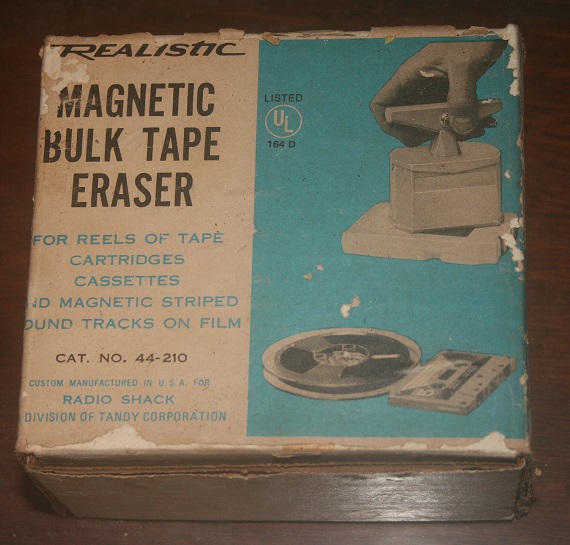
Here is a vintage deguasser purchased from Radio Shack with original box.  I would guess that would be a collectible now.

Vintage Magnetic Tape Eraser

Original Box.
I was in on a lot of computing history.  As far as I know I  actually wrote the first computer program to announce "You've got mail."  Actually it said "You have pnotes."  At that time we called email pnotes, which stood for "personal notes," which were exchanged between individuals.  Before that you had to go see if you had new emails.  The program that I wrote watched for new incoming emails and announced their arrival.  Forums were called gnotes, which stood for "group notes."  We worked on international mainframe networks before the internet.  Just an aside on one of those things I did in an anonymous way.

----

If you find any ivory, such as the ivory higa that I once showed, you should be aware that they are very strict about selling ivory.  Here is something about that from a recent KovelsKomments.

A ton of elephant ivory was crushed in New York City’s Times Square on June 19, 2015. The U.S. Fish and Wildlife Service co-hosted the event with other conservation groups. Carvings, tusks, jewelry and more were sent into a rock crushing machine to be turned into dust. Much of the ivory came from the shop of an antiques dealer, who was sentenced to 30 months in jail and fined $150,000 for selling poached ivory. Other ivory crushes were held in Denver in 2013, and China this past May. Ivory laws have been passed in many states, but there is concern about antique ivory works of art caught up in the new laws. The law that makes it illegal to import new ivory was passed in 1989. Now some states’ rules confuse or stop sales of things like pianos with ivory keys, vintage ivory jewelry and figurines, even mahjong tiles. Art and antiques dealers want existing laws to apply only to ivory from elephants killed since 1989 so ivory works of art can be saved and displayed in museums.

---

I have a lot of new stuff in mind to post.  I won't start that now though.  

I'm so tired of reporting no change in beach detecting conditions, but that is what it is.

Happy hunting,
TreasureGuide@comcast.net