Showing posts with label finger rings. Show all posts

Saturday, February 8, 2020

2/8/20 Report - Beach Renourishment Projects and Conditions. Spanish Colonial Finger Rings and Other Subjects.


Written by the TreasureGuide for the exclusive use of treasurebeachesreport.blogspot.com.

Rio Mar Still Closed
Photo by DJ
Beaches are being renourished around the Treasure Coast.  Rio Mar is still closed.


Ugly Sand at Vero South Beach
Photo by DJ

DJ sent in the following report.

Went to a few beaches starting with Riomar - STILL dumping sand. SO I went to South Beach and took that picture looking south toward Sandy Point. Decided to go north to Turtle Trail. There were 7 detectorists there. One told me they thought last nights’ front might have helped. I ran into Terry Shannon there as well, always a great guy! Had very good things to say about your work, results and dedication. Only down side today was a jerk that refused to fill his holes, I have seen this guy twice now over the last two months. Did not like my asking him to be a responsible detectorist. People like this guy will ruin what little freedom we all have left to detect on a public beach. As I was leaving, ran into three more detectorists arriving. 

Seagrape looked the same as Turtle; lower beach front, lots of small shells, so I did not take a picture. Headed up to Treasure Shores. Passed Golden Sands which is still closed for more sand dumping.  Three detectorists at Treasure Shores, I walked north towards the big curve. Beach front was lower and lots of small shells kicked up from the past days southerly winds. Mostly aluminum but plenty of sneaky targets, solid signals in two directions but the result was an aluminum can end (circular) or the top ring. 

Thanks DJ.

Anyone know where the sand is coming from?  I noticed a lot of trucks going back and forth from out west.

---

There is a lot of discussion about the question of silver rings on the 1715 wrecks.  Just a couple of days ago I posted a link to an article about one beach find that was "certified" by one company to be 1715 Fleet.

The subject of silver rings and their apparent absence on 1715 Fleet wrecks has been mentioned in this blog several times in the past.  Cathleen Deagan, in her book, Artifacts of the Spanish Colonies of Florida and the Caribbean, 1500 - 1800, vol. 2: Portable Personal Possessions, published in 2002,  presents on page 126 an illustration showing several  1715 Fleet rings.  One of those rings is described as a silver Claddagh ring.  Claddagh rings have remained virtually unchanged in design for centuries.  If that illustration is correct, the ring I posted the other day may be the first certified silver 1715 Fleet ring, but it is not the first 1715 Fleet silver ring recovered.  Unfortunately Deagan does not give other details on where the ring was found.  Perhaps one of you salvage people can tell us.

We all know about the relatively common copper-alloy rings and gold rings, but you might be surprised to know that many rings made of other substances were brought to the New World but are very scarce among the salvage records.  Shipping records show (Deagan, 2002, p. 116 and 117) that among the many finger rings shipped to the New World between 1511 and 1613, many were made of glass, some of jet, and some of bufano wood.  Silver wasn't specifically mentioned, but examples have been recovered from Spanish colonial archaeological sites.   Shipping records presented in Deagan's book document several thousand glass rings shipped to the New World in 1590 and thousands more in 1592.  You can understand why those might not survive the ocean for hundreds of years.

I'll also point out the Deagan example ( p. 83) of a 17th century silver "sacred heart" finger ring from Santa Catalina de Guale (Georgia), so we know they were present on Spanish colonial sites but perhaps not common.

Well-informed readers and salvage divers provided some welcome comments on the subject.  A couple mentioned that silver rings might not survive very well in the ocean, and a couple also were surprised that the ring was certified.


Below are a few comments from Jammin Jack.

If any were found, most likely from an overlapping wreck from a later period. 

Certifying the ring was surprising to me, but I am sure Steve had reliable sources.

Also, most research material may include sites from the Gulf, Atlantic, Caribbean, etc. This can cause very controversial arguments, but silver rings on wrecks have always been rare - ANYWHERE! ...


Jammin Jack also told of an experience he had with electrolysis.

I found a (ear)ring back when Noah Wells was leaving the lab. Bill Moore took over the process. We all thought possibly silver with gold filigree and hoping 18th century. I wished I left it alone. After cleaning, it was silver, and very fragile. It was determined late 1800s, and had a small value. I still have the ring as a reminder that sometimes cleaning can ruin the historical value. The below picture is the day I found it. If I showed what it looks like now...well, we learn from our mistakes. 

Silver Earring Find Before Cleaning.
Photo by JaminJack


My first attempt at electrolysis also taught me a lesson. I ruined a buffalo nickel. Thankfully it wasn't any big deal, but I did learn that if I used electrolysis, the process should be carefully monitored, which is something I do with any cleaning method these days. I think it is one part caution and one part curiosity. I like to make sure nothing bad is happening and I'm too curious to wait long to find out how it is going.

When monitoring progress on any cleaning I'm doing, I now like to view the object under magnification.  I've recently learned that you can think an item is clean when there is still some encrustation, sand or shells attached.  I just feel like I get a better look at what is going on when I use magnification.

---

The surf will begin to increase tomorrow, but only reach 3 -5 feet Monday, and then decrease again after that.

The tides are getting bigger.

Happy hunting,
Treasureguide@comcast.net


Sunday, July 28, 2019

7/28/19 Report - 200 Pounds of Found Ancient Coins. Space Debris. Finger Rings From Spanish Colonial Sites: Some Generalities.


Written by the Treasureguide for the exclusive use of treasurebeachesreport.blogspot.com.

Source: See Vietnamplus link below.

Over two-hundred pounds of ancient coins (some shown above) were found and confiscated by police.  They date back to 118 BC, but also included coins made between 621 and 1233.

Here is the link.

https://en.vietnamplus.vn/over-100kg-of-ancient-coins-discovered-in-yen-bai/156763.vnp

---


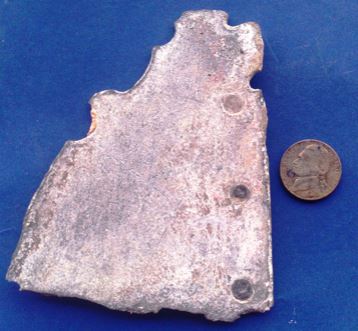
Jim F. found the above item and sent the following email.

Hi TG.

Was out detecting the beach up here in Cocoa a few days ago and got a whopping coin signal on the beach. Came up a 12-45, 12-47 on my Minelab E-Trac and was a good repeatable target...the kind you always dig no matter what. I was surprised when what came up was a very light piece of metal about 3-inches square, with some flush aerospace-type rivets installed along one side and melted carbon fiber on the back. A rather jagged piece of what I think is a piece of Aluminum-Lithium aeroshell from a Space-X Falcon 9 spacecraft. The ship was aborted in 2015 at 200,000 feet running a bit over Mach 2. Hundreds of thousands of pieces were blown to the four winds almost directly over Cape Canaveral. I've found bent and twisted fragments of Berylium Copper (used in rocket engine plumbing and cooling) when the tide is right. Not long ago the beach was "re-nourished" with tons of offshore sand, and I think this may have come from deeper waters. Never know what you are going to find at the beach. I think a lot of people would have thrown this away, not knowing what it really is.Like you always say, don't toss something away until you are really sure what it is! I found the clad nickle used for scale purposed not far from it...convenient.

Cheers!

Thanks Jim.  Nice find!

---

Earlier this year I mentioned the Orlando KellyCo store closing.  I just got a KellyCo brochure in the mail.  It seems they are now located in Knoxville TN.


You can find them online.

---

I've mentioned this before, but I often receive photos of old silver rings and people wonder if they might be from a shipwreck.  As I've said more than once, one of the very top long-time treasure salvage guys said that a silver rings have not been found on 1715 Fleet wreck sites.  Gold rings are not unusual from the same wrecks, as you undoubtedly know.

Silver rings have been found in good numbers on 18th century Spanish colonial archaeological sites though.  The lack of silver rings on the wrecks seems very strange to me.  Why would silver rings be fairly common from 18th century Spanish colonial sites, but not found on the 1715 Fleet wrecks?  I have a few theories, but get into my theories now.

I was looking at Kathleen Deagan's book, Artifacts of the Spanish Colonial Colonies of Florida and the Caribbean, 1500 - 1800, Volume 2, and wanted to post some interesting statements about jewelry from Spanish colonial archaeological sites.  Here it is.

Apart from glass beads, finger rings are the most frequently reported jewelry items on Spanish Colonial sites.  Simple bands of glass, jet, or metal (anillos) and rings with settings (sortijas) are present throughout the colonial period.  Precious finger rings of the sixteenth century were carefully sculpted and enameled, with high, decorated box mounts (Bury, 1984:7): however, this was not the case with the early finger rings from archaeological sites, which tend to be quite humble in both design and material.


You might recall that yesterday I mentioned finding a gold enameled ring on a Treasure Coast beach. At the time I didn't think of it possibly being Spanish colonial and didn't pay much attention to it.

Deagan also mentions that the earlier rings from Spanish colonial sites were humble in both design and material.  Here is a sample of some of those shown in the Deagan book.

Source: Deagan book cited above.

That isn't the best picture, but I think you can tell that they are rings are not really very different from many inexpensive rings that you might find from later centuries.   If you would find one on a beach, you might not think much of it.  There is very little to suggest that those rings are centuries old.

Here is one of many that I could have selected that isn't very different from those shown above.  In fact it is similar to the one on the extreme right in the photo above.  (I know you can't see that photo very well.  Sorry about that.)

Silver Turquoise Ring.
The turquoise is discolored (I mentioned something about how that can happen yesterday.).  In this case the discoloration is due partly to patina.

But this ring provides some good information if you look inside.  You can clearly read the "STERLING" mark.

At first glance I would take this ring as possibly being from the 1970s, but it is really not very different in appearance from rings made centuries ago.

I might be able to make out the other mark if I do some cleaning.

Sterling Mark on Ring Shown Above.

On the other hand, the very corroded silver band shown below shows no markings at all.  That could be due to the corrosion, but maybe it never had any markings.

Corroded Silver Ring With No Identifiable Marks Found on Treasure Coast.

I'll have more examples related to this topic in the future.

---

Source: nhc.noaa.gov

We now have one system with a 10% chance of becoming a cyclone in the next 48 hours.

The surf is still running one to two feet on the Treasure Coast.

Happy hunting,
TreasureGuide@comcast.net


Thursday, August 24, 2017

8/24/17 Report - Hurricane Aiming At Texas. Intertwined Ring. Silver Rings and the 1715 Fleet. New Blog Poll.


Written by the TreasureGuide for the exclusive use treasurebeachesreport.blogspot.com.

Texas Might Get Hurricane Harvey
Source: nhc.noaa.gov

Looks like Harvey became a hurricane and will hit Texas.  As you can see from the map, there is another area off the West Coast of Florida to watch, but it will probably not become a cyclone anytime soon, but it might bring us some more rain.  It probably won't do much more than that.

We still have some good tides along the Treasure Coast, but the surf won't be much for at least a couple of days.

---

Intertwined Silver Knots
Submitted by Al C.

Al C. sent the above photo of a ring he found along with the following eamil message.

A while back you talked about silver rings not being found on the 1715 wrecks much. I found this years ago right near the stairs that used to go up to the old Chuck’s Steakhouse building. There was a tropical storm going by at the time. I cant remember which one, but that same day I found a couple ½ reales in the same area and no junk to speak of. There are no markings at all on this. Just thought it might be something of interest if that subject ever comes up again.
Thanks for your picture and email Al.

Those kinds of rings have been made and used for a long time.  It could be old.  It is similar to a design known as  the Trinity Knot, which, according to Wikipedia was "designed to honour the Mother, Maiden ad Crone of the Neo-pagan Triple Goddess, which represents the three life-cycles of a woman in relation to the phases of the moon.  In modern times, it has come to represent the Father, Son and Holy Spirit.."  I've also seen similar rings referred to as a Celtic Trinity knot.

Similar intertwined rings are still made today.  You can find quite a variety on the internet.   I've seen them and found intertwined rings with both two and three loops.  I think they are sometimes referred to as Russian rolling rings.  In mathematic terms such a ring might be referred to as a Borromean ring (See Wikipedia again.).

Intertwined rings can't be dated by the design alone.  Similar rings have been used from ancient times to the present.  You certainly might expect a modern silver ring to be marked.  Al's is not.

One of the top 1715 Fleet treasure hunters, who undoubtedly knows as well as about anyone in the world, says that silver rings are not found on 1715 Fleet wreck sites.  Kathleen Deagan, in her book Artifacts of the Spanish Colonies of Florida and the Caribbean 1500 to 1800 does show a silver Claddagh ring, which in her book is said to be from the 1715 Fleet.  It could be from the 1715 Fleet, but you can't be sure of that without additional evidence.  Context is not always enough.  It wasn't long ago that I showed a 1968 class ring found by a Capitana diver searching the 1715 Fleet this year.  Obviously it wasn't from the 1715 Fleet.

My personal conclusion is that there might be a few (very few) silver rings from the 1715 Fleet, but they are evidently rare.  Deagan's book shows many more copper alloy rings from the colonies, along with gold rings and numerous rings made of other substances, including glass and jet.  Only a very few are silver.  One silver ring that Deagan shows is from a mission site.  Although it appears there are some examples, it seems to me that the vast majority of rings in Spanish colonial America were not silver.

There is still a lot left to learn.  That is part of the fun of it all.

---

I heard that after reassigning a sports announcer named Robert Lee who was going to work a Virginia game, they are now going to remove a duck named Donald from all the parks.  Just kidding, but that isn't much more crazy than the Robert Lee thing, which is real and was followed by a decrease of more than a dollar per share for Disney stock.  No wonder ESPN is going down the drain.

---

I posted a new poll on the blog.  I hope you'll respond.  We'll find out what kind of detector people are using these days.

---

I also heard from people that were glad to see the YouTube videos that I made.

Happy hunting,
TreasureGuide@comcast.net

Monday, April 25, 2016

4/25/16 Report - Spanish Colonial Finger Rings and Deagan's Book. Book On Finger Ring Lore.


Written by the TreasureGuide for the exclusive use of treasurebeachesreport.blogspot.com.

Yesterday I talked about the observation that silver rings are not found on 1715 wrecks.  The day before that I showed a silver ring that was in question.  Deagan's book on Spanish colonial artifacts shows that some, though not a lot of silver rings have been found at Spanish colonial land sites, but even those are few, especially in comparison to finger rings made of other materials such as copper alloys.

Deagan's book includes an extensive table showing the number of personal items of adornment going to the New World between 1526 and 1613 as indicated by shipping records of the period.  To give an example of one of the largest quantities of finger ring shipments in the table, 7,200 sortijas de vidrio (rings of glass) were shipped in 1590.

I haven't really looked into it, but don't recall any detectorists or treasure salvors reporting glass ring finds.  In fact, I just looked in the Mel Fisher artifact database and found glass items, but no glass rings.  There were beads, buttons and unidentified glass fragments, but no finger rings.

In the metal detecting world, you would expect that most finds would be metal.  Besides not being detectable, glass might be broken into small pieces and might not be easy to see in different environments.

That is just one reason there might be a big difference between what is out there and what is found. Some items are found more easily than others and some items are preserved much better than others. Metal items, big items and durable items will be found disproportionately when compared to items lost in similar numbers.

There are differences between what items were shipped to the colonies and the types of items shipped from the New World back to Spain.  Large numbers of cobs are found because they are metal, do not generally break down completely in the surf, were shipped from the New World in large quantities, and are detected by metal detectors.

I often talk eye-balling, which will help you find non-metallic items.  From time to time I also talk about techniques such as sifting.

Just as an example, the table shows 36 annilos de alquimia (gilded rings) being shipped in 1592.  Also, 432 sortijas de alquimia (rings with metalwork) were shipped in 1602.  Those are still small numbers when compared to rings made of non-metallic materials.  Compare that, for example, with the 7200 glass rings shipped in 1590 alone.

I'll have to do some research, but I'm not aware of glass finger ring finds made either by detectorists or treasure salvors.   Neither am I aware of finds of  rings made of other non-metallic materials, despite the large number that were shipped to the new world. Not surprisingly, underwater finds appear to be heavily skewed in the direction of metal items.  One of the more significant exceptions seems to be the emeralds that have been found on some shipwrecks.

I am wondering why silver rings seem to be so scarce on 1715 Fleet ships while gold and copper alloy rings are not so scarce.   I'll eventually throw out some ideas for your consideration.  At this point I have a few ideas.  I am considering sociological as well as economic and other reasons.  I want to do a little more research before putting those ideas out there.

I am still looking for ideas to explain the apparent lack of silver rings being found on the 1715 wrecks.

---

Correction/Clarification.

The picture of the eroded renourishment sand at Jupiter in my 4/23/16 post was not a recent picture.  It was from early 2015.  Sorry for any confusion.  I didn't post those pictures as an indication of current conditions.  I just wanted to use the pictures to talk about renourishment sand.

---

Here is an interesting book, Finger Ring Lore; Historical, Lengendary, Anecdotal by William Jones.

You can read it online by clicking on the title.

---
\
Sailors and shipwrights have long believed a silver coin under the mast brings good luck.This practice started with the Romans, whose custom was to place a coin in the mouth of a dead person to pay Charon, the boatman who ferried the souls.

---

Happy hunting,
TreasureGuide@comcast.net