Showing posts with label Falcon 9. Show all posts

Tuesday, January 7, 2020

1/7/20 Report - Beach Reports and Photos. Beach and Coin Layer Diagram. Falcon 9 Launch.


Written by the Treasureguide for the exclusive use of treasurebeachesreport.blogspot.com.


Frederick Douglass Beach Monday Morning
Photo by Steve M.
Steve M., who visited Turtle Trail and sent photos to the blog Sunday, visited Frederick Douglass beach yesterday and sent photos and the following report. 

My wife and I went to Douglas beach about 9:30. Hadn’t been here in weeks so not sure how it has changed. An old cut about 4 foot.High tide hits it. Mostly trash and modern coins. Surf is 3 foot and calmer winds today. Real nice cool day.


Frederick Douglass Monday Morning
Steve M.
You can tell a lot from the photos.  Notice the convex beach.  That is not a good sign.


Frederick Douglass Beach Monday Morning.
Photo by Steve M.
Also notice all the little shell pieces.


Frederick Douglass Beach Monday Morning.
Photo by Steve M.

Alberto visited Turtle Trail yesterday (Monday).  Here is what he said.

Read today's post and saw the photos by Steve M. I stopped by TT on Sunday afternoon and saw the cuts and figured maybe Monday early am they might be better, didn't happen like I thought see attached photos. There were 3 other detectorist already hunting at 8 am. I tried but nothing. 


Turtle Trail Monday
Alberto S.

Cuts on the front of the beach like that show very little sand being moved -  It is just a little stirring of sand on the front beach.

Seems like a good time to look at a simplified beach diagram.

Here is a diagram of a beach having high dunes at the back and a flat beach in front of that, which then slopes down into the water.

In relatively calm surf, you have small waves that vary little from the water's surface.  A small cut might be created as shown above.  In that case, the water simply moves a little of the sand down the slope a little way.

The red areas are where the layers of older coins are in this case.  There is a layer from contemporary salvage efforts in the dunes, typically buried about two feet.  A layer under the back beach, which could be deposited either by coins eroding out of the slope at high surf or being washed up during high surf and erosion.  That layer can be changed from time to time as erosion occurs and then the layer is covered again.  Then there is the deepest layer near bedrock, which was exposed during extreme conditions in the past.

For the layer in front of the dunes to be uncovered the erosion has to be farther back than the erosion shown in this diagram.  Coins can end up on the surface when the back dunes erode too.  High surf can undercut the dunes and coins slide down onto the beach, where they can stay until the get covered again.  They can also be swept out into eroded areas on the front beach.

The coins at the deepest layers have to be uncovered before they can be washed up onto the beach.  The amount of sand in the water is important, because it protects those layers and protects the beach.

I just wanted to show that the majority of the time, the various layers of older coins and things are covered.  It takes a good bit of movement to uncover the coins in the water so they can be washed up.  It also takes erosion moving back and deep for mid-beach layers to be uncovered.  And it takes the water eroding the dunes for those coins to reach the beach.

Most of the time the water is only moving the same old sand in and out in the most active area and not affecting the old coin bearing layers at all.  Notice that the green area where the most movement of sand occurs does not touch any of the coin layers (red).

I think the diagram shows something like what was seen at Turtle Trail the past couple of days.

Of course the diagram is a crude oversimplification, but I think it might still help a little.

---

The 9:19 PM Falcon 9 launch from Cape Canaveral was very brightly seen over the Treasure Coast last night.   I saw it, as did my 93 year old mother, who reminisced about how as a child she used to marvel at any airplane flew over their rural area.

You can see many nice photos and articles about the launch online.

https://www.floridatoday.com/story/tech/science/space/2020/01/06/spacex-vaults-falcon-9-to-orbit-from-cape-canaveral-with-60-more-starlink-satellites/2826868001/

---

Today the surf is still small on the Treasure Coast.  Thursday and Friday it might be more like 4 - 7 feet.

Happy hunting,
TreasureGuide@comcast.net


Sunday, July 28, 2019

7/28/19 Report - 200 Pounds of Found Ancient Coins. Space Debris. Finger Rings From Spanish Colonial Sites: Some Generalities.


Written by the Treasureguide for the exclusive use of treasurebeachesreport.blogspot.com.

Source: See Vietnamplus link below.

Over two-hundred pounds of ancient coins (some shown above) were found and confiscated by police.  They date back to 118 BC, but also included coins made between 621 and 1233.

Here is the link.

https://en.vietnamplus.vn/over-100kg-of-ancient-coins-discovered-in-yen-bai/156763.vnp

---


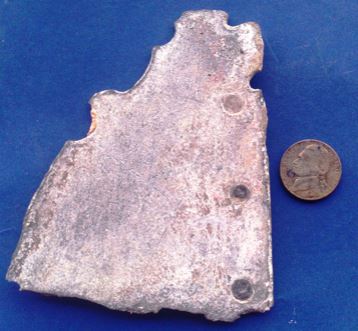
Jim F. found the above item and sent the following email.

Hi TG.

Was out detecting the beach up here in Cocoa a few days ago and got a whopping coin signal on the beach. Came up a 12-45, 12-47 on my Minelab E-Trac and was a good repeatable target...the kind you always dig no matter what. I was surprised when what came up was a very light piece of metal about 3-inches square, with some flush aerospace-type rivets installed along one side and melted carbon fiber on the back. A rather jagged piece of what I think is a piece of Aluminum-Lithium aeroshell from a Space-X Falcon 9 spacecraft. The ship was aborted in 2015 at 200,000 feet running a bit over Mach 2. Hundreds of thousands of pieces were blown to the four winds almost directly over Cape Canaveral. I've found bent and twisted fragments of Berylium Copper (used in rocket engine plumbing and cooling) when the tide is right. Not long ago the beach was "re-nourished" with tons of offshore sand, and I think this may have come from deeper waters. Never know what you are going to find at the beach. I think a lot of people would have thrown this away, not knowing what it really is.Like you always say, don't toss something away until you are really sure what it is! I found the clad nickle used for scale purposed not far from it...convenient.

Cheers!

Thanks Jim.  Nice find!

---

Earlier this year I mentioned the Orlando KellyCo store closing.  I just got a KellyCo brochure in the mail.  It seems they are now located in Knoxville TN.


You can find them online.

---

I've mentioned this before, but I often receive photos of old silver rings and people wonder if they might be from a shipwreck.  As I've said more than once, one of the very top long-time treasure salvage guys said that a silver rings have not been found on 1715 Fleet wreck sites.  Gold rings are not unusual from the same wrecks, as you undoubtedly know.

Silver rings have been found in good numbers on 18th century Spanish colonial archaeological sites though.  The lack of silver rings on the wrecks seems very strange to me.  Why would silver rings be fairly common from 18th century Spanish colonial sites, but not found on the 1715 Fleet wrecks?  I have a few theories, but get into my theories now.

I was looking at Kathleen Deagan's book, Artifacts of the Spanish Colonial Colonies of Florida and the Caribbean, 1500 - 1800, Volume 2, and wanted to post some interesting statements about jewelry from Spanish colonial archaeological sites.  Here it is.

Apart from glass beads, finger rings are the most frequently reported jewelry items on Spanish Colonial sites.  Simple bands of glass, jet, or metal (anillos) and rings with settings (sortijas) are present throughout the colonial period.  Precious finger rings of the sixteenth century were carefully sculpted and enameled, with high, decorated box mounts (Bury, 1984:7): however, this was not the case with the early finger rings from archaeological sites, which tend to be quite humble in both design and material.


You might recall that yesterday I mentioned finding a gold enameled ring on a Treasure Coast beach. At the time I didn't think of it possibly being Spanish colonial and didn't pay much attention to it.

Deagan also mentions that the earlier rings from Spanish colonial sites were humble in both design and material.  Here is a sample of some of those shown in the Deagan book.

Source: Deagan book cited above.

That isn't the best picture, but I think you can tell that they are rings are not really very different from many inexpensive rings that you might find from later centuries.   If you would find one on a beach, you might not think much of it.  There is very little to suggest that those rings are centuries old.

Here is one of many that I could have selected that isn't very different from those shown above.  In fact it is similar to the one on the extreme right in the photo above.  (I know you can't see that photo very well.  Sorry about that.)

Silver Turquoise Ring.
The turquoise is discolored (I mentioned something about how that can happen yesterday.).  In this case the discoloration is due partly to patina.

But this ring provides some good information if you look inside.  You can clearly read the "STERLING" mark.

At first glance I would take this ring as possibly being from the 1970s, but it is really not very different in appearance from rings made centuries ago.

I might be able to make out the other mark if I do some cleaning.

Sterling Mark on Ring Shown Above.

On the other hand, the very corroded silver band shown below shows no markings at all.  That could be due to the corrosion, but maybe it never had any markings.

Corroded Silver Ring With No Identifiable Marks Found on Treasure Coast.

I'll have more examples related to this topic in the future.

---

Source: nhc.noaa.gov

We now have one system with a 10% chance of becoming a cyclone in the next 48 hours.

The surf is still running one to two feet on the Treasure Coast.

Happy hunting,
TreasureGuide@comcast.net