Thursday, June 1, 2017

6/1/17 Report - 2700 Year Old Artifacts Discovered. Number of Shipwrecks Discovered. Cognitive Analysis of Shipwreck Location Data.


Written by the TreasureGuide for the exclusive use of treasurebeachesreport.blogspot.com.
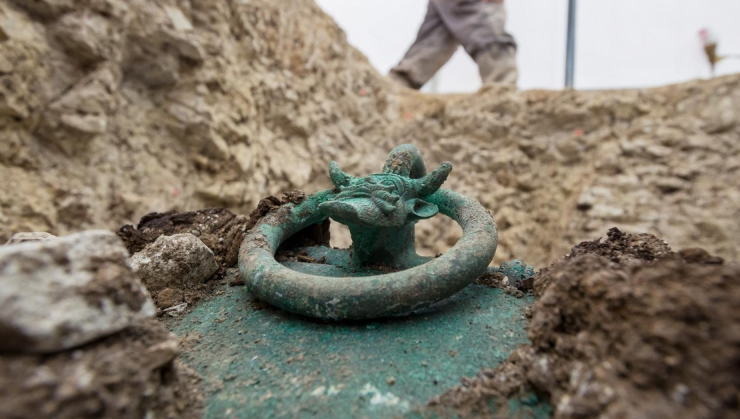
Photo by Denis Gliksman, Inrap.
See International Business Times link below.

After finding well-preserved Greek and Etruscan artefacts, the French state ordered a more detailed exploration of the area. The archaeologists ended up discovering beautiful artefacts from the 5th century BCE, starting with a bronze cauldron ornamented with the head of the god Dionysus.

The remains of the prince were found a little later laid out on his chariot. The skeleton was still wearing the same fine golden jewellery he was buried with.

This was considered to be the most important archaeological discovery made in France in recent decades - comparable to the 1953s discovery of the cave belonging to the so-called "Lady of Vix."

To see more photos and read more about that, here is the link.

http://www.ibtimes.co.uk/lavau-celtic-prince-2500-year-old-royal-tomb-starts-reveal-its-secrets-1623933

---

Photo from the Greek Reporter.
See link below.

The remains of ancient coastal structures and a port, a large number of shipwrecks dating back to various eras and significant smaller finds were found in underwater archaeological excavations conducted by the Ephorate of Underwater Antiquities at the island of Delos from May 2 until May 20, the Culture and Sports Ministry announced on Monday....

Here is that link.

http://greece.greekreporter.com/2017/05/30/culture-and-sports-ministry-significant-finds-from-underwater-excavation-at-delos/

---

Here is the abstract from article published in Frontiers of Psychology (2015; 6: 1615) that looks at the cognitive processes of evaluating and assimilating various types of evidence to locate shipwrecks.

The research described in the present article was implemented to define the locations of two World War II shipwrecks, the German raider Kormoran, and the Australian light cruiser HMAS Sydney. The paper describes the long and complex trail that led through inefficient oceanographic prediction to ambiguous historical prediction involving a single report and on to precise cognitive prediction based on nine reports from more than 70 survivors, a process that yielded a single target position or “mean” just 2.7 NM (nautical miles) from the wreck of Kormoran. Prediction for the position of the wreck of Sydney opened with wishful thinking that she had somehow reached the coast more than 100 NM away when cognitive analysis of the survivor's reports actually provided the basis for accurate prediction in a position near to the wreck of Kormoran. In the account provided below, the focus on cognitive procedures emerged from, first, a review of a sample of the shipwreck hunts, and, second, growing awareness of the extraordinarily rich database available for this search, and the extent to which it was open to cognitive analysis. This review touches on both the trans-disciplinary and the cognitive or intra-disciplinary issues that so challenged the political entities responsible for supervising of the search for the wrecks of Kormoran and Sydney. One of the theoretical questions that emerged from these debate concerns the model of expertise advanced by Collins (). The decomposability of alleged forms of expertise is revealed as a fundamental problem for research projects that might or might not benefit from trans-disciplinary research. Where expertise can be decomposed for operational purposes, the traditional dividing lines between experts and novices, and fools for that matter, are much harder to discern, and require advanced and scientifically informed review.

Here is the link to that academic article. (Another one that isn't light reading.)

https://www.ncbi.nlm.nih.gov/pmc/articles/PMC4623394/

---

We've been having a south wind.  Its really hot now.  Still we have a small surf along the Treasure Coast.  The tides are moderate.

Happy hunting,
TreasureGuide@comcast.net

Wednesday, May 31, 2017

5/31/17 Report - Shipwreck Sinking and Debris Dispersion Model. Detector Depth and Finding Cobs. 103 Gram Meteorite Find.


Written by the TreasureGuide for the exclusive use of the TreasureBeachesReport.blogspot.com.

103 Gram Meteorite Found by SuperRick with Metal Detector
Photo by SuperRick.
We don't have great meteorite hunting in Florida, but they can be found.  I for one don't know if I ever found one or not.  I don't know enough about them to know for sure. Some Florida people have told me that they did find meteorites.

Rick thought the one above (which was not found in Florida)  was a "cold" meteorite, which means that it was not found in a known meteorite area, but then another fellow said he found one in the same area. When it comes to meterorites, a "cold find" is a find made where none had been found before.  It is something like finding a shipwreck cob where there is no known shipwreck and where cobs have not been found before.  That is very different from hunting on a well known shipwreck beach.  It makes the odds much bigger against you, and it makes the find potentially very significant.

Here is the link to SuperRick's YouTube video about the meterorite find.

https://www.youtube.com/watch?v=5vva01ePYkg&t=14s

You might remember the big meteorite auction that I mentioned not long ago.  Some meteorites can be worth a lot.

---

Here is an excellent scientific article on shipwreck sinkings and the formation of the debris field.

On the Hydromechanics of Vessels and Debris Fields During Sinking Events by Sean Kery.

Here is the abstract.

When a vessel leaves the surface and plunges to the seabed, a lot of things can happen that will affect its orientation and position on the seabed and the creation and distribution of the debris field. Crushing and catastrophic implosion due to the rapidly increasing hydrostatic pressure has been noted on portions of many wrecks. Extensive damage due to bottom impact and subsequent motions have also been observed and documented. This paper describes the successful numerical modeling of the sinking of several historic vessels. One was in deep water and another in shallow water. In both cases it was possible for the simulation to replicate important details of the debris field. Further work is planned to help explain some of the taphonomy observed as the wreck decays over time as it is acted on by bottom currents, benthic storms and in the shallow case storm waves. 

This is not light reading.

http://www.sname.org/HigherLogic/System/DownloadDocumentFile.ashx?DocumentFileKey=a7f10ad9-1b65-03ed-757b-7be8daa49310

When thinking about how a ship breaks up and debris gets distributed, here are a few types of damage and debris dispersion to consider as presented in the article.

Damage unrelated to the sinking which occurred over the vessels service life prior to the sinking 
Damage which was causative in the sinking 
Damage which occurred during progressive flooding 
Damage which occurred in the water column on the way down including hydrostatic implosion, and unsecured objects falling off 
Damage due to bottom impact, including collision damage leading to hydraulic outbursts 2 
Debris dispersion due to objects which came off higher in the water column sinking at different rates through layered currents. Objects that fall slower are carried further by currents. 
Debris dispersion due to the sinking microburst plume and hydraulic outburst plumes 
Damage due to currents, waves, benthic storms, corrosion, and biodegradation in situ. 

That gives you some idea of the type of information you will find in that article.

---

Depth is always the big question when it comes to metal detectors.  People usually do an air test and report that X detector will detect a coin at Y inches.  I've talked extensively about the limitation of air tests in the past and recommended some alternatives.  That isn't what I want to talk about now.

The deepest seeking detector, no matter how depth is measured or defined, is not always the best detector for a particular job.  There are a lot of factors to consider.

People often want the deepest seeking detector, but then use their "deep seeking detector" in a way that achieves much less than the best performance.  The wrong sweep or settings can result in very poor performance.  There can be a big difference between the potential depth and the actual depth in field conditions and actual use.

The main point I want to make right now is that depth isn't as important as you might think when hunting cobs on a beach.  The vast majority of cobs I've found have been within and inch or two of the surface.

A few days ago, I provided a link to a video that showed a guy finding old silver coins on the surface without even using a metal detector.  That was because he was looking in the right place.  He was looking where coins had been exposed.  The most important thing in my opinion, is looking in the right place - which are the places where things accumulate and remain near the surface.  In those places they will be on the surface or very near the surface.

Besides eye-balling, another way to know when you are in the right type of place is by analyzing what is in the area, including junk.  That is one reason I don't discriminate a lot.  Junk gives you important information about how good the area is.  Junk can be a good sign or a bad sign, depending upon the type of junk it is.  Different types of junk will normally, on a beach, have a predictable relationship to good targets.  Good targets will tend to be closer to junk targets that are in some ways similar to the "good" targets.  Density is one of several characteristics to consider.  Junk and other targets aren't randomly distributed.  There are reasons they are where they are.  There are enough unknowns and enough complexity to disguise some of the patterns though.

I've eye-balled cobs laying on the sand several times.  And that was not back decades ago and it was not after any of the major hurricanes.

I'm not talking about cobs back in the dunes, where they will often be down a foot or so.  I'm talking about beach cobs, which as you know, most often show up during periods of erosion.

A couple days ago I showed what appeared to be a seawall and discussed how coins can work down along a wall or other things.  That is a little different situation too.  Still they are not going to sink until the sand moves from the area.  It can take a long time for them to sink very deep.  But that was a special situation and not the type of thing I am talking about now.  Coin traps are another matter that I'll talk about again some other time.

--

On the Treasure Coast we're still having smooth seas.  The tides are more moderate.

Happy hunting,
TreasureGuide@comcast.net

Tuesday, May 30, 2017

5/30/17 Report - Exposed Reef In Ambersands/Sebastian Area. Big Nested Iron Pots Found On Margarita Site. Personal Story of Sadness and Gratitude.


Written by the TreasureGuide for the exclusive use of treasurebeachesreport.blogspot.com.

Exposed Rocks at Low Tide.
Photo by Darrel S.
 The rocks you see in the picture above and below were found by Darrel S. two or three days ago in the Ambersand/Sebastian area.

He detected the area and said he dug a hundred holes and left fifty more targets he didn't feel like digging.  There was a lot of small junk.  A lot of fishing stuff (See below.).


Rocks Exposed At Low Tide Up In Sebastian Area.
Photo by Darrel S.

Dug Fishing Related Junk.
Photo by Darrel S.
Darrel also said there was a lot of noseeums one day.  And on Sunday the parking lots in the Turtle Trail area where full - both sides of A1A.  He didn't find a place to park.

Well Memorial Day is over and there should be some out there that the beach-goers lost.  We are getting the summer heat now.

---

Here is some news from the Fisher organization.

The Sea Reaper worked the Margarita scatter where a lot of artifacts from the galley were found.  They recovered over 100 artifacts in that area, including two heavily encrusted large nested iron pots.  Other finds included musket balls, majolica, blade fragments and other unidentified objects.

They will be searching an area that they call the "silver store house," which is where 17th century salvors found numerous silver bars.  Personal property of passengers such as emeralds and jewelry might also be found in the area. One eight reales has been found there.

---

I posted a picture of may father yesterday.  He was in France in 1943, I think.  I posted that it was 1944 yesterday, but after thinking about it some more, I think it was probably 1943.  Anyhow, I awoke last night thinking about something I felt compelled to post today.

When I was about eleven  years old, which would have been about 1956, my dad was driving me somewhere on a unpaved road that snaked along the top of  ridge.  On both side there were green farm fields descending into a valley.  Near one very sharp bend in the road, somebody was building a house on top of a high point that would have been a fine lookout from which you could see for miles in every direction.   It was a very small house being built out of what appeared to be second hand lumber.  Mockingly I cracked, "You might as well live in a chicken coop."  My dad's reaction was strong.  I could see the anger in his eyes.  He told me something like, "Never judge a person like that."  At the time, I didn't really understand why he reacted the way he did.

Many years later - a few years after he passed away - I learned why he responded the way he did.  He was right.  It was wrong to judge a person that way, but there was more to it.  When he was young - younger than I was when this incident took place - there were times when he lived on the streets.  His father was gone and he dug ditches and did what he could from the time he was ten years old. I was too young to realize it, but he was ashamed of his childhood and early family life,  He never talked about it, and  I never knew or met any of his relatives.  If I asked about his family he just said that he was s*it in a field and hatched.

Back to the chicken coop.  When he was about the age I was when this incident occurred ( which would have been during the Great Depression, as well as I can figure it ) he and his destitute single mother and two half siblings lived in a chicken coop.

He wouldn't want me to tell you this, He wouldn't want anyone to know about his youth.  It wasn't long ago that I learned about this.

He was ashamed of where he came from.  He should have been proud of what he overcame to become the man he was.  I thought we were rich.  We didn't have much ( something else I didn't realize at the time ), but I had more than the other kids I knew.  I really did feel wealthy.  I never went without food, and he made sure I had more than I needed and everything I wanted.  He should have been proud.  I had love and security and he spent his hard earned money on toys and things for me that he never had.

I didn't realize it at the time, but he should have been proud, and I should have been ashamed.  But what do kids know?  What do any of us know?

It is always hard for later generations to know what it was like before their time.  And it is therefore hard to appreciate their accomplishments.  The same thing applies to history in general as well as metal detecting.

Very often, we know too little until it is too late.  Thanks dad!

---

Happy hunting,
TreasureGuide@comcast.net

Monday, May 29, 2017

5/29/17 Memorial Day.


My Dad In France
1944.
Pennsylvania Today
I watched TV yesterday.  On one show I saw people at the beach being interviewed.  They didn't know who won the Revolutionary War or who was in the Civil War or World War II.  On another show I watched elderly WW II vets who survived the Normandy landing as they returned to France some seventy years later.   They were greeted with tears and kisses by young and old French townspeople who appreciatively kept the memory of those days alive. The contrast couldn't have been more stark.

I have a lot that I could write about metal detecting today, but won't.  For me, it is a solemn day for remembering.

Sunday, May 28, 2017

5/28/17 Report - Understanding How Nature Creates Treasure Caches. The Importance of Visually Scanning Treasure Sites.


Written by the TreasureGuide for the exclusive use of treasurebeachesreport.blogspot.com.

Finds and photo by Russ P.
Note the Barber Dime and Other Old Coins.
Russ sent me a great email in response to my 5/23 post in which I wrote on the subject, "You can't accomplish what you can't imagine."  Here is what Russ said.

Hope you are doing well.  Enjoyed your column yesterday *  I found it to be dead on.
I first detected between the years 1984-1989.  Though my area was moderately hunted, I never met any other detectorists.  However, I read a lot of the treasure magazines that were available.  I spent way too much mental time lamenting that I wasn't in one of the "good" areas that produced great finds featured in the articles or wishing that I would have gotten into detecting in the 1970's before everything was hunted out!  I'm embarrassed by my mindset, looking back.  I found 26 silver coins in those five years, the oldest 1936.
When I was reconsidering the hobby five years ago, the big question in my mind was if there were any finds left.  I almost did not purchase a detector because of that concern.  However, I'm glad I did.  I am primarily interested in old coins and my current finds far outstrip those finds from the 1980's, including finds that I make without even using a detector, despite hunting in the same general area that I felt was hunted out in the 1980's.
The fact is that some  detectorists find much more than others.  Even if someone does not find more than you, there may be something to learn.  If you had been showing up at my club (though I'm not in one!) with all those finds, I would have been picking your brain for something to apply to my detecting situations.
I don't watch many youtube find videos, but occasionally I'll watch the innovative aquachigger.  This video made me think of your blog, as it demonstrates many of the points you make.
He goes to unfamiliar territory in Texas, I think, to fossil hunt on a river with a local buddy.  However, he happens upon a collection of iron junk that he quickly realizes has been "sorted" by the river.  He then goes on to eyeball some great coins.  The local guy, who hunts the river for fossils all the time, has never found a coin on the river!  Aquachigger finds a handful, by eyeballing, on his first trip.  There are so many lessons here, but perhaps the biggest is there is a reason why some folks find more than others and it is almost never due to luck.
I'm sending you a picture of my morning finds in an hour hunt.  It is a lot I've been to several times, finding only a couple of wheats and a few marbles, but clearly with more potential.  Conditions changed so I returned.  This is the most marbles I've found in an outing and some are in terrific condition.
Take care,

Thanks Russ.

If you watch that video, you'll see how the fellow found old silver coins without using a metal detector.  The video provides some very good tips.

In the past I've talked about eye-balling a lot.  Closely inspecting the area is always a good first step.  You can visually scan a lot of ground quickly.  That will help you get some good ideas on where to spend your with a metal detector.

Below is an area that I hunted briefly about a week ago.


Back maybe ten or more years ago, this structure was buried.  I could see something was there but I didn't know what.  I could just see a few very small pieces sticking out of the sand. I could detect big iron and more to the right of what you see in the photo, I could see a little of what were obviously large slabs of concrete sticking out of the sand  The structure that you see in the photo was not visible at all.

When I last detected the area I found some iron  along with a few badly corroded and encrusted coins.  Also some sinkers and bullets.

You should be able to imagine the path of coins as they would travel over the years. Some of those eroding out of the sand to the right of the picture, assuming they were there to begin with, would be caught by the structures, settling into the crevices and around the structures.  The water would rush around those things, and the objects would stop where ever they got caught or settle into dips or crevices.  When they get covered they won't move for a while until they get uncovered and the water rushes over them again.  Then they'll either be washed out or sink deeper as the sand washes away. The deepest they will sink will be lowest point that the sand was eroded.  The covering and uncovering can happen many times, but they'll only move when exposed and they'll only sink to the lowest surface area created by the erosion.

If there were any items lost before the structure was created, they might still be near the bottom of the structure.

In the above picture you can see a depression around the posts at the front of the picture.  That depression is caused by the water rushing around the posts.  Coins, or whatever, that are washed out of the bank and down the slope can be trapped in depressions like that and remain there until the sand erodes more or the force of water increases enough to wash them out, which of course, would also move more sand.

Unfortunately you won't be able to detect very close to the structures.  To complicate matters, there are plenty of iron bolts and nails.

The only way you can get to the accumulated items, is to remove the sand or wait until erosion moves the sand again.

Older items will tend to be deeper because they would have been can sink deeper every time the sand is eroded to a deeper level.

More recently lost items will be very near the surface, depending upon how far the sand eroded in the recent past.

There are two big points that I want you to get today.  One is the value of eye-balling, and the second is the importance of understanding how water moves sand and other items.  If you understand that, you can figure out where things will accumulate.

---

On the Treasure Coast, the surf is going to be smooth, the tides big and the weather hot.  We'll have some nice negative tides.

Have a safe weekend.

Remember.

By the TreasureGuide@comcast.net

Saturday, May 27, 2017

5/27/17 Report - Research From Laura Strolia On Old Spanish Medallion Find. Beaches Around the Treasure Coast. Bal Harbour.


Written by the TreasureGuide for the exclusive use of treasurebeachesreport.blogspot.com.

I received some great information on Bart's medallion (See pictures posted yesterday.) from Laura Strolia, who has often contributed important research on various 1715 Fleet religious artifacts such as the Pelican of Piety to this blog.  You might also remember her book, The Marigalera of the 1715 Fleet.  Below is what Laura had to say about Bart's medallion find.

One side of the medal represents the Immaculate Conception with the words, “Virgo Sine Peccato Originale Concepta.”  It thus says the “Virgin Mary Conceived Without Original Sin.”
The opposite side shows the Blessed Sacrament or “Santisimo Sacramento.”
The early 17th century began the period to push for the acceptance of the Immaculate Conception as dogma.  In 1621, the Franciscans pledged to teach and spread the mystery. Most of the Spanish missions in Texas were established by the Franciscans beginning in the 17th century.
The Immaculate Conception and Sacred Sacrament were two very popular images seen together in Catholic art.  Along with clergy members, confraternities (religious organizations) greatly promoted what they believed.
The sacred piece discovered in Texas likely dates from the 17th or 18th century.  The chances are equal—it could have belonged to a priest (most likely Franciscan) or a faithful layperson.  For more history on this topic see the post,

2/5/16 Report - Laura Strolia's Historical Research Related To A 17th Century Artifact Found By A Detectorist In North Florida

I said I thought it might be Jesuit.  Forget what I said.  Listen to Laura.

Once again, thanks much Laura!

----
The weather, although I actually preferred the rainy day we recently had, is nice but getting a little hot for my taste.  Here are a few photos from around the Treasure Coast.

South End of Walton Rocks Beach.
There was a small cut down by the condos.  There were a few fossils in the shells, including one fossil tooth.  There was also a little sea glass.
Directly in Front Of John Brooks Beach

John Brooks Beach Looking North.

The above photos were taken yesterday near low tide.  Up by the bend, the cut was a little more fresh and crisp.

The following photos were take a day earlier.

Treasure Shores Thursday.
Photo by Darrel S.

North of Ambersands Beach.
Photo by Darrel S.
The tide was nice and low recently and rocks were exposed at various beaches along the coast as far south as House of Refuge and Walton Rocks to as far north as the Sebastian area.

---

Stanley Whitman, the visionary who built an open-air mall on the site of a former German World War II prisoner-of-war camp in Bal Harbour when everyone told him he was crazy, lived to see his grand idea become one of the world’s most successful luxury shopping centers...

Here is a good article on Stanley Whitman.who recently passed at 98.

http://bvtnews.com/business/bal-harbour-shops-founder-stanley-whitman-dies-at-98.html

I used to detect a good bit along the beach across the street from the shops.  It has changed a lot since then, and hundreds of yards of sand was added to the beach not long ago.  The old hotel that was there was replaced by a much larger resort.

--

No change significant change in beach conditions to report.  Take advantage of the big tides, especially the nice low tides.  Take the sunscreen and water.

Happy hunting,
TreasureGuide@comcast.net


Friday, May 26, 2017

5/26/17 - Colonial Era Religious Medallion Find. Metal Detecting Practice In The Park.


Written by the TreasureGuide for the exclusive use of treasurebeachesreport.blogspot.com.

Nice Religious Medallion Find.
Find and photo by Bart B.

Here is what Bart said about the medallion.

I found this along the Old Spanish Trail in Texas and have had no luck determining how old it is. Based on your article it could be pre 1800 due to the direction of the hole at the top of the medal, any other insight would be greatly appreciated.

Near as I can tell the writing on this side says:

R or B*VIRGO*SINE*PECCATO*OR or B*CONC

The writing on this side is very worn, my best guess is:

SS*SAC L*S*LL or 11


Other Side of Same Medallion.
Find and photo by Bart B.


Virgo sine pecatto means virgin without sin.  IHS refers to Christ.  I think it is Jesuit.

Same Medallion From the Side.
Photo by Bart B.
Thanks for sharing Bart.  I hope the readers can provide more information on the medallion.

The wear looks a little strange to me.  Some of the low spots are as worn smooth as much as the high spots where you would expect a lot of wear.  Maybe that is from manufacture.

The surface corrosion (or lack thereof) sure looks different from the medals you typically find on the beach, but that is to be expected since it came from a different kind of environment.  A salt water beach is really hard on metal.

Thanks for sharing Bart!

---

I seldom post YouTube videos except for the few I've made to illustrate specific things.  I'll share this one though.  I have a variety of reasons for that.  One big reason is the message that Rick delivers.  It is an important message and something I would say myself, but Rick has already done it.  I also referred to this same video in another post a day or two ago.  Rick has often contributed to this blog.

Here is what Rick said in his email to me.

When you get out and practice with your detector you start finding what others have missed. Here are some of the finds (See video) that I had after hitting the local parks. I use the parks as practice and I will hit the same park many times changing settings on the detector every time that I hunt the same park!

You can't get any better at what you are doing if you don't practice what you are doing and what better way of doing it then hunting a local park or two. Now if you live by the beach, you need to go there at different times of the day to see where all of the activity is! One of the things that changing where to hunt is the new parking meters. Most are not using change, and let's face a fact, in south Fla. it cost a lot to park on the beach.  The only problem is that beach-goers are now paying for their parking by credit card.

So you are better off setting up for jewelry and hunting the beaches where you have a lot of beach goers that like to show off what they have in the way of jewelry! Do you have any beach bars where these kind love to hang out?


The main thing I want to repeat is "practice, practice, practice."  Trying different kinds of environments helps you learn more about detecting and your detecting too.  If you don't have the time to go where you really want to go, or you just want to practice, a local park (where they permit it) it just fine.  In a park you might have the challenge of surface trash.  You might learn how to overcome that.  You might have to worry more about target separation and target masking.  You can learn from that.  And even though you might not find the Queen's Jewels at your local park, if you keep at it long enough, I'll be you eventually get a pleasant surprise.

Here is Rick's YouTube video.

https://www.youtube.com/watch?v=CZd6emKGasA&ytbChannel=Rick%20superrick

Thanks Rick!

---

If you've been waiting for calm water and a good low tide, this might be your chance.  Take a look at this.  Just in time for the long weekend too.


Source: Magicseaweed.com.


Send me any thoughts or information you might have on Bart's medallion find.

4:31 PM Update:  I just received a lot of good information on the medallion from researcher and author Laura Strolia.  I'll post that tomorrow.

Happy hunting,
TreasureGuide@comcast.net