Written by the TreasureGuide for the exclusive use of treasurebeachesreport.blogspot.com.
 |
1815 One Skilling.
Find and photo by Jeff C.
|
Had to pass on my find from a week ago in White City. As you know it was a settled by the Danish originally in 1839. So I was very excited to find this 1815 2 Skilling coin.. I’ve found many older coins in the area, 3 wheatbacks over 100 years old in one visit. Also a 1923 mercury dime in very good condition. Can’t help but feel the 2 skilling coin was lost by one of the original settlers due to its condition and depth. It was approximately 8-10” deep with several inches of top soil removed from the construction. Found with my equinox 600.
Congratulations Jeff. Thanks for sharing.
Here is a clearer picture of a similar coin from the internet.
Here is a clearer picture of a similar coin from the internet.
 |
| 1815 2 Skilling Coin. |
The community of White City on the southern border of Fort Pierce is named for the utopian Great White City built by architect Daniel Burnham for the 1893 Chicago World’s Fair. The community’s main road is Midway Road after the fair’s Midway. (Source: visitflorida.com/white-city/)
---
Not long ago I posted an article about "hoe money," supposedly a type of proto-money used in Pre- Columbian South America and Mexico. The subject intrigued me and I wanted to find out if any had been found on shipwreck sites. So far I've not been able to find anything about nautical or other archaeological discoveries of axe or hoe money, but I did find one very good article, Aztec Money: An Inquiry into Substance, Sources and Heuristic Value, by Kenneth D. Jacobson, University of Massachusetts.
While the article didn't answer my questions about axe or hoe money, it did provide interesting descriptions of the market place that was in operation upon the arrival of the Spanish. It also provided thought provoking observations that you might find relevant to today's politics and economics.
Here is the link.
I'm still looking for any descriptions of axe or hoe money found on shipwrecks or other sites.
---
Somewhat related, I did find an article on proto-money, although it is about Celtic ring money, not Aztec hoe or axe money. Still interesting.
 |
| Source: See link below. |
Before coinage was introduced to Britain in the Late Iron Age, people had to conduct transactions by bartering their products, goods and/or services. This process of payment and exchange may have been facilitated by gold “ring money” (most of which seems to date from the late Bronze Age, therefore they are not ‘uniquely’ Celtic and may not have even been used by the Celts as a ‘proto-currency’).
For example, we now know that by the 2nd century BC (the Late Iron Age in Britain) the locals were trading iron “currency bars” shaped like swords, spits, plough-shares and bay leaves. The use of the so-called ‘ring money’ as a proto-currency may have died out well before this...
Here is the link for the rest of the article.https://oldcurrencyexchange.com/2015/03/31/what-is-celtic-ring-money/
---
I hadn't watched any of the Oak Island curse TV show for a year or so, but yesterday happened to see that they haven't learned much of anything and are still popping off instantaneous wild interpretations of finds while ignoring any number of more reasonable alternative explanations. It seems that anything and everything is either "searcher" or "depositor" related. whether it is a piece of wood or rusty metal. So tiring!
---
Mike F. says he reads Japanese but not Chinese, but recognized a couple of the characters on Steve's ring as being Chinese.
Thanks Mike.
---
I've been observing changes along the Indian River lagoon for some twenty or thirty years and hope to soon discuss how things have changed and what I've concluded from some of those observations. I need to take some photos before I discuss that topic much, but one general thing I've noticed is that the big changes are rare. The storms that hit the Treasure Coast in 2004 dramatically changed the west bank of the Indian River and are still predominant even though there have been numerous storms and hurricanes since. After the 2004 storms I would walk down the river and not recognize where I was. The storms that occurred since did not cause changes that were as big or as sustained. Some objects, such as a boat battery, that were deposited in 2004 have been visible since 2004. I'll try to document some of that kind of thing in a post someday soon.
---
There is a little bump in the surf today, but a bigger surf is predicted in a few days.
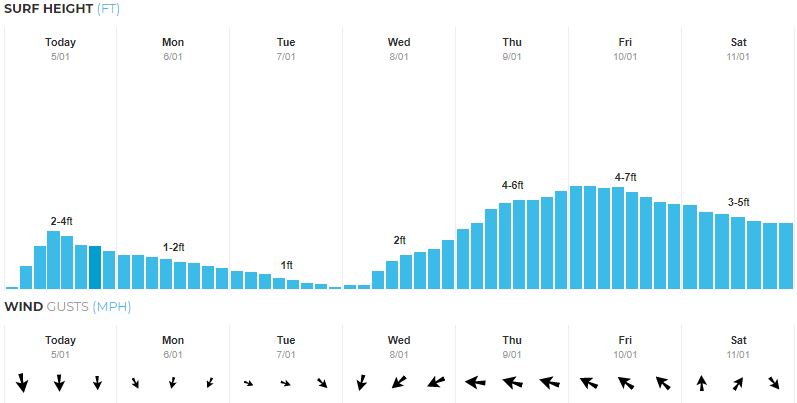 |
| Source: MagicSeaWeed.com |
TreasureGuide@comcast.net


