Showing posts with label increased surf. Show all posts

Sunday, January 20, 2019

1/20/2019 Report - Vero Coin Show Photos. Dug Reproduction Reale Example. Valuable Bottle Find. Bigger Surf Coming.


Written by the TreasureGuide for the exclusive use of treasurebeachesreport.blogspot.com.

One Display At the Vero Coin Show
I visited the coin show in Vero and saw a lot of familiar faces and talked to a lot of nice people, both beach-detectorists and coin collectors. 

Above is one of the display cases.  As you can see there were coins, but there were also artifacts.

They raffled some very nice items.

Below are some of the items that were on display and for sale.  

Gold Belt Piece From the Maravillas.
Navigational Instrument and Some Coins.


The show was put on by the Treasure Coast Coin Club that meets one Wednesday per month at IRRSC in Fort Pierce.

There was no admission fee, and there were hard-copy out-of-date numismatic magazines free for the taking.
  
---

A couple days ago I gave an excellent web site that tells how to identify fakes.  I mentioned that they are often of the wrong metal and have plating that may be pealing.  Here is an example of that.

Fake Eight-Reale
This is an exceptionally chunky fake.  It is made of copper or some copper alloy and was plated.  You can also see that the plating is wearing off.

If I correctly recall, I dug this one down around Jensen Beach some years ago.

The other side of the same fake is encrusted.

Sane Fake Eight-Reale Showing "COPY"

Fake or reproduction coins are supposed to have the word "COPY" on them, and they often do, but sometimes it is not easy to see.  In this case, the word is large and right in the middle of the coin.  The "COPY" is very obvious in this picture, but when you dig up a fake, it can be covered with sand, encrustation, or corroded so that you may not see it.  This one shows up well now, but I didn't see it when I was at the beach and it was still wet and had sand on it.  

Sometimes the "COPY" mark is intentionally small and not at all easy to see.  Sometimes it has been removed by nature and sometimes by man.

Pealing plating on an artifact does not necessarily mean the item is a fake.  Medallions and other artifacts that were plated can lose some of all of the original plating.

---


Bottle Finds by One of This Blog's Readers.
Included are a nice straight-side Coca Cola bottle from Lakeland that is valued at a few hundred dollars despite a lip chip.

The middle bottle is a very nice Hood's Sarsaparilla bottle from the late 1800s.

Remember, when beach conditions aren't great, there is always some place else to hunt and other things to find.  I'll show you more of those in the near future.

---

Source: MagicSeaWeed.com

We're having a west wind.  As you can see from the MagicSeaweed chart, on the Treasure Coast we're going to have an increase surf on Tuesday and Wednesday.  There is a chance of better detecting conditions, but I'm not expecting too much.  It will be worth checking out.

The tides now are big.  Tonight I think a lunar eclipse will begin after 9:30 or so.

Happy hunting,
TreasureGuide@comast.net


Tuesday, March 21, 2017

3/21/17 Report - Legendary Treasure Found In a River. Mystery Stuart Bottle Information Found. Still Up To Seven Foot Surf Predicted.


Written by the TreasureGuide for the exclusive use of treasurebeachesreport.blogspot.com.

A Few of the Thousands of Items Found.
Source: See link below.

CHENGDU, March 20 (Xinhua) -- A centuries-old legend that a vast booty of treasure belonging to the leader of a Chinese peasants uprising was lying at the bottom of a river has now been proven true.


After more than 10,000 items of gold and silver were recovered from the bottom of Minjiang River in Sichuan Province, archeologists confirmed Monday the tale of Zhang Xianzhong and his sunken treasure, dating back to the Ming Dynasty (1368-1644)...

Here is that link.

---

I finally got some information on the Stuart Bottling Works bottles that I've found.

In July 1913, James Elersly Weir, Jr., purchased a pitch pine wooden building owned by Joseph A. Lucas, a real estate developer, located on an isolated dirt road (Decker Street) south of Stuart; he had it converted into a bottling plant, Stuart Bottle Works. Soft drinks were bottled, sealed with large snap off caps and distributed in Stuart, Palm City, Jensen, Salerno, Hobe Sound, even to Fort Pierce and Jupiter. Weir only remained in Stuart a few years, joining family in West Palm Beach, in the plastering business and later, an auction house.

The bottling plant building was eventually owned by Ira L. Decker, who operated a concrete manufacturing business and was used primarily for storage. In the afternoon of Feb. 6, 1933, while Decker and local firemen were battling a brush fire nearby, the building caught fire. The wooden structure quickly went up in flames making it impossible for Ira to retrieve equipment, vehicles or machinery.

At least two bottles from the plant survive, clearly marked Stuart Bottling Works, one of which can be seen at the Stuart Heritage Museum.


The bottle is evidently older than I thought.  I thought it looked like a soda bottle.

Here is the link.

http://archive.tcpalm.com/news/historical-vignettes-some-of-martin-countys-firsts----part-2-ep-306511173-342350261.html

Thanks to Dean R. for the link.

--


Here are the MagicSeaWeed predictions for the Fort Pierce area.  Not too bad.  There is still a chance for something good to happen.

Unfortunately the tides are now pretty flat.  The wind has died down too.

Happy hunting,
TreasureGuide@comcast.net

Thursday, October 27, 2016

10/27/16 Report - Lots of Clad On Some Beaches. Rough Water Today. Australian Pines.


Written by the TreasureGuide for the exclusive use of treasurebeachesreport.blogspot.com.

Looking out the window this morning, it sure looked like a treasure day - cloudy and windy.  We're supposed to have a four to seven foot surf.  I hope we get some change in wind direction.  The tides are still high.  The high water will help at some locations, but I'm not expecting much in the way of old items.  The swell is too much from the East.  It would help if the water gets high enough to hit the dunes where the renourishment sand has been removed.

I dug a ton of modern coins this morning.  There are plenty of those at the tourist beaches.  I want to talk about strategies but don't have time to do it today.

I received the following email and pictures from CladKing.

     ...Spent a couple days camped at  Sebastian Inlet State Park!  No-see-ums not withstanding, it was a decent stay! I only wish the state would spend some money on trees and maintenance! It was much nicer before they cut down all the Australian pines! (Been a long time since l camped there!)  Spent time fishing and detecting!   Bonsteel was still closed. Went to Amber Sands and detected up past Mclarty a good way into park! ( Asked ranger where permissible to detect of course; high water mark to water only) Found iron, and fishing tackle, and not much else on mushy sand! And one message in a bottle, which had only been out one day, so I returned it to the water for a second chance! Also hit Wabasso and Disney Vero, but again lots of iron and few finds! In my defense I was using a new coil, sooo!
   Sounds like you did much better in todays post! (Experience and local knowledge helps, haha) I did much better fishing than detecting; experience favored me on this one! Snook bite was awsome!! Also Redfish! Anyway, here's a couple pics near Mclarty, and Bonsteel ( Really!! Closed for that!!)


Pictures Of McClarty and Bon Steel Beaches by CladKing.


Thanks for the report CladKing!

Its always fun to camp and detect new areas.

I still don't know why so many beaches were closed for so long.  I have no good explanation.

The Australian Pine is not native and is considered to be an invasive pest.  Here is a summary from the Australian Pine Task Force.

Australian pine (Casuarina equisetifolia) is a fast growing tree native to Australia, Southeast Asia, India, Bangladesh and the Pacific Islands that has been introduced to tropical areas throughout the world as an ornamental; to stabilize sand dunes; to form windbreaks around canals, roads, houses, and agricultural fields; and for reforestation due to its capacity to thrive in poor and saline soils. As a result of these intentional introductions, Australian pine has become a highly invasive species and is found along most humid tropical or sub-tropical beaches around the world. In Florida, Australian pine occurs predominantly south of Orlando as it is sensitive to extended periods of freezing temperatures. Australian pine produces copious amounts of wind and water dispersed seeds and is able to colonize a wide variety of habitats including coastal areas, pinelands, disturbed sites and higher areas of elevation in the Everglades. The fast growth, prolific seeding and thick litter accumulation of Australian pine impedes the establishment of native plant species and their associated herbivores, disrupting natural processes. Australian pine readily establishes on sandy shores which leads to increased beach erosion and interference with the nesting of endangered sea turtles and crocodiles. 

I don't see how it can cause increased erosion.  It does in some cases make erosion more apparent, but I would think it actually has a stabilizing effect overall.

Here is the link.

http://www.fleppc.org/Manage_Plans/Casuarinamgmntplan_FINAL-05-13-13.pdf

I think most of the Australian pines have been removed from the beaches.  There are still a few though.

Happy hunting,
TreasureGuide@comcast.net

Saturday, April 16, 2016

4/16/16 Report - Surf Increasing This Weekend. Beach Photos. Toy Cannon Soldier Art.


Written by the TreasureGuide for the exclusive use of treasurebeachesreport.blogspot.com.


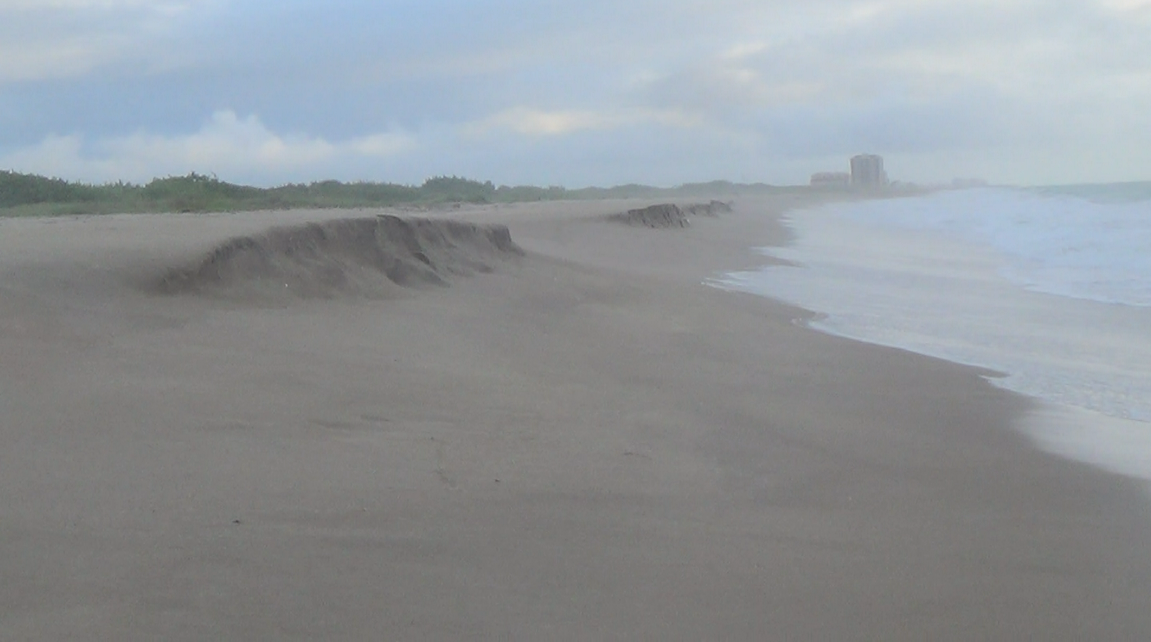
Frederick Douglas Beach This Morning.


Walton Rocks Beach This Morning.
This morning the wind was coming from the east, and I went out to see if anything was starting to happen on the beaches.  I checked a couple of beaches on South Hutchinson Island, and neither had changed much.  If you go back and look at the last time I posted these beaches, you'll see they look about the same.

The surf is supposed to increase Sunday and Monday.  I'll be watching to see what is happening.

--- 


Mystery Object Submitted by John C.

I posted this mystery object some time ago.  I didn't receive any guesses.  My thought is that it is a lead melt.  Whether it was melted accidently or intentionally is unknown.  The chips or material on the bottom might be accidental too.  Other than that I have no answer.

Melted lead is common.  Lead was carried and made into musket balls and was used for a wide variety of other uses.  Musket balls pounded or melted to be used for other things too.


---

I posted the following before but thought it would be worth repeating today.

Toy Lead Cannon
From Old Sedwick Auction.


This toy lead cannon is from a mid-1800s shipwreck The reason it caught my attention is that I once found a similar lead item. For a long time I thought it was a finial, but now I am convinced that it is probably a soldier-art cannon.


The one I found (below) was found near an 18th century cannon emplacement on Pigeon Island.

Carved 18th Century Soldier-Art Cannon

It is always fun to metal detect new places when you travel. It was a lot easier to travel with a metal detector before the 911 tragedy.

I would take my detector with me as carry-on luggage. Security would look at it, ask me what it was, I'd tell them, they'd scratch their heads and I'd walk on the plane with it.

St. Lucia is one island I visited a few times. On a couple of occasions I explored Pigeon Island, which is now connected to St. Lucia by a causeway. 

There was a lot of history on the ground to see. There were a lot of historic ruins, and shards all over the place. I even eye-balled a grapeshot at the base of tree.

I left the grapeshot where it was. If it was taken on the plane and considered an explosive device, which I suppose would have been the case, the fine at the time, if I remember correctly, would have been something like $250,000. I wasn't going to chance anything like that.

Here is a little of the history of the Pigeon Island. 

Pigeon Island was first occupied by the Amerindians, mainly Caribs. The island was later occupied by pirates whose leader was a Norman Captain called Francois Le Clerc. He had a wooden leg and was known to the French as Jambe de Bois. The French who owned the island in 1778 declared war on the British, who retaliated by attacking them in Saint Lucia and capturing the island. The British then built a Naval Base at Gros-Islet Bay, heavily fortifying Pigeon Island. From there they were able to monitor the French fleet in Martinique which resulted in the defeat of the French at the Battle of the Saints in 1782. Pigeon Island was therefore a key factor in the Battles between the British and the French. In 1909 a whaling station was established at Pigeon Island.

That came from the following web site. 

http://search.aol.com/aol/search?q=st+lucia+pigeon+island+le+clerc&s_it=tb50-ie-aolmail-ab-en-us

If you look at the photos of the island, I think you will see that it is an interesting looking place.

---

The salvage vessel Dare is deploying a hovering autonomous underwater vehicle equipped with an EM detector to scan the deep hard-packed mud and clay in search of new targets south of the Atocha's main pile.

---

The surf is supposed to be up to 4 - 6 feet today and larger tomorrow.

Happy hunting,
TreasureGuide@comcast.net