Showing posts with label turquoise. Show all posts

Sunday, July 28, 2019

7/28/19 Report - 200 Pounds of Found Ancient Coins. Space Debris. Finger Rings From Spanish Colonial Sites: Some Generalities.


Written by the Treasureguide for the exclusive use of treasurebeachesreport.blogspot.com.

Source: See Vietnamplus link below.

Over two-hundred pounds of ancient coins (some shown above) were found and confiscated by police.  They date back to 118 BC, but also included coins made between 621 and 1233.

Here is the link.

https://en.vietnamplus.vn/over-100kg-of-ancient-coins-discovered-in-yen-bai/156763.vnp

---
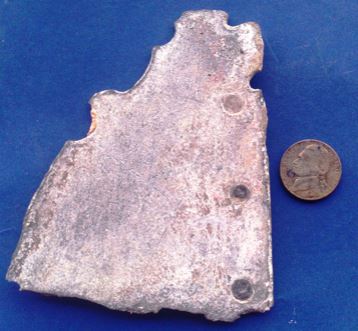

Jim F. found the above item and sent the following email.

Hi TG.

Was out detecting the beach up here in Cocoa a few days ago and got a whopping coin signal on the beach. Came up a 12-45, 12-47 on my Minelab E-Trac and was a good repeatable target...the kind you always dig no matter what. I was surprised when what came up was a very light piece of metal about 3-inches square, with some flush aerospace-type rivets installed along one side and melted carbon fiber on the back. A rather jagged piece of what I think is a piece of Aluminum-Lithium aeroshell from a Space-X Falcon 9 spacecraft. The ship was aborted in 2015 at 200,000 feet running a bit over Mach 2. Hundreds of thousands of pieces were blown to the four winds almost directly over Cape Canaveral. I've found bent and twisted fragments of Berylium Copper (used in rocket engine plumbing and cooling) when the tide is right. Not long ago the beach was "re-nourished" with tons of offshore sand, and I think this may have come from deeper waters. Never know what you are going to find at the beach. I think a lot of people would have thrown this away, not knowing what it really is.Like you always say, don't toss something away until you are really sure what it is! I found the clad nickle used for scale purposed not far from it...convenient.

Cheers!

Thanks Jim.  Nice find!

---

Earlier this year I mentioned the Orlando KellyCo store closing.  I just got a KellyCo brochure in the mail.  It seems they are now located in Knoxville TN.


You can find them online.

---

I've mentioned this before, but I often receive photos of old silver rings and people wonder if they might be from a shipwreck.  As I've said more than once, one of the very top long-time treasure salvage guys said that a silver rings have not been found on 1715 Fleet wreck sites.  Gold rings are not unusual from the same wrecks, as you undoubtedly know.

Silver rings have been found in good numbers on 18th century Spanish colonial archaeological sites though.  The lack of silver rings on the wrecks seems very strange to me.  Why would silver rings be fairly common from 18th century Spanish colonial sites, but not found on the 1715 Fleet wrecks?  I have a few theories, but get into my theories now.

I was looking at Kathleen Deagan's book, Artifacts of the Spanish Colonial Colonies of Florida and the Caribbean, 1500 - 1800, Volume 2, and wanted to post some interesting statements about jewelry from Spanish colonial archaeological sites.  Here it is.

Apart from glass beads, finger rings are the most frequently reported jewelry items on Spanish Colonial sites.  Simple bands of glass, jet, or metal (anillos) and rings with settings (sortijas) are present throughout the colonial period.  Precious finger rings of the sixteenth century were carefully sculpted and enameled, with high, decorated box mounts (Bury, 1984:7): however, this was not the case with the early finger rings from archaeological sites, which tend to be quite humble in both design and material.


You might recall that yesterday I mentioned finding a gold enameled ring on a Treasure Coast beach. At the time I didn't think of it possibly being Spanish colonial and didn't pay much attention to it.

Deagan also mentions that the earlier rings from Spanish colonial sites were humble in both design and material.  Here is a sample of some of those shown in the Deagan book.

Source: Deagan book cited above.

That isn't the best picture, but I think you can tell that they are rings are not really very different from many inexpensive rings that you might find from later centuries.   If you would find one on a beach, you might not think much of it.  There is very little to suggest that those rings are centuries old.

Here is one of many that I could have selected that isn't very different from those shown above.  In fact it is similar to the one on the extreme right in the photo above.  (I know you can't see that photo very well.  Sorry about that.)

Silver Turquoise Ring.
The turquoise is discolored (I mentioned something about how that can happen yesterday.).  In this case the discoloration is due partly to patina.

But this ring provides some good information if you look inside.  You can clearly read the "STERLING" mark.

At first glance I would take this ring as possibly being from the 1970s, but it is really not very different in appearance from rings made centuries ago.

I might be able to make out the other mark if I do some cleaning.

Sterling Mark on Ring Shown Above.

On the other hand, the very corroded silver band shown below shows no markings at all.  That could be due to the corrosion, but maybe it never had any markings.

Corroded Silver Ring With No Identifiable Marks Found on Treasure Coast.

I'll have more examples related to this topic in the future.

---

Source: nhc.noaa.gov

We now have one system with a 10% chance of becoming a cyclone in the next 48 hours.

The surf is still running one to two feet on the Treasure Coast.

Happy hunting,
TreasureGuide@comcast.net


Saturday, July 27, 2019

7/27/19 Report - Mystery Item Find. Enameling and Cloisonne. Assessing Possible Age of Items.


Written by the TreasureGuide for the exclusive use of treasurebeachesreport.blogspot.com.

Domed Cloisonné Button.
Measures 5/8 inch diameter.

Here is a dug item.  I think it might be a cloisonné button, but not sure.  What do you think?

Below is the back of the same item.


Back of Same Button.

There is a gold gilt on the back, which has been mostly worn off.  The shank has also been lost.

On the front, you can see where some of the enamel has come off.

Send me your thoughts.

---

I refined and improved my list of factors that can help determine the age of a dug item.

Here is my new revised list.

1. Stamps or markings   
        a. Country name or references.  
        b. Legal statement  
        c. Maker's mark  
        d. Marks of composition or purity 
        e. Owner's mark  
        f. Patent or registration marks   
        g. Retailer's name   
        h. Statement of allowed, proper or customary use 
        I. Year or date   
2. Shape
        a. Designs or symbols associated with a time period or culture.   
        b. Image of real objects or events of known date.
        c. Exact or similar example from a particular time period
3. Corrosion, weathering, aging    
4. Context or stratigraphy  
5. Known history of the area where found   
6. Usage wear 
7. Signs of manufacturing process.   
8. Hi-tech scientific testing ie. radiocarbon

Some factors or stronger than others.  By that I mean they provide more confidence or a specific date or narrow date range.

In the above listing stamps and markings are strong factors, for example, while corrosion is a weak factor that only provides a very general idea of the possible age.

Even though stamps and marks are generally relative strong factors, they can be fake, faint, incorrect or incorrectly interpreted.

Factors also intereact.  For example, corrosion might provide some information that an item has a little age, but at the same time removes or obscures stamps or marks.

Some cases are simple and clear.  A single mark might be considered highly definitive, while other cases involve multiple factors and are still not conclusive.

I once posted the silver bracelet shown below.

One additional thing that fits in with factor three is the aging of stones.  Turquoise for example changes color over time, but it probably takes an expert to observe that change.

Here are some of the factors.  The metal is silver, which is no help.  There is a lot of corrosion.  It was found on a beach where other old shipwreck items have been found.  There does not appear to be much use from wear.  Although there is a lot of corrosion, the close-ups of the hands do not appear to show a lot of wear.  Similar hands are similar to those from old shipwreck jewelry, but a photo of a extremely similar modern silver bracelet was found (thanks to Mitch K.).

A few factors can be observed, but inconclusively.

Context can be a strong factor, but it isn't in this case because of the dynamic beach environment and possibility of items from various age periods showing up at the same location.

The amount of corrosion shows that the item is not brand new, but it doesn't take long for items to corrode in a salt water environment. ( I always thought about doing experiments to see how long it takes silver to corrode in salt water, but never did it. )

And although the hands are similar from to those of older periods, they are also common on modern items, and more impressive is the near exact match with a specific example of a modern item.

Overall, the very good match with a modern bracelet seems to carry the most weight.  That, however could be a design that has been used for centuries, but we have no evidence of that.

I said factors can interact.  Here is one example.  Notice that I did not mention stamps or markings, which can be very strong and precise factors.  None were found on this item.  I searched for stamps or marks using a microscope, but it is possible that the corrosion obscured them if they were ever there.  You would certainly expect some type of silver mark on a modern retail piece, yet none was found.  Corrosion can, as you know, obscure stamps or marks.

The band seems too thin and round for most stamps or marks.  Any mark on the thin band would have to be very small, so I did a little additional cleaning of the ands, which to me seemed to be the most likely area for any stamps or marks.  I still found none.  After cleaning the hands and inspecting them closely under magnification, I still found on evidence of any stamps or marks.

I think the checklist can be helpful as it is, but I'll continue to try to improve it.  It might be helpful to define the strength and limits of the various factors.

There can still a good bit of subjectivity involved in reaching a conclusion.  I don't think I'll be able to remove that.  It might not even be desirable to do so.

---

Did you know - Turquoise is a compound that includes metals such as aluminum, copper or iron. Water and oil can cause some of these metals to oxidize, or in other words rust. As a result of oxidation, the stones can actually change color.  Blue turquoise that contains copper can change from a light blue to a dark green.

Household chemicals and lotions can also cause turquoise to change color.

---

First used on small pieces of jewelry, enamel is not paint but a thin coat of glass. Once applied to a metal and heated to high temperatures, will melt and become fused to the metal. This is similar to how ceramic glazes adhere to pottery. Pure gold, silver and copper were traditionally the only metals used in the enameling process...

Cloisonné: Enameling was practiced as early as the 5th century B.C. by the ancient Greeks, and it was the Greeks who developed the most well-known technique of enameling, cloisonné. The technique of cloisonné enamel is produced by by soldering flat metal strips to the surface of the piece, creating a groove. These are then filled with the enamel, and the piece is then fired until the enamel fuses. When cooled, the surface of the object is polished. Modern Chinese cloisonné is probably the most well known however, Chinese cloisonné ware isn’t the only collectable or desirable form of cloisonné. Russian cloisonné from the Tsarist era is also highly prized by collectors...


Distinguishing between antique and modern enamel can be a very complex process. Even experts can be led astray, and without a trained eye, evaluating these pieces is difficult. An antique Chinese vase was sold recently by Potburys, a UK auction house, for 31,000 pounds. Although it was first catalogued as 19th century, specialists later recognised the vase as a rare survivor from the reign of the emperor Qianlong...


Here is the link.

https://sarasotaantiquebuyers.com/how-to-identify-collectible-enamel/

That reminds of the cloisonné ring I once found just north of Turtle Trail.  The beauty of it struck me.  I always liked cloisonné, but  at the time I didn't think it could possibly be old.  I thought cloisonné was a more modern technique.  I didn't learn until years later that it could have possibly been from a shipwreck.

---


Let me know what you think of the mystery item or my list of factors.

There is currently no significant weather or changes in beach conditions.

Happy hunting,
Treasureguide@comcast.net

Saturday, March 28, 2015

3/28/15 Report - Turquoise Jewelry. Silver Prices. 90 Silver Coins Found In Field. Some Real 18th Century Works of Art.


Written by the TreasureGuide for the exclusive use of treasurebeachesreport.BlogSpot.com.

Styles come and go, and so do the types of things you will find.  Back a few decades ago silver and turquoise jewelry was very popular and there was a lot of it to be found.  There was a time when you would find a silver and turquoise piece on almost every hunt.

Here are a couple of examples of old water finds.  Both were found back in the eighties, I think, and both had been in the water a number of years before being found.

Here is what the March 25 Kovels Komment said.

Turquoise, the semi-precious stone, has long been popular on American Indian jewelry. Turquoise jewelry is now popular with designers of expensive jewelry and a Tiffany necklace of turquoise stones worn by Cate Blanchett to the Academy Awards was newsworthy. Turquoise is found when mining copper. Many mining companies have closed their turquoise production since 2012 to concentrate on the more valuable copper. The best stones doubled in price last year. Designers of gold and turquoise jewelry use stones without matrix, the black lines that mark the stone. Vintage Indian silver jewelry used more common turquoise with lines. Arab customers also prefer gold jewelry with the matrix because it is said to absorb evil and protect the owner. All real turquoise jewelry is going up in price. Beware, there are many good ceramic and plastic copies of the natural stone that are made to look like the plain blue or the matrix marked stones. There are also inferior soft stones that are artificially colored.

The ring in the top photo is broken and discolored, as found.  It is silver, though, and weighs .86 troy ounces.

The second ring is silver and turquoise and discolored.   Just two of many examples of old silver finds.

Silver will discolor when stored in contact with some other metals.  Be careful to store your better silver so that it is not touching any lesser metal.  The same thing can happen if a silver piece is on a piece of iron or something while in salt water.
Silver Prices


There have been two big spikes in silver prices in the last fifty years.  One was back in the seventies when the Hunt brothers monopolized the silver market and manipulated prices.  The other was back just a few years ago.


-----

Want to marvel at some real 18th Century treasures?  These are remarkable works or art.

http://www.sothebys.com/en/news-video/videos/2015/03/swiss-mechanical-marvels.html

------

A man stumbled upon an earthen jar with about 90 silver coins from the 16th-18th century while plowing a field with a tractor in the town of Zahari Stoyanovo, Popovo Municipality, in Northeastern Bulgaria.

Here is the link.

http://archaeologyinbulgaria.com/2015/03/26/bulgarian-man-finds-silver-treasure-of-western-european-ottoman-coins-while-plowing-field/

-------

A month or so ago I told you about how you can have your own DNA tested for about $100.  Here is a genetic study that used DNA testing to identify major migration patterns.

http://www.ox.ac.uk/news/2015-03-24-complex-genetic-ancestry-americans-uncovered-0

----

A nice cold front came through bringing all that rain and some nice cool air.  The surf is only around two or three feet though.  The tides are moderate now.

Next Sunday they are predicting up to an eight foot surf.  I'd give that less than a ten percent chance o actually happening.  I hope it does.  We sure need it.

Happy hunting,
TreasureGuide@comcast.net