Showing posts with label pot. Show all posts

Saturday, February 29, 2020

2/29/20 Report - A Couple Mystery Finds: One Copper and One Maybe Silver. Also A Newer Find.


Written by the TreasureGuide for the exclusive use of treasurebeachesreport.blogspot.com.

2-inch Long Pierce of Copper With Rolled Edge.
Find and photo by Bill M.
First, here is an item found just Thursday.  Bill dug this piece of copper Thursday on one of the Treasure Coast wreck beaches.

People often think first of sheathing when they find a piece of copper on a wreck beach, but copper was a common metal used for a variety of things.  For example, copper kettle parts and patches are among the most common artifacts found at 18th century archaeological sites.  Below are just some of the examples from one site described by Timothy McGuire in his book, Recovered Colonial and Revolutionary War Artifacts (Leprechaun Press, 2013).


Copper Pieces From an 18th Century Archaeological Site Identified as Kettle Parts and Patches
Source:  Recovered Colonial and Revolutionary War Artifacts, by Timothy J. McGuire, Leprechaun Books, 2013.
There are more pages of copper pieces described as kettle parts in the same book.

Pots and kettles were patched over and over again until the object was unrepairable, and then the pieces would be repurposed or finally discarded.

The following photo shows the rolled seam on an old copper kettle that I once found.

Seam on Old Copper Kettle.

I'm  thinking that the piece found by Bill M. could be from something like that with the seam torn apart.

Flat thin pieces of metal can often be found near the surface.  Shape is one characteristic that is seldom mentioned when it comes to how things move on a beach.  People tend to think mostly of density.

Here is a web site that discusses how to determine the age of antique copperware.

https://frenchkitchenantiques.com/copper

Look for signs hand-hammering, dovetailing and rivets.

Here is more on rivets.

Rivets


Hand hammered copper rivets

To attach the iron or brass handles to copper vessels rivets were used for making strong joints. Rivets could be made from a variety of materials, but the most common ones are made of copper.

These would be carefully hammered into a round shape to fit the hole. Light hammer marks can often be seen on the surface of the rivet and are a good way of telling modern and antique kitchenware apart.
---

I posted the mystery find shown below a day or two after digging it on 1/22 and asked for opinions.

Mystery Find.
There are holes on each end and the ends are flat while the middle bridge is bowed up.  It is shaped very much like a pull handle, but very small.

Among the excellent thoughts, DJ thought it might be a hasp and provided the following photo that shows a hasp, although a more ornate and perhaps larger one.

Hasp Example
Submitted by DJ
That could be it.  Perhaps to a small box or something.  I don't know.

---

A couple weeks ago Joe D. was hunting a park and found the 40% silver Kennedy half shown below.

Silver Half
Find and photo by Joe D.


Joe mentioned it was found in a junky area and didn't give a great signal.

Congratulations Joe.

--- --- 

Joe D. sent this photo of sand be added to the beach just north of the Seagrape Trail stairs.  It looks like the main purpose is to protect the front yards and buildings of the beach-side property owners.


Sand Added To Portect Front Yards of Beach Side Buildings.
Photo by DJ

---

With the recent offshore winds and small surf, you might be able to find some nice spots for a little low-tide hunting.  No big surf is expected for a while.

I still have a variety of topics to discuss.  I plan on doing more on beach dynamics.  Several people told me they'd like to see more on that.   Also more miscellaneous recent finds, and other topics.

Enjoy the cool weather,
TreasureGuide@comcast.net


https://www.seawear.com/claddagh-story-legend.html


Friday, February 14, 2020

2/14/20 Report - Surprises! Treasure in Jar of Clay. Earthquake Footprints. Encrusted Bits. Increasing Surf.


Written by the TreasureGuide for the exclusive use of treasurebeachesreport.blogspot.com.

Treasure From a Clay Jar.
Source: English.tau.ac.il web site (See link below)


We’re always told that the journey is just as important as the destination. This is true in many aspects of life, but perhaps nowhere as much as in scientific research. Flexibility, curiosity, and attention to detail can lead to a treasure you weren’t even expecting to find. TAU’s scientists talk about research that began one way and ended another, thanks to a few surprises along the way...

That is the beginning of an article in the Tel Avive University News entitled Recalculating: when research starts one way and ends another.   It is about surprise discoveries that change the direction of the research.

Continuing with the first story in the article...

A treasure in a pot

A team of archeologists on an excavation mission found that sometimes the appearance of a clay pot is no indication of its contents. "On one of the excavations in Megiddo, we removed the partitions separating the different sections of the dig and found a whole clay pot full of dirt," says Naama Walzer, a doctoral student in the Department of Archaeology and Early Eastern Cultures at Tel Aviv University.


"We packed it up and planned to send it to a molecular residue lab to find out what used to be stored inside of this pot, which we dated to around 1100 BCE." The pot was stored in an office, but after a while it became clear that preservation in that area of the excavation wasn’t up to standard, so the team decided to empty the pot, in a controlled way, and poured out its contents on the table. "We weren’t expecting to find what ended up being inside: a treasure trove of jewelry, considered one of the greatest troves found in Israel from the Biblical period!"   (See photo at top of this post.)

Among other things the trove contained nine large earrings and a seal ring, over a thousand small gold beads, and silver necklaces and jewelry.  "This is how we found the big treasure of area H, which is now part of the permanent exhibition, at the Israel Museum in Jerusalem," concludes Walzer.

That is the first story of several interesting stories found in that article.  Below is the link for the rest of the article.

https://english.tau.ac.il/news/recalculating\


If you look at the earrings found in the over three-thousand year-old jar, could you tell that they are not modern or how old they are?   They aren't really that much different from modern earrings.  That is how difficult it can be to identify the age of an item by just looking at the form of the object.  Those types of hooks worked then and would still work today.

Someone once said that he learned everything he knew from six fellows: Who, What, Where, When, Why and How.  So here is one question - Why nine earrings.  Seems an odd number - in more ways than one.  Loss?  Extra Earring?  Only wore one at a time?  Just a grouping?  What?  Who knows?

Written around 59AD by Paul (who, by the way, was a shipwreck survivor), 2 Corinthians 4:7-9, reads, But we have this treasure in jars of clay to show that this all-surpassing power is from God and not from us. 8We are hard pressed on every side, but not crushed; perplexed, but not in despair; 9persecuted, but not abandoned; struck down, but not destroyed.   He was evidently familiar with treasures in jars of clay and saw it as a suitable metaphor.

You might find the second story in the article interesting too.  In the picture below, notice the swirly sedimentary layers.  It is at the bottom of the Dead Sea (lowest place on earth that is dry land) and the swirls, it seems, were created by earthquakes hundreds of thousands of years ago.


You might enjoy reading that story too.

---


I was picking up some small bits of metal when I was finding cobs a few weeks ago, and said I was going to take a closer look at some of those to try to figure out what they are.  Here are a couple of small encrusted bits that I'll be cleaning.


The one above seems to be as heavy as lead.  I wouldn't be surprised if that is what it is.


This one is flatter and hard to compare but doesn't feel as dense.

Both have a brown/orange encrustation.

They are being cleaned now.

---


Sourcea; MagicSeaWeed.com

As you can see, the surf will be building today up to around six feet.


Happy Valentine's Day,
TreasureGuide@comcast.net

Thursday, August 15, 2019

8/15/19 Report - Thoughts on Mystery Find. Metal Detector Conductivity Numbers and Object Identification.


Written by the TreasureGuide for the exclusive use of the treasurebeachesreport.blogspot.com.


I posted this item found by Jerry P. several days ago.  Jerry wondered what it might be.  He wondered if it might be an ink well, but I didn't mention that in my post because I didn't want to influence you.

Someone said they wish there was an object for comparison in the photo.  That might have helped.  Jerry did say that it is about three inches around.  If by that he was referring to the outside circumference of the object, it is small.  To give you some perpective, a US quarter is very close to three inches around.

I got a lot of different ideas on this object. Mitch K., who has been very accurate with his mystery item IDs, said it is probably a pet urn.

DJ thought since bronze is non-magnetic it might have been for a compass. He also thought maybe an inkwell.

Joe D. thought it would be too heavy for a snuff box, and thought maybe it held a clock or instrument.

On the ink well idea - I think that is a possibility, but if three inches is the outside circumference, it would be smaller than most. A three inch diameter would be more typical for an ink well. A typical ink well might have an opening with a three inch circumference but the pot would typically be larger than that.

Below is an 18th century ink well set that I found online. Motice that the pots are very similar to Jerry's item.


Below is a pewter pet urn.  Pet cremation urns come in a variety of sizes and shapes and are made of various materials.

Pet Urn.

Being an isolated find and having such a common shape, Jerry's item is difficult to identify.

Here, for another example, is a salt cellar.  It definitely shows some similarities to Jerry's object.

Salt Cellar.

Unfortunately I don't think we can say what Jerry's object is, although we have some good ideas for Jerry to consider.

One thing that I noticed is the clean uncorroded hinge on the object.  That doesn't seem to suggest a lot of age to me.  I'd expect to see more corrosion from a very old item coming out of the sea.

The owner of the object, knowing more about the circumstances of the find and being able to hold it, has the best chance of coming up with an ID.  He is now armed with a variety of thoughts on the subject.  Perhaps a mark or something will show up to provide additional evidence.

---

As you know I have just started to explore the Equinox metal detector.  This morning I decided to do a few conductivity tests.  I used the same test area I've used many times before. The area is subject to various sources of electrical interference.  In fact today I started out in multi-frequency mode, but then it became noisy and I switched to 15kz, which was nice and quiet.

First I tested a zinc penny and a copper penny.  The zinc penny generally came up as 21 - 22 while the copper penny showed a conductivity of 25 - 26.

Then I tested a clad dime and a silver Roosevelt dime.  The clad dime showed very slightly higher numbers than the silver dime.  Both dimes were in the 24 - 27 range.  The silver dime might have been about one point lower on average.

Next I tested a clad aquarter and a silver quarter.  The clad quarter was around 28 - 29, and the silver quarter a touch higher, at 29 - 30.

The silver versus clad coin numbers in this test were too close together for me to draw any conclusions.  The zinc penny rang up lowest, and the quarter numbers were slightly higher than the dime numbers, while the copper penny was not very different from the dimes.

I also compared a 1967 to a 1964 half dollar.  As you might expect there was very little difference.  They were in the 33 - 35 range.

Then I checked a Morgan dollar, which showed in the 35 - 37 range.  So pretty consistently, the larger denomination coins showed higher numbers than the smaller coins even though there were differences in composition.

I also tested the two rings that I showed in recent posts.  One was the small silver turquoise ring and the other the small alloy Claddagh ring.  Both gave conductivity numbers of 24.

This wasn't an extensive or even good test.  I just wanted to get some ideas on how the specific conductivity numbers might provide helpful information, so it is too early for me to draw many conclusions.

The conductivity numbers definitely help some.  For example, you can certainly tell the difference between iron and most coins, for example, but when it comes to making more precise judgements, like the difference between clad or silver coins, I'm not so sure you can do that reliably using just the conductivity readout.  It does look like you will get a different reading for zinc and copper pennies.

People often conduct their metal detector tests with US coins, but I don't know how many people are out there looking for US coins.  I think most people are more interested in finding gold jewelry, old artifacts or other types of things.  Coins do provide convenient test objects, but one thing you probably really want to know is how your metal detector responds to the types of objects that you most want to find.

If you want to find gold jewelry, gold nuggets, silver reales, or old artifacts, the best test objects are the things most like those you want to find.  If you are after gold rings, for example, be sure to test your metal detector on a variety of types and sizes of gold rings.

Many of us hunt a variety of types of objects.  That means that you should become familiar with how your detetor responds to a wide variety of types of objects.  Want to find a Rolex watch?  I'd suggest testing your detector on watches.

---

One person hoped that Glen would keep us informed about any progress he makes on his mystery object, for example if he cleans it or gets it x-rayed or finds anything else that might be related.   When people contribute their ideas they are interested and have a little investment in an object, they would like to know what happens next.  When I take the time to answer a question for someone, I hope they let me know of any additional developments.


Expect a few more days of calm surf.  There are not storms forming yet.

Happy hunting,
TreasureGuide@comcast.net


Sunday, August 11, 2019

8/11/19 Report - Two Finds for ID. One From Treasure Shores and One From the Gulf. Your Help Needed.


Written by the TreasureGuide for the exclusive use of treasurebeachesreport.blogspot.com.

Unidentified Underwater Find.
Find and photo by Glen S.
You could possibly help find a shipwreck if you can identify this find.  As you can see below, it is slightly less than one and a half feet long.

Here is an email I received from Glen s.

I have been searching for a shipwreck over here on the west coast of Florida that L.Frank Hudson gave a general location for in one of his books. Today I was metal detecting in the water offshore and found a strange iron item and some lead sheeting about a foot under the sand. Can anyone help me identify the item? Could this be part of the ship's rigging? I've attached pictures of the items. The iron piece weighs 26.6 pounds. 

Thanks.

Here are more pictures of the item and the small piece of lead sheeting.

Two More Views of the Object Found by Glen S.


Small Piece of Lead Sheeting Found With Other Object.
Find and photos by Glen S.
  Any and all thoughts and opinions on the possible use or identify of the item are appreciated.

Thanks in advance.

---

Small Bronze Pot Found by Jerry S.
Photos by Jerry S.


Here is another find for ID.  Jerry P. found it last summer near the south end of Treasure Shores beach where salvage boats were working just offshore.

Here is a bit of what Jerry said.

If you hunt long enough you will have a jar, cigar box, shoe box or in my case a large rubbermaid tote full of mystery objects... 

...sometimes an object becomes a clue and remembering where you found it is key to finding something valuable. If you don’t know don't throw and remember where you found it. Here is a mystery item from my tote...

There are no markings on it, it’s darn heavy and it’s just under 3 inches around. 


Jerry thought it might be bronze.  And as he said, just under three inches around and heavy.

It looks like maybe a lid was once attached.

He had an idea what he thought it might be, but I want to get your opinions before telling you what Jerry or I think because I want YOUR opinions.

Again, all thoughts and opinions are appreciated.

Thanks in advance.


---

It has been hot, but the water has been fine.  Now the surf is only one foot or less and that is predicted for the next week or so.

There are no new weather systems on the National Hurricane Center map.

Let me know what you think of both of the objects for ID today.

Happy hunting
TreasureGuide@comcast.net

Saturday, August 18, 2018

8/18/18 Report - 260,00 Coins Buried in a Large Pot. Vintage or Antique Snuff Box Currency Album.


Written by the TreasureGuide for the exclusive use of treasurebeachesreport.blogspot.com.

260,000 Coins Buried in a Jar.
Source: See link below.
The treasure was buried 6.5 feet (2 meters) below ground and was likely placed there to save the samurai's riches, as it was a troubled period in Japan's history. Over the course of the 15th century, civil war broke out as the Muromachi shogunate was under attack. This was a period where the Emperor was relatively weak, with military dictators known as shoguns leading the country...
For now, 70 of the coins have been examined. These coins were looped on a string and include 19 different coins from China and different areas of Japan. It's thought that all of the coins—which have holes in the center—would have been strung together on a rope before being added to the jar. Based on the coins looked at so far, researchers believe the jar would have been buried at some point after the second half of the 15th century...
Here is the link for more about that.


Thanks to SuperRick for that link.


-----

Yesterday I mentioned that sometimes containers are as nice as the coins or whatever else you might find in them.  Here is one of that appears to have some age to it.

Vintage or Antique Snuff Box.
The handle of flip has some nice engraving that reads "La Bretonne."  That refers to Britanny.

It appears to be handmade and has some mother of pearl inlay.


Same Box Opened.

The box appears to be carved from a single piece of wood.

I found similar boxes on ebay that were listed for $75 to $90.

---

Here is a handy item that I recently purchased.  It is called a currency album.

It is a good way to store your silver certificates or collectible paper money.


It has clear plastic holders inside that makes it easy to view your bills without having to remove  them.


Really good way to store collectible bills.

---

Happy hunting,
TreasureGuide@comcast.net


Monday, February 22, 2016

2/22/16 Report - Pottery: Whole Vessel and Small Piece.


Written by the Treasureguide for the exclusive use of treasurebeachesreport.blogspot.com.


Nice Old Conserved Pot.

A few days ago I was talking about artifacts as being more than objects.  I was talking about how there is always a story behind an object.  And it is a detailed and often personal story.

Who made this pot?  Why?  Who used it?  And how did it end up where it was found?

Those are all good questions, and I'm sure the answers would be interesting.  Unfortunately we can't answer those questions in this case, but we can start down the path.

One nice thing about this item you can see the imprint of the fingers or hands of the person who made it.  Those markings were preserved in the clay when it was made.

This particular pot is about thirteen inches high.

This pot was formed on a wheel by hand.  Notice the grooves around the sides.  You can also see the grooves inside the pot.


Bottom of Same Pitcher.
You can see that this area near the bottom has deteriorated some.

Tools were used on some pottery like this, but in this case, it looks like it was formed by hand.

Marken, in his book on shipwreck pottery, shows a number of olive jars with shoulders that were smoothed over.  The grooves were not apparent on the shoulders even though they were on the rest of the jar. 

A big part of it is knowing where an item was found.   

Put together whatever facts you can to narrow it down and then use your imagination.  After that enjoy doing some research.

---

Sometimes you don't have the entire artifact.  Pots are fragile and if you see something washed up onto a beach, it would likely just be a sherd.

Not all sherds are the same.  Some provide more information than others.  And it isn't always the biggest pieces that tell you the most.

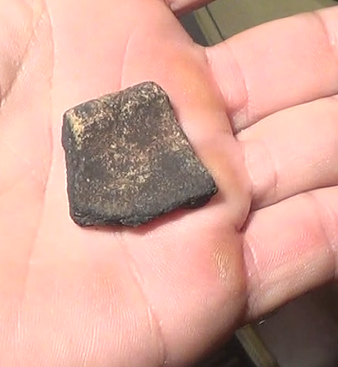
Shown here is a small sherd - or shard if you prefer.
It is a beige color but is has been blackened on the surfaces.

This piece shows some of the rim, which is thickened towards the inside.

You can get a good idea of the circumference of a vessel from the rim.

This small piece provides even more diagnostic information than that.

The outside is more heavily darkened than the inside. Could that be from being over a fire?  I'd guess that is the reason.

Also notice the incised design.  It shows one incised line slanting up and to the left on the left side and two lines slanting up and to the right on the right side.

I'd say this is a Native American sherd.  It is surprising how often you can see those if you keep your eyes open when you are on a beach or out in nature.

In my experience, you are lucky to get a piece that is decorated.

What story does it tell?  As you know objects found on a beach get washed around.  They may be a long distance from where they were.  They would have no context.  It would be nothing like an archaeological site that you could excavate to unravel the story behind it.

If you find object, there is higher probability that there are more similar objects in the same area. That isn't very specific information, but it tells you to keep your eyes open.

I'm sure there are some people who might be able to tell you a lot about even a little piece like this.

---

Happy hunting,
TreasureGuide@comcast.net

Sunday, January 11, 2015

1/11/15 Report - Mystery Pot For Age Determination. Variety Of Great Old Coin Finds. Diamond Ring Recovered From Inside Dog.


Written by the TreasureGuide for the exlusive use of treasurebeachesreport.BlogSpot.com.


I got this message a couple of days ago from Jonah M.

Jonah said, I went out last night to a beach that I've found really good treasure on with no ties to our 1715 beaches. And this is what I found . We find a lot of China and all sorts of pottery on our wrecks but this piece looks older I could be wrong ,but after a light cleaning this is as good as I could get it. It's about 4 inches tall with no marks on the bottom.  Please feel free thoughts on age.


Let me know what you think about the age of the pot.

Context is often one of the better indicators of the age or source of an object.

Remember, when beach conditions aren't right for one type of material, it might be a good time for other types of material.  I've said that in the past, but not recently.


Michael E. has been putting in a lot of field work.  That is one of the biggest determinants of finds.  If you want to find a lot, you have to put in the time.

Michael said

... still land hunting for me to begin the new year. Last 2 hunts have resulted in many items, and some nice coins. 1943 half dollar, 1891 v nickel, 1870 centimos, 1918 buffalo, all first for me, which most things still are. Still have a gift for you in my truck, hope to catch up one day. This is my gold from 2014, less 3 pieces found after this photo. I dedicated to swing hard, Long and often in 2014, really to see what could happen. My goal overal was 100 rings and 10k pennies. Only made 5.6k pennies but dug over 10k individual pieces of clad. With minimal time at local parks. Didn't think I would reach the ring goal, but amid a few other hunters at my usual beach on December 31, I recovered #100, 18k band...


Below are some of Michael's recent old coin finds.

Coins Found by Michael E.
Photos by Michael E.
 
Very nice.  Thanks for sharing guys!


Did you hear about the dog that swallowed an expensive diamond ring and wedding band?

Here is the link to a video on that.
Maybe you should run your detector over the animals you come across.


I got word of some reale finds from a couple of days ago. 


Looks like the Treasure Coast will get something like a three or four foot surf for a few days.   The wind won't be out of the North until Tuesday.

I'll put my beach detecting conditions rating back down to a 1.


That is all for today.

Happy hunting,
TreasureGuide@Comcast.net


Sunday, May 12, 2013

5/13/13 Report - Calusa Pot Shards, AT Pro First Find & Backyard Detecting


Written by the Treasureguide for the exlusive use of treasurebeachesreport.blogspot.com.


Check Stamped Pot Shard.
Two days ago I mentioned a book, Culture and Environment in the Domain of the Calusa, edited by William Marquardt, University of Florida, 1992.   Totally available free online.  I gave the link too.

When I mentioned that book two days ago I referred to the chapter on   shell artifacts.  I also wanted to mention the chapter on Calusa pottery.

To the right is one example of a pot shard shown in the book.

I saw one very much like it laying on the surface in plain sight right beside the road when they were doing construction on Indian River Drive.  When I first saw it I wasn't sure what it was.  It didn't look like a shard at first glance, more like a piece of bark or something.  It did catch my attention though, and on closer inspection I could tell what it was.

My point is that you will from time to time see such things laying in plain sight.  If you read through books like the above, you'll be prepared to recognize them when you do see them. 


William M., who has made a lot of really nice old detecting finds from the 17 or 1800s and who has one great Native American pot shard collection, got a new detector the other day.   He said,  I just got my Garrett (AT Pro) yesterday and walked across the street domain my house along the C-24 canal this morning to start practicing with it.

The area is full of iron trash...my first decent signal was a penny which I got some practice pinpointing on.. beautifully simple on that machine.... the very next non-iron target was silver! LOL.

Thanks for sharing William.

William didn't get real excited about this find, but I wanted pass along the story simply because it is instructive.


William's Second Good Signal
With His New Detector.
What I want to point out first is that phrase "across the street."  Sometimes we overlook places right under our nose.  Sometimes we think there won't be anything there and never look.  It is always worth taking a look at those places in our own back yard.  You never know what you might find but will some times be surprised.

Even if there isn't anything really nice there, it is worth finding out for sure.  And when you don't find anything any good, at least you increased your experience level and it didn't take a lot of time.

I often detect my own yard.  Even today and even though I've done it many times before.

I don't really expect to find anything worth while.  I've been over it many times with different detectors and think I've found most everything, yet occasionally I get the urge to take out my detector and check.  I always find something.  Not anything good.  And never have I found anything gold or even old there, but I always manage to find something.  Poking a little further under this or that, or working through some trash.  It can be a good way to push your technique and your detector to the next level. 

Hunt those overhunted areas occasionally just to see what you have to do to get the remaining whatever it is that is still there.

Hunt those real junky areas too, especially when they are in your own back yard.  It only takes a few minutes to walk out the door with your detector.  Learn to work through junk.  That is one thing most people don't really know how to do too well because they always try to avoid it.  It will teach you about masking and how to sift through junk most effectively.

There are places out there that have a lot of good targets remaining simply because most people won't try to work through all the junk.  Learn how to do it and then do it and you'll be surprised what you can find.

Burnt down cabins, sheds or whatever will be covered with iron junk.  Learn how to work through it and you'll have some good hunting that most people will simply pass up.  You might not find anything much good, or you might.  In any case, you'll KNOW what is or is not there, and most likely you'll learn something else in the process. 

I know one place in the Keys where I always stop and detect if I am in the area.  Lots of people pass right by there, but very very few people ever detect there.  It just doesn't look any good.  It is muddy - deep mud that you sink in up to your ankles every step.  It is weedy.  It is ugly.  There is very little reason to believe much of anything good will be found there, but every time I've stopped there to detect for a few minutes I've found a gold ring.

As surprising as it may seem, you can find very good hunting spots on old beaches that are overlooked by almost everybody even in big metropolitan areas that can become your own little honey hole.

A lot of good detecting sites will be overlooked by the vast majority of detectorists.  That's one reason they are still good. 

Trash and other obstacles can hide treasure.  Many treasures have a dragon of one sort or another that guards them.

I used to have a saying that I often repeated in regard to detecting.  Here it is.  If you don't want to do it, do it.   That is for those of you that are real hard core.  And I do have to state some exceptions.  Don't follow that advice when the reason you don't want to do it is because of morals, law or safety of self or others.  Otherwise you'll often find it good advice as it relates to metal detecting.


The surfing web sites say that we can expect a calm sea today with a surf of down around only one foot.  And just a tad more for the next few days.

If that is actually what happens, it might be a good time to get into the water of work the low tide area. 

Hope you all had a wonderful Mother's Day.

Time flies. Make the most of it.

Happy hunting,
TreasureGuide@comcast.net