Showing posts with label test targets. Show all posts

Monday, February 17, 2020

2/17/20 Report - Conductivity Numbers for Reales and Other Test Targets. Winding Unpaved Roads.


Written by the TreasureGuide for the exclusive use of treasurebeachesreport.blogspot.com.

Variety of Test Targets Including Among Other Types of Finds a Four-Reale and Half-Reale 

For whatever it is worth, I decided to look at the conductivity numbers for the recently found four-reale and half-reale.  I forgot what numbers they produced in the field and wanted to know that so I took them out to test along with some other targets for context.

Left to right in the photo above are the targets: (1) a 13 gram four-reale, (2) a 1 gram half-reale, (3) a small very thin bit of what looks like copper found at the same site, (4) a silver cross, (5) a silver ring, (6) another silver ring, (7) a copper alloy looking piece.

I used the factory presets, except I used the Beach 1 mode, which is what I used on the beach.

Below are the conductivity numbers that I got for each item using the Equinox 600 metal detector - the same detector that found the first three and the seventh item.

Item                                  Conductivity Reading

1.  13 gram four-reale -  29 - 31
2.   1 gram half- reale -   17
3.  very small copper  -    2
4.  silver cross             -   20-21
5.  silver ring               -   30-31
6.  oval silver ring       -   35
7.  copper alloy piece  -  20-21

I was most interested in knowing the numbers for the reales.  The reals consistently produced numbers that were distinct from most of the other targets, except the four-reale produced numbers in the same range as one of the silver rings.   The small half reale produced a very stable 17, while the numbers produced by the much larger four reale were less consistent.

I get the feeling that shape affects the conductivity number.  The more thin and irregularly shaped silver cross produced numbers that were between those of the two reales.  I should do a thorough experiment on that someday.

The conductivity numbers can be useful in some situations, but there is a lot of variability and overlap.   It seems that the position of the object and its depth can change the numbers somewhat.  And many different types of objects produce the same or overlapping numbers.

It does appear that reales will generally show conductivity numbers from around 17 and up.  I do find the numbers useful to some extent even though they may not always be precise or consistent.  Too much reliance on the numbers could be a big mistake. 

As detectorists we are always dealing with probabilities.  I would define skill as the ability to improve the probability of success through intentional action.

If there is one thing I regret not remembering from my college and professional years it is the math of probability theory and statistics.  Detectorists use a variety of types of clues or signals that if properly interpreted and used can dramatically increase the probability of success.   Although I don't actually need to do the math for field applications, it would be helpful for explanations

---

Some say heaven has streets paved with gold.  I don't really know what use I'd have for that.

I see it as unpaved roads winding up and down hills sparsely decorated at various distances by two or three tightly grouped small but happy homes built by struggling young families recently returned from the war and animated by children of various ages tumbling in the summer grass and exploring every nook and cranny of the nearby woods and streams, catching frogs and snakes or sledding in the snow.

That is what I see sometimes when I awake in the private threatre of night.  The gang is still there, just as it was.

In our plaid shirts and blue jeans, seven year-old David, a year older than I and a veteran at seven years of age, walks me down the road past the barns, farm fields and cows to my first day of school, neither one of us having any way of imagining what lies in the years ahead.   A special good fellow, I'd like to thank David for his company in those carefree days.

He's not the only one.  There was Eddie, Gary, Bobby, Loretta and Becky and others.  We shared the same hills, neighbors, schools and friends for our entire childhood.  We had a baseball team in summer, and a football team in the fall, even if we were a several positions short.

I'm sure I'm not the only one that awakens in the night and returns every once in a while to those green hills to meet old friends so many years and miles away. 

---

I've been eagerly watching the surf predictions and hoping that the predicted big surf doesn't disappear.


Source: MagicSeaWeed.com.

As of this morning, it still looks good.  Rather than decreasing, the predicted surf for next weekend has actually increased another foot.

Happy hunting,
TreasureGuide@comcast.net


Wednesday, September 11, 2019

9/11/19 Report - Exploring the Equinox With Gold Test Targets. Reader Emails. Three Systems to Watch.


Written by the TreasureGuide  for the exclusive use of treasurebeachesreport.blogspot.com.

Top: Small 2.9 gram 14K ring.
Second Row: ,.8 gram 14K charm, and thin 1.5 gram 10K bent ring
Bottom: 6.1 gram 18K ring
I did some tests with a few gold targets (shown above) and the Equinox 600 metal detector

The first thing I found is that the EQX11 Double-D smart coil that came with the Equinox does indeed have a blunt sensitivity profile as you would expect from a double-d coil.  There appears to be some center effect though.  I'll have to do more testing to be more precise about that.  I observed some interesting effects under different areas of the coil, but need to do more testing before saying much more.

I wanted to test the conductivity numbers for the different test targets to see what I could learn.  I was testing in an environment with a lot of nearby cables and electrical interference, and would like to do my tests again in a cleaner environment.

The conductivity number for the first item, the small 14 K ring, was 12.

The conductivity number for the charm 14K charm was 9 - 12.

The conductivity number for the 10 K bent pearl ring was 6 -8.

The conductivity number for the 18K band was 26.

I'm not sure how much I can make of those numbers at this point.  Will 10K gold items consistently show a lower conductivity number than a 14K item?  I'll find out before long.

I was going by the markings on the items and did not test the gold purity.  I assume they were right, but I'll have to make sure of that when I get a chance.

At this point I'm really wondering how much use I'm going to get out of the conductivity numbers.  The small gold items were producing numbers that are similar to a lot of other things, and the numbers do seem to jump around a lot.  It might just be my lack of experience with this metal detector, but I would not presently use these numbers to determine if I should dig an item or not.  They seem too inconsistent at this point.  I'll do more testing and see how it comes out.  And maybe I'll learn enough to be able to use the numbers better in the future.

While I'm not yet sold on the practical value of the conductivity numbers, with the possible exception of those in the iron range, I'm impressed by what I'm able to tell from the audio signal.  For example, standing the charm on edge results in a double blip when the coil is swept at a 90 degree angle to the edge, but very little signal when swept the same direction as the edge.  And the 14K ring made a double signal when it was turned in one direction and a single blip when turned the other.  It does seem to me like there is a lot of information in the audio signal.

I'm accustomed to using audio signals to determine the depth, size and shape of objects, so maybe that is why I found the audio signals so informative.  I'm more skilled at that.  I'm not accustomed to using conductivity numbers to discriminate.  Time will tell.

I will be doing more testing.  I have a long way to go before feeling confident that I know how to get the best out of this metal detector.  At the same time, I am growing more confident that the detector generally works well.  I have a lot of questions though about the practical value of the conductivity numbers.  Again, that might just be because I have not yet learned to use them well.  And it might also be because my tests were conducted in a difficult environment with a lot of electrical interference.

---


Here is an email I just received from Bill G. on the subject of beach closings.

My mother had a place across the street and 2 streets down from the main public beach access just south of Riomar. My understanding is all the houses have deeded right to beach access. Her access was a designated path between two ocean front condos with a boardwalk over dunes.  Back in the early 2000s I was going down to stay a few days and do some fishing (didn't detect back then, dont fish now) and she mentioned they had put up a fence and gate at her access and it was only open sunrise to sunset. Police would come by and open/close. She said she asked around and it turns out a councilman had a relative in one of the condos and they were having an issue with people sneaking in and having sex in their pool. She said he abstained from the vote for obvious reasons. If it was me I would have challenged it and made it very public. I grew up there, but no longer a resident. 


And catching up after a busy week or so, here is an email from Russ P. that I received a few days ago after I talked about the costs and risks of hurricane preparation.


I could not agree more with your post today.  

Two personal stories of the cost of 10 days of essentially fear-mongering from media, government, and forecasters:

One of my cousins owns a hardware store and lumber yard in Belle Glade, south of Lake Okeechobee.  He sold 2000 sheets of plywood on Friday.   On Saturday, people were still purchasing the more expensive finish plywood despite all the models now showing that the storm would turn north and miss Belle Glade.  He actively tried to dissuade folks from buying the unnecessary plywood because so many of the people were clearly very poor and had other important necessities to spend their money on, but people had been so worked up by a week of worse case reporting that they wouldn't hear it.  

We have a family reunion every Labor Day weekend which is one of the highlights of the year.  The event is on Anna Maria Island, south of Tampa.  About half the family did not attend (from the Panhandle), because they were so nervous about the hurricane.   We had some of the best weather and beach conditions ever, so it was really disappointing they were not there to enjoy it.

I know everyone has stories like this, but you are right on when you talk about the costs.  The economic cost is huge, but so are the intangible costs, including the stress of watching 10 days of doomsday scenarios.  

Russ


And another one from DJ.

I spent the last three days getting everything stowed away and battened down! Your right about cost! Even with a generator already, it probably cost me between 500 and a 1,000 dollars to stock up on fuel, food, etc... 

---

I couldn't really see the recent post-Dorian reale find that I posted yesterday, but at first glance it looks like it might be a Potosi two-reale.

---
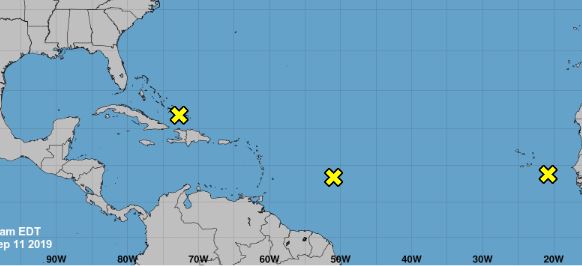
Source: nhc.noaa.gov

There is a lot to watch in the Atlantic.  The first system in line will probably not become very strong but will bring us some rain this weekend.

It is too seeon to tell about the others.

Happy hunting,
TreasureGuide@comcast.net


Monday, November 14, 2016

11/14/16 Report - One More Use For Test Targets. Call of Nature Leads To Important Discovery. Small Surf This Week.


Written by the TreasureGuide for the exclusive use of treasurebeachesreport.blogspot.com.

Detectmg The Land Where My Ancestors Roamed The Frontier

I did some land hunting not long ago and posted a couple pictures from the hunt. I haven't done much land hunting lately - maybe only a few days a year.  I used a different detector than I usually use on the beach and found that I needed some refreshing.  I wasn't sure of some of the signals,

One of the things I highly recommend for most anybody, and especially beginners is using test targets of various types and under various conditions to really learn what your detector is trying to tell you.

In the past I talked a lot about using test targets.  I use test targets occasionally even with a detector that I've used a lot - not only to explore signals to various types of targets under different conditions, but also to test my settings during a hunt to see if they are the best I can get for the situation.

In this case there were ID readouts that were a little inconsistent.   There were some ID readings that jumped a bit depending upon where I passed the coil over some objects.  In order to identify exactly what that indicated, I used some test targets and placed them at different angles and then scanned them at various distances.

The depth of an object will affect the accuracy of the ID on some detectors, especially when the target gets close to maximum detectable depth.  The angle of an object can also affect the signal or readout.

The most simple way to use a test target is to lay the coin or object flat on the ground.  That is usually what is done.  Sometimes the object is buried, but almost always laying flat.

If you lay a test target on the ground you can see exactly where the coil is in relation to the target and how a change in relative position affects the signal.

Coins and other objects can be wedged against a rock or root and be on end or at an angle instead of flat.  That can affect your signal.  I think I've shown in the past how a coin standing on end can sound more like a nail or other long narrow target.

Partly due to the fact that I hadn't used that particular detector a lot recently and partly due to the fact that I wanted to investigate the cause of some mixed signals, I used test targets once again on that recent hunt.  I don't think there is any better way to get to know your detector than by using test targets, and I don't think most people do it enough.

---

“Nature called, and Cliff walked up this creek bed into this gorge and found this amazing spring surrounded by rock art,” archaeologist Giles Hamm told the Australian Broadcasting Corp. “A man getting out of the car to go to the toilet led to the discovery of one of the most important sites in Australian prehistory.”

Here is the link for the rest of the story.

http://digital.olivesoftware.com/Olive/ODN/MiamiHerald/shared/ShowArticle.aspx?doc=TMH%2F2016%2F11%2F13&entity=Ar25E4&sk=A211F79C

Thanks to Alberto S. for that link.

I know of a few times when Treasure Coast detectorists found reales when they went to relieve themselves.

---

Darrel S. reports that Seagrape Trail is now open again.  Thanks Darrel.

We'll have a small surf most of this week, not increasing until Friday.  We'll still have some good high tides and a northeast wind.

Happy hunting,
TreasureGuide@comcast.net

Saturday, September 19, 2015

9/19/15 Report - Surprising Results of Detector Test With Three Small Cobs. Tropical Storm Ida And Other Weather.


Written by the TreasureGuide for the exclusive use of treasurebeachesreport.blogspot.com.

Three Small Under Weight Cobs.
In the past I've talked a good bit about specific target training and tuning.  By that I mean learning the optimal detector settings for finding particular targets, and also tuning in the field for those specific targets.

If you are interested in finding small silver items like those shown above, you need to experiment with different detector settings to find the settings that are best.

These particular cobs are way under weight.  They were found on a beach near a 1715 wreck site. They lost much of the original material.  The one on the left is only about .015 ounces, and the other two around .02 ounces.  The second is actually a touch lighter than the third.  My scale isn't highly accurate for small weights like that.

When selecting test targets, I will often select those that are on the smaller side, assuming that if I can find the smaller ones I will have no trouble with the larger ones.

Size is much like depth in relation to signal strength.  Small items sound much, not exactly, like larger but deeper targets.

One thing I try to keep the same is the material.  If you want to find silver, test with silver.  You generally want test targets that are as similar to the desired targets as possible.  One possible exception, as I said, is size.  Again, I tend towards smaller test targets.

If you are going to hunt for a particular type of item, you want to know if your detector will detect it and what settings are required.  It is best to test your detector before going on a hunt so you have confidence that your detector will detect whatever you are hunting.  What a waste it is to spend hours hunting with a detector set up in a way that would not detect what you want to find if you were right on top of it.

I hadn't tested one my newest detector on small cobs and wanted to find out how it would do with those types of targets, and secondly, what settings would be best.  I had tested these test targets with a couple other detectors, and knew how they would perform, but I wanted to know how this detector would perform with the same test targets.

I took these items out to a space that I have cleaned out and often use as a test area.  I kept changing the settings and modes to see which worked best on these test targets.

My test area is not the easiest even though there is no ground mineralization.  There is a lot of ambient electrical interference to deal with that causes a lot of detector noise.  In this area, there are some inexpensive detectors that actually do better than some of the more expensive and powerful detectors because of the electrical interference.

Which of the above three test targets do you think gave the strongest signal?  You might well guess the first, which is both lightest and presents the smallest surface area.

Charles Garrett in his book Successful Coin Shooting, said that generally detectors are surface area detectors, and that mass makes little difference.  He suggested a way to prove that for yourself.  Take a coin and run your coil over it.  Then take a stack of the same coins and run your detector over it.  You should get about the same signal because the surface area that is presented to the coil is the same.

He threw that word "generally" in there, and that is a good thing, because I have found exceptions.  I haven't done a real precise experiment on that, but I have observed enough to feel confident about that.  There are times when thickness, or mass, seems to make a difference, though not a large one.

To answer the question, the first and third targets (as shown in the photo above) cause much stronger detector signals that the second one.  That is very consistent.  And it proves out with different detectors.

The first item, has a small surface area.  You can see that.  The photo accurately shows that.  It is however thicker than both the second and third items.

The second and third items are nearly the same weight, and one might be a bit thinner than the other, but it is not enough to be obvious from look or feel.

So what is it about the second item that produces a weaker signal?   I can't say for sure, but it does seem to be something other than surface area.  Perhaps it is the material, although the three cobs should not be very different.  They should have similar silver content.  Maybe they are a touch different though.

I've shown in the past that shape makes a big difference.  Detect a coin laying flat, and then turn it on edge and you'll probably notice a big difference in the signal.  On some detectors the difference will be greater than on others.

The second item does not appear to be shaped hugely different from the third item, but it is a little less round.  The first item is much less round than the second, but still produces a better signal even though it also presents a smaller surface area.

I've done experiments that show that angles and irregular surfaces make a difference.  A slanted surface may not produce a signal that is as strong as if the surface was flat and parallel to the surface of the coil.

The top surface of the small item is a little convex.  I don't know if that produces a better signal.

It is pretty complex.  I'd have to do a lot more experimenting before I could say exactly why the second items produces a much weaker signal than the other two.  At this point I just have some ideas.

The main thing I want to say today is that you should experiment with detectors and their various settings and relevant test targets before you go for a hunt.  Get to know what your detector will and will not do, and get to know the best settings.

---

Source; nhc.noaa.gov
We now have a named tropical storm, Ida.  Also a tropical depression, Nine.  And another disturbance up by Georgia.

I doubt we get much of anything from any of these, however there is a chance.  Both tropical depression nine and Ida will probably live and die out there in the Atlantic.

The disturbance up by Georgia might turn into something, but North Carolina has a better chance of getting something out of it than we do.

Right now the surf predications are for a slightly increase surf for mid week.  If you look out a week from Monday, they are predicting something like 4 - 7 feet.  That might be nice - if it actually happens.  I guess there is some chance, but I'm not betting on it.

Happy hunting,
TreasureGuide@comcast.net
Tuesday, April 21, 2015

4/21/15 Report - Jewelry To Coin Ratio. More On Test Targets. Lake Michigan Wrecks.


Written by the TreasureGuide for the exclusive use of treasurebeachesreport.BlogSpot.com.

Single-Day Finds By Leonard G.
Photo by Leonard.


Leonard found these items on Sunday morning.  Way to go Leonard!  Great jewelry to coin ratio. 

Not only did he find some ear rings, but a matching pair.  That doesn't happen real often.

----

If you want to get the maximum value out of your beach hunts, you might want to hunt where there is a good jewelry to coin ratio.  To give just one simple general example, the jewelry to coin ratio is higher in the water than on the beach.

Concentrations of coins can help point you to jewelry, but the best jewelry spots do not always have a lot of coins.  There ate times and places where you'll find a nice high jewelry to coin ratio. 

One extreme and unusual example is a muddy spot along the road in the Keys where people tend to stop and wade.   It isn't a nice beach and isn't heavily visited, but every time I detected there I found a gold ring but seldom a single coin.  People wander out into the shallow water and in a few yards find that it is actually more like mud.  Any hand or foot with a ring on it that is put into the mud will come out without the ring.  The suction will pull it right off. 

Another beach where I used to detect was more typical.  It was your usual sandy Florida beach, but it was spread out over a huge area.  It also had a very high jewelry to coin ratio for some reason.  You'd spend an hour or two and typically come out with one piece of jewelry and maybe two or three coins.

You have to know those places.  At a place like that a lot of people would spend a little time detecting, not find many targets and quit too soon. 

---

One thing that I've really come to appreciate in recent years is the benefit of using test targets.  I know I've talked about that some before, but my appreciation of test targets continues to increase, even after all these many years.

I happened to notice the other day where another blog linked to one of my posts about test targets.  After reading the article, the author of the blog concluded that it was indeed a good idea to carry a test target.  The linked post was the one where I was talking about how I used a test target in the field to check my tuning.  In the post I talked about how one day I noticed that my detector's response seemed less than what I would have expected on a particular target.  I then put the test target down and tested the detector on the test target.  I knew about what type of signal I should get with that particular test target.  As with the other target, the response wasn't as strong as I expected.  That verified that my detector was not tuned optimally and might need to be retuned.  The test target provided a quick and easy test, and since I knew how my detector typically responded to that carefully selected target, it also provided an accurate test.  After retuning with the test target, I go much better performance.

One key is to use a relevant test target, such as a small gold ring if that is the kind of thing you are targeting.

I can remember times way back in the days not long after I began detecting when my settings were way off and it took me a long time to find that out  On one occasion my settings looked right.  I put the knobs where I usually had them and everything looked right, but I later learned that somehow the settings were off.  Just as an example, lets say the sensitivity setting was at 10, but the detector was acting more like it was at 5.  I hate to think how long it might have been before I learned that.  If I had done what I do now, I would have checked with the test target to at the beginning of each hunt and quickly found out if the settings were off.  

Things do go wrong with detector's at times, and it is good to quickly discover when that happens.

Even when everything is working well, you can still benefit from retuning or ground balancing from time to time.  A test target can help you discover that and help you assess the impact.

I frequently do a check with a relevant known test target in the field to verify that I have close to the optimal settings.  Some detectors benefit from it more than others, but even with a simple turn and go detector, using a test target can quickly show you if everything is all right or not.  No need to waste time detecting an hour or two before finding out.  Verify first.

----

The water has been very clear in Lake Michigan.  Here are some nice views of unidentified wrecks.

http://xfinity.comcast.net/video/ice-reveals-shipwrecks-in-lake-michigan/430995011645/Comcast/Weather_Channel_newest?cid=hero_sf_shipwrecks

----

On the Treasure Coast we still have very smooth seas and good negative tides.

Happy hunting,
TreasureGuide@Comcast.net