Thursday, May 25, 2017

5/25/17 Report - Various Types of Finds and Objects. A Quick Video Tip For Target Recovery.


Written by the TreasureGuide for the exclusive use of treasurebeachesreport.blogspot.com.

Great Diamond Ring Metal Detector Find.
Find and photo by SuperRick.
Great find Rick!  Thanks for sharing.

---

50,000 frozen Alaskan artifacts were saved.   Some were very unusual exceptionally nice.  Here is a brief excerpt from a BBC News article.

He [ Frank Knecht ] said: "The unique conditions in this arctic region mean artefacts have retained an unbelievable level of detail.

"We have uncovered grass baskets and mats made when Shakespeare walked the earth but when we take them out of the ground the grass weaving still retains a trace of its green colour and we have been amazed by the variety and intricacy of the woven patterns."


One Beautifully Preserved Wood and Ivory Artifact.
Source: See BBC link below.
Here is the link.

http://www.bbc.com/news/uk-scotland-north-east-orkney-shetland-39973667


---

These very old fossil finds were made earlier this week.

Fossil Finds From This Week.
The above fossil finds were discovered in shell piles this week.  They aren't the biggest or best Treasure Coast fossils, but they certainly are old.

Included are three turtle skutes and one pad.

As you can see, they are all fairly small.

---

Now for something really ugly that sold for over  $110 million.

http://www.939thebeat.com/2017/05/22/basquiat-painting-sold-at-110-5-million-sets-new-auction-record/

One Very Ugly But Very Valuable Painting.
Source: See The Beat link above.
Certainly ugly, but very valuable.  There is no accounting for the tastes of some people.   It can be difficult to estimate the value of some collectibles.

---

In a recent post I mentioned how I watched YouTube videos and counted the seconds it took to recover targets.  Here is a tip that might help you recover targets more quickly.  I use it, but it will only be helpful if you detect and pick up any small iron targets.  If you discriminate iron or don't detect in junky places, it won't help you much.

I sometimes use a magnet with a long handle, mostly when detecting old house sites or something like that.  When you have an small iron target, like maybe a nail or some other piece of rusted iron, just use the magnet to pick it up.  Don't spend time pinpointing or trying to dig it up until you've used the magnet.  Chances are that in a high percentage of the situation, especially if the soil is mostly sand, the magnet will pick up the nail or whatever in no time at all.  A lot of iron junk will be near the surface, but you can even work the magnet down into the sand a little ways, and you will hear the target click onto the magnet.  The video shows one example of when the target was very near the surface and another time when the target was down an inch or so.

Here is the link to the short little video illustration.

https://www.youtube.com/watch?v=eZ2XQiljBF4

This is just one more tool that you might find handy at times.  I think I got the one shown at Tractor Supply for just a few dollars.  You can also purchase magnet rakes like those used by roofers to clean up after a job.  They can be used before detecting just to get some of the junk out of the way.  I call it "site preparation."

Of course you can discriminate out iron, but it is often better to remove it for a variety of reasons.  For one thing, it can mask good targets.  And there might be iron targets that actually help you understand a site and other iron targets that might be desirable relics.


I once posted a description of a multiple stage detecting strategy for old sites.

---

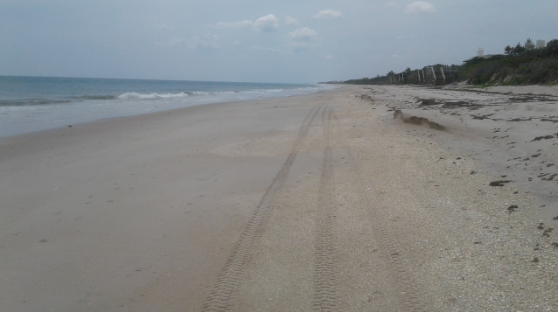
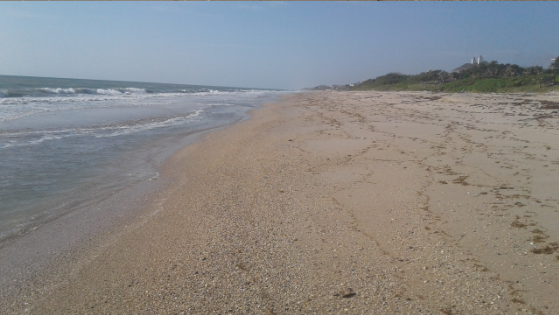
Yesterday was windy.  Even the wind of an isolated thunder storms can cut a beach a little if it hits at the right time and way.  It won't be huge though, but it can make a difference.

Don't expect any big changes to the beach for at least a few days though.  The surf will be small. There will be some decent tides though.

Happy hunting,

  • TreasureGuide@comcast.net

Wednesday, May 24, 2017

5/24/17 Report - Vero Area and South Hutchinson Island Beaches. Capitana Crew At Work.


Written by the TreasureGuide for the exclusive use of treasurebeachesreport.blogspot.com.

Turtle Trail South Tuesday.
Photo by Darrel S.

Darrel S. sent in some recent views of Turtle Trail yesterday (Tuesday)  In the one above you can see the shell piles that will be of interest to some of you.

Besides shells, you might want to check the shell piles for things such as small fossils, sea glass or pot shards.

Darrel sent in another excellent report today.  Here it is.

Not much change in beach past few days. Low was around 12:30pm.
Deep trench between shells and sand bar. Too mushy to work water edge.

Capitana was out.

My new 12x13 NEL Tornado worked as expected. At first, worked better in the drier sand. Amazed that it found small objects close to surface. Most larger coils lose the top few inches to sacrifice for going deeper, and require lowering sensitivity to work properly. I was able to work wet sand after pumping coil, readjusting threshold, and lowering sensitivity.  I will stick to the 12x8 coil rest time down here. Always have the CZ21!

Turtle Trail South Tuesday
Photo by Darrel S.
A lot of sand below the high tide line here.

Capitana At Work Tuesday
Photo by Darrel S. 
Thanks much for the photos and report Darrel.

---

Things looked similar down on South Hutchinson Island Tuesday.


Walton Rocks Yesterday Near Low Tide.

Shells at Walton Rocks Yesterday.
Looked like the shell piles might have been heavier at Turtle Trail.  I would suspect similar shell piles at places like Ambersands, but didn't see it so don't know for sure.

---

In South Florida one diver died and two more died in a separate boating incident this week.

Take shelter from lightning too.

Here is a link to a story about what it is like to be struck by lightning - if you live.

http://www.bbc.com/future/story/20170523-what-its-like-to-be-struck-by-lightning

---

A one foot surf is predicted for the next week or more on the Treasure Coast.  That means nice calm water.

We are also having some nice negative tides too.

I have some nice find pictures that I'll probably be able to post tomorrow.  A very nice diamond ring, a meteorite and some fossils.

Happy hunting,
TreasureGuide@comcast.net

Tuesday, May 23, 2017

5/23/17 Report - You Can't Accomplish What You Can't Imagine. Beach Today.


Written by the TreasureGuide for the exclusive use of treasurebeachesreport.blogspot.com.

John Brooks Near Low Tide Today (Tuesday)
Notice the old cut and the new mushy sand that has filled in front of the cut.  You can see that it is mush from the foot prints.  


John Brooks Looking South Tuesday
This photo shows more of the same.

There were some shells near the high tide line.  Also there were shells near the low tide mark at another beach.

The surf was small all along the Treasure Coast.  Only one foot or so.  We're supposed to have a one foot surf for several days.

There is a negative tide today though.  

I'll try to have those pictures for you tomorrow.

---

You can't accomplish what you can't imagine.  Some people have a hard time believing how much can be found.  It seems they prefer to believe that there is nothing out there and that it has all been found.  .

 If you don't think there is much to be found, you'll become resigned to making few finds and you won't be motivated to keep working and improving.  The fact is, the more time and effort you spend the more you can find.  You can't make a lot of finds if you don't hunt much or don't work at it.  You have to believe it is possible to begin with or you simply won't make the effort.

I received an email just yesterday from someone who said he posted his finds on the internet, and people commented that it wasn't.  They didn't believe he found all that the way he did.  That was their immediate conclusion.  They missed the opportunity to see if there might possibly be something they could learn that might help them. They failed to see his finds as inspiration and motivation, but instead they let their own ego rob them of a chance to learn and improve.

I'm not saying there is no dishonesty out there.  On sites where people receive money for clicks or views, there is a motive to lie, cheat or mislead. Where books or being sold or persons are being promoted for personal gain, there is a motive.  And some people give in to the temptation.   Stories are sometimes exaggerated, misperceived, inaccurately portrayed or overly dramatized.  I recently discussed how some TV programs may not be totally honest. In short, you can't believe everything you see, but that doesn't mean you should immediately conclude that everybody is being misleading, especially when their might actually be an opportunity for you to learn and improve.

I can relate to what that fellow told me when he said people didn't believe him.  Back maybe thirty years ago I attended a metal detecting club for a few months.  I was finding a lot of gold jewelry down south and every month took my finds to the club meetings. Every month I brought more than ten times the gold finds than anyone else.   People started to say that I was cheating.  They didn't believe I could find that much.   I wasn't cheating -  I was just detecting and finding things.

One month when I brought an 18 pennyweight class ring from Pace University with my finds, one person accused me of bringing the same class ring that I showed before.  I didn't.  In fact, the first one heavy one he was referring to from an earlier month was a 20 pennyweight ring from the University of Miami.   If they would have paid attention at all, they would have known it was not the same ring. I guess they preferred to think I was not finding good new stuff every month.  It must have helped them feel better about themselves in some strange way.  I remember it so well because of the false accusation.

 After a few months of bringing my finds, NO ONE in the club even looked at my finds any more. It was like they were actually trying to avoid seeing what I brought. I guess they didn't believe me, so that was the end of my attending the club.  Before that I almost never showed any of my finds, and I rarely showed any after that.

I've heard similar things from a few other detectorists.  They say that there are people that don't believe them when they show a lot of finds.  People accuse them of lying.  Some people might lie - I'm sure some do - but some of them are not.

Some detectorists I've encountered over the years seemed to want to believe that they are just better than everyone else.  They don't want to acknowledge that they might not be doing things better than everyone else.  I've run into people on the beach that got angry at me when I didn't agree with something they said. I remember one that stomped off grumbling "I've been detecting X number of years."  I value experience and experienced people, but time doesn't mean you are perfect. Treasure hunting involves so many factors that no one can not know everything about it.  It is possible to do something poorly for a long time. I was wrong about some things for many years before I changed my mind.  There is always something you can learn.  I am studying, experimenting and learning all the time.  That is one of the things that keeps me interested and motivated.

I'm not saying to believe everyone all the time.  That would be stupid.  But when you see some nice finds - maybe some that are hard for you to believe - before dismissing it, ask yourself if there might be something you can learn from what you are seeing.  Don't miss an opportunity to learn something new when it stares you in the face.

Don't limit yourself by refusing to believe that there are a lot of good things out there.  Don't refuse to believe that it is possible.  There just might be something more out there for you to learn.  I know there is for me.

There is a lot of negativity in the world today, but negative people and negative attitudes will not get you very far.

---

I appreciate the Google Pluses that I've been receiving lately.  It tells me which posts you really like.

Happy hunting,
TreasureGuide@comcast.net

Monday, May 22, 2017

5/22/17 Report - Learning From Treasure Hunting Yesterdays. Ransomware Hits One Operating System. Beach Update.


Written by the TreasureGuide for the exlcusive use of treasurebeachesreport.blogspot.com.


My first metal detecting was way back, but unfortunately I can't figure out what decade it was. I don't think the detector we had would detect a coin. My grandmother bought it. Maybe we didn't know how to use it. I'm very vague about that now.

I do remember that we went out to an old homestead where there was not much more remaining than a chimney. It was where she lived a short while as a child.  We found some things. I remember finding a horse shoe.  Too bad we didn't know what we were doing at that point.  It would have been nice to pick up some nicer things from her childhood.  Maybe that is what she was hoping.

I think it was the limitations of the detector that discouraged us from continuing, but it might have been our lack of knowledge that was the problem. It wasn't until years later (again, I can't figure out precisely when that was) when I was living in Florida and got a decent metal detector. It was a White's detector that I got from a Sears catalog. I started detecting the Hollywood Florida beaches, which were close to where I lived.

My coin finds increased quickly.  Every week it seemed I found more.  I remember detecting under a beach walkover one night and finding a big bunch of coins.

For some reason I returned the Whites detector to Sears, and I went to Pot O Gold, which was near the Fort Lauderdale Airport and bought a submersible detector.  It was a Fisher 1280 Aquanaut.   That detector turned out be be a good detector.  It was very reliable and effective.

I don't know which detector I was using, but it was either the Whites or the Aquanaut because I know it wasn't very long after I started detecting when I found my first ring. It was a silver skull ring by the water's edge near the main lifeguard station at Hollywood beach.

 I've said before how I found a lot more men's rings early on with the Aquanaut until I learned to turn down the discrimination, then I started getting more small ladies rings with diamonds or other gem stones.

My next detectors were made by Steve Noga.  They were modified Nautilus detectors.  Super detectors.  By that time I was finding a lot of gold.  The first one I got from Steve, was so good that after using it a couple of days and finding a lot of gold, I called him up and asked him if he'd give me a deal on a second one just to have as a backup.  He gave me a deal, and I bought the second.  I don't know what happened to Steve.

My next detectors were also modified Nautilus detectors, made by a fellow whose name I can't remember right now.  He lived in Margate.  I know he is now deceased.

I had left my consulting job and was teaching at a University in South Florida.  In between jobs I detected a lot and proved to myself that I could do well enough to make a living by detecting.  I didn't do that though. University teaching permitted a lot of time to do some metal detecting.

Since I got the Aquanaut I mostly did water hunting except when the water was too rough.  I had a long list of places that I liked to hunt, both in the water and on the beach.  I also did some parks - especially those that had swimming holes.  

At some point, maybe thirty years ago ( I don't know how many years) I started to make an occasional drive up to the Treasure Coast to try to find 1715 Fleet treasure.  It took a while.  I made a number of trips before hitting it right.  I got pretty discouraged before I managed to come when the beaches were producing, but kept at it.  

I had already found an 18th century escudo in South Florida, but was having no luck with the Treasure Coast.   Eventually I got my first piece of shipwreck silver on the Treasure Coast, then years later moved to the Treasure Coast.  I guess I've lived on the Treasure Coast over twenty years now.

The original purpose of starting this blog came from the wasted trips I made to the Treasure Coast.  I started out posting my Treasure Coast Treasure Beach Conditions Ratings so people would be able to find out about the Treasure Coast beach conditions before deciding if it might be worth making the trip.  I had made a lot of wasted trips, not knowing what the beach conditions were and thought that would be useful information.  So that was the beginning of this blog.

I didn't write this just to tell you more about me.  I hope there are some useful hints in it.

First, if you are going to begin metal detecting, you don't need the most expensive detector in the world, but you do need one that is capable of finding the types of things you want to find.  Visit a shop and get a demonstration.  Make sure you know what your detector can find and the basics of using it.

I've detailed in many posts how important it is to understand your detector.  I've also told how you can experiment with your detector to learn how to understand it better.  Do a lot of air tests and ground tests with different types of objects in different environments.  Adjust the settings and see how that affects the response.

You can expect to progress with both the quantity and quality of finds.  You should continue to learn and improve.  There will be dry spells, and some might be long, but overall you should continue to improve.

To keep making finds you'll have to adjust from time to time.  It is always good to try new places and new techniques.

---

FRANKFURT, May 18 (Reuters) - Two-thirds of those caught up in the past week's global ransomware attack were running Microsoft's Windows 7 operating system without the latest security updates, a survey for Reuters by security ratings firm BitSight found.


Did you know that you can communicate over an international computer network without using the internet.  You can.  Back as far as the 1970s I was on an international network of Cyber super-computers that were not connected to the internet.  The hardware and software was completely different. The whole world wasn't on it, of course - just the relative few that had access.

 It amazes me that such high level people in our government have been communicating on such an insecure system.  The internet has become the public park.  Some of them are good and some not so good, but you never know who might be there or what might be going on.   If I wanted to communicate information that was critical to our nations security and had the resources, I would not be using the internet.  I assume there are levels of our government that use more secure systems.

I don't think it would be a bad idea for any large organization wanting to protect its data and operations to have a separate network system for sensitive functions.

---

Darrel S. has given updates on a variety of beaches the last few days.  Here is a new update from Darrel for today.

Beaches about the same. Low was around 11:30am. A lot more beach being exposed as we head into summer tides. It was glassy early, but wind picked up by the time Sun rose. Thought I saw one of the salvagers heading out earlier, but did not see anyone out.

Randy and I were the only detectors out. I had several shell hunters thanked me for sending in the images. That makes me feel better that people appreciate the effort...

Thanks for the report Darrel.

Happy hunting,
TreasureGuide@comcast.net

Sunday, May 21, 2017

5/21/17 Report - Analyzing How You Detect. One Person's Adventures With Treasure Hunting. Turtle Trail Beach Conditions.


Written by the TreasureGuide for the exclusive use of treasurebeachesreport.blogspot.com.

Turtle Trail Beach Sunday
Photo by Darrel S.
The summer heat is here.  Darrel S. sent in these photos.  He also sent the brief report that I posted below.

Notice the shells near the water line.  The picture below also shows a little dip in front of the beach.

You can find a few shark teeth and other fossils around there at times.

Another View of Turtle Trail Beach Sunday.
Photo by Darrel S.

Here is Darrel had to say about his hunt.

Better then last few days. More shells, but sand is still thick in low tide line. Very mushy. Nothing but pull tabs and iron debris. Others had similar finds. Mostly clean. Too many detectors in this area for summer!

Thanks for the pictures and report Darrel!

---

Some of you might know Ken H. (Southern Digger).  He detailed some of his activities in a recent email to me.  Here are some of them.

...I have been enjoying the Gold Shows including Coopers Treasure. It was in 1973 while attending college and visiting Fisher's treasure museum ship in Ft. Lauderdale when being offered a job to dive for Mo in Ft. Pierce to Sebastian area. I did not get certified until 1975 when my dive coach offered me a second opportunity to dive for Mo at Sebastian on the Fisher contracts. However, after I graduated, instead, I personally pursued a wreck at Jupiter Inlet in 1977 but was shut down by the local politics, Soon after,,I was brought into land explorations and archaeology and the work became overwhelming. Therefore, I formed a non-profit society to assist with land archaeology sites in South Florida and one of my members--an X-Marine--after being directed by me, became a diver for Mo in the latter 1980's.Sometime before or thereafter, I am certain that I met Mickos's father at a shipwreck artifact exhibit.,,

...my family took a camping trip to Central Florida East Coast and camped at Sebastian Inlet on the north side and fished at the inlet., Back then, anyone could camp west of the bridge on the north side of the inlet for free. However, no electric or facilities. More important, north of the inlet and east of the bridge was a small cafe and that is where I saw some of Kip Wagner's shipwreck artifacts mounted on the back wall.On inquiring, I was referred to the "Pieces of Eight" book and all things changed after reading it. I called Kip in 1971 or 72-ish asking for wreck locations so that I could detect the beach. I ended up talking to his son and learned that he had recently passed, However, his son spent a good 15-30 minutes and provided me with mileage south of the inlet to each wreck site. After that, I spent trip after trip to the area, searching the beaches between Ft. Pierce and the Sebastian Inlet. Later, I gave these locations to a non-profit historical club member and late-friend after taking him to search the beaches.Later, he converged with a few treasure divers, updated the locations which are now beach parks, and published a book that provides wreck locations which is still popular today. Cooper dived with Kip on occasion and I wished I was born a few years earlier so that I could meet both of them. Never give up the pursuit....

Thanks for sharing Kenneth.

It is interesting how people get into treasure hunting, and there are still a few around who were involved with the early years of detecting.

---

I watched a few metal detecting videos lately and was amazed by the amount of time a lot of people spend on target recovery.  Between the first signal and getting the target in the pocket, a lot of time elapses.

One of the advantages of using discrimination that people talk about is saving time by not recovering junk targets.  I think sometimes that it is actually not so much a concern about time being wasted as it is about the effort spent in digging and sifting and the frustration that results from seeing a junk target emerge after going through all of that.

I've seen people spend tons of time going over a target multiple times and trying to decipher what the detector is telling them.  That spent time does not seem to bother then nearly as much as a little digging.  They don't seem to realize how much time they are spending in pinpointing and target ID.  I think that is partly, if not entirely because their hopes aren't dashed by seeing a junk target emerge after spending the effort.

I've counted the seconds on some videos and definitely found that many times it would have been quicker to just dig the target and put the junk in one pocket and the goodies in another pocket.  Like I said, I'm thinking that the emotion of seeing a junk target emerge magnifies the perception of wasted time.

On the other hand, people aren't disappointed when they mistakenly pass up a good target, even if it is a Rolex watch.  They think they did a good thing and go on their way satisfied, never knowing what they missed.

The psychological aspect is an important part of detecting.  We talk a lot about the operating characteristics of metal detectors, but the operating characteristics of the detectorist are just as important.  How a person detects is very much the result of their personality.  To some extent, so is metal detector selection.

If you analyze your style and productivity, you can overcome some your weaknesses.  That requires objective analysis, which is more difficult for some people than others.

Happy hunting,
TreasureGuide@comcast.net


Saturday, May 20, 2017

5/20/17 Report - Why Nor'easters Move More Sand and Coins: A Small Scale Video Illustration.


Written by the TreasureGuide for the exclusive use of treasurebeachesreport.blogspot.com.

Erosion I Found Yesterday

It is not often that I am able to capture such as good image of such a basic and important thing. Usually I don't have my camera, or the batteries or dead or for some other reason I just can't capture the image in a way that shows what I really want to show.

Yesterday when I was out I hunting, I saw the above little eroded cliff. I made a very short video that shows how water hitting the beach at a sharp angle slices away the sand.  That is something I often talk about, especially as it relates to Nor'easters.

This erosion is on a very small scale, but the small scale and the clarity of the water, worked out for the better.  The same thing you see in the video below happens on the beach on a much larger scale when the surf is larger.  I think you can see from that video how the water slices along the front of the cliff.

Here is the link to the video.  Take a look.  It is only nine seconds.

https://www.youtube.com/watch?v=I8aCk1zC0e4

Notice how the water speeds along the face of the cliff.

I suggest running the video and few times and watching how the water skirts long at the base of the cliff.

At the end, you see multiple steps in the sand.  The steps were created as the tide went down.  Some steps are greater than others because there were times when the waves were bigger.

Below is a an illustration of the eroded area and the neighboring beach. The general direction of the water adds sand in one place and removes it in another.  If the direction of the waves changed, the sand would be removed and added at different locations.


The curve in the beach is important.   To the right of the illustration, sand was accumulating.  It was only eroding where the water was hitting at an angle (orange line).

The water hits the cliff and bounces back off the cliff.  That water bouncing off the cliff then gets pushed along the face of the cliff by incoming water.  On the leading edge of the rushing water, you see a little swirl created where the wave pushes the water that is bouncing off the cliff.

I was glad I caught that on video.  I often see something I want to talk about, and for one reason or another, don't catch it on video.  On this small scale, it was pretty easy to see what was happening.

The movement of sand on the beach is multi-directional.  How the incoming and outgoing water interact is important.

When the water hits at a sharp angle, as in the video, there is a redirection of water as the outgoing water hits the incoming water.  When it is hitting at a sharp angle, there is not so much of a collision as when the water is washing directly up and down the slope.  When the water is hitting at a sharp angle, there is more of a combining and redirection rather than a collision that severely reduces the force of both the incoming and outgoing water.  In some areas it actually appeared that the two sources added together and added to the overall force.  There were times when the incoming and outgoing water combined to create a swirl that moved along the beach near the front of the combined sources.  The sand appeared to suspend more in the area of the swirl.

Clip From Another Video Segment
In the above illustration you can see the direction of the incoming water, the outgoing water and the area where they were gathering (arrows).  That area is where there appeared to be the most sand suspended, for the area at the base of the cliff when the water hit it with some force.  The swirl moved parallel to the beach for a short distance.

As I've discussed when I talked about trigger points and drop points, what is moved by the water is determined by the amount of force.  The small amount shown in this video moved sand but would not move coins - other than those that might happen to fall out of the bank.  If you understand the movement of sand and other objects on a beach you'll know better when and where to look for coins.

---

This looks like it would be a good read.

The Wreckers: A Story of Killing Seas and Plundered Shipwrecks, from the 18th-Century to the Present Day Hardcover – July 14, 2005, by Bella Bathurst.

Unfortunately you don't get much of an online preview, but here is the link.

https://www.amazon.com/Wreckers-Killing-Plundered-Shipwrecks-18th-Century/dp/0618416773

---

The most read post of April was the 4/27/17 Report - More On Cooper's Treasure Show. Salvage Lease Process In The Bahamas. Blog Provided Touch of Home to Deployed Detectorist.

People have been going back and reading a lot of the old posts.

---

Happy hunting,
TreasureGuide@comcast.net

Friday, May 19, 2017

5/19/17 Report - A Two-Detector Hunt. Beaches Around the Treasure Coast.


Written by the TreasureGuide for the exclusive use of treasurebeachesreport.blogspot.com

Round Island Park Yesterday
Photo by Darrel S.
Here is Darrel's report from yesterday.

We went to Round Park first. A lot scrap iron. Few coins and jewelry. 8am to 10am.

Pepper Park big disappointment. A lot seaweed and only 2 hits. Both hits were pennies, but older.

Stopped by Turtle Trail. After 12 noon and exhausted. We went home!

Round Island Park Yesterday
Photo by Darrel S.

Turtle Trail Yesterday
Photo by Darrel S.
Turtle Trail North Yesterday
Photo by Darrel S.
Thanks much for the photos and report Darrel.

Those beaches look much like one from South Hutchinson Island that I showed yesterday.

---

I went out to the beach this morning.  It was a two detector hunt.  By that I mean I used two detectors.

At the ocean beach I used what I call a power detector.  Just a deep-seeking detector - no discrimination or anything.

I found a few coins and some junk jewelry in the wet sand.  There appeared to be nothing in the dry sand.  Very clean.

Then I moved to another location where I wanted to pick through the junk.  I used a Garrett Ace to pick through the junk and get small spaces.  I found one eight inch iron spike and a few smaller connectors.  The larger spike was so deteriorated it was crumbling.  Also, a couple modern coins that were very corroded.  There was clay or mud that was very acidic.

One spot at that locastion was exposed to levels that I had not seen in many years.  Just around the corner the sand was piled at least three feet higher than it was the last time I was there.

I think have a couple photos from that hunt on my phone.

When I moved out of that small eroded area, I switch back to the power detector, but I did better in the junky area with the Ace.  The eroded area was the only area worth detecting at that location.

Sometimes junk will be your best friend.  A lot of people won't work a junky area, and some that do will miss things.

As I've mentioned in the past, I like to select detectors depending upon the location and type of target.  don't however like to leave a detector in the car, so I don't often take a second unless I know that I will want to have two choices with me.  I knew that I would want both today, and one worked best at one location, while the other worked better for me at the other location.

---

The FBI needs to be investigated.  They seem incapable of detecting and preventing security threats and leaks.

---

The surf is going to decrease again this weekend.  The tides aren't big either.

Happy hunting
TreasureGuide@comcast.net