Showing posts with label black light. Show all posts

Monday, March 16, 2020

3/16/20 Report - Reales Found While Sifting Peace River For Fossils. Meth? Handy Tools For Any Detectorist.


Written by the TreasureGuide for the exclusive use of treasurebeachesreport.blogspot.com.

1784
1784 and 1805 Coins Found by Lady Sifting For Fossils In The Peace River.
Submitted by Robert H.
Robert H. sent me this news along with the two photos.
Here’s a very cool and interesting story. I belong to a Facebook fossil group and this lady found 2 reales sifting for fossils on the Peace River. Unfortunately it looks like the fossil group or she took down the post but the lady that found them gave me permission to share with you.

Other Side of Same Two Coins.
Photo submitted by Robert H.
I know that some of the readers of this blog have been fossil hunting on the Peace River.  Its always an interesting trip.

I went there once myself.  I hired one of the guides that do it for a business.  If you hire somebody to take you the first time, you'll save a lot of time trying to find out where to go.

I always like sifting.  When targets are packed closely together, there is no need to detect each and every one separately.  Just dig and sift.  And of course sifting is good for non-metallic targets.

Thanks Robert.

---

It seems we have a diversity of opinions on the mystery items I showed yesterday.  Brian F. says the crystal like items look like crystal meth.  He provided the following link.


https://chapterscapistrano.com/how-to-tell-if-someone-is-on-crystal-meth-signs-of-crystal-meth-use/

Brian also said, Meth seems to come in blue or white and i have detected two heroin bottles on TC beaches before. This would not surprise me. 

---

A detectorist will find a variety of items beside a metal detector and sand-scoop helpful.  One of the less obvious is an ultra-violet or black light.

A black light is most useful for identifying non-metallic objects such as gems or minerals.  Certain types of glass, such as Vaseline glass or depression glass will fluoresce.

I discovered that one piece of red sea glass that I found fluoresced under ultraviolet light on just one side.  I believe it was a piece of a lantern from an old buoy that was infused with uranium. I noticed some yellow in the glass, but didn't pay much attention to it until I put it under a black light and found out it glowed.


Many interesting beach finds, including calcite crystals, certain fossil shells and even arrow points made of fossilized coral will glow.  I once found an old fishing lure that glows in the dark.  

Yesterday I posted a discussion of fluorite crystals, which will fluoresce.  In fact, the word "fluoresce" was derived from the word "fluorite" which was the first mineral discovered to fluoresce.

Other tools that might come in hand include the following.

Obviously enough, a magnifying glass, jewelers loop or microscope will undoubtedly come in handy.  Sometimes the naked eye just isn't enough.

A camera that will take good closeup photos is also very useful.

Another very useful item is a magnet.  Many of the questions that I receive can quickly be answered by using a simple magnet.  It is inexpensive and easy to use.  Some coins are magnetic, such as the steel war pennies and many foreign coins.

Another important item is a good scale for weighing small items such as coins.  The weight of a coin will often tell you a lot about the coin - perhaps what denomination it is, how badly it is corroded, or if it is made of the correct metal.

An acid test or test pen for testing metals is very handy, although you can take items to a pawn shop or jeweler to have the metal tested by XRF.

I'd also recommend a rock tumbler for cleaning common coins.  DON'T tumble items that could be historic or valuable.  Don't tumble encrusted objects until you know what they are.  I've made that mistake before.

---

Don't expect any more than a four foot surf this week.

Happy hunting,
Treasureguide@comcast.net

Tuesday, March 13, 2018

3/13/18 Report - Two Simple Inexpensive Techniques To Help Determine the Nature of a Find.


Written by the TreasureGuide for the exclusive use of treasurebeachesreport.blogspot.com.

Small Raw Unpolished Gem Stones As Found.
One of my favorite diagnostic tools is a black or ultraviolet light like the inexpensive ones used for black light posters.  A black light can help you find or identify some gem stones.  Above are a few small gem stones that I found a number of years ago.

The round one that looks like a ball at the top actually has many flat sides something like a geodesic dome.  I believe it is a pyrope garnet.

The six sided red one to the left of that is a ruby.  There are other rubies or pieces of ruby in the group.

The above photo shows what they look like in normal daylight.  Below is what they look like under black light.

Same Gem Stones Under Black Light.
 Unfortunately I wasn't able to keep them in the same position while holding them and taking the photo.  The rubies fluoresce under ultraviolet light.  The pyrope garnet does not  You can see a touch of the red fluorescence on the big piece on the far right.

You can easily find tables that tell which gem stones show fluorescence.  This is one easy way to test to see if the red stone in your ring might be a ruby.  Using a black light will also help you see rubies in dirt or matrix.

It actually gets more complex.  Jewelers use both shortwave and longewave ultraviolet lights for diagnostic purposes.  Some gems respond differently to each.

I've talked about other finds that fluoresce in the past, including vaseline glass, depression glass, and my favorite; a nice piece of red sea glass that was treated with uranium.  I believe it came from an old buoy. Only one side of the sea glass was treated and glowed.  The sea glass is shown below as photographed in daylight and then in ultraviolet light.


One Side Of Piece of Sea Glass Treated With Uranium To Glow.


Another very simple diagnostic tool is a simple magnet.  I often receive photos of iron flakes that look something like cobs.  You can test those with a magnet.  If the object sticks to a magnet, it isn't a cob.  In fact it isn't silver or gold or any other kind of nonmagnetic material.

A couple days ago I posted a little video using the Ace 250 to detect three one-cent coins.  Two of those coins stuck to a magnet.  The magnetic coins were the Euro cent, which was copper coated steel, and the U. S. steel penny.

Three Coins Sticking To A Refrigerator Magnet.
The photo above shows the U. S. steel cent, the Euro and one other unidentifiable corroded coin sticking to a small refrigerator magnet.  The copper coating does not prevent the Euro coin from sticking to the magnet.  Many foreign coins will stick, but few U. S. coins.

If you are wondering what metal a find might be made of, a simple magnet can quickly help you narrow it down.

---

Tuesday we'll have mostly a north wind.  The primary swell will be from the north, but the surf is only two or three feet.

Happy hunting,
TreasureGuide@comcast.net

Tuesday, July 11, 2017

7/11/17 Report - Photographs For Viewing Coins and Artifacts. Looking For Lost Items: A Reminder.


Written by the TreasureGuide for the exclusive use of treasurebeachesreport.blogspot.com.


I receive a lot of pictures of coins and artifacts and make quite a few myself.  Yesterday I received the pictures of the lost gold cross, and they were excellent for the intended purpose.

A lot of the photos that I've taken leave a lot to be desired.  The most important consideration is what you are trying to accomplish.  A picture that is good for one thing might be a total waste for something else.  The picture of the cross being worn was an excellent picture; it showed the owner, the size of the cross and there was also another photo showing a closeup of the cross.

If you are just trying to show a nice find, that is one thing, but if you want people to be able to identify the item or put a value on it, that requires a different kind of photo.

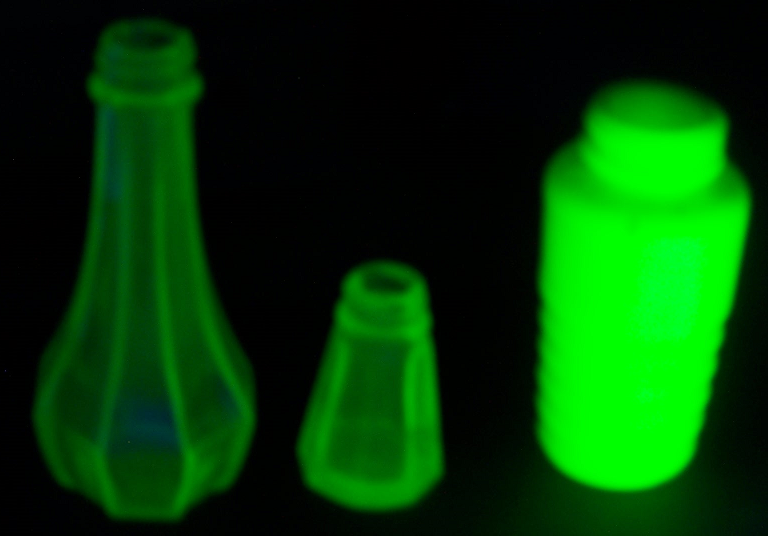
Sometimes you might not want the item to look like it looks in real life - not because you are being dishonest, but because you want to show certain details or features that might not be real obvious to the unaided eye.  The photo at the top of this post shows some found bottles.  The photos were taken in black light to show something you wouldn't see by actually looking at the bottles without the black light.  Those photos were taken for a specific purpose.

No matter how good a photo might be, it is not like being able to hold the item in your hand.  If you are holding it, you can turn it, get it under different lighting, inspect it from all angles and touch it.  It is easier to get a good feel for an object when you are holding it.

You can sometimes photograph things so that you can see things that you can not easily see with your own eyes.  You can use magnification, for example, and you can adjust the photo with editing software to do such things as increasing contrast or sharpness.

If you have a good closeup lens or a microscope that can take pictures, you might be able to see and show very small marks or details.  Different kinds of lighting can help too, as shown above.

I had one piece of red sea glass that I did not realize was made with uranium to make it glow.  I found information that told how lenses used on buoys were sometimes infused with uranium to make them glow.  I could only see some suspicious yellowish specks in the glass, but when photographed under black light, I could see that the glass was fluorescent on one side.

You can read more about the red sea glass and those fluorescent bottle finds in an old post by using the following link.

http://treasurebeachesreport.blogspot.com/2015/09/91715-report-how-one-artifact-continues.html

When it comes to coins, it is often best to have them lighted from an angle.  A flash aimed straight at a coin will usually glare out a lot of detail.  Remember that a coin is not a flat object.  It is often best to photograph it in a way that shows the three-dimensional features.

Photo of Recently Found Wheat Penny.
This photo isn't a bad photo for the intended purpose.  I just wanted to get a good closeup view.  It was taken with a Celestron microscope camera - an inexpensive camera setup that can make decent close-up photographs of smaller objects such as coins.  My primary purpose was the see if there was any doubling.  There was not.  The one shown below does show doubling.  That photo is from eBay.

Photo Taken From eBay Showing a Error Coin.
The Celectron is more convenient than using a  high-powered loop at times.  And the lighting is easily adjusted.

Lighting is one of the most important things for any photo.  Move the light around until the coin shows like you want it to.

When submitting photos of artifacts to be identified, make sure to provide a variety of angles and some idea of the size of the object.

If you want to photograph old embossed bottles, I often position them so the sun is behind the bottle and shining through it.  Move it around until you have the right angle.  That can take some experimentation.

My main point is to think of the purpose of your photos and make adjustments so that the photo will accomplish the intended purpose.

It is usually easier to identify an item in person, so if you want somebody to try to identify an item from a picture,  give them some chance by giving them the best pictures you can.

---

Bill Popp sent me an email and reminded me that items are often not lost where people think they are lost.  That is a good point.  Bill pointed out that when a person first misses an item, they tend to think that is where they lost item, but that is not always the case.

I've found items almost exactly where someone told me they were lost, but more often the item is not found or is found somewhere else.  It is not unusual for an item to show up some distance from where it was thought to be lost.

Thanks for the good reminder Bill.

---

There is no tropical activity brewing.  The tides are moderate.

Today the Treasure Coast will have a one to two foot surf.  The surf will increase a little tomorrow and be up to three of four feet Thursday.

Happy hunting,
TreasureGuide@comcast.net


Some people believe that they can make good things happen for themselves by keeping a positive attitude.  There is undoubtedly some truth in that, even if it might not work exactly the way they think.

A positive attitude is a real asset for a treasure hunter.  If you don't have the expectation of being able to find something, you probably won't even buy a metal detector.

People are different.  Some can tolerate long periods of frustration.  Others can't.  A positive attitude can keep you going through the dry spells.

People often say that persistence is the difference between success and failure in treasure hunting.  It is certainly a big factor, but not the only one.

Many people who buy a metal detector get discouraged and quit after a few outings.  They don't stick with it long enough to learn what it is about.

A treasure hunter must be somewhat optimistic, otherwise they wouldn't spend the time looking.  It takes time to become proficient.  The ability to be happy with small successes is also an asset.  It will keep you entertained and going until you can find bigger and better things.

Have you ever wondered what is the difference between the treasure hunter and those that sit on the beach watching.  Many beach-goers are curious.  Some will stand and watch over your shoulder while  you dig, hoping to get a glimpse of what you find.

How many times have you got the question, "Did you find anything?"  Or, "Did you ever find anything good?"  Or, What is the most valuable thing you have found?"  Those are common questions that you will get.  Those people seem to be curious, but not enough to try it for themselves.

One place where I hunt once in a while, people will tell me there's nothing there.  Yet I go out and make finds.  The next time I'm there they tell me again, there's nothing there.  I show the gold ring or old coin I found the last time, and then they tell me there is nothing else there.  The fact that I showed them that there was something there doesn't seem to impress them or change their mind.

There are people who are curious but won't try it for themselves, and there are people who are not curious at all.  Neither will give it a try. They don't have the dream.  They won't make the effort.

A positive attitude is a great asset, especially if you can keep it when things are not going well.

Not only will a positive attitude make you happier and more energetic, it will also improve your relationships.  One negative person can bring down an entire team, while a positive attitude can inspire and energize people.


http://blog.spiritdaily.com/inspiration/why-negativity-is-a-social-killer


When too much success comes too quickly, it can set up unrealistic expectations.  There have been people who have found a gold coin on their first outing.  Imagine going then going out the next time, next ten times, or next hundred times and being unable to follow the first outing with anything nearly as exciting.  It could lead to discouragement and disappointment.  I hear a lot of you saying, "Wish I was that lucky."


People who start out with unrealistic expectations are not likely to last long.  Most will become disappointed and discouraged in a short time. Those won't last a year.

The expectation might be totally unrealistic for some people.  They think if they have a metal detector all they'll have to do is go out for a while and it they'll find gold or something great.  They might not realize how much some people put into metal detectin


This summer’s Mel Fisher Days are set for July 13th-15th. Every summer a celebration is held in honor of Mel Fisher, a man who pursued his dreams and discovered a fortune in treasure in the seas off Key West, inspiring millions to follow their own dreams and earning him the title of The World’s Greatest Treasure Hunter.

On July 13th and 14th Mel Fisher Fans can participate in Behind the Scene Tours of the Mel Fisher’s Treasures Conservation Lab on Thursday and Friday, 10am and 4pm, at 200 Greene Street. Space is limited; Pre-registration is encouraged on the Mel Fisher Days website.

The annual Dock Party at Schooner Wharf will take place Saturday, July 15th from 3pm-9 pm at 202 William Street. From 4:30pm-6:10pm, Captain Andy and his crew are offering tours on board Mel Fisher’s Treasures’ 90 foot salvage vessel, JB Magruder. The Magruder will dock at the Historic Seaport, just behind Schooner Wharf Bar.

The evening is filled with a HUGE silent auction, live auctions, the famous Cupcake Contest, 50/50 raffle, the presentation of the prestigious Mel Fisher Lifetime Achievement Award to Andy Matroci, great music and drink specials. The world famous Mel Fisher silent auction will offer over $15,000 in exotic items including everything from gourmet dinners to luxurious vacations and authentic treasure from the Atocha, The Santa Margarita and the 1715 fleet shipwrecks.

Starting Monday 10th, Mel Fisher Fans can enter a free raffle at both of the Mel Fisher retail locations, 200 Greene Street or 613 Duval Street. Drawing for the raffle winner will take place at Schooner Wharf at 8:45pm. One lucky winner will take home an Authentic Atocha coin valued at $1,400. Must be present to win. No purchase necessary.

During the 16-year search for the Nuestra Senora de Atocha, Key West embraced Mel, his family and crew, and supported them when others did not. Now his namesake company, Mel Fisher’s Treasures, is committed to giving back to the island community he called home. All of Mel Fisher Days’ net proceeds benefit Wesley House Family Services, a non-profit organization whose mission is to promote and enhance the safety, well-being and development of children by educating, supporting and meeting the needs of families. “Mel Fisher’s legacy is part of the life-blood of Key West,” commented Jeremy Wilkerson, Director of Community Relations for Wesley House, “and Wesley House Family Services is honored to share in celebrating this legacy and thankful to be the recipient of Mel Fisher Days event proceeds, which will provide crucial support to child welfare and family preservation throughout the Florida Keys.”

For a full Mel Fisher Days schedule and advance registration discount tickets visit


Boat Update

June was one of the best month’s we have had this year for finding Atocha and Margarita artifacts. We found a ornate piece of gold jewelry, more than a dozen silver coins
g.  They might not realize how long it can take to become really skillful. They might think that the detector will lead them to treasure somehow.

Thursday, September 17, 2015

9/17/15 Report - How One Artifact Continues To Reveal More Of Its Story. Tropical Depression Nine.


Written by the TreasureGuide for the exclusive use of treasurebeachesreport.blogspot.com.

nhc.noaa.gov


We have tropical depression nine now.  It is supposed to stay out there.  Probably won't have much effect on us.

As you can see there is another disturbance behind that one, and one down by Key West.

Today we had around a three or four foot surf on the Treasure Coast.

The tides are moderate.  The surf will be down around one or two feet again this weekend.

---


I found this red sea glass quite a while ago.  It is in my opinion an exceptional piece of sea glass and would sell for a few dollars.

It is nicely worn and shaped and is a rare color.  Yellow is more rare, but red is right up there.

But what I wanted to talk about today is the detective story and how information about an item can be revealed slowly over time.

As I said, I found it a long time ago.  As with all finds, I'm always interested in trying to determine what things are and where they come from.  I didn't know, but I guessed that this piece was part of a lens.  If so, what kind of lens?

Well, it sat around for a good while without me gaining any more information about it.  I had inspected it with a loop and saw some very small yellow specks in the glass.  They weren't really on the surface - more like in the small air bubble depressions.  I didn't have any idea what that yellow residue was about.

Yesterday I showed how a black light could be used to reveal more information about fossil seashells.  That was just one example, but a good one.  What I was really trying to show is how to inspect items in various ways, such as under magnification and different types of lighting.

Vintage Glass Finds.
I often find old bottles and glass.  The above picture shows three such finds.  The two on the left are Depression glass and the one on the right is Vaseline glass.  I think those are the right terms.

There are a lot of collectors of both depression glass and vaseline glass.  I've sold some pieces in the past.

I'm not changing topics.  I'm going somewhere with this.

Depression Glass and Vaseline Glass Photographed Under Black Light.
I tried the black light on those items, and you see what I saw.  They glow.

Both types of glass were made with uranium.  Yes, uranium.  Vaseline glass has a more yellow color. To create the more green depression glass, iron oxide was added.

OK.  A black light can reveal some interesting things with some types of glass.  So now I tried the red sea glass under black light.

Red Sea Glass Under Black Light.
I shut out all the light and shined the black light onto the red glass.  The one side showed nothing.  I couldn't even see it in the dark room, let alone photograph it.

I turned it over, and saw a world of difference.  On this one side, it glowed!

It was the side with the yellow specks infused in the glass that glowed.  It glowed orange.

What does that say?  Uranium isn't used in glass nearly as much as it was back in the day, although people do copy depression glass and vaseline glass.  So is this glass older?  I thought it was older just judging from how it was worn into a very rounded cushion shape.  And why was it made to glow?

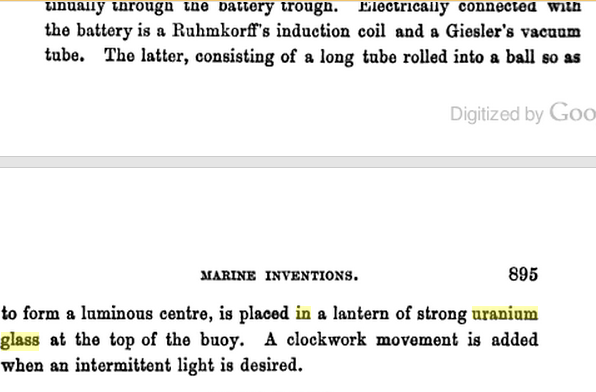
Then I ran across the following text.


This clip was found in an 1878 nautical magazine.  It is talking about how uranium glass was used on a buoy.  Is that what I have a piece of?  I don't know.  But the evidence is mounting that this red sea glass was once part of a lens, perhaps like was used on a nautical buoy.

Click here to link to the nautical magazine.

What I am talking about today is how an item can continue to reveal more about itself, and how various methods of inspection and research can help make a find come alive.

The same process can occur with almost any kind of item.  Even an item as simple and mute as a squarish little piece of glass will continue to tell you more of the story as long as you are curious and really want to know.

It is something like that with people too.


---

I was without internet most of the day, so that is it for today.  I didn't think I was going to get any kind of post done today.

Happy hunting,
TreasureGuide@comcast.net.

Wednesday, September 16, 2015

9/16/15 Report - Old Rare Treasure Coast Treasures. Using Black Light On Sea Shell Fossils and Artifacts. Outer Banks Videos.


Written by the TreasureGuide for the exclusive use of TreasureBeachesReport.blogspot.com.

Fossil Seashell From The Treasure Coast
Lighted By Ultra Violet Light To Reveal Yellow Bands.

A black light can be used for more than lighting up psychedelic posters.  I found that out somehow long ago.

You can use a black light for finding or identifying some gem stones, such as corundum.  Actually not all corundum glows in black light, but an ultra violet light will make some rubies and other gem stones glow in the dirt.  That makes them easier to find.

You can also use a black light to classify gem stones.  Black light can also be used to tell if some gem stones are natural.

I've pointed out before that calcite crystals in fossil shells will glow under black light.

Black light can also be used to reveal the original lost color patterns of chalky white fossil shells, which can help to identify previously unknown species.

Southern Florida has a very rare and special treasure that you might not be aware of.

These fossil seashells are found in deposits at several places in southern Florida. The ones figured here [in the following linked paper] came from spoil banks bordering a canal in Okeechobee County and are ten to fifteen million years old...

Their "secret" character is not possessed by the Los Angeles County fossils or, to the same degree as far as I know, by other fossil seashells from elsewhere. We have tested all the ones in our museum collections, which is worldwide in scope, although obviously incomplete. What causes this geographic restriction is unknown at present. When exposed to the short wave kind of ultraviolet light in darkness, some of the fossil Florida seashells fluoresce brilliantly with symmetrical orange patterns against a glowing violet background.

The two paragraphs above are from a really good paper that can be found through the following link.

http://research.nhm.org/pdfs/33751/33751.pdf

I didn't have a good setup to make good pictures in black light, but I did manage to get the photo at the top of the post.  The nice yellow lines show under black light.

The paper found through the research.nhm.org link above shows other examples Florida fossil shells and their color patterns as seen under black light.

The fossil shell shown at the top of this post, to the best of my very limited understanding, is an excellent museum quality specimen of a fossil tulip shell.

Here is another link on the same subject of using a black light to see color patterns of fossil seashells.

https://www.washingtonpost.com/news/speaking-of-science/wp/2015/04/01/bone-white-ancient-shells-reveal-their-dazzling-colors-under-uv-light/

If you are not into seashells, even million-year-old Florida fossil shells, you can use a black light to bring out markings on artifacts that otherwise might be very difficult to see.  Black light will also reveal slight differences in the surface of artifacts.

One hand made lead fishing sinker that I found, when displayed under black light, showed how the edges were carved.  I didn't notice that under normal lighting.

If you have an ultra violet light take a look at a variety of artifacts under the black light and see what you can find.  I'd like to hear about it if you find anything interesting.   Send me an email.

---

Here are some nice quick video clips of a North Carolina beach sent by GoldNugget.  He shows the beach, finds and equipment.

The North Carolina beaches are a bit different from ours.  They get more tides, and I would say lately, they've also been getting more waves.  GoldNugget has some nice old coins and buttons and other things to show.


https://youtu.be/POT3aqQP2i0 


---

There are now two tropical disturbances in the Atlantic that could be headed our way.  Both have a 90% chance of becoming a cyclone in the next 48 hours.

Keep a watch on those two even if they are still out there a ways.

This was the kind of morning I like -  cloudy and rainy.  I could do without the thunder.  And I'd like more wind and better beach conditions, but otherwise, I prefer this to those glaring sunny days.

Happy hunting,
TreasureGuide@comcast.net

Thursday, May 28, 2015

5/28/15 Report - Unique Beach Treasures. Fossil Shells With Calcite Crystals


Written by the TreasureGuide for the exclusive use of treasurebeachesreport.blogspot.com.

Sometimes you can find fossils on the beach that are a million years old.  That hasn't been the case much lately though.  Conditions have been too poor, and like with cobs, some of the best places  have been covered with renourishment sand.

Whelk Shell Fossil Photographed in Black Light.


Did you know that naturally formed gems have  been found on the Treasure Coast beaches?  I'm not talking about those that have been lost at some time.   I'm talking about gems that formed and were never before touched by man.

They aren't diamonds, rubies, or emeralds either.  What I'm talking  are fossils shells filled with crystals.  I'm talking about fossil shells that are thousands or millions of years that have turned into crystal gardens.

You've probably heard of Ruck's Pit.  I'm not talking about those either, but the web site for the Fort Drum Crystal Mine (present name for Ruck's Pit) tells something about how they form.  Here is what it says.

The crystals form inside of the clam shells by a long process. "The calcite is dissolved from the fossil sea shells by acidic groundwater and then transported downward where it then reprecipitates inside the shells of the clams (called quahogs) and occasionally other mollusks," explained Means. Means further explained that the calcite crystals actually form just below the water table in water that is supersaturated with calcite (calcium carbonate).


Talking about Ruck's Pit again, the web site says, The deposit is actually a nearshore marine deposit that represents a former shoreline, " said Harley Means, assistant state geologist, Florida Geological Survey, Florida Department of Environmental Protection. Means explained that sand and fossil seashells found in the mine are thought to be several million years old...

Here is the link to the Fort Drum Crystal Mine Web Site.
http://www.thefortdrumcrystalmine.com/
You can visit the Fort Drum Crystal Mine to search for fossils for $45 per person until June when the price increases to $60 per person.
Long before global warming the sea was much higher than it is today.  Things come and go.
Back to the beach.   There are deposits of calcified fossil shells found at other places besides Ruck's Pit.  An occasional shell with calcite crystals can be discovered on the beach.  The one shown at the top of this page is one example.

Same Whelk Shell Shown Above
Closeup In Regular Daylight.

In this blog I've shown both fossil shells and bones found on Treasure Coast beaches that contain calcite crystals.  One neat small fossil bone that was found on a Treasure Coast beach has calcite crystals in the hollow of the bone.
Certain minerals fluoresce in ultraviolet light.  That is what you see in the picture at the top of the page.  It isn't easy to photograph objects under black light, but I think you can see some of the rich purple and yellow fluorescence in that photo.

I have also used a black light to find certain fluorescent gem stones such as rubies and garnets.  The black light really makes them pop.

Paleodirect.com sells fossils and shows one calcite crystal fossil conch shell on the site.  I found the following description of that fossil shell instructive.
Here it is.

ULTRA RARE GEM-GRADE YELLOW CALCITE CRYSTAL-FILLED FOSSIL CONCH SHELL
Okeechobee County, Florida, USA
PLEISTOCENE PERIOD:  1.81 million years - 10,000 years ago
Fossils that have been formed or filled with gem grade minerals are amongst the rarest and most beautiful of all.  The highly uncommon geological occurrence of a well-preserved fossil formed out of stunning gemstone grade minerals is why these specimens are so passionately coveted by both fossil and mineral fanciers, alike.  They make up the rarest of fossils and almost always sell for several thousands if not, tens of thousands of dollars.

In south Florida, there is a gravel shell pit that this strange phenomena can be found - crystals in fossils!  The occurrence of calcite-lined shells is this site's hallmark but the calcite ranges from a light coffee color to a drab burnt honey hue.  Intense yellow gem-grade specimens such as this are not found at the mine but have been found in the same formation of a nearby undisclosed site.  A fossil of this quality, completeness with crystals of this clarity and intensity is no less rare than finding fine grade gemstones of any type from any site in the world - actually rarer since this is a perfect crystal specimen AND a fossil. 
  
This is a small Busycon species gastropod fossil from the last North American Ice Age Period.  The entire shell's internal cavity has been fossilized with the whorl and inner chamber filled with bright lemon yellow gem-grade calcite crystals.  Nearly the entire shell has been completely replaced with translucent glowing calcite as seen in the above images.  Busycon was a predatory marine whelk that fed mainly on bivalves by attaching itself to its prey with its foot and slowly rasping a hole in the shell of its unfortunate victim.  Whelks can move great distances and can go against tidal currents with the use of its powerful foot.

This specimen was part of an extremely limited find that was made by the quarry geologist NOT at the working mine but at a location nearby that is not part of the commercial operation.  This find was very limited, discovered and collected in the early 1980's and specimens of this nature have never been located since.  This color and quality certainly does not occur at the working quarry.  Of the few rare examples that have hit the market, prices have exceeded $1000.  The color and lack of crystal damage on this beauty easily top those $1000+ examples. This is the only one we will ever offer as it was a rarity unto itself for us to even acquire it.  If you want a stunning and rare mineral AND fossil specimen all wrapped up in one, you could hardly find a more affordable and yet beautiful example.  Guaranteed NO REPAIR and NO RESTORATION.  This beauty is AS FOUND!

The deposit that this prize specimen was collected from offers an abundance of well-preserved fossil marine shells.  Its coquina matrix dates to the Pleistocene and is part of the 'Nashua Formation' being composed of cemented marine fossils with calcite.  


That description is from https://www.paleodirect.com/pgset2/ga034.htm

Not only have I seen fossil shells with calcite crystals on the beach, I have also seen some in the Indian River.  I don't know how they got there.  They could have been dumped there with road fill for Indian River Drive, but I don't really know.

---

People say all the time that you can't take it with you when you die, but there is an exception.  The only thing you can take with you is what you give to others.

----

Happy hunting,
TreasureGuide@comcast.net