Written by the TreasureGuide for the exclusive use of treasurebeachesreport.blogspot.com.
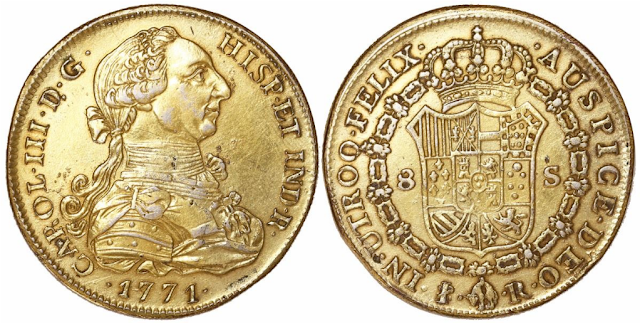 |
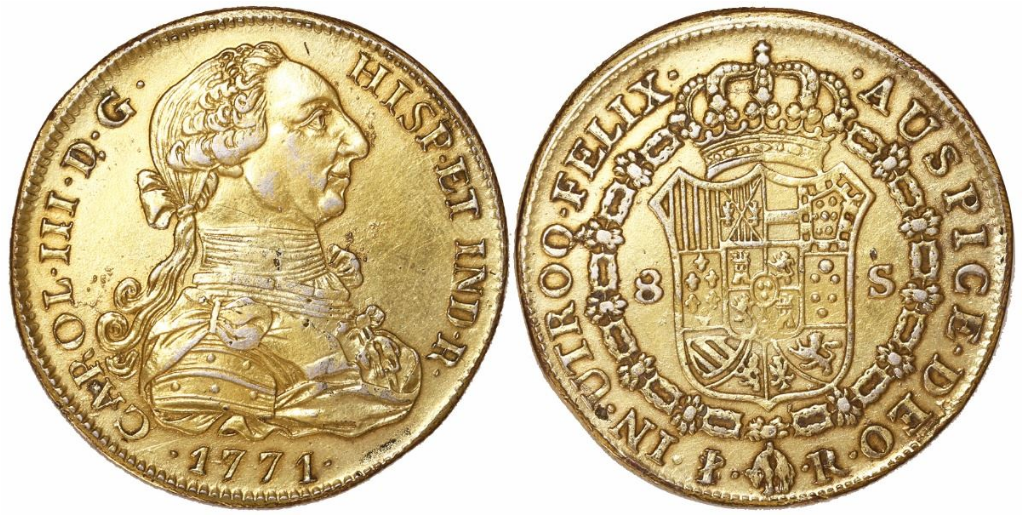
Contemporary Counterfeit Sold for $2350 in Recent Sedwick Auction.
Source: Sedwick Auction Catalog. |
This contemporary counterfeit sold for $2350 in the recent Sedwick auction. It is gold gilt over platinum. That might seem funny to you if you don't know the history of platinum. While platinum today is a precious metal, there were times when it was little more than a nuisance.
...Despite being worked with some skill by South American Indians over 1,000 years ago, it was not until after the Spanish conquest of the New World during the fifteenth and sixteenth centuries that news reached Europe of a new white metal with unusual properties.
By the end of the 17th century, the Spanish Conquistadors had discovered alluvial deposits of platinum while they were panning for gold in the Choco region in what is today Colombia. They considered the metal a nuisance because it interfered with their gold mining activities. In fact, since platinum was considered of little value, it was soon being used by forgers to adulterate Spanish gold coins.
And here is the Sedwick auction description.
Gilt platinum contemporary counterfeit of a bust 8 escudos of Charles III, 1771, fantasy mintmark and assayer R. 26.81 grams. Incorrect but convincing details, the mintmark somewhat like the Potosi monogram, AU- (lightly circulated) with traces of platinum peeking through the slightly worn high points.
"Contemporary counterfeit" is the term used to describe a copy that was made to be used when the coin was in circulation. It does not refer to later copies or reproductions such as fantasy coins or souvenirs.
---
You might recall that the crew of the Captiana found hundreds of escudos during the 2015 season. Three, if I correctly I recall, were minted in Seville.
Previously there had been very few, if any, Seville minted coins found on the 1715 wrecks. In the Florida collection of about 24,000 silver coins, most of which came from Spanish shipwrecks and approximately 600 of which are illustrated in Alan Craig's book, none of those illustrated are from Old World mints. I can't swear that I didn't miss a mention or two of Seville minted coins in his book, but it is clear that there were few if any Seville minted silver coins in the nearly 24,000 coins in the Florida Collection.
Also as I recall, in the distribution from the 2015 salvage season, the state selected one of the three recovered Seville minted escudos. With all that they had to choose from this year, the fact that they chose a Seville minted coin must say something about how rare and interesting it is. The state also selected a Royal that was found this year - a rare coin indeed.
I was therefore interested in the good sample of Seville minted escudos that were offered in the recently concluded Sedwick auction. That sample provided a good opportunity to take a look at the relative prices and the factors that affect the price.
If I didn't have so much else to do, I'd go through auction results and develop an equation that would give a good estimation of the value of auctioned Spanish shipwreck coins. It wouldn't be difficult, and I'm sure I could develop an equation that would account for some 90 percent of a coins perceived value. I'd bet it would take no more than eight variables, including such things as year, mint, assayer, denomination, condition, etc. I like analyzing data and doing that type of thing.
I did a very limited and simple partial analysis of the realized prices of a few of the Seville escudos sold in the recent Sedwick auction just to illustrate how easy and productive it could be.
Below is a graph showing the prices of ten Charles and Johanna one-escudos sold in the auction. The prices are the winning bids, not including the buyers premium. If I were to do it again, I would probably include the buyers premium.
As you can see the range is $500 to $900, with an average of $685. The progression in price is gradual. There are no real outliers, suggesting that there were no really exceptional escudos in the group.
Comparing the Seville minted Charles and Johanna one-escudos with three Phillip II Seville one-escudos sold in the auction shows no huge difference in prices. The Phillip IIs had a range of 600 to 900, and an average of 800. The average is higher, but the sample size is simply too small to be very useful. I just did this comparison for illustration purposes. It appears from this very small sample, that there is no big difference in perceived value between the Charles and Johanna and the Phillip II one-escudos.
There were seven Seville four-escudos of the Phillip II era that sold in the auction, so I did a chart for them. The range for this group was larger, 750 - 2600. The average was 1471.
The range of this group was about five times greater than the range for the group of Charles and Johanna one-escudos.
There appears to be two distinct groups shown by that chart. The lower priced grouping with prices ranging from 750 to 1000, and another group ranging from 2050 to 2500.
Actually, there was a happy mistake. I thought I'd go back to see what factors separated the two groups, and what I found was that the low-priced group was composed of two-escudos, while the high-priced group was composed of four-escudos. I only wanted to include four-escudos, but pricing showed that there were really two distinct groups included.
The mistake actually illustrated how useful price charts can be. This one shows that two-escudos and four-escudos are valued very differently. There are other factors besides denomination that cause price differences, but in this case the priced differences that can be attributed to denomination is considerable. It could have been condition issues, a rare date or something else. And if those factors affect prices enough, I would expect those differences to also be apparent in similar charts.
The lower-price group that is actually composed of Phillip II two-escudos falls into the same price range as the Charles and Johanna one-escudos. The era difference appears to be significant there.
On the other hand, the three Phillip II four-escudos shown on this chart are about three times more expensive than the Charles and Johanna one-escudos.
I could go on and on about this, but the sample size is so small, and I just wanted to illustrate how easy it would be to figure out how coins should be priced and what factors most influence price. With more data I don't think it would be difficult to work up a good regression equation that would give a weight to each factor that affects a coin's price. The sample size could be increased by going back to the records of previous auctions.
I noticed one coin that didn't sell. It wasn't included in the chart. The starting price was more in line with a more expensive group than the group to which it belonged. From a quick analysis of results, it looked like the "no sale" could have possibly been predicted.
In some forums there is probably no more common question than "What is it worth." This type of analysis can help answer that question. A person equipped with the equation and relevant data could figure out a good approximate price very much like an expert.
Just a couple more notes on Seville cobs. Seville cobs documented to a shipwreck, especially a New World shipwreck, tend to be more expensive. With more analysis I could probably give a good estimate of how much more.
I used the terms "cob" and "coin" interchangeably. If you want to be more precise, there is a real difference between a cob and a coin.
---
Puebla. Residents in a Mexican city woke in fright before dawn on Saturday to bright light in the sky and then a thunderous noise, fearing a nearby volcano had suddenly erupted, AFP reported.
But officials said Popocatepetl volcano had not stirred and no earthquake had registered.
Instead, the phenomena witnessed by the inhabitants of Puebla de Zaragoza, a city of three million people 50 kilometers (30 miles) from Mexico City, was "most likely a meteor," the local Astronomic Society tweeted.
The rock from space probably burned up in the atmosphere and no impact was detected, it explained.
"It was horrible, we thought it was the volcano, but it wasn't," said one resident, Emma Chavez.
"There was a light that shone for a couple of seconds like it was daytime and then there was tremendous thunder."
Another resident, Alvaro Morales, said: "It was really strong. Windows were shaking. We thought it was an earthquake, but it wasn't. There was a sound like an explosion. We were truly terrified."
---
Happy hunting,
TreasureGuide@comcast.net
 Small Encrusted Rattling Object.