Showing posts with label page. Show all posts

Tuesday, October 30, 2018

10/30/18 Report - Life On Board a 17th Century Galleon. Serial Number Hunting. Survey Monuments. Hurricane Oscar.


Written by the TreasureGuide for the exclusive use of treasurebeachesreport.blogspot.com.
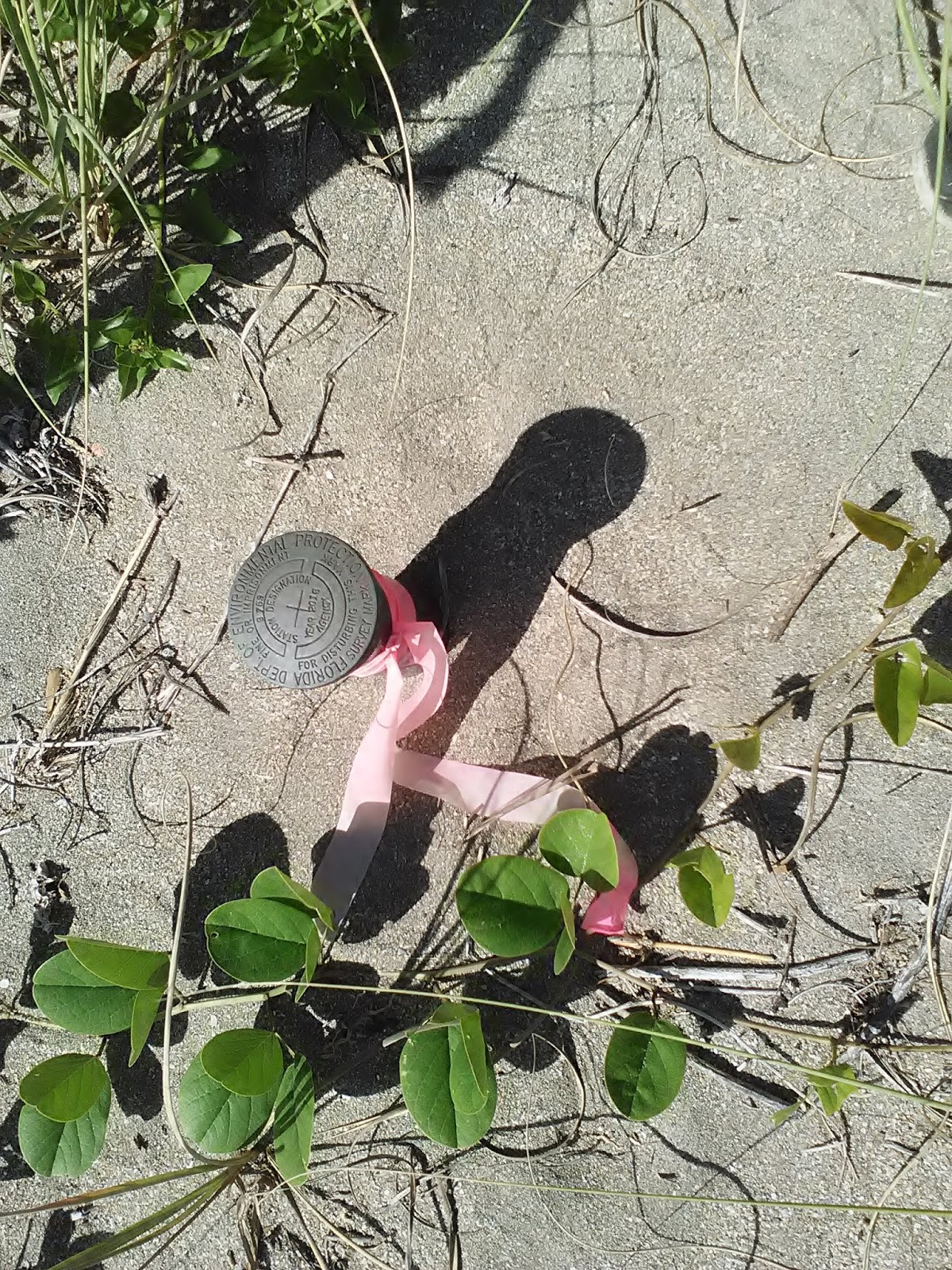
Survey Monument Near John Brooks Walk-over.
A couple of days ago I was talking about tracking the beach and how it has moved over the years.  In that post I showed a map with the survey monuments marked.  Here is one of those markers at John Brooks, just south of the walkover.

---

I've also been talking about serial number hunting.  Here is a near winner that I got recently in change.


The serial number is 21221912.  If the nine was either a one or a two, the bill would have been worth probably at least ten times the face value.  It would have been what they call a binary.  As it is, it is a tertiary (has three different numbers in the serial number) and still might be worth a little premium.

---

It is easy in this day and age to forget about the people and experience of daily life on board a 17th or 18th century galleon.  It is difficult, if not impossible, to have much of an idea of what it was like.  Below are a couple examples reported by passengers that will give you some idea of the rituals.

The watchglass (sandglass) and the compass box were both maintained with care.

At each half-hour turning of the watchglass, the page on duty calleed out a verse, with words specific to each of the eight turnings in the four-hour shift.

At the first turning, he would say, "Good is what's past,and better what comes; one glass is past and the second is filling; more will be filled if God be willing; to keep the right time makes the voyage fine." 


At nightfall after the evening meal those on board heard the Buenas Noches of the page bringing light to the compass box for the night: "Amen and God give us good night; good voyage, good passage for the ship, sir captain and master and good company."  Then two pages recited the evening prayers: Pater Noster, Ave Maria, Credo, and Salve Regina.  Once finished, the pages on duty went to care for the watchglass, which presumably had been running as usual while the prayers were being said, and recited the nightly blessing; 

Blessed be the hour God came to earth, 
Holy Mary who gave him birth,
and Saint John who saw his worth.

The guard is posted,
The watchglass filling,
We'll have a good voyage,
If God be willing.


On special occasions, there might be quite elaborate religious ceremonies in a fleet, particularly on the capitana and almiranta.  After surviving a thirty-six hour hurricane, one ship returning from the Indies in 1622 held a service of contrition dedicated to Our Lady of Carmen, patroness of mariners.  Everyone on board attended, with the image of the Virgin, adorned with what finery they could salvage, presiding over the gathering from a portable alter on the poop.  The Jesuit chronicler of this voyage led the service, including in his chronicle the long litany to the Virgin recited by those on board, with Latin phrases chanted by the priest answered by the Latin responses from his floating congregation.


For Holy Week, among other great festivals of the church year, crew and passengers participated more fully in the events, although Holy Week would have been rather early for voyages across the Atlantic.  One description of the events noted, 

Since there were religious in the fleet, most of the people confessed, and  on Holy Thursday, with silks and other things that had been brought along, each ship decked itself out in the manner of a monument , displaying images and crosses, and on many ships there were a large number of penitents attending the persons who carried the images.  Holy Saturday at the time of the "Gloria," the capitana first and afterwards the other ships made much rejoicing and fired all their heavy and light artillery, so much that it was quite something to see.  Easter Sunday, in the morning, all the ships, led by the almiranta, went to salute the capitana, which displayed its many flags and banners, and they saluted her with much artillery.  The capitana returned the salute of the almiranta with seven or eight pieces of heavy artillery and with music and trumpets and other instruments returning the salutes of the other shipwswith music alone.


The above excerpts in blue were taken from Six Galleons for the King of Spain by Carla Rahn Phillips.

---

Oscar is now a hurricane but is out in the middle of the Atlantic and headed away from us.

The surf will build Wednesday then start decreasing again Thursday.


Source: MagicSeaWeed.com.

Happy hunting,
TreasureGuide@comcast.net

Friday, September 21, 2018

9/21/18 Report - The People of the Treasure Galleons and Those Who Salvaged a New World Wreck. Internet Domination.


Written by the TreasureGuide for the exclusive use of treasurebeachesreport.blogspot.com.


In 1634, the galleon Los Tres Reyes was wrecked  at the entrance to Cartagena harbor on Aug. 4.  Local boats were recruited to do the salvage.   The work was done mostly by black slaves, and even though they were clearly designated as slaves, they were paid three reales a day for their work.

That seems to be a pretty good amount.  Just for comparison, a first class seaman at the time would be paid about 44 reales per month - a little over one reale per day.  And a cabin boy or page on a galleon would be paid about 22 reales per month.  Wages went up rapidly from the 1500s into the 1700s, so the amount would be much higher in the 1700s.  Most wages nearly doubled from 1514 to the early 1600s.

Pages were the lowest paid of mariners.  They were often orphans with no better choices in life, or wanting to learn and develop a career as a seaman.  Above the page was the apprentice seaman and common seaman.

The highest paid of a fleet was the captain-general of the galleons, who around the year 1630 would make about 5000 reales a month.  In descending order from there was the admiral of galleons, captain-general of merchant fleet, admiral of merchant fleet, joint captain sea and land, sea captain, master, master or rations, pilot, contramaestre, diver, guardian, master gunner, water bailiff, dispenser or provisions, notary, chaplain, carpenter, caulker, cooper, gunner, drummer, barber/surgeon, and then the common seaman.

That information is taken from original source documents in the Spanish archives and published in Carla Rahn Phillips' book, Six Galleons for the King of Spain.  That book follows the building and life cycle of six galleons built in the early 1600s, including costs, logistics, events, etc. 

I think we often forget that people of the treasure fleets.  This book puts the treasure fleets into a more complete and realistic context.

I have some personal observations from the 1715 Fleet beaches that I've wondered about over the years.  One is the high percentage of half reales found on some of the wreck beaches relative to the small number of small denomination cobs salvaged from the nearby wrecks.  One thing I've wondered is if the half reales  (and some trade goods such as silver rings, which have not been found on the wrecks) were used as payment for the salvage workers.  I have no evidence to support that idea.

The lack of silver rings found on submerged wreck sites by treasure salvage crews  is a bit puzzling because silver rings have been found on Spanish colonial archaeological sites.

----

Google, who has cooperated with China to develop a repressive government-controlled internet for China while suppressing conservative expression in the US, says China is well on its way to developing a dominant internet to rival that of the US.  US tech companies have been willing to give up their intellectual capital to have a piece of the Chinese market.  China is making a serious move to be THE world leader, and a big part of that is control of the information super highway.  The interenet, as you probably know, was originally developed by the US Department of Defense.

Here is a link about that.

https://www.cnbc.com/2018/09/20/eric-schmidt-ex-google-ceo-predicts-internet-split-china.html

The internet is a indispensable tool for detectorists and treasure hunters.  As someone who was into detecting before the internet was common, it has changed things dramatically.

Before the internet, research was much more difficult and there was very little sharing of information.  A lot of the detectorists back in the eighties, especially those detecting for modern jewelry, were very secretive.  Some of the best detectorists hunted mostly before sunrise and, were seldom seen and never told what they found.  Some of that is still in me, although I've certainly opened up a lot.

---

Source: nhc.noaa.gov
There are four areas of weather to watch in the Atlantic now.  I'd watch the one down by South America with most interest.

The  Treasure Coast surf won't change much in the next week or two if the predictions are correct.  I'd like the weather to cool down.  We often get a nice fall storm when the weather changes.

Happy hunting,
TreasureGuide@comcast.net