Showing posts with label shipwreck. Show all posts

Monday, July 13, 2020

7/14/20 Report - Florida Archaeologists Versus Treasure Hunters. Church Attacks. Creating Greater Understanding.


Written by the TreasureGuide for the exclusive use of treasurebeachesreport.blogspot.com.

See link below.


Saturday, the Queen of Peace Catholic Church of Ocala was set on fire with parishioners inside.  That is only one of a rash of church attacks that has been taking place across the country, but it isn't being reported in the media.

... Dr. Taylor Marshall, founder of the New Saint Thomas Institute and author of Infiltration: The Plot to Destroy the Church from Within, told viewers and listeners of his popular podcast that on the day before the attack, “some men of the parish of Queen of Peace” had gone up to a group of police officers to give the medals of St. Michael for protection.

“They made a Catholic gesture,” Marshall said. “They were doing evangelization. They’re doing what we Catholics should do.”

“Guess what happened: Within 24 hours someone serving the invisible enemy ran his car into their church, and poured two gallons of gasoline and lit it,” he continued. “The same police officers were the ones who came to the church and got the bad guy. So you never know. I think it was the Holy Ghost leading these good men from the parish … to give this medal, these medals to the police officers.”...


The arsonist was said to be schizophrenic.   Interesting how the "invisible enemy" terminology keeps popping up.  Sounds like a real spiritual war.

----


The above illustration is from an article that was published in the January 2020 Smithsonian Magazine.  I think I missed it, but it is still a good read.

Here is the link.


---


I posted this picture of a glass a few weeks ago.  I knew it was relevant but it wasn't quite time to discuss it in more detail.  Now it is.

About forty years ago, I would guess, I was watching Monday night football, when Howard Cosell said to Dandy Don Meredith, "You have a tremendous grasp of the obvious."  I never forgot that.

People are different.  They process information differently.  If I didn't tell you which of those two people made the comment, but you knew something about each of them, you would have no trouble attributing the comment to Howard Cosell.  It just isn't the kind of thing you would expect Don Meredith or Terry Bradshaw to say.

Some people are quite content to see the sun as coming up in the morning and going down in the evening.  They are fine with a simple view of things.  They see no relevance to the fact that it can be seen as anything different. They don't need Copernicus to add confusion.  They would undoubtedly also be fine with saying the glass is half full or half empty and not giving it any additional consideration.  Who cares anyhow?  And why consider the air?  You don't see it anyhow.  What is the relevance, they ask.

But then there are people who aren't content to simply accept the first or most obvious view of things.  They dig a little deeper.  They ask questions and consider alternatives, even if things become a little more complex.

Those people might ask how you would know if the glass is half full anything?  How would you measure half full or half empty?  Would you go by the level of the surface of the water and say the glass is half full or empty if the surface of the water is half way between the bottom and top of the glass?  Or would you measure the volume that the glass could hold and the volume of water in the glass to see if half the volume of the glass was taken up by water?

But then if you are intellectually active, you might ask even more questions.  For example, you might wonder if the glass can contain anything since it doesn't have a top?  And since the top of the imaginary glass is even more imaginary, why would you assume that the top goes straight across the top of the glass?  Could the imaginary top not be convex or concave?  

And if you are a very precise person and want to be precise in your measurements, maybe down to three or four decimal digits, it would be very unlikely to ever be half.  It would be a job to get it just right.  The more precise you make your measurements, the more difficult it would be to fill the glass to be exactly half.

I could take it farther, but I won't.  I'm sure some of you think this is all crazy jiberty jab.  But that is my point.  People are different.  

Some won't see the point of all this talk about liquefaction.  They won't see the practical application or the potential.  I'm not surprised at all by that.  But for me, understanding sand liquefaction and the factors involved seem like something that might help me more accurately understand what goes on under the crashing waves of a good storm.  Understanding how vibrations, water and air can liquefy sand, and seeing sand being sucked up into waves, can be important contributions to putting it all together.  And once you understand that, you should have a better idea of where things will show up on a beach.  

Some people are not interested in figuring it all out.  They rather wait for it to become common knowledge and then go with whatever people are saying at the time.

At this point, there are still holes in my knowledge - mostly concerning exactly how things work directly under crashing waves.  You add to your knowledge piece by piece.  You improve your level of understanding.  It is a slow and incremental process, and every once in a while, when you have enough background and understanding there are those moments of insight when it comes together for you.  But before that happens, you gradually improve your understanding and add to your conceptual toolbox. Those things make that moment of insight all the more likely.  

Adding new terms and concepts to the discussion helps too.  Even those that are eventually rejected.

Those who do not see the relevance or do not agree help too.  Old ideas can be stubborn, and people don't like to have to change their mind.  Copernicus found that out.  It is easy to find fault with what you don't understand.    

---

Source: YouTube link below.


And for those of you who, like me, aren't tired of it yet, here is a great video showing a hot-tub of liquidized sand and how to do it.


Thanks to Bill G. for the link.

---

Nothing interesting on the National Hurricane Center map for our region.

The surf continues to be low.  If you are in an area where you can hunt in the water, you won't have to fight much surf.

Happy hunting,
TreasureGuide@comcast.net


7/13/20 Report - Blue China Shipwreck. Gold Prices Increasing. Ancient Necklaces Made By Early Sea Shell Collectors.


Written by the TreasureGuide for the exclusive use of treasurebeachesreport.blogspot.com.

Site of BA02
Source: See link to Jacksonville "Blue China" Shipwreck below.

I found a good study of the "Blue China" wreck, which lies about 70 miles east/southeast of Jacksonville.  The study was conducted by Odyssey Marine Explorations and provides a lot of great information and photos.  Above is one illustration of the site.


Plates and Jars on the "Blue China" Wreck Site.
Source: Odyssey Marine Explorations Report (link below)


Source: See link below.


There is  a lot to see in this report.  Here is the link.


---

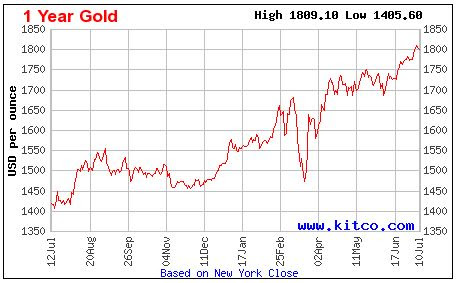
Source: Kitco.com

Gold has been doing well.  As you can see from the above chart, the price has increased from just over $1400/oz. to over $1800/oz. in the last year.

After peaking back in 2011, it has almost reached those levels again recently.

Source: Kitco.com.


Silver, on the other hand, has not be doing so well.  Silver was nearly $50/oz. back in 2010, but is below $20/oz. today.

Source: Kitco.com.


---

Picking up seashells has been a human habit for almost as long as there have been humans. Archaeologists found clam shells mingled with other artifacts in Israel’s Misliya Cave, buried in sediment layers dating from 240,000 to 160,000 years ago. The shells clearly weren’t the remains of Paleolithic seafood dinners; their battered condition meant they’d washed ashore after their former occupants had died....

Shell collectors at Misliya seemed to like mostly intact shells, and there’s no sign that they decorated or modified their finds. But 40,000 years later and 40km (25 miles) away, people at Qafzeh Cave seemed to prefer collecting clam shells with little holes near their tops. The holes were natural damage from scraping along the seafloor, but people used them to string the shells together to make jewelry or decorations. Tel-Aviv University archaeologist Daniella Bar-Yosef Mayer and her colleagues examined five shells from Qafzeh and found microscopic striations around the edges of the holes—marks that suggest the shells once hung on a string...

Here is the link to read more about that.


---

No storms to be concerned about right now.

Happy hunting,
TreasureGuide@comcast.net

Sunday, July 12, 2020

7/12/20 Report - Very Interesting Study of Database of 1,431 Shipwrecks Lost in Florida Waters. Making Quicksand?


Written by the TreasureGuide for the exclusive use of treasurebeachesreport.blogspot.com.


I found a very interesting study that provides a lot of useful concerning shipwrecks around Florida.  It is Shipping Losses and the Expansion of Global Capitalism: A Quantitative Analysis of Florida Shipwrecks, 1520-1890 by Chuck Meide.

Here are a couple excerpts that describe the study.

The present study is different in that instead of focusing on the material remains of wrecks in the archaeological record, it relies on shipping losses extant in the documentary record. My analysis is of a dataset of 1,431 shipwrecks lost in Florida waters between 1520 and 1890, modified from a larger database originally compiled by state underwater archaeologists in the Florida Bureau of Archaeological Research, Division of Historical Resources. At least one study of similar scope has been undertaken to date, that of Garrison (1989; et al 1989) which utilized a database of 4,000 shipwrecks in the Gulf of Mexico. Garrison’s valuable and innovative study focused primarily on spatial patterning in order to generate a predictive model of likely shipwreck locations, based on factors such as shipping routes, winds and currents, port location, historic hurricane paths, and the location of shoals, bars, barrier islands, reefs, and other hazards. The present 1 analysis, however, is less concerned with where or how the shipwrecks took place than with where they were going to or coming from, and with what commodities they were carrying. The quantification of these types of variables should expose patterns reflecting the ongoing processes of economic restructuring that took place throughout Europe and the New World between the 16th and 20th centuries...

The Florida Bureau of Archaeological Research (BAR) Shipwreck Database is a listing of 2,560 shipwrecks, dating between 1521 and 1949, all in or believed to be in Florida waters. It has been compiled using Microsoft Access 97 by BAR underwater archaeologists, mainly James Dunbar, under the direction of Dr. Roger Smith. While a summary of the geographical distribution of the wrecks in this database has been presented in Smith et al 1997 (38-39), for the most part this valuable resource has not been subject to any significant analytic study. The version I have used for this analysis dates to 1997, and no further records have been added to the database since that time (Della Scott-Ireton, personal communication, December 2003)... 

The following graph illustrates the kind of information you will find in this paper.


You can easily see the transition of the major shippers going from primarily Spanish to English to American shipwrecks.

This is only one of many informative illustrations you will find.  

There are breakdowns for cargos and shipping routes as well.

There is also a good bibliography.

---

Here is another video of a beach showing a group of people turning a section of beach into quicksand by stomping their feet.

You have to see this to believe it.


If you imagine the surf continually pounding the front beach, you can imagine how the sand might fluidize in a similar manner.

Thanks to DJ for that video link.

---

One person pointed out that the coin in my drain/experiment was a nickel, not a quarter.  Keen eyesight.  I'm glad the photos can be seen that well.  I was thinking I should have taken better photos, but evidently they weren't that bad.

Thanks for the correction.

--- 

I'm enjoying the Dino Hunters TV show.  It might make you more interested in finding fossils even though Florida doesn't have dinosaurs.

---

The blog is getting big and a little sluggish.  I think I'm going to start a new blog, and keep the current one for old posts.  I'm sure there will be a few small problems when I start the transition.

---

There are no storms to watch right now.

Happy hunting,
TreasureGuide@comcast.net


Monday, June 8, 2020

6/8/20 Report - Shipwreck Bochie or Manillas From 1600s Wreck. Fenn Treasure Finally Found. Sebastian Beaches.


Written by the Treasureguide for the exclusive use of treasurebeachesreport.blogspot.com.

Sebastian Sunday
Beachcam image submitted by JaminJack.

Jaminjack sent these two beach images.  The first was a little earlier when there were fewer people out.

You can see the scooped front beach and some dips in the water.


Sebastian Later Sunday.
Beachcam image submitted by JaminJack.

Thanks Jack.

---

Odyssey Marine explored a shipwreck found at the Western Approaches to the English channel.  the wreck, dated to circa 1660 - 1680, appears to be a merchant vessel of the Royal Africa Company.  36 iron cannon, a quantity of elephant tusks and copper bracelets were among the artifacts discovered on the site.


Manillas or Bochie
Bracelets Used As Money in West Africa Up To The 1940s.
Source: Odyssey Marine, Paper 23.

In Odyssey Marine Paper 23, bronze or copper bracelets that were used as money in West Africa since at least the 1500s, were discussed.  It is thought that originally they were created by the indigenous Africans from rods or spikes salvaged from shipwrecks.  Later they were manufactured in great numbers by Europeans who traded them for slaves, gold, ivory and other products.

 West African exchange demanded enormous quantities of this form of currency. As early as 1504-07, just one trading station along the Guinea coast imported 287,813 manillas from Portugal (Davies, 2002: 47). In modern terms of monetary exchange they yielded high dividends. In 1505 a Portuguese merchant reported that at Calabar a large elephant tooth could be exchanged for one manilla and a slave purchased for eight to ten copper manillas (Einzig, 1949: 150-1; Johansson, 1967: 12)…

The Odyssey paper provides a detailed study of the wreck, including much damage by fishing trawlers and provides many pictures of the site and artifacts found on the site.

Here is the link for more of the study.

https://www.academia.edu/3597456/Neil_Cunningham_Dobson_and_Sean_A._Kingsley_A_Late_17th-Century_Armed_Merchant_Vessel_in_the_Western_Approaches_Site_35F_?email_work_card=title


---


SANTA FE, N.M. (AP) — Famed art and antiquities collector Forrest Fenn, who hid $1 million in treasure in the Rocky Mountain wilderness a decade ago, said Sunday that the chest of goods has been found...


Fenn posted clues to the treasure’s whereabouts online and in a 24-line poem that was published in his 2010 autobiography “The Thrill of the Chase."...


Fenn told The New Mexican in 2017 that the chest weighs 20 pounds (9 kilograms) and its contents weigh another 22 pounds (10 kilograms). He said he delivered the chest to its hiding place by himself over two separate trips...

Here is the link for more about that.


---


Cristobal weakened as it moved inland.

On the Treasure Coast we'll have a few days of smooth surf.

Happy hunting,
TreasureGuide@comcast.net

Wednesday, June 3, 2020

6/3/20 Report - Edge of Empire Symposium Topics. Mistakes I've Made and Learned From. Tropical Storm Cristobal.


Written by the TreasureGuide for the exclusive use of treasurebeachesreport.blogspot.com


Tropical Strorm Cristobal
Source: MagicSeaWeed.com.


Tropical Storm Cristobal looks to be  headed towards Louisiana.


Source: Ventusky.com


---.

I've been finding a lot of good information online.  Below is a link that will take you to articles on the following twelve topics.  You can read any and all of them online.


1. A group for the study of iberian seafaring – Filipe Vieira de Castro  7
2. The iberian caravel: tracing the development of a ship of discovery –  George R. Schwarz  23
3. Exploration and empire: iconographic evidence of iberian ships  of Discovery – Katie Custer  43
4. The nau of the Livro náutico: the textual excavation of a portuguese  indiaman – Alex Hazlett  63
5. The spanish navy and the ordenanzas of 1607, 1613, and 1618 –  Blanca Rodriguez Mendoza   79
6. Diego García de palacio and the instrucción náutica of 1587 –  Erika Laanela  153 7. Rigging an early 17th – century portuguese indiaman – Filipe  Vieira de Castro, Nuno Fonseca and Tiago Santos  177
8. Santo António de Tanná: story, excavation, and reconstruction –  Tiago Miguel Fraga  201
9. Spanish shipbuilding in the eighteenth century: the album  of the Marques De La Victoria – J. Bradshaw Coombes  215
10. Ship timber: forests and ships in the iberian peninsula during  the age of discovery – Pearce Paul Creasman  235
11. Nautical astrolabes – Gustavo Garcia  249
12. Design of a computer-based frame to store, manage, and divulge  information from underwater archaeological excavations: the pepper  wreck case – Carlos Monroy and Richard Furuta 275


Here is the link.

https://www.academia.edu/2026686/Edge_of_Empire._Proceedings_of_the_Symposium_held_at_the_2006_Society_for_Historical_Archaeology_Annual_Meeting_Sacramento_California?email_work_card=title


---

I was thinking of some of the mistakes I've made over the years and came up with a quick list of ten.  These are mistakes I regretted enough that I kept them in mind over the years and have avoided repeating them too many times.  Some are very simply yet costly.   The one I'll mention today is very simple, yet it is something I never want to repeat.

It occurred around thirty years ago.   I parked at a state park, and walked probably a good mile or so to get to a shallow water area in front of a high-end resort that I liked to detect.  The people gathered in a small area with a sandy bottom.   I guess the surrounding sea grass kept them from spreading out more, so that helped me.   It was a small exclusive resort so there wasn't a lot of people, and there weren't many coins or good items, for that matter, but I could usually pick up one good find.  It was  not easy to get too, but there was one fellow who worked at the resort who also regularly detected the area.  He was closely watching me and what I was doing when I dug up a gold chain in the very shallow water right in front of him.  I saw him react with disgust upon seeing the flash of gold in the sunlight when I lifted my scoop out of the water.  It was a very delicate 14K Italian chain with a small Jesus charm.  Very pretty.

Anyhow I stuffed the chain in my shirt pocket and started my long walk back to the car.  When I got to the car I noticed the chain was missing from my pocket.  Additional inspection revealed a small hole in the corner of my pocket.  I had to walk back most of that mile or so before refinding the chain partly exposed in the wet sand.  I learned that it only takes a very small hole for a thin gold chain to escape.  I also learned to check my pockets before putting any good finds in them.

There was also the time my wife thought she found a very good spot and was picking up a lot of coins.  She discovered she was picking up some of the same coins because they were falling through a hole in the leather marble pouch she was using.  We both had a laugh over that one.  At least it was just coins and she didn't have to walk a mile to find her losses.

---


Soaring and Mourning.

What a day of contrasts!  Saturday we saw the human spirit soar towards the stars and fall to the depths of hate and despair.  When the human spirit is free, it soars to the heavens, but when wounded, it burns cities.  The riots of this weekend reminded me very much of the Viet Nam war era protests  and riots when I was a psychology professor 50 years ago.  The only thing that surprised me this time, is that it didn't happen sooner.  The pressure was building before the George Floyd killing lit the fuse.

As Viktor Frankl, Holocaust survivor and psychiatrist, wrote: man's primary drive is not pleasure; it is the discovery and pursuit of meaning.  The life of the spirit must be maintained along with that of the  body.  When the God-given rights of life, liberty and the pursuit of happiness are taken away, you can expect an explosion.   

I am not justifying or excusing illegal or destructive behavior - just taking a look at one psychological factor that contributed to the explosiveness of the situation and at the same time holds the solution.


---

The bush burned and was not consumed.
TreasureGuide@comcast.net

Wednesday, May 20, 2020

5/20/20 Report - Beaches. Mystery Items Reappear. Borderline Conditions Last Week. Surf Increasing.


Written by the TreasureGuide for the exclusive use of treasurebeachesreport.blogspot.com.

Fort Pierce South Jetty Park Tuesday.
I was in the area and stopped to see how the renourishment project at the Fort Pierce South Jetty beach was doing.  It looks like they finished but didn't dump as much sand as I was expecting to see.  They didn't go as far east or south as I thought they would.  The sand is a fine white sand - nicer looking than some of the previous projects.

Fort Pierce South Jetty Beach Tuesday.

Also stopped at John Brooks.  If I had my pole, I would have done some fishing.  There were some nice schools close in and a nice big fish chasing them.  I didn't take my detector out.


John Brooks Beach Tuesday.
Sand had piled up on the front beach.

John Brooks Beach Tuesday.

I also took a quick look at Frederick Douglass.  Not very exciting, and a thunder storm was coming.


, 
Frederick Douglass Beach Tuesday.

---

A couple days ago I posted a photo of a mystery find by DJ.  I got some good information on that object from John C., who showed five examples of the same thing.

Here is what John said.

Yeah, we  used to find those pretty frequently back in the 90s.  I was told back then that they were from a shipwreck, but not associated with 1715, but it's been a while, I haven't found one since I would say the hurricane season of 04.  It's interesting seeing them show up again.
Thanks.   James 1v12 

Items That Look Like the Mystery Item Found by DJ.
Finds and photo by John C.
Thanks John.

Also from the Not Just Coincidence department, below is a find from Steve L. It is the same kind of copper tack I found a few days ago.

Steve said, I also detected turtle trail around low tide Sunday. I saw 2 other guys detecting south ahead of me but none of us were digging much.  I managed to get only one target but I am happy with it. I took a picture next to a penny for size reference. I think it is like the one you found a few days ago I enjoy your blog. Steve L 

If anyone can tell me more about these items, please do.  I'd like to hear from others who have found them and whatever ideas you have about them.  Thanks.


Copper Tack Find by Steve L.
Photo by Steve L.

I always say when you find one of an item, there is a very good chance that there is more nearby.

Last Thursday I checked out a beach and there was some erosion, but I didn't know if it was enough.  I found this piece of lead, which as I said in a previous post, I took as what I call a signal find.


That piece, dense and nearly the size of a cob, told me that there was a possibility of other older dense metals nearby, so I checked the next day and found a few more small and seemingly old items, including another folded piece of lead.  My finds, along with John and Steve's finds, suggests to me that beach conditions were getting very close to producing some cobs, and perhaps would have produced one or two small ones if I had been in just the right place.  While beach conditions were not great yet, they were improving.  Unfortunately, the next day, conditions on the same beach seemed to deteriorate.  With the calm conditions we've had lately, I would guess that there are still some things that are close and could easily become accessible again with a little more movement of sand.

---

Archaeologists are racing against the clock to save the remains of a buried Viking ship from a ruthless foe:  fungus.

If the project is successful, the 65-foot-long (20 meters) oak vessel — called the Gjellestad ship — will become the first Viking ship to be excavated in Norway in 115 years, said Sveinung Rotevatn, the Norwegian Minister of Climate and Environment...
Here is the link for more about that.

https://elexonic.com/2020/05/18/fungus-is-destroying-a-buried-viking-ship-heres-how-norway-plans-to-save-it/

---

Looks like after today the small surf will disappear from the Treasure Coast.  Then we'll get up to six feet.

Surf Predictions.
Source: MagicSeaWeed.com.
Happy hunting,
Treasureguide@comcast.net


Friday, May 15, 2020

5/15/20 Report - Tropical Storm Could Be Developing. A Few New Treeasure Coast Beach Finds. The Role of The Beach Detectorist.


Written by the TreasureGuide for the exclusive use of  treasurebeachesreport.blogspot.com.

Source: nhc.noaa.gov

 Gradual development of this system is
expected, and it will likely become a tropical or subtropical storm
on Saturday when it is located near the northwestern Bahamas. Later
in the weekend and early next week, the system is expected to move
generally northeastward over the western Atlantic...
See nhc.noaa.gov for more about that.

---

Yesterday I looked a few beaches and did a little quick check at one beach.  As I mentioned yesterday I found a couple pieces of what I think is old lead.  Those finds gave me a clue that despite the relatively sandy conditions, shipwreck finds are not too far off.

Piece of Folded Lead Found Thursday.

In the past I talked about what I called "signal finds."  They are finds that are most valuable as clues or signs of conditions or nearby treasures.

When I looked out this morning and saw the nice rainy weather, even though I wasn't planning on going out until evening, I decided to go to the beach.  I like rainy mornings and staying out of the hot sun.

So when I got to the beach, conditions didn't look any better than the day before.  In fact, there was more sand.  Overall conditions were worse.  I would estimate that in most places there were inches of new sand.  Nonetheless, yesterday I had identified one area as a good possibility and focused on that area after doing a general quick check of a wider area.

When I hit the newly targeted area, I got additional encouraging signs.  First a small corroded bullet showed up.  It was not a old shipwreck item, but still somewhat encouraging.

Next I found a nearly dissolved piece of iron, then another piece of lead, which was folded up when found, then a shipwreck spike, and then a tack (photo below).


Friday Finds.

I was most surprised by the spike.  And to make it more surprising, it was found in one of the most heavily detected spots of the entire Treasure Coast on a day when there was no big improvement in conditions.  I saw two people metal detecting that area just yesterday, and that is no small target.  I could understand the tack being missed, but not so much the spike.

Anyhow, no big finds.  I guess if it was on Oak Island, the spike could be the subject of hours of excited hooplah, talk and speculation, but no big deal for the Treasure Coast.  Just a pleasant day of metal detecting.

---

People who metal detect search for different reasons.  Different people search for different kinds of objects.  What a person searches for depends upon a variety of factors, including where they are and what kind of objects can be found at a location, but it also depends upon personal interests.

Some detectorists search for coins, others for modern jewelry, others for hoards, others for gold nuggets and others for shipwreck artifacts.  Those are just a few examples.ind

Different kinds of finds can be treated differently.  Coins can be either spent, sold, made part of a collection, or in the case of those that might be corroded or badly damaged recycled for the metal content or simply thrown away.

Jewelry finds might be returned to the original owner when that is possible, sold, or kept and worn.

The Treasure Coast is known for its shipwreck related finds, including both coins and artifacts.  In the case old coins or artifacts, the role of the detectorist might be seen as finding or recovering the item, but the detectorist's role might involve much more.

After the find, there is the cleaning and identification.  Every detectorist wants to know more about their find.  In the case of a coin, that might mean identifying the mint and date, but it can involve much more, such as the shipwreck it came from, if it did indeed come from a shipwreck, as well as the method of manufacture and other details of its history, use and cultural significance.

The primary role of the detectorist is often discussed as finding or recovering items, but that might be only the first step of a long series.  Some items, depending upon the type of the item and it's condition and significance, might be passed down as a family heirloom for generations or become part of a collection or museum display.

Items that are published in one form or another, can entertain and inform many people.  Both trivial and more significant finds can add to the overall knowledge base of individuals and contribute to the knowledge of the society.  Digital communications have made it possible for the regular citizen to become broadly informed and contribute to the shared experience and knowledge of societies and cultures.

The beach detectorist does not find undisturbed sites with items preserved in context.  Rather they recover "isolated" finds that were not preserved in context.   That is one thing that differentiates the beach detectorist from the archaeologist.

Beach detectorists save individual items from the dynamic and corrosive salt water environment in which will gradually deteriorate or quickly be destroyed by natural forces.  The challenge is to not only to recover items that have survived up to that point, but then to clean and conserve them and glean whatever can be known about them.  The next step is to share the knowledge and pass the items and knowledge down to future generations.

---

A year or two ago I thought my detecting days were over, but my back has been holding up well this year so far, so  I'm just happy I've been able to put in a little detecting time without any big problems.


Today the surf is supposed to be four to seven feet.  The same tomorrow.  We might get a change in wind direction though, which could help.

Happy hunting,
Treasureguide@comcast.net


Sunday, May 10, 2020

5/10/20 Report - Eight-Reale Kicks Off 2020 Salvage Season. Old(?) Wood Handle Fork Find. 18th Century British Indiaman Wreck. Surf Building.


Written by the TreasureGuide for the exclusive use of treasurebeachesreport.blogspot.com.


2020 started off as a good year for beach hunting.  A good number of reales were found on Treasure Coast beaches January through March, and then came the beach closures.


Now the 2020 salvage season has begun.  The calm surf allowed an early start to the salvage season and at least one eight-reale was found off of Douglass Beach already.  The 1715 Fleet find was made by Queens Jewels, Jason and Joey Gooch working on the M/V Blackwater salvage vessel.


Congratulations!


---

Two Tine Fork or Skewer.
As I mentioned yesterday, I decided to go back and look at some tableware that I found in the past and never researched much.

Here is a peculiar two-tined fork or skewer.  I believe it is probably a skewer rather than a fork simply because of size and feel.  It also shows very little wear, but it could have been repaired.  I'll show you why I think that might be the case.

There are no maker's marks or anything like that on this one.  It does not appear to be very well made.  There is some obvious asymmetrical grinding on the back near the base of one tine.

Wood Fork Handle With Wood Pins.

The rivets are not metal.  Wood pins hold the handle to the tang.  I haven't seen that on any other tableware that I've found.  Mostly they seem to have metal rivets.

The handle appears to be a relatively soft wood and very square - not nicely shaped for the hand.

Poorly Fitting Tang and Handle.

Notice how square the edges are and how poorly the tang fits into the handle.

My opinion is that the fork or skewer was either not made by a company that made tons of them or else it was repaired - maybe both.

I'd guess it is old, but don't know much of anything about this one.  It lacks any identifying marks.  The use of wood pins makes me think it is probably older, but it shows little wear as it is.

I don't think I'll ever find out much more about this one.

---

I've found a lot of silverware over the years.  Some came from the beach.  Many of those were in very poor condition.  A good number also came from inland sites where some were dug and some were evidently secreted.  They were generally in better condition.  It is very common to find silverware at home sites.

I recently started researching some of my old silverware finds.  Yesterday I posted a photo of a spoon with a maker's mark I couldn't identify.  Mitch King said the mark is that of the AB&Co., England.  I don't have the dates on that company yet.

Thanks much Mitch!


Spoons have been around for thousands of years, but forks, which took over for knives and fingers, came later.

Forks were the last of the flatware tools to be added to this gastronomic arsenal. The early Greeks were known to use forks, and one was carried to Italy by a Greek princess in 1071. There is some disagreement about when tined instruments first appeared in inventories on the continent. Many credit Catherine de Medici with bringing them from Italy to France in 1553 upon her marriage to the future King Henry II, but gold and silver forks, used only for eating mulberries and other foods that stain the fingers, are listed in the inventory of Charles V of France (1338-1380).

Nevertheless, by the 1600s, fork usage had spread all the way to England, where a gentleman traveler by the name of George Coryat credits himself with the momentous introduction. This may have been a bit of a boast, as Queen Elizabeth I counted them in her inventory. Even so, forks were not readily adopted in England. The Church had frowned on them, ruling that they took glory from God who gave us fingers to eat with, and were seen as effeminate in many corners. However, King Charles I of England declared them “decent to use” in 1633, and the fork slowly but surely gained acceptance at the table...


You might find the following linked article on the history flatware interesting.  It is the source of the above excerpt.

https://rauantiques.com/blogs/canvases-carats-and-curiosities/flatware-history

---

Here is the title and abstract of an article about an early 18th century British West Indiaman wrecked near Soldier Key.  If you know the area around Key Biscayne you'll be familiar with a lot of the history and shipwrecks in that area.  Actual treasure chests were recovered from Key Biscayne, not to mention many other treasures.  I spent a lot of time in that area when I lived down south.


A FINE WRECK IN SHALLOW WATER: INVESTIGATION INTO, AND CONSERVATION OF, A HEAVILY DISTURBED 18TH CENTURY BRITISH WEST INDIAMAN, THE SOLDIER KEY WRECK

Allen Donald Wilson

In the summer of 2012, a team of archaeologists excavated a known shipwreck site in the
submerged bottomlands in north Biscayne National Park. This site had been excavated
previously by John Hall, a professor from the University of Miami, in the early 1980s. Hall never
produced a report on the excavations and did not curate the artifacts recovered. The purpose of
this 2012 research was to document any remaining material culture, determine the best way to
preserve the site, and ultimately to use whatever remaining hull structure and portable artifacts
were available to determine the nationality, previous ports of call, and potentially the name of the

vessel as well as how the ship came to wreck in that location. 

The excavation revealed the midships to stern portion of a British West Indiaman that
dates to the early to mid 18th century. The sparse artifact assemblage suggests that the vessel
was coming from Jamaica en route to England when the ship succumbed to a hurricane.
However, a large number of ships wrecked in the region during the time period the Soldier Key
Wreck would have sailed. Unfortunately, no name could definitively be ascribed to the ship. 


Here is the link.

https://www.academia.edu/19559882/A_FINE_WRECK_IN_SHALLOW_WATER_INVESTIGATION_INTO_AND_CONSERVATION_OF_A_HEAVILY_DISTURBED_18TH_CENTURY_BRITISH_WEST_INDIAMAN_THE_SOLDIER_KEY_WRECK?email_work_card=view-paper


This one is in Biscayne National Park and I do not know of any treasure from the wreck being reported.  Still it is an interesting read.

---

The past couple of days I posted links to some very good studies.  One was a major study on near-shore shipwrecks and another was on privateering.  You won't want to miss those.


It looks like the surf will be building for a few days and maybe get up to five or seven feet.


Source: MagicSeaWeed.com


Happy Mother's Day,
TreasureGuide@comcast.net


Tuesday, May 5, 2020

5/5/20 Report - Molasses Reef Wreck. Maravedi Cove. Archaeologists and Treasure Hunters.


Written by the TreasureGuide for the exclusive use of treasurebeachesreport.blogspot.com.


One of the oldest, if not the oldest, shipwreck ever discovered in the New World is the Molasses Reef wreck. In fact it is thought by some to be one of Columbus' ships. The identify however remains uncertain.

I think you'll enjoy reading about it and some of the story connected with its discovery and excavation, which I found on the Turks and Caicos Museum web site.


About 1513, on a reef located on the southern fringe of the Caicos Bank some 20 miles south of the island of Providenciales, a ship sank.

This ship, known only as the Molasses Reef Wreck, is the oldest European shipwreck excavated in the Western Hemisphere. The Museum’s first floor is dedicated to what archaeologists, scientists, and historians have discovered about this wreck.

For over 450 years, the wreck sat on the reef apparently undisturbed after its loss. In the mid-1970s, a pair of treasure hunters discovered it. Through their rudimentary knowledge of ordnance, they concluded that the wreck was not the usual galleon wreck sought by treasure hunters, but an earlier vessel from the late 1490s or early 1500s.

Based on this information, they leaped to the conclusion they had discovered the wreck of Columbus’ ship La Pinta, a wreck whose fame was worth more than any treasure cargo. This unfounded claim, however, backfired on the treasure hunters. The Turks and Caicos Islands Government recognized that the wreck, Pinta or not, was one of the oldest wrecks ever found in the Western Hemisphere and took over management of the site on the basis of legislation passed in 1974...


Here is the link for the rest of that article.
https://www.tcmuseum.org/projects/molasses-reef-shipwreck/

A related article follows.

“Divers find oldest shipwreck in the Caribbean . . . and treasure that could be worth MILLIONS” screamed the headline in the Daily Mail on April 29, 2011. Nicknamed the “Precioso site” by the American treasure hunters working it, the shipwreck is located off the east coast of the Dominican Republic. This caught my attention immediately because for the last 30 years the Spanish shipwreck we excavated off Molasses Reef in the Caicos Islands has been recognized as the oldest ever found in the entire Western Hemisphere.

I read on, eagerly, curious to know how they dated the wreck and what was on it. By the reference to “700 silver coins” in the third sentence I was already suspicious. The presence of coins meant the ship went down some time after the Mexico City mint was established in 1536. By the end of the article I knew that the Molasses Reef Wreck’s title was still safe. The “Precioso” went down decades later, probably after the middle of the 1500s based on the dateable coins. Furthermore, the remains of the ship seemed to be widely scattered and already picked over by local divers.

The story brought back memories of the way the Molasses Reef Wreck burst on the global media scene in 1980, complete with similar hyperbole and outlandish claims made by Caribbean Ventures, the treasure hunting group that announced the find. They claimed it was one of the three ships Columbus used on his first voyage to the New World, La Pinta, and that it sank in 1498 loaded with a cargo of “red pearls” worth $100,000,000!
A visitor quietly perusing the Molasses Reef Wreck exhibit in the Turks and Caicos National Museum today would never imagine the dramatic struggle between treasure hunters and archaeologists that preceded the site’s excavation, or appreciate the fact that if the archaeologists had lost the fight there would be no Molasses Reef Wreck exhibit or, for that matter, Turks and Caicos National Museum!...
And here is the link for the rest of that article.

https://www.timespub.tc/2011/10/the-oldest-shipwreck-a-cautionary-tale/


You might remember my discussion of the Discovery Channel TV show, "Cooper's Treasure," starring Darrell Cooper.  While the above article mentions Roger Cooper's attempt to get salvage rights for the Molasses Reef Wreck, from the point of view of an archaeologist, the following article talks about his activities from another slant.

Here is a brief excerpt.


And here is the link for the rest of the article.

https://justrichest.com/roger-miklos-biography-death-net-worth/

That is a different perspective than the one given by the archaeologist.  Which is more true?  Or are both off in their own way?


You might also enjoy reading about Maravedi Cove, which is related to the Molasses Reef wreck.

It begins..

In the early 1980s, Grand Turk dive operator Mike Spillar was cruising around the islands, diving with some friends. After a dive on the west coast of West Caicos, the group motored to shore, hoping to find a place to land. But that side of the island, unprotected by a fringing reef and often scourged by the full force of the sea, offers no beach, only the ragged, eroded limestone formations called ironshore. Not willing to risk the dingy, they were about to turn back when they spotted a natural cove large enough to enter and tie up in protected waters.

Once on shore, they were delighted to discover pools of fresh water that had accumulated in natural basins in the rock. The shallow pools were tepid, but fresh and inviting. Mike stretched out in one to rinse off. Then, in water only a few inches deep, something caught his eye. It was a small, irregularly-shaped piece of metal, hardly worth a second glance. Mike had recently participated in the excavation of a shipwreck on Molasses Reef only a few miles to the east. Maybe it was that experience, maybe it was just dumb luck, but an inner voice told Mike that the little piece of metal might be important. So he put it in his pocket...
And here is the link for the rest of that story.

https://www.tcmuseum.org/projects/maravedi-cove/

That is a lot of good reading for today.

---

I'd like to get to the beach today but have something else I need to do, so probably won't.

Anyhow it should be a beautiful day with calm surf.


May you be free of the oppressive spirit of fear (2 Timothy 1:7) that is so prevalent today.  The effects can be devastating, ranging from ulcers to war.

Happy hunting,
TreasureGuide@comcast.net