Written by the TreasureGuide for the exclusive use of treasurebeachesreport.BlogSpot.com.
Yesterday I was doing something that I normally don't do. I was reading reviews of various metal detectors. I'm not in the habit of doing that because I prefer to do my own tests, which I conduct in my own way.
It is truly remarkable how much people disagree about detectors. Some people will swear by a particular detector, while others will not have anything good to say about the same detector. It is really hard to draw any conclusions from the online reviews.
I kept reading things like the Fisher 1280 didn't work in salt water or that it didn't find gold, for example. Those are things that I know from vast personal experience are not true.
I could only wonder how people could arrive at a conclusions like that. It made me think that the reviews were either posted by people having a motive or bias (maybe they worked for a particular company or sold that type of detector), or they did not know how to really conduct a meaningful test. A third possibility, which I have a hard time accepting, is that quality control is so poor that the detector manufacturers ship detectors that vary a lot in quality and capability.
From what I've seen written, I tend to believe that the second is the most likely. It seems that people do not know how to conduct meaningful tests or do not know how to evaluate a detector, maybe because they don't really know how to use it well.
The second detector that I ever owned, and the first underwater detector that I owned was a Fisher 1280. That was over twenty years or more ago, and I dug plenty of gold with that detector on salt water beaches and in the water. That was an older version. I can't believe that the ones Fisher makes today are not as good. That is why I know that some of the reports that I read about that detector are baloney. My 1280 found big gold and small gold in very good quantities over years of use.
When I first used the 1280 I only found medium to large gold rings with it. In fact I remember concluding that men must lose a lot more rings than women. However when I learned to turn down the discrimination, I started to find as many small gold rings as large gold rings. The incorrect conclusion that I reached earlier was because of how I used the detector, not because of the detector's limitations.
You can not pay too much attention to most of the detector reviews. I did not find one review that was based upon a really good and thorough test. Usually people go out and use a detector a while and give their impressions. Usually their impressions are formed before they have really learned how to use the detector or without a fair comparison with other detectors.
If you really want to compare the performance of two detectors, test them both on the same targets under field conditions. Don't, however, use valuable test targets under field conditions that are so challenging that you might lose the test target.
I know you can't carry two detectors around at the same time, but have someone else carry the second one. You simply can't conduct a fair test without testing two detectors on the same targets under field conditions.
The next best thing is to take the two detectors you want to compare to the beach or wherever you plan to hunt, and also take a variety of test targets. Test the detectors on the same targets in the same environment.
Using test targets that you take with you is not the ideal. Test targets will not be exactly the same as targets that have been buried by nature over time even if you do carefully bury them. In my opinion you will do just as well to lay the test targets on the ground as to bury them because when you dig a hole and bury a test target, the sand or dirt surrounding the object is not compact like it would be if it was buried by nature and if there was time for leaching and the halo effect to form.
Even though using your own test targets is not the ideal it provides a good first step to begin with. It provides the advantage of allowing you to select the type of targets that you are most interested in and the type of environment you plan to hunt.
If you want to find gold jewelry, don't test your detector with coins. Use the types of targets you really want to find.
Here is the ideal. Take the two detectors to be compared to the type of place you want to hunt. If you want to compare them on the beach, do that, but it you want to know how they will work in the water or on dry land, test them there.
This will take two detectorists, or at least one detectorist and one person to carry the second detector. When a signal is received, don't dig the target before switching detectors and testing how the second detector responds to the very same target under exactly the same circumstances. After carefully listening to the signals produced by both detectors without disturbing the target, adjust the settings on both detectors to maximize the signal on the target.
The detector's settings are very important. If they aren't maximized, your test will not reveal what the detector could do if it was being operated optimally. That means you will be comparing how well you are using the detectors, not the detectors' capabilities.
You must know enough about the detectors to use them well for the types of targets that you want to find. Otherwise the test is meaningless.
I believe that many of the reviews are not worth reading simply because the detectorist has not learned how to use the detector very well.
When I tested the ACE 250 just out of the box, I was not testing it against another detector to see how it compared. I was not trying to see if it was the best detector, only if it would work well enough to find things. It passed that test. I have not yet tested it on a beach and have not compared it with other detectors in a salt water environment. Some day I'll do that.
You can't go out one day and compare what you find with one detector one day with what you find with another detector on another. There are too many factors that are not controlled, including different targets, different ground conditions, etc.
How you use a detector is as important as the detector you use. A person who knows how to use a lower quality detector can out-perform a person that does not know how to use a better detector. Let me repeat - how you use your detector is a very big factor. Don't blame your detector if you aren't using it well.
In the past I've described procedures that will help you learn to use your detector. Test it on various types of targets. See how changing the settings affects how it reacts to those targets. Change your sweep speed and observe the results. And remember, you have to put your coil over a good target before you can detect it. Knowing where to search is very important too.
My main point today is that you can't really compare two detectors by reading the reviews that you find online. If you really want to compare two detectors, you will need a more thorough and meaningful test than what you are likely to find online.
Well, we have a new tropical storm. It is named Christobal. With the forming of the storm we also got a better prediction of the track it will take.
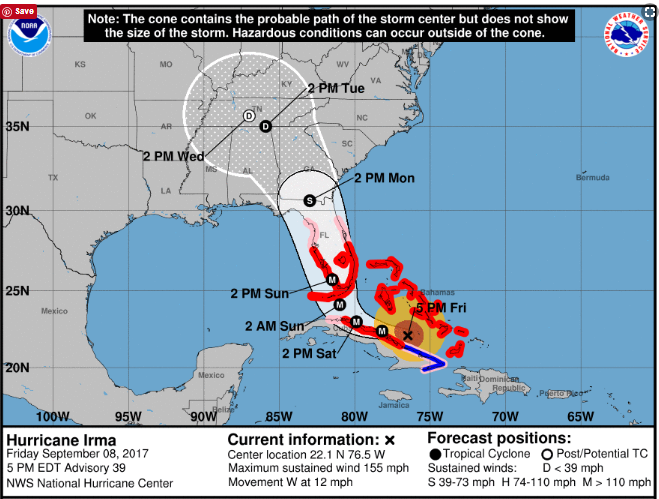
As you can see they expect Christobal to remain to the east of the Bahamas. That means we will not get the full force. As a result, the surf predictions for the Treasure Coast have been slightly reduced from yesterday. The peak surf expected for the Treasure Coast Tuesday and Wednesday is now more like four feet. That is not normally enough to increase my beach conditions rating, but could result in a small rating change if other factors such as the angle of the wind and waves are good.
I'm happy for any increase in surf. I'd like to see a little sand get stirred up and perhaps even a dip or two created.
Happy hunting,
TreasureGuide@Comcast.net