Showing posts with label shell artifacts. Show all posts

Saturday, July 6, 2019

7/6/19 Report - Bone and Shell Artifacts From the Treasure Coast and South Florida and Reader Thoughts.

'
Written by the TreasureGuide for the exclusive use of treasurebeachesreport.blogspot.com.

Yesterday I talked about points.  Below are some other items I've shown before.  They all came from the same Treasure Coast beach, but were found at different times in shell piles.  Mostly found by a shell collector, included are what appears to be a celt, made from a heavy conch shell, an arrowhead, a discoidal, and a rounded shell, maybe either a discoidal or a preform of some sort.


You can see more examples of many similar items online.  I'd recommend checking out the PeachStateArchaeologicalicalSociety web site, where you'll find many examples.

http://peachstatearchaeologicalsociety.org/index.php/26-shell-decorative/446-shell-tools-2


Here are some other Florida items.

Two Bone and Two Shell Artifacts.
The two on the left appear to be shaped bones for punching.   To the right of that is what appears to be a shell punch.  And last is  a piece of shell that I'm told was for shaping a shaft or something.  The wood, if that was the case, would be drawn through the curved depression at the top.

Not only are stone points occasionally found on beaches, but there are also other types of items.

I don't know much about these types of  things, but if you are on the beaches much, you might see pieces of shell that appear to have been worked into a usable form such as a spoon, scrapper or cup.

The Horse Conch shell shown below is a bugle.  I thought it might be Native American, but the people at the Florida State Museum said it is probably modern.

Horse Conch Shell Bugle.
The first thing I noticed was the slot.  Then I noticed the top was removed and that it works as a horn if you blow it.

Here is what I learned after doing a little research on the bugle.

In classic Mayan art, the Horse Conch is shown being utilized in many ways including as paint and ink holders for elite scribes, and also as a bugle or trumpet.

In southern Florida, Native Americans, including the Calusa and Tequesta, used the horse conch to make several types of artifact. The whole shell, or more commonly only the columella, was attached to a wooden handle and used as a hammer or woodworking tool. The body whorl was used as a drinking cup. The columella was also used to make plummets or sinkers.

So now it is known that the shell is a Horse Conch, and that Horse Conchs were used as bugles, and additionally, that they were used by the Calusa and Tequesta Indians.

I also found that locals used conch shells as horns in the 19th century when they hunted possums with dogs. 


Of course it might be even more modern than that.

I have learned to blow it with pretty good results, but it takes some practice.

The shell below looks like it was modified to make a ladle.  It is over a foot long and has what appears like a nice handle.  You'll see things like that in the shells at the beach.  Shell collectors pick them up all the time.
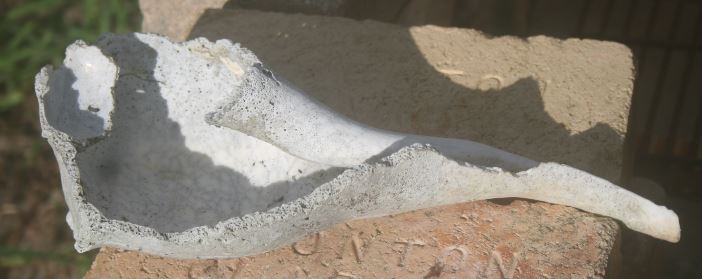
Ladle.

I'm never sure when I see things like that, if it is accidental or worked.  I just don't have the knowledge and skill to know without asking.  Just by appearances, I find it very unlikely that this one was broken accidentally in that way, but it could have.

Here is example of a piece that I would think would NOT break that way naturally.

Broken or Formed (?)
And here is one that would make a nice cup or holder - with legs yet.

Two Views of Broken or Formed Shell.

You'll also see columella that look like they might have been worked.

One reader provided excellent information on the coral arrowhead I posted yesterday and said it looked reworked.  He explained why and referred to a couple great references.  One is the Overstreet Arrowhead Identification and Pricing Guide.  You can find that online.  He said he gets the new one every year to see the new point photos and stone tools.  It also has a tutorial.  Looks like an excellent reference.

Here are a couple of links.


Very useful.

---

As you probably know, there are laws regarding archaeological resources.  They are many and complex and can be very confusing.  I can't summarize or interpret them all, so don't ask me to.  Do, however, realize that there are strict penalties for removing artifacts from state and federal lands.  If you have WRITTEN permission, you CAN collect artifacts on private land.  That is my understanding.

On the Treasure Coast it is not unusual to find artifacts on your own property.  I've found artifacts on my property and have posted some examples.  It is not uncommon.

Beachcombers, shell collectors and tourists will pick up unusual or interesting items and remove them without knowing what they are.  If you look through any large collection put together by a shell collector, there is a very good chance you will find an artifact.  I've been asked several times while on the beach, about items found by tourists.

Metal detectorists do not generally go out looking for artifacts and might not recognize them.  I think I've shown that they can be difficult to identify.  I am not good at identifying stone and shell tools in particular, and have to ask those know.

We all want to respect artifacts and follow the laws.  Laws can be broken unwittingly, and I hope this post will help you begin to become more familiar with artifacts so that you will be better able to identify, respect and protect them and follow the laws.

As a beginning, you might want to look at this summary of the Florida laws.  Here is a link.

https://dos.myflorida.com/historical/archaeology/underwater/laws/

I know that quick summary might give rise to more questions than it answers, but that is the best I can do.

One good principle when in doubt is to take photos and report your find.  Most of us carry smart phones with good cameras these days, so that is easy to do.

---

I also received an email from Susan E. who appreciated reading the Declaration of Independence, which I posted a couple days ago.  Here is what she said.

Thank you for printing this document.  While I was reading the list of grievances against Britain, I knew that each one referred to specific events.  What if a Revolutionary history textbook began with the Declaration, and then used as its chapter headings each of the complaints and justifications presented in the document?

What was most important to the Congressmen?  Why were the grievances listed in that order?  Were any left out, and if so, then why?  What was/were the "last straw(s)"?  And how do all of these things compare to what the rest of the people thought and felt? 

Susan

Thanks Susan.  Great ideas!

I'm surprised that I have not yet received photos of any Treasure Coast arrowhead finds.  Maybe they are not found on the beach as commonly as I thought.

Happy hunting,
Treasureguide@comcast.net


Monday, November 2, 2015

11/2/15 Report - More On Heart Shaped Cobs. Help For Identifying Native American Shell Artifacts.


Written by the TreasureGuide for the exclusive use of treasurebeachesreport.blogspot.com.

You don't often get a good chance to look at many heart-shape cobs.  They are rare, but the recent Sedwick Coins auction provided the opportunity for us to get a look at several of them.

I was glad to receive Laura Strolia's email on that topic. Here is what she said.

Your stories, questions, and publicity on the Sacred Heart coins have made an absolute compelling topic!
On these heart-shaped cobs, the idea was to put the hole above the cross. People wanted to wear the cross
in a vertical manner to be the main symbol on the heart. One did not want to show it off as a piece of currency.
In my opinion the coin with two holes could be a mistake.

Someone must have been rushing, picked the wrong bar of the cross for a hole, and then corrected the error with a second hole.

I am investigating more into this mystery of this heart coin through archives, especially those of missionaries.
There's great knowledge to be learned concerning these objects because there are some discrepancies with their
usage, origin, and development (previously recorded). 

The answers will only be in archival material to substantiate theories.

If you've been reading this blog over the past few years, you know that Laura is the author of the book, The Marigalera of the 1715 Fleet, and has contributed a lot of information about  1715 Fleet artifacts, such as the Pelican of Piety.

In a second email, Laura added the following information.

...According to some scholars, the heart cobs began in production at a time way before St. Mary of Alacoque renewed the Sacred Heart devotion... 

I'm eager to see what her research eventually reveals about the heart-shaped cobs.

If you look at the heart-shaped cobs shown in the auction catalog, most are "holed" above the vertical bar of the cross, which often puts the hole in what appears to be the flame extending at the top of the cob.

---

When you are metal detecting, you are probably not looking for a Native American artifact, yet you might find one if you have a sharp eye and are able to identify those kinds of artifacts. Arrow heads and other artifacts occasionally appear on Treasure Coast beaches, especially in good shell piles.  I've shown some of those in the past.

I ran across a Master's Thesis that provides a lot of pictures of Native American shell artifacts.  You might want to check it out.  It could help you recognize one on the beach some time.

Here is the link.

http://scholarcommons.usf.edu/cgi/viewcontent.cgi?article=2025&context=etd

---

The most read blog post of October was the 10/19/15 Report - Early Edition and Follow Up. Treasure Coast Treasure Beach Detecting Conditions Rating Increased To A Level 2. Beach Survey.

The most Google Plused post was the 10/27/5 Report - New Poll. Dynamics of Pebble Covered Beaches. Detecting The Past. Why Today Is The Day.

---

Not much new to say about beach detecting conditions.

I'll have my analysis of the poll results for you in a day or two.

Happy hunting,
TreasureGuide@comcast.net

Wednesday, October 30, 2013

10/30/13 Report - Barber Quarter, Shell Artifacts, Auction Begins & More


Written by the TreasureGuide for the exclusive use of treasurebeachesreport.blogspot.com.


Here is another very worn old coin.  It appears to be a Barber quarter, which would make the date between 1892 - 1916.

You can barely see the profile of Liberty on this side.

If you look at the Seated Liberty dime from yesterday's post, you can see that both are worn almost completely down.

Barber quarters were 90% silver.  I would guess that would be about $8 in melt value.

Below is the other side of the same quarter.  You can see part of the eagle on that side.


It isn't easy to find old coins on old land sites.  People weren't as careless with their change as they are today.

It helps to do what I said yesterday, get a good mental map and poke around selectively.  That is especially necessary since there is usually a lot of junk.


This morning (10/10/13) the first session of the Sedwick Coins treasure auction begins at 10 AM.  The auction takes place at the Doubletree Hilton near Downtown Disney in Orlando.  You can follow it online.


High end classic cars have been increasing in price more than any other collectible for some time now.

An article from carproperty.com says,  A recent study by global real estate advisor Knight Frank discovered that cars like Ferraris, Bugattis and Bentleys increased their value by 21% over the last six months and by 28% over the last year. By comparison, prime real estate in central London grew by 7% in the last 12 months and gold saw a 23% decline.

Here is the link for more about that.

http://www.carproperty.com/page.php?id=256


Finds and Photo Submitted by Dan B.

There are some very nice pieces in there.  Look them over closely.

I like the flaked piece near the center.

A day or two ago I showed some of the fossils, including hundreds of shard teeth found by Dan one day at the Peace River.

Thanks for the great photo Dan. 


I mentioned the TV mini series about the California Gold Rush.  There will now be one on the Klondike.  I hope it is as good.

Here is the link for information.


This morning on the Treasure Coast the surf was a little higher ( 2 - 3 foot surf).  It is predicted to gradually increase until next Thursday and Friday when it is predicted to be 4 - 6 feet.

Today there were a few very small cuts at some spots, but most of the beaches had more new sand and a lot of sea weed on some beaches.

Conditions remain poor for now.

Yesterday was the one year anniversary of Sandy hitting the northeast.

Happy hunting
TreasureGuide@comcast.net