Showing posts with label bugle. Show all posts

Saturday, July 6, 2019

7/6/19 Report - Bone and Shell Artifacts From the Treasure Coast and South Florida and Reader Thoughts.

'
Written by the TreasureGuide for the exclusive use of treasurebeachesreport.blogspot.com.

Yesterday I talked about points.  Below are some other items I've shown before.  They all came from the same Treasure Coast beach, but were found at different times in shell piles.  Mostly found by a shell collector, included are what appears to be a celt, made from a heavy conch shell, an arrowhead, a discoidal, and a rounded shell, maybe either a discoidal or a preform of some sort.


You can see more examples of many similar items online.  I'd recommend checking out the PeachStateArchaeologicalicalSociety web site, where you'll find many examples.

http://peachstatearchaeologicalsociety.org/index.php/26-shell-decorative/446-shell-tools-2


Here are some other Florida items.

Two Bone and Two Shell Artifacts.
The two on the left appear to be shaped bones for punching.   To the right of that is what appears to be a shell punch.  And last is  a piece of shell that I'm told was for shaping a shaft or something.  The wood, if that was the case, would be drawn through the curved depression at the top.

Not only are stone points occasionally found on beaches, but there are also other types of items.

I don't know much about these types of  things, but if you are on the beaches much, you might see pieces of shell that appear to have been worked into a usable form such as a spoon, scrapper or cup.

The Horse Conch shell shown below is a bugle.  I thought it might be Native American, but the people at the Florida State Museum said it is probably modern.

Horse Conch Shell Bugle.
The first thing I noticed was the slot.  Then I noticed the top was removed and that it works as a horn if you blow it.

Here is what I learned after doing a little research on the bugle.

In classic Mayan art, the Horse Conch is shown being utilized in many ways including as paint and ink holders for elite scribes, and also as a bugle or trumpet.

In southern Florida, Native Americans, including the Calusa and Tequesta, used the horse conch to make several types of artifact. The whole shell, or more commonly only the columella, was attached to a wooden handle and used as a hammer or woodworking tool. The body whorl was used as a drinking cup. The columella was also used to make plummets or sinkers.

So now it is known that the shell is a Horse Conch, and that Horse Conchs were used as bugles, and additionally, that they were used by the Calusa and Tequesta Indians.

I also found that locals used conch shells as horns in the 19th century when they hunted possums with dogs. 


Of course it might be even more modern than that.

I have learned to blow it with pretty good results, but it takes some practice.

The shell below looks like it was modified to make a ladle.  It is over a foot long and has what appears like a nice handle.  You'll see things like that in the shells at the beach.  Shell collectors pick them up all the time.
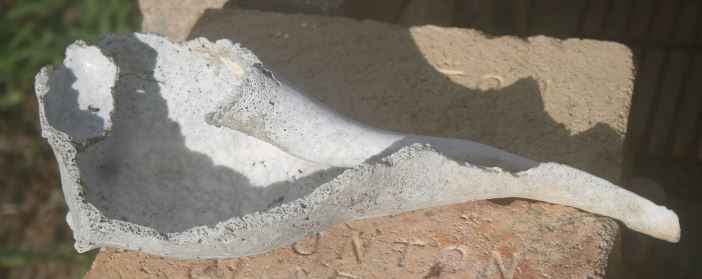
Ladle.

I'm never sure when I see things like that, if it is accidental or worked.  I just don't have the knowledge and skill to know without asking.  Just by appearances, I find it very unlikely that this one was broken accidentally in that way, but it could have.

Here is example of a piece that I would think would NOT break that way naturally.

Broken or Formed (?)
And here is one that would make a nice cup or holder - with legs yet.

Two Views of Broken or Formed Shell.

You'll also see columella that look like they might have been worked.

One reader provided excellent information on the coral arrowhead I posted yesterday and said it looked reworked.  He explained why and referred to a couple great references.  One is the Overstreet Arrowhead Identification and Pricing Guide.  You can find that online.  He said he gets the new one every year to see the new point photos and stone tools.  It also has a tutorial.  Looks like an excellent reference.

Here are a couple of links.


Very useful.

---

As you probably know, there are laws regarding archaeological resources.  They are many and complex and can be very confusing.  I can't summarize or interpret them all, so don't ask me to.  Do, however, realize that there are strict penalties for removing artifacts from state and federal lands.  If you have WRITTEN permission, you CAN collect artifacts on private land.  That is my understanding.

On the Treasure Coast it is not unusual to find artifacts on your own property.  I've found artifacts on my property and have posted some examples.  It is not uncommon.

Beachcombers, shell collectors and tourists will pick up unusual or interesting items and remove them without knowing what they are.  If you look through any large collection put together by a shell collector, there is a very good chance you will find an artifact.  I've been asked several times while on the beach, about items found by tourists.

Metal detectorists do not generally go out looking for artifacts and might not recognize them.  I think I've shown that they can be difficult to identify.  I am not good at identifying stone and shell tools in particular, and have to ask those know.

We all want to respect artifacts and follow the laws.  Laws can be broken unwittingly, and I hope this post will help you begin to become more familiar with artifacts so that you will be better able to identify, respect and protect them and follow the laws.

As a beginning, you might want to look at this summary of the Florida laws.  Here is a link.

https://dos.myflorida.com/historical/archaeology/underwater/laws/

I know that quick summary might give rise to more questions than it answers, but that is the best I can do.

One good principle when in doubt is to take photos and report your find.  Most of us carry smart phones with good cameras these days, so that is easy to do.

---

I also received an email from Susan E. who appreciated reading the Declaration of Independence, which I posted a couple days ago.  Here is what she said.

Thank you for printing this document.  While I was reading the list of grievances against Britain, I knew that each one referred to specific events.  What if a Revolutionary history textbook began with the Declaration, and then used as its chapter headings each of the complaints and justifications presented in the document?

What was most important to the Congressmen?  Why were the grievances listed in that order?  Were any left out, and if so, then why?  What was/were the "last straw(s)"?  And how do all of these things compare to what the rest of the people thought and felt? 

Susan

Thanks Susan.  Great ideas!

I'm surprised that I have not yet received photos of any Treasure Coast arrowhead finds.  Maybe they are not found on the beach as commonly as I thought.

Happy hunting,
Treasureguide@comcast.net


Tuesday, April 12, 2011

4/12/11 Report - Horse Conch & Internet Tools


Interesting Horse Conch Found on Treasure Coast.

This Horse Conch was found most likely on the Treasure Coast. The person who found it is unsure of where it was found because it has been sitting around with other shells, probably for years. Fact is, it could have been found on his own property. He doesn't remember and is simply unsure.

You might wonder what is interesting about this shell. Well, one day recently the shell was moved for some reason and it was noticed that the shell had a slot in it. You can clearly see that slot in the photo. Upon closer inspection, the slot appeared to be man-made. The shell also appeared to be an older shell, exhibiting the chalky-like surface that old shells often have.

The first reminder that I'll give here, is that you should record your finds. It can come in handy when you go back and discover something new about a find no matter what it is. Also if you have records, it helps to document your find and could help you to determine where different kinds of objects have turned up in the past. In this case, as I said, the finder didn't know that the item had any significance other than being a nice shell, and it might have been laying in his back yard for a long time, maybe even before he lived at that location. The origin is simply unknown at this point.

Secondly, I've mentioned how it can be fun to go back and review your finds from time to time. Here is something that wasn't noticed before. It doesn't matter what kind of object it is, you might notice something years later that you didn't notice at first. Maybe you've learned something that makes things more significant and noticeable.

With this shell, the discovery of the slot was only the beginning. After the shell became an object of attention and research, it was discovered that not only did it have a slot in it, but the top was also cut or knocked off. So what? Well, after blowing through the slot and then through the top of the shell, it was noticed that now the air passed easily through the shell and sometimes made a sound. A little more research on the internet showed other shells that were used as bugles. About the same amount of the top of the shell was missing on those shells.

Now it seemed like maybe this shell was actually modified to be used like a bugle. After a number of tries, the shell actually did issue a nice loud and clear blast.

After asking about the shell in a treasure forum, it was learned that the shell is a Horse Conch shell.

It is not clear if the shell was made to work like a bugle, and if it was, when it was made. The time of any workmanship remains unclear. But now that the type of shell is known, a little more research turned up the following on Wikipedia.

In classic Mayan art, the Horse Conch is shown being utilized in many ways including as paint and ink holders for elite scribes, and also as a bugle or trumpet.

In southern Florida, Native Americans, including the Calusa and Tequesta, used the horse conch to make several types of artifact. The whole shell, or more commonly only the columella, was attached to a wooden handle and used as a hammer or woodworking tool. The body whorl was used as a drinking cup. The columella was also used to make plummets or sinkers.


So now it is known that the shell is a Horse Conch, and that Horse Conchs were used as bugles, and additionally, that they were used by the Calusa and Tequesta Indians.

The evidence is building but not yet conclusive. It was also found that locals used conch shells as horns in the 19th century when they hunted possums with dogs. So even if the item was intentionally modified to be used as a horn, it might have been made either many years ago, decades ago or just a few years ago. That has not yet been determined. The horn, if that is what it is, could have also been created accidentally or naturally by the top simply being broken off.

So here we have an item that led one person to do some research. He learned a lot in the process, but there is more to learn.

This story reminds me of how the story of Ian's coaked sheve unraveled as he did his research. I covered that story in this blog in a number of posts in the past. You might enjoy looking it up by using the search box on the main page of this blog.

It should also remind you how you can notice something you didn't originally notice about an item years later and how helpful it can be if you keep good records.


Beach Seen From Google Earth.

There are so many wonderful tools on the internet these days. The above is a beach I recently visited for the first time. I looked it over before the visit.

You can use Google Earth and other programs to locate new beaches or scan beaches before a visit.


Treasure Coast Beach Forecast and Conditions.

I'm afraid to say it looks like we are already well into summer beach conditions. The wind is out of the south and the seas are calm. As you know the weather is already very warm as well.

The south winds and calm seas probably means added sand and shells to the beach front. These conditions also usually lead to dips forming immediately in front of the beach, with sand accumulating to form a bar just after that.

Those are not good conditions for finding shipwreck cobs. It probably also means that the artifacts that have been found along the beach fronts and near the shell piles will probably be decreasing. There will not be enough water force on the front beach to bring up new artifacts and not enough to erode or churn up new items.

The water will be calm enough for easy water hunting and the front beach will be in easy access but not very productive.

If this weather pattern continues, the biggest hope is for a storm that sits just off shore and sends in bigger waves from the northeast. But, as I've mentioned before, even southeast winds and local storms can cause a little erosion.


Happy hunting,
Treasureguide@comcast.net