Showing posts with label treasure fleets. Show all posts

Tuesday, February 11, 2020

2/11/20 Report - Detectorist Finds Rare Gold Coins. Havering Hoard Surprise. "Spanish" Galleons.


Written by the TreasureGuide for the exclusive use of treasurebeachesreport.blogspot.com.

Source: BBC.com (See link below)

A hoard of 19 gold coins from the Iron Age unearthed in Suffolk was a "really unusual" find for the area, an expert has said...

Archaeologist Dr Anna Booth said it showed "cross cultural interaction" between nearby counties at the time... 


A metal detectorist found the hoard within a 10-15m (32-49ft) square...


Here is the link for the rest of that article.


As the old FIXX song says, "One thing leads to another."  There are usually "cross cultural interactions," and we need to remember that in regard to our local treasure wrecks.

Below is another article to consider.

French bracelet among surprises in mysterious Havering hoard 


One of the largest and most mysterious bronze age hoards ever found in the UK contains objects that have astonished archaeologists, including items more commonly found in France and the Alps.
The Museum of London Monday revealed new finds among the Havering hoard, a remarkable collection of 453 swords, axes, knives, chisels, sickles, razors, ingots and bracelets excavated from a quarry in east London over a period of three months and revealed last year...

There is also a bracelet believed to be from what is now north-west France, and copper ingots possibly originating from the Alps...

“These objects give clues about how this wasn’t an isolated community but rather one that fitted into a much larger cultural group with connections along the Thames Valley and across the continent.”...
Here is the link for the rest of that article.

https://www.theguardian.com/culture/2020/feb/10/french-bracelet-among-surprises-in-mysterious-havering-hoard


That is a good lesson, and one that should be remembered.  Events are seldom as simple as people tend to make them.  As inconvenient as it is, things tend become more complex the more you understand about them.  I have been thinking about that as it relates to the treasure wrecks along our coast and was glad I ran across these articles to help me illustrate the point.  The fleets were international events in more ways than one.

They are often called "Spanish" galleons with good reason, however did you know that they were constructed and provisioned with many materials from many countries.  By the sixteenth century Spain's shipbuilding resources were already becoming strained.  Tall timber for masts and spars, for example, were already used up so long timbers were imported from the Baltic.  Sail canvas was imported from Holland and France.  Powder and arms came from Belgium and wheat from the Netherlands.  Those are just a few of the most basic items.  The point being that a treasure fleet does not represent an isolated community in any way, and that should be remembered when finds are studied.  A fleet or a galleon is not isolated chronologically or geographically.  There are many important intermingled pre and post wreck events and many diverse countries, regions and communities involved.

I'll end there once again feeling like I'm trying to stuff the bobcat into the soup can.  As the old song by FIXX says, "One thing leads to another."

---

Back a couple years ago it seemed that the MagicSeaWeed surf predictions had a systematic error in tbeir model.  Often a big surf was predicted for the future, but then it shrank as the time got nearer.  It seemed like they got that fixed.  They were pretty accurate with their predictions for the past year or so, but it happened again.  The big surf that a few days ago was predicted for up around ten feet has now shrunk down to 3 - 5 feet.  I'm disappointed.

Below are the current surf predictions for the Fort Pierce area.


Source: MagicSeaWeed.com

---

You might want to read Six Galleons for the King of Spain by Carla Phillips, John Hopkins University Press, 1992.


Happy hunting,
Treasureguide@comcast.net

Wednesday, December 4, 2019

12/4/19 Report - Flintlocks Found on Treasure Coast 1715 Fleet Beaches. Metal Detecting Lesson Learned Hard Way.


Written by the TreasureGuide for the exclusive use of treasurebeachesreport.blogspot.com.


Yesterday I ended up talking about the wheellock and the fact that none have been found around Florida.  At the time they were used, they were thought to be unreliable and were not used much in the New World by the Spanish.

Next came the flintlock, the miquelet being an early version of the flintlock.  

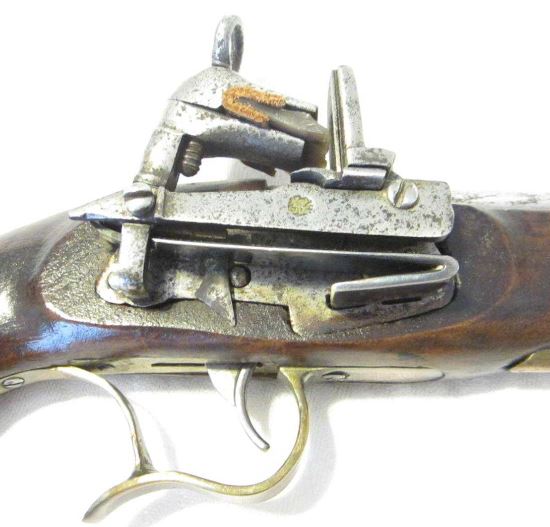
Lock of Miquelet Pistol.

You can easily see the flint being held in the lock by what in this case looks like maybe a piece of leather where you would often see a piece of lead.

You can often tell a Spanish flintlock from those made in other countries.  Spanish made miquelets were more boxy, while those made by some of the other countries were more curved and graceful in appearance.

Don't forget that Spanish galleons were provisioned by equipment from many countries, so if something isn't Spanish that doesn't mean that it didn't come from a Spanish treasure ship.

If you want to know more about the parts of a miquelet lock, click here to see a good video.

So what has been found in and around Florida waters?  First here is what Noel Wells' book Small Arms of the Spanish Treasure Fleets says about that.

As I said yesterday, matchlocks have been found on the 1622, 1715, and even the 1733 wreck sites, and never, according to Wells, has a wheellock been found in or around Florida waters.

* 24 French cavalry pistols (flintlocks) were found on one 1715 shipwreck site.  Some were totally encrusted.

*A miquelet musket stock (broken in the area where the lock would have been) was found on a 1715 fleet site.

* A 1660s era miquelet pistol from a 1715 site which is in the McLarty museum collection.

* In 1990 a trubuco musket was recovered from a 1715 site.

* In 1993 treasure divers found 2 encrusted muskets on a 1715 Fleet site.

* Around the year 2000 a beachcomber at a 1715 Fleet beach found a complete encrusted English flintlock lock that had never been fitted to a weapon.

Those are the ones I found listed in the wells book.  I might have missed one or two.  Of course there must be others.

For example, in my blog I reported on musket parts and a barrel mold that was found by Will R.  You can find information on that find in my 12/4/12 post and my 6/25/19 post.  Will was able to create a cast of the barrel.

I also remember one being found in the Sewall's point area, although I did not find right off where I reported on that one in my blog.

There are others for sure.  I found what I believe is most likely a piece of a silver side plate.

Piece of Silver Side Plate?

Here is the link to the post where I previously posted that.

https://treasurebeachesreport.blogspot.com/2012/07/72312-report-1715-fleet-ornate-silver.html

I once found a photo showing a side plate almost exactly matching the shape and design on the one that I found.  I don't know where that is now but there is a somewhat similar one shown in my old Dixie Gun Works catalog.

I clearly remember the first musket find that I made and have told that story before.  I found the rusted hammer and jaws of a musket on a steep hillside.  I can remember digging it up like it was yesterday, even though at the time I didn't know for sure what it was.  It was my first hunt in a historic area like that, and I didn't pay too much attention to the rusted twisted piece of metal that I just uncovered, and left it where it was.  In just a few short minutes, I found the flint.  I also didn't keep that.  I totally regret that to this day, but I just didn't have the knowledge and didn't know what I was doing. Sometimes you are just not ready for a find.  You can make good finds and not even know it if you don't have the necessary knowledge.  It would have been better if I found those items today rather than many years ago.  If I appreciated the items for what they were when I dug them up, I would have hunted the area better and I would have followed up by doing the research to better identify them. You can also ruin a find by not knowing how to conserve and store it.  Years later, I can now say that the musket lock and flint I found on that hillside was most likely English.

I've become painfully aware of how slowly I gain knowledge from experience and how that knowledge only makes my long history of ignorance that much more regretful.  Being a person that tends to learn independently rather than being quick to take advantage of the knowledge of others, much of my learning comes from making mistakes over the years.   One thing I've learned the hard way is that I could have saved myself a lot of wasted time and grief by being more organized and detailed in my documentation and record keeping.  I've said that before, but it is something I find myself very often regretting that I did not do.  I have objects that I can't easily find when I want to, and I've read things that I can not longer find when I want to.  I guess you can't avoid that, but being highly organized can help.

---

The tides are pretty flat now, as is the surf.

Happy hunting,
TreasureGuide@comcast.net


Tuesday, December 3, 2019

12/3/19 Report - Pirate Ship Artifacts Found. Part I of A Brief Introduction to Firearms of the Spanish Conquest and Treasure Fleets.


Written by the treasureguide for the exclusive use of treasurebeachesreport.blogspot.com

Source: VintageNews.com (See link below.)

17th century hand grenades and cannons from the wreck of a pirate ship have been found along the coast of Cornwall in the United Kingdom...

The wreck was rediscovered about two years ago. Local historian and author Robert Felce told Fox News that he found one hand grenade in November 2018 at Dollar Cove on Cornwall’s Lizard Peninsula. Felce found a similar grenade at the site in May 2017.
“I don’t use a metal detector – I use sight,” he explained. “I have become accustomed to what a lot of these things look like.”...
Both objects were heavily encrusted after lying on the seafloor for more than 300 years, and “Felce said he at first thought the latest grenade was an ordinary rock until he slipped and dropped it, and it broke open, revealing the two halves of the metal weapon and the explosive powder inside.”...


Here is the link for more finds and photos from that wreck.


---


Part 1.
Introduction to Firearms of the Spanish Conquest and Treasure Fleets.

The first small firearm was the hand cannon.  It was little more than a small cannon.  It was fired by touching a match directly to the powder.  Imagine trying to hold a firearm and aiming while applying a match to the touch hole.  Having a second person ignite the powder while another held and aimed the hand cannon made the process more manageable and accurate.

The hand cannon was used centuries before it was brought to the New World.  Christopher Columbus brought crossbows on his first voyage, along with one hand cannon, but brought a hundred hand cannons on his second voyage.

After the indigenous populations overcame their fear of the noise, the hand cannon lost much of its effectiveness in battle.

The hand cannon was eventually replaced by the matchlock arquebus, which was the first firearm to have a trigger.

The matchlock arquebus was invented in Spain in the 15th century.  It held a burning fuse in a clamp at the end of a lever.  When fired, the clamp dropped down, lowering the smoldering match into the flash pan and igniting the priming powder. The flash from the primer travelled through the touch hole igniting the main charge of propellant in the gun barrel.  (Wikipedia).


Source of illustration: Firearmshistory.blogspot.com. 
 Complete link immediately below.

See https://firearmshistory.blogspot.com/2010/04/matchlocks.html


In his book Small Arms of the Spanish Treasure Fleets, Noel Wells says that matchlocks have been found on the wreck sites of the 1622, 1715 and 1733 treasure fleets.  Things were repaired and used over long periods of time in those days.

In the same book, Noel Wells also writes that in 1596 Ponce de Leon requested 500 arquebuses and one hundred muskets.

It seems to me that some of the terms are confusing and different sources don't always use them the same.

On quora.com ( https://www.quora.com/What-is-the-physical-and-operational-differences-between-the-matchlock-musket-and-the-arquebus ) I found the following explanation.

The arquebus was the main firearm during the 16th century and was used into the 17th century (Gush, 1975). In the early 16th century the term arquebus covered quite a range of weapons but the most common type was a weapon about 3′ 6″ long (~108cm), weighing about 10 pounds (4.5 kg), and firing a ball of 1 1/2 ounces (~10 to the pound). From the 1540s the heavier muskets became a separate class of firearm and arquebus (called Caliver in England) standardized around 4′ (~123cm), weighing 12 pounds (~5.5 kg), and firing a ball somewhere in the range 10-16 to the pound.

The next step in the evolution of firearms was the development of the wheellock, sometimes called the Spanish lock.  The wheellock mechanism was used on pistols as well as long guns.

Here is how Wikipedia describes the wheellock.

The wheellock works by spinning a spring-loaded steel wheel against a piece of pyrite to generate intense sparks, which ignite gunpowder in a pan, which flashes through a small touchhole to ignite the main charge in the firearm's barrel. The pyrite is clamped in vise jaws on a spring-loaded arm (or 'dog'), which rests on the pan cover. When the trigger is pulled, the pan cover is opened, and the wheel is rotated, with the pyrite pressed into contact.
A close modern analogy of the wheellock mechanism is the operation of a Zippo lighter, where a toothed steel wheel is spun in contact with a piece of sparking material to ignite the liquid or gaseous fuel.
A wheellock firearm had the advantage that it can be instantly readied and fired even with one hand, in contrast to the then-common matchlock firearms, which must have a burning cord of slow match ready if the gun might be needed and demanded the operator's full attention and two hands to operate. On the other hand, wheellock mechanisms were complex to make, making them relatively costly.

The following simple illustration shows the main differences between a matchlock and a wheellock.

Source: Pinterest.

And here is another illustration of a wheellock.

Source: Pinterest.


In his book on Spanish firearms Wells says, An interesting note about Spanish guns is there has never been found on any of the Spanish shipwreck sites in or around Florida waters, a wheel lock pistol, a long gun, or a wheellock mechanism.  


I don't have time to complete this topic today.   This was a challenging topic for me because of what seems to me to be some inconsistency in the terminology, the difficulty of finding the best illustrations, and my general ignorance about early firearms.


I hope to be able to post part II tomorrow, which will focus more on firearms and firearm parts that have been found on treasure fleet wrecks, including the 1715 Fleet.

---

With the recent cold front moving through, we'll have offshore winds and a calm surf for a few days.

Happy hunting,
TreasureGuide@comcast.net