Tuesday, September 29, 2015

9/29/15 Report - How The TBR Beach Studies Paid Off. Tropical Storm Joaquin. Ten Top Treasures. Great Research Tip.


Written by the TreasureGuide for the exclusive use of treasurebeachesreport.blogspot.com.

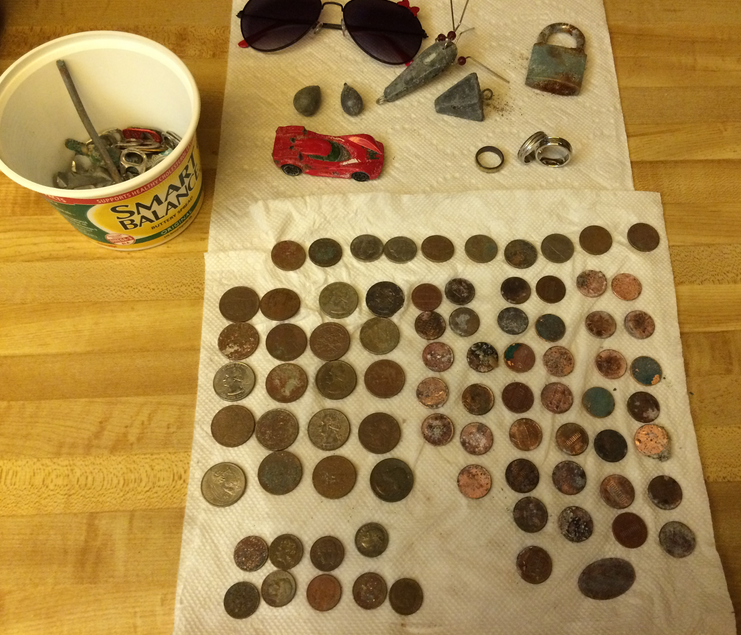
Three Rings Found In Coin Line
Finds and Photo by Doug E.
I am glad to know that people are not only reading and using the tips and techniques that I present, but they are being successful with them.

Here is what Doug E. said.

Thanks to your research on coin line formation I was able to determine from the wave direction, tides, and beach cams that a line was likely forming near Cocoa.

On Sunday I quickly found and  followed the line for almost 2 miles. From the condition of the coins and rings one could tell it was all older material. 


Most of the targets were at the same depth. More research is less less hard work digging. 

Please keep on with the study, it really helps in the field.


Doug E,

Thanks for sharing Doug, And congratulations!  

Doug's Finds.
Notice the predominance of discolored coins along with the other varied items, including sinkers and rings.  

You can indeed save time by learning to locate coin lines or coin holes.  Once you locate one, it can be worth working it completely.  

When targets are densely distributed, I'll pick it clean and then go back over it.  It seems that removing the obvious signals, you can then tighten up and focus on the less obvious signals.  That can produce gold that otherwise would be missed if you didn't go back over the area.  

As I've said before the idea of cleaning out a coin line or hole is not to find clad coins, it is to get the better items that might be associated with the line or hole.

Yesterday, I first went north to see what the beach around the bend looked like.  It wasn't any good.  I then turned around and went back south.  After walking a good distance I found a cut that I could not see from where I walked onto the beach.  

Binoculars are a good idea when you want to be able to see a little farther down the beach.

---

Top ten lost treasures of the world.


---

Dan B. gave this great tip.  When searching for quality reports and studies include the term pdf with your search terms.  It does help weed out the useless stuff and provides better search results.

Thanks Dan.

---

We have a new tropical storm, Joaquin.  We also have two disturbances.  

On the Treasure Coast we've had a south wind for what seems like years.  This morning the wind was blowing off-shore.

Despite Joaquin sitting east of the Bahamas, we're still not getting any beneficial changes.  Jaoquin will probably move north instead of closer to us.

Expect a three to five foot surf today and a foot or so higher tomorrow.  That is getting up there.  It will do some good if we can get some decent angles.

Happy hunting,
TreasureGuide@comcast.net

Monday, September 28, 2015

9/28/15 Report - Surge and Backwash and Cut Beach. Tropical Depression Eleven. Higher Waves.


Written by the TreasureGuide for the exclusive use of treasurebeachesreport.blogspot.com.


Illustration Showing Surge and Backwash On A Beach With A Cut
A few days ago I presented a couple of illustrations to show how coin lines were formed.   My intention was to continue on that subject, but I got on some other subjects.

The illustration in the previous post showed how the surge went up the slope and gradually decreased and then washed back down the hill.  When there is a cut, the surge can hit the face of the cut before the water slows.  When that happens the surge bounces off of the cut and washes back down the slope with greater force than if it had gradually slowed down on the slope.

The tide is important.  When a cut is created before high tide, as the tide increases, more and more water hits the cut as the tide comes in.  When the tide starts to go down, and if the waves are not big enough, the water will no longer be hitting the cut at all.

If the cut is created at low tide, the high tide can over-wash the cut and smooth it out if the water is hitting the beach straight on.

The main thing to notice is that when the water continues to hit a cut with force there is no gradual slowing of water as the surge slows and reverses.  Instead the water can hit the cut with force and bounce back sending the water back down the slope with force.

When the waves are hitting straight on, the backwash will be colliding with new surges.  If the wave period is small, that will happen frequently.

When the surge and backwash collides there will be a reduction in force at that point, and items can be dropped off.

Any items washing out of the cliff can be temporarily covered and protected by sand eroded from the cliff.

If the water is hitting at a angle from the north, then the water can wash up onto the beach and curve back down without losing as much force.  That can move a lot of sand and other items.  Of course if it is coming in at a good angle it can still carve away at the cut when the water is high enough.  You get more erosion when there is a good angle and high water.

High water washing directly up the beach will not cause nearly as much erosion as water washing in at an angle.

---

Treasure Coast Beach This Afternoon


Last night we had a super moon and a lunar eclipse.  The tides were high, and I hear that in some areas there was flooding.  On the Treasure Coast the tide was about two feet higher than normal.  I didn't see any type of flooding.  In fact I thought the water was not any higher than yesterday.

Ida has finally disappeared.  We have Tropical Depression Eleven to the east of the Bahamas.  I expect it to stay out there and move north and not affect us much.  The waves were bigger though.  I thought in some places they looked like six to seven feet.  I saw a few surfers.

I found one cut that was close to two feet high.  I'm sure there were others around the Treasure Coast. I only looked at a couple of beaches.  One was mushy.  The other wasn't.

I wasn't finding anything old where I was.

There were some shells and fossil pieces.

We also have a disturbance in the Gulf.

The surf is supposed to be 3 to 5 feet until Wednesday when it is supposed to be up to 6 feet.

You might be able to find a good cut somewhere.  The waves are hitting directly from the East though.

---

The history of money diggers article that I presented yesterday is a good read.  You might be able to pick up a few good clues from it.  In any case the folklore and history is interesting enough by itself.

Also check out the bibliography at the end.

---


Happy hunting,
TreasureGuide@comcast.net
---

Sunday, September 27, 2015

9/27/15 Report - History of "Money Digging." Tropics More Active. Rare Coins On Auction.


Written by the TreasureGuide for the exclusive use of treasurebeachesreport.blogspot.com.


A Couple Fine Coins From An Upcomng Sothebys Auction
Source: See Sothebys link below. 


Have you ever heard of money diggers?  That is how they described treasure hunters in the early days of our country.

Treasure hunting was much practiced in the U. S. long before there was a United States.  Religious and other leaders of the day participated, as well as the common folk. Joseph Smith, founder of the Church of Latter Day Saints, was a money digger.

I found an article about the Joseph Smith's treasure hunting activities.  The article talked about Joseph Smith, but it also tells a lot about the history and superstitions associated with money digging.

Thetitle of the article is The Persisting Idea of American Treasure Hunting.  It was written by Ronald W Walker, and was originally published in BYU Studies, back in the 1980s.

Here is one paragraph from that lengthy paper.

From colonial times to at least the age of Jackson, Americans dug for magical treasure.  There were hundreds and probably thousands of these "money diggers," all seeking troves of fabled coins, mines, jewels and other valued prizes. They worked from the Atlantic Coast to the Mississippi hinterlands, and in a few localities heaped up tailings that rivaled those of the later forty-niners.  Yet for all this prodigious toil their finds were as rare as Merlin's transmuted gold.  What made them persist, relying on an immemorial but now forgotten world view, the money diggers placed faith in conjuring, elemental spirits, thrice spoken dreams, seeric gifts and enchanted treasure that could slip and rumble through the earth as easily as a fish moving through the deep.  The modern age will probably never fully understand the diggers strange compound of treasure seeking, religious feeling and intense psychological devotion to an old but fading way of life.  Theirs was another world which we can speak of but hardly enter.

 Here is the link if you want to read the entire article.

https://ojs.lib.byu.edu/spc/index.php/BYUStudies/article/viewFile/5447/5097

Treasure hunting is an activity that inspires superstition.  Treasure hunters seek the unseen.  They depend to some extent upon luck, no matter how scientific and thorough they are.  Intuition can be a  big part of it,  Guesswork is also a part of it.  Despite all of the hard work and diligent effort, the outcome is uncertain, and success and failure begs for explanation other than pure chance.

Few of us share the superstitions common among the money diggers of the 18th century.  There are some that still use dowsing and other methods that do not have the support of science.  For the most part metal detectors have replaced dowsing rods, but many treasure hunters still experience the hunt as being somehow mystical, if not religious.

As Ronald Walker's paper details, treasure hunting has a long and deep history in America.  No wonder!  It is as instinctual as curiosity.  It is as natural as work and progress.

---

If you watched TV the last few days it would have been difficult to miss the throngs of people that gathered excitedly to see the Pope.  It just goes to show how much of a hunger there is for the virtues characterized by the Pope and the Faith.

People of all faiths, as well as those of no religious faith at all, had good things to say about the Pope.  Many were moved to tears.  Congress, where leaders often rail for separation of church and state, seemed to have forgotten about their common cry for that separation.  Politicians of all stripes appeared to be deeply moved by the Pope's character and presence.  None had anything bad to say about him. News anchors, who usually are either hostile or at the very least show no friendship to religion, were also moved.  Nobody that I saw had anything critical to say about the man, including the aetheists, anti-religious, and those that are typically against religion.

It seemed to me that I was seeing a different side to the world.  Not in the Pope, He did not surprise me.  Nor did those of faith.  It was the politicians and media that surprised me.   It was those who make decisions for us and present the world to us.  It was also the unanimous, or what appeared to me to be the unanimous, interest, excitement and over-whelmingly positive reaction to this religious leader.

It appears to me that there is a deep world-wide hunger for authenticity and virtue and leadership. For a few days, on the TV news at least, conflict, hate and evil did not dominate.

Security was evident at every turn.  That shows that there is still evil in the world.  Maybe it was crowded out for a time - at least off of the TV screens that present so much of what we take to be the world.  Maybe what they normally present, with their continual emphasis on conflict and tragedy, gives us a lop-sided view of things.  I'm sure it does.  Maybe the imbalance swung the other way for a few days, and we'll soon be back to normal.  My hope is that it was not an illusion, and that in some small way we and the world were permanently changed for the better.

---

I recommend spending some time with the https://www.windyty.com/?swell,30.477,-80.112,6 web site.  Not only will it give you a animated map showing the wind, but also the swell and waves.  Also if you place the cursor on any specific location it will give you detailed information for that location.  Give it a try.  Great  tool!

---

Here is a site where you can see some great photos of some great coins.  The two coins shown at the top of this post are from this web site.

http://www.sothebys.com/en/auctions/2015/stacks-bowers-rarities-auction-n09385.html?cmp=email_N09385_1015_2_CATexample1_event

---

The past couple of days, I did a little detecting on a flat beach and found a good number of coins.  I didn't test any of the steeper beaches.

There are now two tropical disturbances in addition to Ida.  Ida doesn't seem to want to go away and is lingering out in the Atlantic.

There is one disturbance in the Gulf and one East of the Bahamas.  The one in the Gulf has a 10% chance of becoming a cyclone in the next 48 hours, and the one out East has a 20% chance.  Both are affecting our wind patterns.

For the next few days we'll be having something like a 3 - 5 foot surf.  There is a chance we will eventually get some significant beach improvement.

Happy hunting,
TreasureGuide@comcast.net

Saturday, September 26, 2015

9/26/15 Report - Pierced or "Holed" Coins: Characteristics and Uses. Slight Beach Improvement. Sea Glass Again.


Written by the TreasureGuide for the exclusive use of treasurebeachesreport.blogspot.com.


Pot Shard and Sea Glass Incidental Finds
Here are a couple beach finds from this morning, They were eye-balled while detecting near low tide.  The blue sea glass is well tumbled and has a nice elongated teardrop shape.


Before I get into my main topic for today, I wanted to mention that the high tides lately has done some good, but not enough for me to  change my Treasure Beaches Detecting Conditions Rating.

I should also say that I would bet that there will be a few small cobs found.  I suspect they will be very few and very small.  The high tides have been dropping shells near the high tide mark on some beaches.

There are some shells and pieces of fossils on a few beaches now.  More than I've seen in quite a while.

---

If you've dug many coins you've probably found some that were "holed" or "pierced."  Over the years I've found everything from holed pennies to holed reales.  Probably most common in my experience are holed wheat cents.

You might have noticed the holed large cent in yesterday's post.  I pointed out the hole in one of the large cents dug by GoldNugget.

Holed coins are thought to have served a variety of purposes.  For slaves, it is said that holed coins were worn on a cord around the neck and served as a type of wedding band.

Holed coins may also have been used as charms.  You've probably heard of lucky pennies.  Some people wear coins bearing their birth year or other important years.

Some holed coins are simply used as a nice shiny trinket or adornment.

One coin found by archaeologists was punched multiple times and may have been used as a button.

Coins bearing two holes, one on each side, may have been strung together as bracelets or necklaces.

It is also said that coins were sometimes pierced to be sewn into clothing to prevent loss.

The practice of piercing coins may have been replaced to some extent  by the practice of mounting coins in a bezel.

One study looked at hundreds of "holed" coins offered on eBay.  Most had one hole, were holded at the top of the obverse (side bearing the main design) as if holed for hanging, and the majority were from the mid 1800s.

I think this survey of auction coins is great, but on a site like eBay, you never know how many might be copies, fakes or simply misrepresented.  Still, I think this survey is a good start.

The title of that study is Pierced Coins: Insights From eBay, by William B. Lees and Monica L. Beck of the University of West Florida.

Here is the link.  http://uwf.edu/wlees/SEAC2007.pdf

Here is something interesting on the subject found at another web site.

Based on my study of old coins excavated in Virginia, on average about eight per cent of the older coins have holes. Almost all are holed near the rim. Coins holed at center are unusual to dig. I understand coins used in West African rituals to be holed at the center and buried at the corner of structures. The tradition served to help spirits who could recognize objects they possessed in life, to find their way back to visit their living relatives when taken away from familiar surroundings...

That came from the following linked site.

http://www.coinbooks.org/esylum_v14n26a07.html

---

Beach Near Low Tide Yesterday.

This particular beach has about twenty yards of flat sand out in the shallow water.  That sand came from the beach, which is now rather firm.  I chose to detect this beach rather than the steeper one with shells at the high tide mark.  This one had shells down near the water line.

We have a full moon tonight and will have another good high tide.  The surf will be increasing up to five feet in a couple of days, and the longer range prediction is for nine feet.  I can't get excited about the nine feet yet, because the long range predictions are not very accurate.

Nonetheless, it does look like we'll have some continued improvement in beach conditions.

Happy hunting,
TreasureGuide@comcast.net

Friday, September 25, 2015

9/25/15 Report - Great Beach Finds: Large Cents, Half Disme, Shield Nickels, Three Cent, and Reales.


Written by the TreasureGuide for the exclusive use of treasurebeachesreport.blogspot.com.

If you saw the beach hunt video by Gold Nugget that I posted yesterday  you know what the beach was like where the coins shown today were found.  If you didn't see that, you might want to take a look.

Here is GoldNugget's first silver three cent find.  Very nice coin.

Congratualtions!

But that isn't all.  Below are some more of his old coin finds, including some reales.

These coins are shown after GoldNugget spend a couple of days cleaning them.


Beach Finds By GoldNugget.
Next are some shield nickels that he found.


Notice the holed large cent.  I think I'll probably be talking about "holed" coins more tomorrow.


Very impressive finds.  Congratulations to GoldNugget.

All of the coins appear to be worn and have suffered considerable corrosion.  They are also  all

The coins are a good sign that artifacts should be in the area too.  It appears to be an 18th Century site.  It would be fun to unravel the history of the place.

Once you locate a site like that you can hunt it over and over whenever the conditions are right.

---

I received emails about the excellent web site link that I posted yesterday.  You'll find it listed on my blog as Wind, Swells, Waves.  I'll be using it a lot.

---

On the Treasure Coast we'll be having a three foot surf for a couple of days and then next week up to four feet.

There is no tropical action to be concerned about right now.

Happy hunting,
TreasureGuide@comcast.net

Thursday, September 24, 2015

9/24/15 Report - Great New Beach Forecasting Tool. Beach With Cut Scenario. Surf's Up. Sea Glass Blog.


Written by the TreasureGuide for the exclusive use of TreasureBeachesReport.blogspot.com.

Still Clip Showing Wind Direction
Source:https://www.windyty.com/?30.477,-80.112,6
This is a great tool  You can select to see the wind, waves or swells and predictions for future dates.

The still clip above shows the wind.  You can see it streaming down from the northeast over the southern states and North Florida.  The center of a low pressure zone is sitting just north of Canevaral.  At the time shown,we were getting south/southwest winds.

You can see a lot of areas.  If you were traveling, you could tell where you would have a good chance of finding good detecting conditions.

The tool also allows you to look at the swells and waves.  It is a great beach forecasting tool that I'll be using a lot.

You can see a center of circulation just north of Canaveral.  In this clip they're getting northeast winds.  We're getting a west wind in the same clip.

To see this in motion, along with a lot of other neat and useful stuff, use the following link.

https://www.windyty.com/?30.477,-80.112,6

I'll add this to my Surf Conditions  and Waves link list as soon as I get around to it.

GoldNugget sent me the link.  Thanks!

---

Here is an illustration I showed yesterday.  I'll start with it so I have it to compare with the next illustration.


One thing is different in the illustration below.  It shows a cut instead of a gently sloping beach.  When there is a cut, as shown in the following illustration, the water bangs against the front of the cliff when it gets up that far.  That means that the surge can hit with a good amount of force, and instead of the water gently slowing and dropping off sand and other objects, the you get a more forceful backwash.
This illustration assumes the water hitting the beach straight on rather than at an angle.  One other thing that occurs in this situation is that the surge continually hits the backwash and they pretty much cancel out each other.

The point where the surge and backwash collide will often stop the flow enough to drop out any objects at the point of the collision.

Of course for any coins to be caught up in either the surge or backwash they must be exposed rather than protected by the sand.  That can be either down near the breakers, when they are carried up the slope, or on the slope.  They can also get carried either up or down, depending upon the force of the surge and backwash.

As the tide goes up, they tend to collide higher on the beach, and as the tide goes down, they tend to collide lower on the beach.

In this scenario there is not a lot of sustained momentum as there would be when the waves hit at an angle and slice away at the beach.

---

Dan B. found a sea glass blog site that has a post on red sea glass.  It shows a neat distress lamp with a red lens that was found near a shipwreck site.  It also talks about other sources of red sea glass. Thanks to Dan B, for sending me the link.

https://westcoastseaglass.com/blog/rare-red-sea-glass-beach-combed-seaglass

---

This morning the surf was up a bit on the Treasure Coast.  The water got up a little higher than usual.  While the waves weren't bit, they were nicely formed and big enough for a lot of surfers to be out.

I also saw a good number of detectorists out early this morning.

I suspect that in places where the beach is angled just right that you might be able to find a few modest cuts.

Happy hunting,
TreasureGuide@comcast.net

Wednesday, September 23, 2015

9/23/15 Report - One Way To Add Value And Interest To Your Treasures. North Carolina Beaches Producing. Sea Glass Web Sites.


Written by the TreasureGuide for the exclusive use of treasurebeachesreport.blogspot.com.

What's the most valuable thing you ever found?  That is a question that I hear a lot.  If you detect very much you've heard it too.

I'm never comfortable with that question.  For one thing, I don't know the answer.   I'm sure you've heard that an item is only worth what you can get somebody to pay for it.  If I do sell something, which is rare, I do some research, but I let the market tell me what the item is worth.

Since my primary interest isn't economic, and I know that is what I'm being asked, I don't know how to answer the question.  I could get into a long discussion, but that isn't what the person wants.  Their interest isn't complicated, but it doesn't mesh with my thinking.  The result is that I'm left with an uncomfortable feeling knowing that not only do I not know the answer, but I am also a little uncomfortable with how the question is posed and the underlying assumptions.

Even if you boil it down to a matter of dollars and cents, I'll bet that some of your finds will fool  you. You might have finds that are worth a lot more than you realize and vice versa.

Not long ago I talked about a red piece of uranium sea glass that I found.  I didn't know until very recently that it was uranium sea glass.  I didn't find that out until years after it was found when I finally looked at it under a black light.

Red sea glass is rare.  Only about one out of 5000 pieces of found sea glass are red.  But this piece is more rare than that.  It is nice extremely well tumbled and shaped.  It is more rare than that.  It is also uranium glass.  That puts it in another category altogether.  The fact is that the red piece of uranium sea glass that I found would probably sell for more than many of the silver reales that I've found.  Who would have guessed?  Most detectorists have no interest in sea glass.

My point with this discussion is not about sea glass.  It is about treasures and how easy it is to be fooled by the potential economic value of finds.  It is easy to over value or under value different types of items.

I think more mistakes are made by not not appreciating the value of items than by thinking that things are worth more than they are.  If you over-value something, you won't throw it away or sell it ridiculously cheaply.  You'll just be disappointed to find out that you can't get much out of it.

In the case of items that are not thought to have any value, they are often ignored, sold too cheaply or thrown away.  You might never find out about that mistake, or you might.

This is just as much about silver cobs or escudos or other kinds of treasures.  They can be over valued or under valued.  The key is knowledge.  Do your research.

Here's another question.  What is the oldest thing you've found?  You might think of coins that are hundreds of years old, or maybe an artifact.  In my case, I didn't know what my oldest find was for a long time.

My oldest coin find is about 5th century BC.   Obviously that is not a U. S. coin.  But that is far from my oldest find.  My oldest finds are millions of years old.  They are fossils.

The first fossil I found came up in a scoop of sand and shell when I was digging probably a penny or something.  I didn't know what it was at the time, but thought it was unusual, and as I often advise, I put it aside and kept it. I didn't know what it was for a number of years.

The knowledge you bring to a treasure can totally transform it.  You might not know something important about a find, but when you learn more about it, the find can be transformed.

It is knowledge that makes the item more interesting and possibly more important.  Knowledge can also actually make an item more valuable.

Take for example, a coin with a certificate of authenticity.  The certificate provides knowledge.  It should tell you something about the item, such as who found it, maybe what wreck it was associated with etc. etc.  That knowledge makes the item more valuable.  Having a coin graded can also make the coin more valuable.

Research can provide important information about an item.  Notice that auction catalogs provide as much relevant information as possible.  The catalog might tell you about any special features, rarity and anything else that might make the item more valuable.

As I learned more about my red sea glass, it became more valuable - in more ways than one.  That is another example of how what you bring to your treasure is important.  What you know about an item can add a lot of value - again, in more ways than one.

Most people look for the obvious treasures.  Anyone will recognize a coin, and value it if it is old or made of silver or gold, but there are treasures that aren't obvious to the eye.  There are treasures that you might not recognize at first.

I feel like I'm talking in code or symbolism here, but that was unintentional.  It is still there.  There are multiple levels to what I am talking about.

I'll bet that you have found better things than you know. I'll bet that you've seen and passed over or even thrown away some valuable treasures.  I have.  As they say, knowledge is power.

What you bring to a treasure is important, and adds value.

----

The surf on the Treasure Coast is a little rougher now.  It increased today and will be something like three of four feet for several days if the predictions are correct.

Ida is still out at sea, but that disturbance that has been slowly moving north should be affecting North Carolina.

I actually got a recent video clip from GoldNugget who is finding reales and other old coins on a North Carolina beach.

Here is the video.

https://www.youtube.com/watch?v=ToHgfXtNytI&feature=youtu.be

---

A package of pot was found on a Fort Pierce beach yesterday.

Some years ago, I found three large (4x4x4 foot bales) on a Fort Pierce beach early one morning.

---

Here are some good sea glass web sites.

This one is about uranium sea glass.

http://www.findseaglass.net/vaseline-uv-ultraviolet-and-uranium-treas-glass/

And this one presents a table showing the rarity of different colors of sea glass.

http://seaglassreinvented.blogspot.com/2012/02/sea-glass-color-rarity-chart-how-rare.html

---

Happy hunting,
TreasureGuide@comcast.net