Showing posts sorted by relevance for query kang hsi. Sort by date Show all posts

Sunday, December 29, 2013

12/29/13 Report 1715 Fleet Kang Hsi Porcelain, European Pot Shard & Native American Shard


Written by the TreasureGuide for the exclusive use of treasurebeachesreport.blogspot.com.


Tip of Kang Hsi Shard.
Yesterday I scouted three Treasure Coast beaches.  All three looked pretty much the same.  Poor!

All three were sandy and sloped up to the old berm.  I didn't manage to find any shell piles either.

While treasure beach conditions remain poor, three things I'd consider is looking for non-metallic items in shell piles, if you can find any good shell piles, hunting modern jewelry or going off-beach.

A couple photos of the beaches I saw are posted below.

I thought I'd take a close-up look at some non-metallic finds today, such as shards.

I've talked about Kang Hsi porcelain in the past.  And I've shown some pieces.

Kang Hsi Shard
Second View.
You might know that valuable Kang Hsi porcelain was carried on 1715 Plate Fleet ships as they carried their treasures back to Europe.

Most often, the Kang Hsi porcelain you might see on the Treasure Coast beaches is blue on white, although there are a few other colors that you might find.

Kang Hsi porcelain is good porcelain.  You can learn to identify it, even though much European pottery was later produced to mimic Kang Hsi.

I decided to take a good look at a Kang Hsi shard and discovered one thing that could help you identify Kang Hsi.

First the porcelain is white and fine grained and the items are thin.   That contrast sharply with much European and American blue on white ceramics.

Above is a close-up photo of a Kang Hsi shard.  And below is another shot of the same piece from another angle.

European Pottery Shard - Probably British
Circa 1800.
Look at the broken edge on the right where the blue strokes end.  Notice that the blue has depth.  You can see that it goes through the layer of glaze.

Kang Hsi, unlike the typical European and American blue on white pottery, has that kind of depth.

Here is common shard of European blue on white pottery.

Notice the course darker clay on the European shard.  Also notice how much thicker it is.

You can also see that the surface blue does not penetrate the clay but lays on the surface of the glazing.

I think the differences are clear.  The European shard came from a Caribbean fort and battle area.  It was all over the ground there.


Here is a second view of another part of the same shard.


View of the Clay Where the Surface Glaze Has Been Chipped Off.
One other difference between Kang Hsi porcelain and common European pottery is the blue on the European, and American, pottery will be the same shade.  The blue on Kang Hsi will show various shades and appears to have been applied by a skilled artistic hand.

There are a number of very good books on Kang Hsi porcelain if you want to know more.

You should keep your eyes open for it when on shipwreck beaches.

Entire dishes have been found on the beach in years past.  It is difficult to find an unbroken item on the beach, though, but even the shards are sometimes mounted and sold in jewelry.

Below is another type of pottery.  It is native American and came from South Florida.  Instead of painted, this shard is incised.

Incised Native American Pot Shard

I don't have any idea how old this one is.

After the hurricanes I spotted a stamp checked piece of pottery laying right on the surface beside the road.

You never know what you might see, but the more you know about various things the more likely it is that you will see something.

As I always say, keep your eyes open while detecting.


Beach detecting conditions are poor on the Treasure Coast.

Below are a couple of beach photos from yesterday.


Two Different Treasure Coast Beaches Yesterday.
Same Conditions - Poor.

Happy hunting,
TreasureGuide@comcast.net


Tuesday, January 21, 2020

1/21/20 Report - Vero Man and Treasure Coast Fossils. Kang Hsi Notes. Big Surf Coming.


Written by the TreasureGuide for the exclusive use of treasurebeachesreport.blogspot.com.

Source: SiberianTimes.com web site.  See link below.


The Kotelny island woolly mammoth was killed by humans some 21,000 years ago, say scientists.

Dr Albert Protopopov shared new pictures of the remains found at a location which was then part of the vast Beringia Land Bridge connecting what is now Siberia and North America.


'The traces on the bones show that the mammoth was killed and butchered by ancient people,' he said...

Here is the link for more of that article.


You might be aware that some of the oldest things you can find on the Treasure Coast beaches are fossils. It might surprise you to learn that you can find mammoth fossils on our beaches. I've found both mammoth teeth and a section of a tusk.

Mammoth Tusk Section.
Source: SiberianTimes.com (Same link as above).
The tusk section I found was of about the same diameter as the one shown in the above photo.  The end was sticking out of some eroded sand on the Treasure Coast.

Every Floridian, full or part-time, should know about the world-famous "Vero Man" site and James Kennedy's history making find of a 13,000 year-old mammoth bone bearing a human carving.

Wikipedia describes Vero Man this way: Vero man refers to a set of fossilized human bones found near Vero (now Vero Beach), Florida, in 1915 and 1916. The human bones were found in association with those of Pleistocene animals. The question of whether humans were present in Florida (or anywhere in the Americas) during the Pleistocene was controversial at the time, and most archaeologists did not accept that the Vero fossils were that old. Recent studies show that the Vero human bones are from the Pleistocene and are the largest collection of human remains from the Pleistocene found in North America.

See https://www.nationalgeographic.com/news/2011/6/110622-mammoth-bone-oldest-art-americas-science/

And also https://www.livescience.com/20088-early-floridians-mingled-mammoths-mastodons.html

---

Shards Found South of Seagrape Where Kang His Has Been Found.
Photo by Robert C.
I recently received multiple questions about Kang Hsi porcelain.  As you might know, Kang Hsi porcelain is sometimes found on 1715 Fleet shipwreck sites and on the neighboring beaches.

Robert C., who sent in the above photo showing shards that he found, was wondering if others might know of Kang Hsi porcelain found on the Treasure Coast having colors other than the more common blue and white.

I'm sure he'd like to know if anyone had opinions to offer on the shards shown above.

I've talked about Kang Hsi porcelain in the past, but made some new photos that I think might be helpful for those attempting to identify Kang Hsi.

Below is a comparison of a piece of what I believe to be Kang Hsi porcelain and a piece of common European blue on white pottery side-by-side


Broken Edge of Common Blue on White Pottery (left) and Kang Hsi porcelain (right)
First off, in my experience, the paste of Kang Hsi porcelain is very white and very fine as compared to the common blue on white shards that you'll often find, and Kang Hsi porcelain is generally thin.

Another thing you will notice from the above photo is that the color will sit on the surface of most shards, while the color on Kang Hsi will penetrate the glaze.  The yellow on the shard on the right is encrustation, not a part of the shard.

I am far from an expert on this, and will gladly accept correction if I am wrong about any of it.  From my experience, though, these observations seem to hold.

---

It has been a relatively busy year so far.  While there have not been a lot of shipwreck finds, there have been some finds, and there has been periodic erosion at a few spots around the Treasure Coast.  Too bad there is so much renourishment sand to deal with.

The surf predictions look real encouraging.


Source: MagicSeaWeed.com

The surf will start to build today and peak tomorrow (Wed.).

The wind and primary swell is northerly, but the wind is a bit off-shore until tomorrow

Not only will we have high surf (if the predictions are correct), but we'll also see some swells coming from the north and a few wind direction changes.  Altogether, it looks promising at this point.

Happy hunting,
TreasureGuide@comcast.net


Wednesday, May 29, 2019

5/29/19 Report - Book on 1715 Wrecks. Kang-Hsi Or Not. Couple Odd Finds.


Written by the TreasureGuide for the exclusive use of treasurebeachesreport.blogspot.com.


Illustration from Sunken Treasure on Florida Reefs.
I had some of my treasure books out a few days ago and talked about a few of them in recent posts.  The Frank Hudson books give the general location of various sunken and buried treasures.  If you are more interested in the details of 1715 Fleet wreck sites, you might be interested in books such as Robert Weller's Sunken Treasure of Florida Reefs.  In addition to giving the location of the wrecks, he also shows details of the wreck sites and scatter patterns and a good number of photos of the more outstanding finds.

--

Kang-hsi porcelain was carried on the 1715 Fleet, and can be very valuable.  I've talked about Kang-hsi porcelain in several posts and posted pictures of shards, and even provided information on how to identify Kang-hsi.  See my 3/29/13 post, for example.

Obviously not all blue on white shards are Kang-hsi.  Blue and white pottery is very common and has been for a long time.

There was other pottery shipped in the Manila galleons that was not as fine as the Kang-hsi porcelain. Lower quality pots were used for storage.

Here is a part of a cup I found.

Broken Cup.


Another View of the Same Cup..

Notice the thickness and quality of the paste.  It does not appear to be of the quality of Kang-hsi.  Beside the thickness and the coarse paste, the color sits on top of the surface.

In the past I've also posted photos of pieces of Kang-hsi porcelain that were found on the Treasure Coast.


Here is a link to a Sothebys auction of Kang Hsi porcelain.

http://www.sothebys.com/en/auctions/2014/kangxi-porcelain-n09110/kangxi-porcelain/2014/02/kangxi-porcelain-a-.html

That will give you a good idea of possible values.

And here is a Kang-hsi teapot that was found on a shipwreck, although the web site doesn't say which wreck.

https://orientalceramics.com/index.php/product/a-yongzheng-porcelain-teapot-from-the-ca-mau-cargo/

They are not always marked, but if you are lucky enough to find a mark, this site might help you.

https://antique-marks.com/kangxi-chinese-porclain.html

Both complete pieces and broken bits have been found on the Treasure Coast.

I always remember the story of one detectorist who saw a stack of plates exposed by erosion and thought nothing much of it.  He just figured they were plain old plates, but after he learned they could be valuable, he went back to find them again, but couldn't.  It could have been a fortune.

That is why I talk so much about various types of treasure.  You can walk right past a fortune and not realize it.

Here is a link to a brief but good overview of the archeology of the Manila galleons

http://www.themua.org/collections/files/original/61b274c68e00272c5e50f0af53f5b140.pdf


Introduced to Europe in the fourteenth century, Chinese porcelains were regarded as objects of great rarity and luxury.

The examples that appeared in Europe in the fifteenth and sixteenth centuries were often mounted in gilt silver, which emphasized their preciousness and transformed them into entirely different objects.

By the early sixteenth century—after Portugal established trade routes to the Far East and began commercial trade with Asia—Chinese potters began to produce objects specifically for export to the West, and porcelains began to arrive in some quantity. An unusually early example of export porcelain is a ewer decorated with the royal arms of Portugal; the arms are painted upside down, however—a reflection of the unfamiliarity of the Chinese with the symbols and customs of their new trading partner...


That is part of an essay on Chinese export porcelain. Here is the link for the rest of the essay.

https://www.metmuseum.org/toah/hd/ewpor/hd_ewpor.htm

---

I found the following corroded copper disc.  It is about the size of a penny, but has no obvious details.


Two Sides of a Penny-Size Copper Disc.


I have pennies that are one third the thickness of this disc that still show enough remaining design to make it identifiable.

The second photo shows a side has something that if you really use your imagination could be construed as a profile of Lincoln.   I couldn't really see that at all until I took this photo.  I'm not certain, but it must be a corroded penny.  That is my best guess anyhow.

I also found this die.  I thought it was wood until I magnified it.  Now I think it is bakelite.


---

One person from Miami recently thanked me for the beach conditions reports.  When I don't post any on a given day it is usually because the conditions aren't much good and haven't changed much since the last time I gave a conditions report.

I used to post conditions reports more often, but it became to repetitive.  During the summer months there is usually not much change unless we have a storm or something.

Today the surf is supposed to be only two or three feet and the wind from the south.

Happy hunting,
TreasureGuide@comcast.net


Thursday, March 14, 2019

3/14/19 Report - Great Coin Collection Dug Up. Kang Hsi Porcelain. Surf Worth Watching.


Written by the treasureguide for the exclusive use of treasurebeachesreport.blogspot.com

Source: CoinWorld (See link below.)


An eight-coin 1876 Proof set containing silver and minor coinage, buried by its owner in the backyard of his Chicago home more than two decades ago, was brought for authentication and grading April 27 to the Central States Numismatic Society convention in Schaumburg, Illinois, by the late owner’s son...

The unusual story has a tragic element. The late collector, who died in 1994 at age 84, suffered with Alzheimer’s disease the last five years of his life, according to his son. The son said there’s a possibility that his father may have buried his entire extensive collection of United States coins. The coins, which have been off the market for more than 50 years, were primarily silver and gold issues...
The son said he has purchased a metal detector to help better pinpoint where else on his father’s property other coins may have been buried.

The son said his father told him some time before his death that, if something happened to him, to be sure to look under the home’s front porch. After his father passed, the son said, he did just that, and discovered three metal coffee cans housing Morgan silver dollars that were also wrapped in plastic bags. Although he has never executed a complete inventory of his discoveries to date, he said there are examples of Morgan dollars from the Philadelphia, Denver, San Francisco, New Orleans and Carson City Mints...
Here is the link.
https://www.coinworld.com/news/us-coins/2018/05/family-finds-1876-proof-set-buried-in-yard.all.html


When I post stories like this, there is always something to learn from it. These kinds of stories generally tell you where things were discovered and how. That is something to remember for your own hunts.

It seems it is not highly unusual to bury valuables in the back yard or under a porch.

I've seen some porches that I'd love to get under, especially at commercial locations where there have been millions of people and there are spaces for things to fall into.

I still remember the first time I detected under a walkover at Hollywood beach and found a good bunch of coins.  It was exciting.  I hadn't been detecting very long at the time.

---

Not all treasure is made of silver or gold.  There are treasures that are not even metal.  One thing you can find on the Treasure Coast is fine Chinese porcelain that was being carried on the 1715 Fleet.  I've mentioned it before and you are probably aware of Kang Hsi or Kangxi (spelled various ways) porcelain.  On the beach you will usually find only a small piece but there are cases when intact cups, plates or other porcelain items have been found.  Those can be quite valuable.  The small pieces are often mounted in silver or gold jewelry.  The Kang Hsi item shown immediately below is offered by Sothebys is offered with an estimated price of 6 to 8000 dollars.


Source: http://www.sothebys.com/en/auctions/ecatalogue/2019/kangxi-the-jie-rui-tang-collection-part-ii-n10031/lot.301.html


Unless you have studied, it can be difficult to identify Kang Hsi porcelain from a lot of other pottery.  Kang Hsi is often blue and white, and that is also a common color of a lot of old but less valuable pottery.  I've done posts on how to tell the difference.

See https://treasurebeachesreport.blogspot.com/2013/12/122913-report-1715-fleet-kang-hsi.html

In the past I've also posted photos of pieces that were found on the Treasure Coast.

Here is a link to a Sothebys auction of  Kang Hsi porcelain.

http://www.sothebys.com/en/auctions/2014/kangxi-porcelain-n09110/kangxi-porcelain/2014/02/kangxi-porcelain-a-.html

That will give you a good idea of possible values.

And here is a Kang His teapot that was found on a shipwreck, although the site doesn't say which wreck.

https://orientalceramics.com/index.php/product/a-yongzheng-porcelain-teapot-from-the-ca-mau-cargo/

They are not always marked, but if you are lucky enough to find a mark, this site that shows the Kang Hsi marks might come in handy.

https://antique-marks.com/kangxi-chinese-porclain.html

---


Source: MagicSeaWeed.com

\
It looks like we could get some good surf next week.  The forecast surf has increased to 4 - 7 feet now.  It will probably change some in the next few days.  It could get either bigger or smaller.  It is something to watch though.

In the mean time, we're getting some decent southish winds.  There are a few beaches that sometimes improve with south winds.

The tides are pretty flat.

Happy hunting,
TreasureGuide@comcast.net


Tuesday, February 23, 2016

2/23/16 Report - Various Beach Shards. Frozen Gold TV Program.


Written by the TreasureGuide for the exclusive use of treasurebeachesreport.blogspot.com.

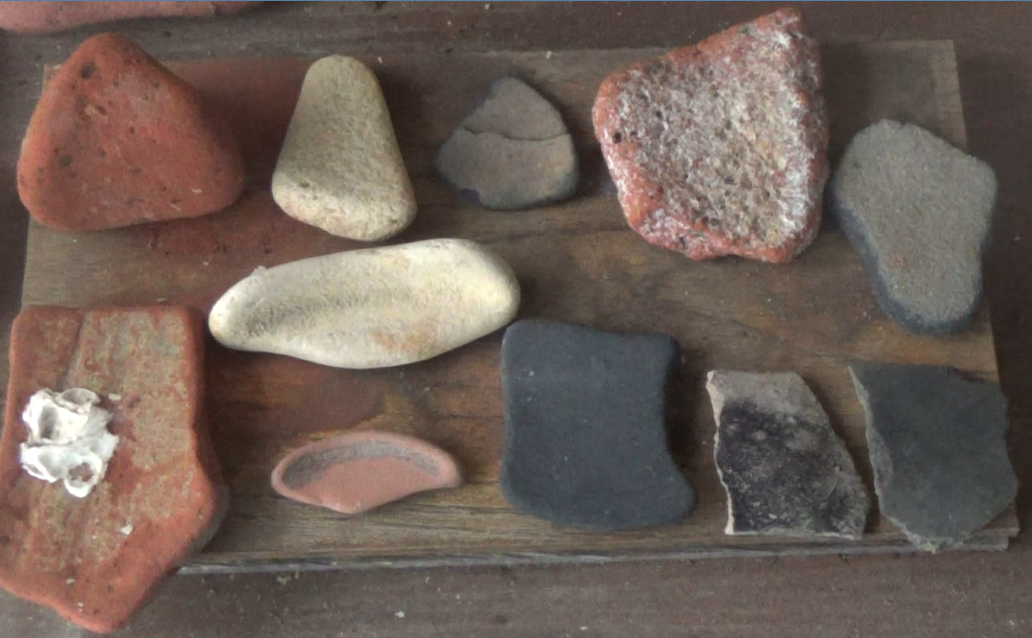
Variety of Beach Sherds.
Yesterday I showed some pottery.  I thought I'd follow up on that today.

Glass and pottery can be one of your first hints of a land site.  They can be very plentiful on the surface.

On a beach, there are times when they might be found, but most often you won't see any shards.

The picture above shows a wide variety of beach pieces.

The three big orange ones could be from olive jars or something similar.

It is easy to confuse more modern pieces with older pieces.  You can learn to tell the difference though.

Modern pieces are often extruded.  If you carefully inspect them, you can see how they were extruded.  They look different than pieces that were wheel thrown.  For one thing, they won't show the marks of the potter's hands or fingers.  The surface might be more perfect, the clay more consistent and the surface more heavily glazed.

If you want to learn to tell the difference, study modern items such as drain pipes, roofing tiles, etc.

The top left piece in the picture above shows some fairly large inclusions.  The other two pieces of similar color show some encrustation or other signs of sea life having been attached.

The one at bottom left corner, shows the ridges typical of wheel thrown pottery.

The two light colored pieces are actually more beige than they appear in the picture.

The lower of the two is a bottom piece and is very chalky and worn but shows only a touch of remaining glaze.

Directly below that is a small red/orange bottom piece.  The glaze, which is darker, remains only in the more protected corners.

There are both Spanish and Native American pieces in that group.

The blackened beige piece second from the right side in the bottom row is incised.


Kang Hsi Porcelain

Kang Hsi porcelain was transported on 1715 Fleet ships and has been found on Treasure Coast shipwreck beaches.

At left is a small piece of Kang Hsi porcelain. Note how white it is, how thin it is and how the blue is sinks into the top layer.   That is typical.

It isn't difficult to distinguish Kang Hsi from the more common types of blue on white pottery that you will often see.

I've talked about how to identify Kang Hsi and other porcelain before.

Seal Mark Of The Kang Hsi Dynasty


If you are lucky enough to see a marked piece, the mark shown to the left woul indicate the Kang Hsi dynasty.


---

Here is another TV show you might like - Curse of the Frozen Gold.   You can also watch it online.

http://www.history.ca/curse-of-the-frozen-gold/

Thanks to Dean R. for the link.

---

The surf will be decreasing a little.  Expect another day of south wind on the Treasure Coast.

Happy hunting,
TreasureGuide@comcast.net

Tuesday, October 18, 2016

10/18/16 Report - Civil War Ordnance Uncovered by Matthew. Kang-hsi Of Manila Galleons. TCBDCR= 2.


Written by the TreasureGuide for the exclusive use of treasurebeachesreport.blogspot.com.

Pot Shards From Manila Galleon
Source: Xinhualin link below.


The first thing I want to mention today is the big tides that will be combined with a 4 - 6 foot surf today and an even bigger surf tomorrow.  Unfortunately the winds will hit straight on, but there could be enough water action to help, especially tomorrow.

High water can result in a few scattered cobs on the beach even if there are not much of any cuts. However, you can almost always find some erosion if you look around enough after high water, especially around rocks and other natural or man made obstacles.

---

4PM update: I was out this afternoon and as a result am giving a Treasure Coast a beach detecting conditions rating of a 2.

---

Hurricane Matthew uncovered Civil War ordnance in South Carolina,  One corroded clump of grenades was exploded.

Trae R. sent the following link.

http://www.surfline.com/surf-news/great-white-nursery-discovered-off-new-york-old-civil-war-ammo-on-south-carolina-beach-ocean-oddities-east-coa_142415/

Here is another link about the same thing.

http://www.livescience.com/56458-hurricane-matthew-uncovers-civil-war-cannonballs.html

That reminds me of the grapeshot I found in the Carribbean, but left there because to take it on the plane could have meant hefty fines or other troubles.

---

Mexican archaeologists have uncovered thousands of fragments of a 400-year-old shipment of Chinese "export-quality porcelain" that was long buried in the Pacific Coast port of Acapulco.

The shipment of rice bowls, cups, plates and platters dates from the reign of the Ming Dynasty's 13th emperor, Wanli (1572-1620), and is believed to have arrived in Acapulco aboard the China Galleon, which regularly sailed between Asia and the New World...

Evidence even shows that starting in 1565, the return trips to Mexico were manned by Chinese crews, said Fonseca.


Here is the link.
http://news.xinhuanet.com/english/2016-10/17/c_135761246.htm

I've talked a good bit in the past about Kang-hsi porcelain, which is sometimes found on 1715 Fleet beaches.  I've posted pictures of shards in the past and even provided information on how to identify Kang-hsi (See photo above.).  My 3/29/13 post is one that talks a little about Kang-hsi porcelain.

Obviously not all blue on white shards are Kang-hsi.  There was other pottery shipped in the Manila galleons that was not as fine as the Kang-hsi.  Lower quality pots were used for storage.

You can learn to easily distinguish between lower quality pottery and Kang-hsi.

Here is a link to a great but brief overview of the archaeology of the Manila galleons.

http://www.themua.org/collections/files/original/61b274c68e00272c5e50f0af53f5b140.pdf

That is all for now.

Happy hunting,
TreasureGuide@comcast.net

Sunday, June 25, 2017

6/26/17 Report - Kang Hsi Porcelain. Silver Cleaning Cloth. Fenn Treasure Hunters Die.


Written by the TreasureGuide for the exclusive use of treasurebeachesreport.blogspot.com.

Kang Hsi Displayed At St. Lucie County Historical Museum
Photo submitted by Darrel S.

The porcelain shown above was on display at the St. Lucie County Historical Museum that is located near the East side of the big bridge on the south causeway from Fort Pierce to Hutchinson Island.  It is near the aquarium and is easy to miss.  The link below will give you the address and more information about the museum.


I showed a new find of Kang Hsi in my 5/18/17 post. Smaller pieces can be found on the beach at time. Small pieces can have some value and are sometimes mounted in jewelry. I've shown a few pieces that were found on the beach.


A stack of Kang Hsi plates were once seen on South Hutchinson Island newly exposed by erosion. That was back years ago. The detectorist did not bother to collect them. He thought they were from a beach picnic or something and didn't think much more about it. When he learned what they were, he went back and couldn't find them. That is why I talk so much about being able to recognize various types of treasure. Big mistakes can be made when you do not realize what you are looking at. A stack of Kang Hsi plates could be worth quite a bit.


I once did a post on how to identify fine China like Kang Hsi.  It can easily be distinguished from other blue and white old pottery.


You can sometimes find small pieces in shell piles.

If you do any research on Kang Hsi, you'll find that it is spelled in a variety of ways.

---

The museum owns some very early Fort Pierce phone books that I found before they were discarded by what was then the Indian River Community College.  


---


People have died seeking the famous Fenn treasure and the police want people to stop looking for it.

Here is the link for more about that.

http://www.msn.com/en-us/news/us/police-urge-treasure-hunters-to-stop-after-latest-death/ar-BBD7vqZ?li=BBnbfcL

Thanks to Dean for submitting the link.

--

I have a polishing cloth that I used for years.  The bag it came in reads, "Miracle All Purpose Polishing Cloth."  I wouldn't call it a miracle, but it works.  What is most amazing to me, is that the cloth still works after all these years.  I looked it up and found that they still sell them.

It won't take heavy corrosion off things, but it will remove the black patina off oxidized silver.  You might want to look into it.

---

To everything there is a season.  It is now hurricane season and also salvage season.  For beach hunters, depending upon where you are and what you hunt, it can be either a slow season or productive season.

The Treasure Coast is supposed to have a couple weeks of one-foot surf.  There is no tropical weather on the Atlantic map right now.

The tides are pretty big.  We've been having some nice negative tides.

Happy hunting,
TreasureGuide@comcast.net

Monday, October 29, 2018

10/29/18 Report - Eerie Eelie Beach. Some Small Erosion. Not Kang Hsi, Oxidation on Nice Mercury Dime.


Written by the TreasureGuide for the exclusive use of treasurebeachesreport.blogspot.com.

John Brooks Beach Sunday Afternoon.
The surf wasn't large but the wind direction was good so I went out to take a look at the beaches yesterday.  Often when a front comes through you'll get a little cutting.  As you can see from the photo above, there was a little erosion.  The surf and tides were high, so the cut was low on the slope. The sand in front of the slope was fairly soft.

The weather was beautiful, and on such a beautiful Sunday afternoon, you'd expect to see a lot of people, but there were very few people at the beach.  Evidently the Red Tide was still keeping people away.

I felt a little respiratory irritation, but not as much as at Jensen Beach a couple days ago.  There were a few dead fish and eels.  


I didn't know there were eels in the lagoon until the I saw some dead ones over there recently.

John Brooks Beach Sunday Afternoon.
Notice how the water is washing up onto the beach here was at about a thirty degree angle.  That was directly below a cut and was the cause of the cut.  

Frederick Douglass Beach Sunday Afternoon.
Above is the view looking south from Frederick Douglass beach.  As you can see there was less erosion there.  The depth of the foot prints also shows you that the sand was soft there.

Fort Pierce South Jetty Beach Sunday Afternoon.
There was a nice cut south of the Fort Pierce Jetty.  Unfortunately that is all renourishment sand.  

Notice the steep slope in front of the cut in the distance.  That is down near the old picked-over wreck.

For such a beautiful day, it is a shame that people weren't able to enjoy it more.

---


Blue and White Beach Shard.
If you were walking the beach and found this shard, at first glance you might think Kang Hsi.  If you've seen much Kang Hsi, a closer look will show that it is something else. Take a look at the broken edge.

Edge of Shard.

The paste is not as white and fine as Kang Hsi.  This paste is more coarse and not as hard.  But that isn't all.  The top layer of blue sits on top of the surface.  Kang Hsi has a transparent layer and the blue penetrates down through that layer.  I think I've shown that before.

---

1942 Mercury Dime.
This is an old find that I decided to experiment with.  I'm experimenting with methods of removing the black oxidation.

Close View of Oxidation.
This dime was probably in excellent shape when it was lost.  The date and lettering is still very nice.

It is very rare to find a nice silver coin on a salt water beach that isn't badly damaged.

--

We'll have some more north wind, but the surf won't pick up until late Tuesday.

Happy hunting,
TreasureGuide@comcast.net


Saturday, September 6, 2014

9/6/14 Report - 16th Century Cob Found on Treasure Coast. Reales, Emerald & Porcelain Found Too. Biggest Dino Ever.


Written by the TreasureGuide for the exclusive use of treasurebeachesreport.BlogSpot.com.

Very Early Mexico Four-Reale Found Along Treasure Coast
Photos submitted by Captain Jonah Martinez


I showed a great escudo and a very interesting cluster of artifacts yesterday.  Today you'll see that that was only the beginning.  You might consider this post to be continuation of yesterday's.

The crew of the Capitana has been busy this year.  It has been a good season.  Here are some more photos of finds sent in by Captain Jonah Martinez.

This is a very early four-reale.

You can see the denomination over the waves between the Pillars of Hercules.


You can see the legend running across the coin reading "PLUS ULTRA," meaning something like "more beyond" and referring to the New World.


Same Mexico Four-Reale
Photo submitted by Captain Jonah Martinez


Here is the other side of the same cob.

It would have been minted prior to the Great Shield era, which began in 1572.

Notice the M mint mark to the left of the shield.

In my 8/28/14 post I showed another old Pillars and Waves cob that will be auctioned by Sedick this November.  That particular eight-reale could possibly be a million dollar cob.

The coin shown today is probably just a bit later.


Below is a real handful of treasure.   Looks like about sixteen or seventeen reales and a piece of K'hang Hsi porcelain.  It is spelled in a variety of ways.

You can occasionally find pieces of the K'hang Hsi porcelain on the beach.

 
Handfull of Treasure
Photo submitted by Captain Jonah Martinez.

I've talked about Kang Hsi porcelain in this blog a few times, for example in my 12/29/13 post.

http://treasurebeachesreport.blogspot.com/search?q=Kang+Hsi

You can use the blog search box to find specific topics by keyword.

There was a fellow who found a entire stack of plates that were uncovered by a storm.  He didn't know what they were.  When he found out that they could have been K'hang Hsi porcelain from a sunken galleon, he returned to find them, but never did.   They could have been worth a fortune.

It helps if you read a lot so you know what to look for.

The variety of cobs you see here ranges from small half reales on up.

If you look close you can see details on a few.  Those look a lot like what you can find on some of our shipwreck beaches when the conditions are right.


An Emerald Found On The Treasure Coast
Photo submitted by Captain Jonah Martinez.


Here is one more thing to keep your eyes open for when walking down the beach.

There are treasures that aren't made of metal.
This emerald is one more example.  You have to use your eyes to find these.

Well, you've seen a good sample of the kinds of treasures that are still out there waiting to be found.  And things like this will be found from time to time, occasionally showing up on the beaches.

Thanks to the Captain for letting us see all of these.  Keep it up guys.


The remains of the largest land mammal has been discovered.  They think it would have weighed something like 65 tons, about what a Boeing 767 weighs.

Here is a link to that very good article.

http://www.washingtonpost.com/news/speaking-of-science/wp/2014/09/04/this-is-the-kind-of-dinosaur-you-find-in-hollywood/


We still have a small surf on the Treasure Coast, but there are two disturbances to watch.  One is over North Florida and one is just coming off of Africa.


I'll have more new information on how coins and rings sink on a beach soon.  I made a little video of another experiment which shows what causes things to sink quickly.

Happy hunting,
TreasureGuide@Comcast.net