Monday, May 9, 2016

5/9/16 Report - Mandala Designs: European and Aztec Cultures. 16th Century Gold Imports to Spain. Adventures of Cabeza de Vaca.


Written by the TreasureGuide for the exclusive use of treasurebeachesreport.blogspot.com.


Example of Mandala.
https://redice.tv/news/on-the-nature-of-four-jung-s-quarternity-mandalas-the-stone-and-the-self

You probably have heard the word "mandala."  It seems every major culture has used mandalas. Sometimes they are referred to as "squared circles."  Some of them seem to me to be more like quartered circles - circles divided into four parts. Above is one of an infinite variety.  This particular example can be found all over the internet.

Just the other day it occurred to me that the design displayed on many cobs is that of a mandala.  Below is an example.  Not the absolute best example, but it will serve.

1711 Mexico One-Escudo From The Curren Sedwick Coins Auction.

Another example would be the Aztec calendar wheel below.


Is this all just coincidence or making too much of nothing?  Or is it something more?

I can certainly see how an Aztec or Incan might see something familiar in the design of a cob, and how the cob might become an object of meditation for the mystically inclined from either the Old or New World.

---
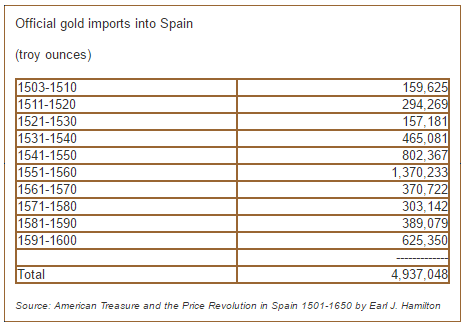

Conquest of Peru by Francisco Pizarro brought the destruction of the fine gold treasures of the Chimu and Inca peoples. The ransom for the Inca emperor Atahualpa alone yielded around 150,000 ounces. Total looting of wonderful ornaments in South America may have provided over 250,000 ounces, reflected in the jump in Spanish imports 1531-40 (see box). Most ornaments were melted down for coin.

The above table and paragraph are from the following linked site where you can learn more about gold supplies.

http://info.goldavenue.com/info_site/in_arts/in_mill/16thcentury.htm

There was an edict in the 16th century that the gold ornaments sent to Spain would be melted and made into coin.  The Seville mint produced that coinage made from New World sources.  Of course then some of that coinage would find its way back to the New World.

---'


In this excerpt from La Relación, published in 1542, the Spaniard Álvar Núñez Cabeza de Vaca relates how he and several others escaped their enslavement by an American Indian tribe on the upper Gulf Coast of present-day United States. As they come upon another town of Indians, the Spaniards are taken as faith healers and welcomed. Cabeza de Vaca and his compatriots—Andrés Dorantes de Carranza, Alonso del Castillo Maldonado, and an enslaved Moroccan Berber named Esteban—were the only survivors of an expedition launched by Pánfilo de Narváez in 1528. They journeyed from present-day Florida and through the American Southeast, finally arriving in Mexico City in 1536.

Below is the link to the excerpt describing some of the adventures of Cabeza de Vaca in the New World.  He was shipwrecked, became a slave and then a healer to the natives, and was later appointed to office in South America.  Really good reading.

http://www.encyclopediavirginia.org/The_Healers_an_excerpt_from_La_Relacion_by_Alvar_Nunez_Cabeza_de_Vaca_1542

If you want to read more about this  fellow, look up La Relacion.

---

I started a few new object cleaning projects and will have photos of those for your soon.  

Happy hunting,
TreasureGuide@comcast.net

Saturday, May 7, 2016

5/7/16 Report - Happy Derby Day. Detecting Stones. Beach Conditions. Most Read Posts of April.


Written by the TreasureGuide for the exclusive use of treasurebeachesreport.blogspot.com.

A Very Sandy Treasure Coast Beach As Seen Yesterday Near Low Tide.
Notice the waves breaking top left of center.  There was a dip just to the north and sand pile to the south of the white water.  

Same Beach Looking North.
Notice all the mushy sand.  Beach conditions have not improved and I don't expect them to improve for a while.

Cut On A Treasure Coast Beach Yesterday Near Low Tide.
Here is a cut that was up to about two feet.  It wasn't a real new cut.  South of there was an area that looked worth detecting.  There was no cut but the beach front was moved back.  It was also firm.

Overall, beach conditions remain poor, but like I showed there are a still few spots worth checking.

While the surf is nice and small, the tides are big.  This weekend we'll have nice high tides and good negative tides.

---

You might remember that I mentioned that the crew of the Dare had identified an EM target on the site of the Atocha that was not indicated by a magnetomete survey.  That means that it was not ferrous.

Well, they recovered the mystery target and now know exactly what it was.  The target was a concentration of large ballast stones - 15 ballast stones, in fact.

So why did they get an EM reading on stones?  They say, "The answer is that these ballast stones were quarried from mines that were loaded with traces of copper an other metals and minerals that show up on the EM detector."

The navigation and pin pointing of Dolores (an HAUV) was found to be very effective and Dolores proved able to locate both ferrous and non-ferrous targets.

That brings up a funny story.  My wife was going through the  scanner at the air port and she absolutely lit up the scanner.  She wasn't wearing any obvious metal, but there was a shiney metallic thread woven into the blouse. 

---

The most read post of April was the 4/20/16 Report - Gold Brooch From Corrigans. Poll Results On Treasure Hunter Spirituality. More On Andy's Crucifix Find.

The second most read post was

4/13/16 Report - Blockade Runner Found. St. Augustine Well. WW I Ships Investigated Using Drone. Eight or Nine Foot Surf Predicted.

---

The first thing I noticed yesterday when I walked onto the beach was that strange dip in the water that I showed in the first picture.

---

Happy Derby Day.  If you've never been to the Kentucky Derby it is a nice experience if you are in Louisville..  I was at the Derby two years when I was at  the University of Louisville.

Happy hunting,
TreasureGuide@comcast.net

Friday, May 6, 2016

5/6/16 Report - The Guale Uprising of 1597. PARES Portal to Spanish Archives. Atocha Silver Bar. Smooth Surf and Big Tides.


Written by the TreasureGuide for the exclusive use of treasurebeachesreport.blogspot.com.

Illustration from Murder and Martyrdom in Spanish Florida Don Juan and the Guale Uprising of 1597.

Here is a lot of great information on the missions in Spanish Florida and relations with the natives, including many pages of detailed information on the murder of missionaries and the following investigations. The title of the article is Murder and Martyrdom in Spanish Florida Don Juan and the Guale Uprising of 1597.

Here is the abstract.

In the late fall of 1597, Guale Indians murdered five Franciscan friars stationed in their territory and razed their missions to the ground. The 1597 Guale Uprising, or Juanillo’s Revolt as it is often called, brought the missionization of Guale to an abrupt end and threatened Florida’s new governor with the most significant crisis of his term. To date, interpretations of the uprising emphasize the primacy of a young Indian from Tolomato named Juanillo, the heir to Guale’s paramount chieftaincy. According to most versions of the uprising story, Tolomato’s resident friar publicly reprimanded Juanillo for practicing polygamy. In his anger, Juanillo gathered his forces and launched a series of violent assaults on all five of Guale territory’s Franciscan missions, leaving all but one of the province’s friars dead. Through a series of newly translated primary sources, many of which have never appeared in print, this volume presents the most comprehensive examination of the 1597 uprising and its aftermath. It seeks to move beyond the two central questions that have dominated the historiography of the uprising, namely who killed the five friars and why, neither of which can be answered with any certainty. Instead, this work aims to use the episode as the background for a detailed examination of Spanish Florida at the turn of the 17th century. Viewed collectively, these sources not only challenge current representations of the uprising, they also shed light on the complex nature of Spanish-Indian relations in early colonial Florida.

Really a lot of good reading.  And here is the link.

http://digitallibrary.amnh.org/bitstream/handle/2246/6123/AP95.pdf?sequence=1

---

PARES is the portal to the Spanish archives.  This is for the serious researcher who is fluent in Spanish.  You can get some really good research material through the PARES.

Here is that link.

http://pares.mcu.es/

---

Silver Bar in Sedwick Auction.
Lot number 300.


About two more weeks are left for the current Sedwick Coins auction. Many lots already have starting bids.

The 85 pound silver bar shown above has an bid of over $35,000.  That bar has a lot of nice markings.  No wonder it is getting so much interest. It is from the Atocha.

The auction will be concluded live on the internet May 18 and 19.  Until then you can bid online.

http://www.sedwickcoins.com/ta19/catalog.htm

---

We're having some smooth surf.  Expect at least a couple of days of one-foot surf.  That is good for getting in the water.  Also we're having some nice big tides with good negative tides.

Happy hunting,
TreasureGuide@comcast.net

Wednesday, May 4, 2016

5/4/16 Report - 300-Year-Old Intact Pot Uncovered. Evolving As A Treasure Hunter. Mound Key Archaeology.


Written by the TreasureGuide for the exclusive use of treasurebeachesreport.blogspot.com.


300-Year-Old Intact Bowl Uncovered In St. Augustine.
This rare 300-year-old intact bowl was recently uncovered by archaeologists in St. Augustine.

Here is the link to the video.


---

If you don't evolve as a treasure hunter, you probably won't be a treasure hunter very long.  If you don't evolve, you'll probably quit.

I see some people who believe all they have to do is get a detector and swing it around, and the detector will find treasure.  That won't get you very far.  You won't find much, and you'll probably quit before long.

Learning is necessary if you want to find much, but it is also a lot of the fun of metal detecting.  If you are not learning, you're missing out in both ways.

To be most effective, you have to learn to use your detector.  You have to learn about different areas and how to read the environment so yo will see the clues that will lead you to good finds.  You have to learn techniques and strategies.  

You'll also change what you want to find.  Your goals will change.  You'll expect to find more, and you'll target higher quality finds.  

That is why I say, "If you don't evolve, you are not a treasure hunter."  It might be slightly more accurate to say, "If you don't evolve, you won't be a treasure hunter very long."

I think it is good to ask yourself every once in a while if you've been evolving.  If so, how, and if not, why not.  

---

Here is an academic publication in which the formation of Mound Key, the capital of the Calusa kingdom at the time of European contact in the sixteenth century was studied.


Here are some of the key observations from the study.

First, it appears that the island was occupied early in its existence, abandoned, and then reoccupied. During Mound Key’s second occupation, its inhabitants substantially altered the landscape by redepositing old midden to form at least the upper portions of the two largest midden-mounds. We argue that this reoccupation and the associated large-scale labor projects are part of a deep history of human-environmental interactions tied to the production of aquatic surpluses.

Here is the link if you want to read the entire article.


---.

It seems the crew of the Dare has identified a new target that has them excited on the site of the Atocha.  It is a new EM target that the magnetometer did not show. 

---

We got some much-needed rain. I'd rather have that than the hot sun.

The surf is smooth today, but there is a bigger tide.   I've been waiting for a negative tide, but won't get a chance to get out today.

Happy hunting,
TreasureGuide@comcast.net

Tuesday, May 3, 2016

5/3/16 Report - 1715 Fleet Gold Royal and Disc Displayed in 1968. Commerce in Havana and Atlantic in 16th and 17th Century.


Written by the TreasureGuide for the exclusive use of treasurebeachesreport.blogspot.com.


1702 8-Escudo Royal Displayed At Wakeman House in 1968

1715 Fleet Gold Disc Displayed at Wakeman House in 1968

The Wakeman House is a reconstructed historic house in St. Augustine that housed displays including the above, which were said to be displayed in 1968.

These photos were found on a searchable web site that you can access using the following link.

http://maps.fiu.edu/saug/

Scroll down to the digital collection and use the search box.

---

As a result of some recent discussions and the research I was doing, I came across some interesting things. One thing I found was the book, Havana and the Atlantic in the 16th Century.  It discusses the history of Havana and the central roll it played in commerce and transportation.  You can read some of that book online by clicking the above link.

Here is just one sample table.  It shows that Havana imported a lot of wine, textiles and slaves from across the ocean.  That was in the time period 1578 - 1610.

Transoceanic exports (items exported to the Old World) included primarily bullion or specie.  That isn't surprising.  Another big export was hides.  They raised oxen.  That to me was entirely new information. They also exported a lot of dye (such as cochineal) and ships from Havana.  

Havana imported from other colonies a lot of bullion/specie (again not surprising), but also a lot foodstuff.  (Specie is money in the form of coins.)

Bullion/specie was being shipped around a lot.  One interesting figure is the relatively large amount of bullion/specie imported into Havana from across the ocean.

Florida was in the same region and controlled by the same governor that controlled Havana.  Money sent for the maintenance and defense of St. Augustine went to Havana before going to St. Augustine. St. Augustine bought a lot of supplies from Havana, so some of the money sent to Havana never got to St. Augustine, but stayed in Havana to pay for those supplies.

There are other good books online that you can view partly or completely that give information on commerce and transportation during the days of Spanish colonization.

From what I've been reading of Spanish colonial history, it seems that the government regulations provided a lot of opportunities to make money for those who were well connected and were in position to take advantage of the regulations and also those who found ways to circumvent the regulations.

---

CORRECTION.

Yesterday I mistakenly labeled the pictures as if all eight rings were from the same cut.  I corrected that.  The coins and two rings shown in the first picture came from the same cut, but the six rings shown in the second picture were found at other times.

---

We're having a nice small surf.  It is getting hot though.  The tides are getting bigger.

Happy hunting,
TreasureGuide@comcast.net

Monday, May 2, 2016

5/2/16 Report - Old Beach Ring Finds and More On The Apparent Lack Of Silver 1715 Wreck Rings.


Written by the TreasureGuide for the exclusive use of treasurebeachesreport.blogspot.com.

Two Rings and Cobs Found in One Beach Cut Back Years Ago.
Finds and photo by John C.
Back a few days ago I was discussing the observation that no silver rings have been found on 1715 Fleet wrecks.  Concerning that, I received the above and following photos and an email from John C. Here is what John said.

So here's some pictures that may, or may not,shed some light on the controversy. The coins and rings in the picture were found over 20 years ago, and all came out of the same cut, maybe fifty yards long, But I think the Rings in the photo, are a perfect example of the different classes of people that may have been on these ships, at the time, the top ring in the picture is obviously crudely made hand carved notice the file marks on the inside of the Ring where it was tapered, I would say copper or bronze or maybe even very low kt gold, there has been quite a few rings as low as 8 kt,found off these wrecks. The ring , Possibly belonging to a common sailor or crew member, with some extra time on his hands as they sailed across the ocean.  The bottom ring is beautifully crafted, very high kt possibly 22,... So is the ring personal , possibly belonging to a higher class passenger on the ship ? Or is it just cargo, maybe originally crafted in China then brought over on the trade routes from Manila ? Who really knows...

More Rings Accumulated Over Years
Finds and photo by John C.
So now on the topic of silver rings.. the next photo shows 6 Rings with no markings on the inside. 4 out of the 6 Rings show evidence of gold. The two plain rings in the middle are huge one is bigger than a quarter, 4 out of the 6 Rings also have a design or pattern on the outside, one ring I partially cleaned years ago to try to find some markings. Some of the designs on these rings are very similar to rings found off these wrecks over the years.. the broken ring in the photo is very fragile almost paper thin, there's no evidence of gold on this ring, but I think it was gold plated at one time, just like the other rings in the picture. But notice the diamond pattern on the outside the same pattern that's on the 22 karat gold ring in the previous photo.. just a coincidence" could be,, but I don't think so I know where I found it,... the 4th photo also shows a ring with a pretty common shipwreck pattern. There was one found years ago I think it was 1989 by one of the salvers. it was High kt. and had the same Arrow design on the outside. But the inside had those strange abbreviations and Crosses Zachariah blessings !, or what we used to refer to as a nun's ring....

Another important factor to consider is Beach finds,, and water finds,, have two completely different environments. If you think about what these coins and artifacts had to endure to finally end up in the dry sand. These items are in a very high energy environment being pounded by waves and tidal currents for hundreds of years.. most of us treasure Hunters have been on the beach during a strong Nor'easter and remember how fast the current is moving from north to south many of these items may have originated hundreds of yards or more further north up the beach.. I'm not saying that the items found in the water,, especially being relatively shallow water don't get banged around. They do,, But in many cases they're protected by rocks or Ledges or pockets in The Reef , in some cases even Coral growth protects these items,

So did we get any closer in answering question ,, has there ever been silver rings found off the 1715 Fleet ? Probably not ' I just think that many more of these silver artifact and rings were gold plated then we thought,, but by no means do I consider myself an expert,, and I'm not saying that those six rings I showed you are shipwreck rings. I don't really do a lot of research,, I just try my best to find the stuff.

Great photos and email John!  Thanks for sharing.  I think we all benefit from sharing our experiences and observations.

It is important to note that these rings were found in a cut along with shipwreck coins.  That suggests that the rings are shipwreck rings too.

I've heard it said that the huge rings were sometimes made to be worn over a glove.  I'll have to see if I can find a picture of something like that sometime, maybe in an 18th century painting.

My conclusion so far is that silver rings on the 1715 Fleet are very rare, but there must have been a few - perhaps only personal belongings and very possibly worn by missionaries.  We know that silver rings have been documented from Spanish colonial land sites, although the majority were copper alloy or gold.

It seems to me, that you would have the cargo, and then personal belongings, with the personal belongings being predominately those of the rich, and then the meager belongings of the lower class, with few middle class passengers at all.  Maybe someone can provide real data about the people that were on board some of these vessels.

There is also the matter of non-metallic rings such as those made out of jet or glass.  It is documented that a lot of those were brought in as cargo on ships coming from the Old World, but they, as far as I know, have not been found on the wrecks, at least not in numbers - perhaps because they broke up and disintegrated and partly because they would not be detected by a metal detector.  It must also be remembered that some of those would have been trade goods, or for use by colonists and would not be returning to the Old World.

I still hope to photo some other old beach rings.  Hope to get around to that some day soon.

It is good to have some good ideas to research.  One thing leads to another and in the process we learn a lot.

You probably don't remember but this all started with a mystery silver ring and wondering if it might be from a shipwreck.  And then there was the comment that no silver rings have been found on 1715 wrecks.  As I said, one thing leads to another.

---

We have a two to three foot surf, decreasing even more for a couple of days.  Not much to comment on there.

Happy hunting,
TreasureGuide@comcast.net

Sunday, May 1, 2016

5/1/16 Report - Lot of Mushy Sand On Beach Fronts. Non-metallic Finds Returned. Thousands of Bronze and Silver Plated Coins Found in Spain.


Written by the TreasureGuide for the exclusive use of treasurebeachesreport.blogspot.com.

A Lot of Mushy New Sand In Front of an Old Cut.
Add caption
 All of the beaches have a lot of new sand on the front of the beach because of the mild surf and south winds.

We have summer beach conditions.  We've had a lot of south winds.  There will be two or more weeks of almost no surf.

The front beach will be poor.  With the smooth surf the water will be easy to hunt, but conditions there will be sandy too.

I found the following items at the water line.  First was the fish grabber.

Fish Grabber Find

Then I found the waterproof container shown below.  Very nice.

It was full.  I suspect that it held a wallet or whatever.

I saw a fellow down the beach looking around like he lost something, so I went down and asked him what he lost.  When he told me, I returned the following items.  Needless to say, he was very happy.


Watch the water line for things like this.  Some of my favorite finds are no metallic and were found near the water line during a mild surf.  I've mentioned some.  One was a wax seal that I found.  I wonder how it survived all of those years.

Can you believe we are into may already.  It seems to me like New Years was just a few weeks ago. This has been one of my most hectic years.

I have a lot to talk about and show but won't get around to some of it for at least a few days.

---

MADRID — Workers laying pipes in a southern Spanish park have unearthed a 600-kilogram (1,300-pound) trove of Roman coins in what culture officials say is a unique historic discovery.

The Seville Archaeological Museum said the construction workers came across 19 amphoras containing thousands of bronze and silver-coated coins dating from the end of the fourth century. The coins are believed to have been recently minted at the time and had probably been stored away to pay soldiers or civil servants...

Here is that link.  Thanks to Dean R. 


That's it for now.

Happy hunting,
TreasureGuide@comcast.netn Coins Dis