Thursday, March 21, 2019

3/21/19 Report - Lot of Detectorists On The Treasure Coast Today. One More Day of Good Surf.


Written by the TreasureGuide for the exclusive use of treasurebeachesreport.blogspot.com.

Big Hole Being Dug This Afternoon by the Seagrape Beach Access.
Smile - You were favored by TreasureGuide Cam.

It was a beautiful sunny day today - the type I don't like.

I liked Monday.  So windy and rainy.  Monday was one of those days that reminded me of so many good metal detecting days of the past.  I don't like to go to the beach so much when it is sunny.  But I went today to look around.

Monday I met a few of the local metal detection experts that showed up a little while after I did.  Today there were a good number of people metal detecting the beaches, including some snow birds that were obviously new to the hobby.

I only visited two beaches today.  Turtle Trail and Seagrape Trail.  That reminds me, I need to recharge my detector batteries.  Neither of those beaches looked great, and there wasn't much digging going on.

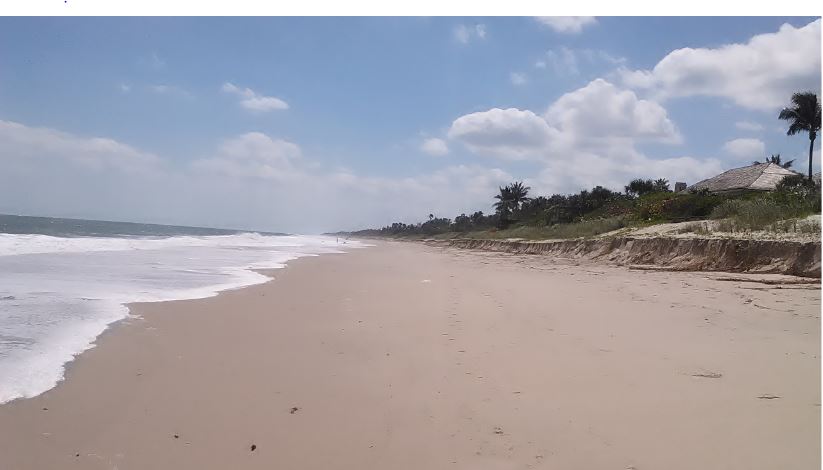
North of the Seagrape Access Looking South.

These beaches were filling a little again.

North of Seagrape Trail.
First I stopped at Turtle Trail and saw Warren leaving.  A couple other detectorists were behind him, and there were a couple beginners up by the beach access.

South of the Turtle Trail Access.

South of the Turtle Trail Access.

The higher surf of Thursday is supposed to be later.  We'll see how that goes.  Then the surf is supposed to start decreasing into the weekend.

I'm definitely at only a 2 on my TCTBDC rating scale now.  We have one more chance for things to improve a little tonight.  


Source: MagicSeaWeed.com.
Even where we had erosion this week, it wasn't getting into older layers of sand.  We had too much accumulation and too much renourishment sand out there.  In most places you could see a large protective sand bar in front of the beaches at low tide.

The things I found were mostly things that you expect to see near the surface, although a couple were fairly deep.

For example, this cookie.

Coin Enclosed in Sand Crust.
The sand crust makes up much of the bulk of this lump and gives it a lower total density.  Therefore, it "rides" higher than the coin would alone.  I still haven't settled on terminology to describe things that are more readily moved on a beach.  I'm thinking of "portable" and degrees of portability, although that just doesn't sound quite right to me for some reason.

I'm pretty sure there is a coin in that crust, although at this point I have no idea what type. 

Piece of Copper.
The copper also is more portable and rides high in the sand, but in this case it is mostly because of its shape.

Warren told me that Kellyco is going to have a close-out sale.  He thought it might be for items other than detectors.  I haven't looked up the details yet.  You might want to.

I have a lot more to talk about, but have just been keeping up with beach conditions lately.  When the surf decreases, I'll catch up on a lot of other things.

Happy hunting,
TreasureGuide@comcast.net

Wednesday, March 20, 2019

3/20/19 Report - How Some Treasure Coast Beaches Are Shaping Up. Big Tides and More Surf Tomorrow.


Written by the TreasureGuide for the exclusive use of treasurebeachesreport.blogspot.com.

John Brooks Beach This Morning.
I didn't see John Brooks yesterday, but it looked to me like the last high tide took away some sand.  The average cut was about three feet high.  Some places were higher and others lower.

It looked very similar to how it looked back a few weeks ago when there was a big cut.  There were no layers or shells or other major features.  It was just a uniform brown sand.

I checked it out and there were very few widely scattered targets.

John Brooks Beach This Morning.
The cuts ran to the south, decreasing some at Douglass beach.

Frederick Douglass Beach This Morning.
The cuts were smaller at Frederick Douglass beach.

There were some modern coins near the water line at Frederick Douglass.

Blind Creek was cut pretty good Monday, but was mostly filled back in today.

Walton Rocks Beach This Morning.

Maybe I did better yesterday than I thought.  I thought it was all junk, now I'm not so sure.  Some items were encrusted.  I'm pondering what I want to do with them and hope to have some photos later.

The biggest thing for me yesterday and today was that I was able to detect an hour or so without any back problems.  You might remember that I wrote around a year ago that my detecting days might be over.  My back has been better since then, and although I kept my detecting time way down the past couple of days so I wouldn't overwork my back, my back took the exercise with no big problems.  That is a big relief even though I was frustrated that I couldn't put the time in that I wanted to.

Dale J. sent me a variety of photos from around noon yesterday.  He said, The only beaches with only very small new cuts were Golden Sands and N of McLarty.  I didn't see Golden Sands beach yesterday.  His photo or Rio Mar also didn't show any erosion.

Thanks much for the photos and report Dale.

I have some more finds to clean off and photograph.   One of the more interesting ones is heavily encrusted, although I don't know what it is yet.


Source: MagicSeaWeed.com


The surf is supposed to be even a little higher tomorrow.  The tides are big now too.

The wind has been wobbling and one day one beach will be cut and the next day it will fill again, and another beach will be mush one day and then cut the next.

To use my beach conditions rating scale, I'm tempted to give it a three rating, but it just doesn't seem quite that good.  Of course, I wasn't able to look at all the beaches.  There are just too many beaches and too little time.  Right now I'm wavering between a two and three rating.  I wouldn't be surprised if a few cobs were found, but I would expect the finds to be relatively few.

It takes a lot of perseverance.  You might remember my success formula.  Time spent detecting is one of the biggest factors.

Scouting is also important.  Sometimes time spent scouting is almost as important as time spent detecting.  It doesn't matter how much you detect if you are in a area that isn't producing what you are seeking.  Of course if you are out there a lot, you have a better chance of being there at the right time.

Happy hunting,
TreasureGuide@comcast.net


Tuesday, March 19, 2019

3/19/19 Report - Beach Conditions in The Vero/Sebastian Area Today. More 4-6 Foot Surf Coming.


Written by the TreasureGuide for the exclusive use of treasurebeachesreport.blogspot.com.

Turtle Trail This Morning.
I went out to check some of the beaches in the Vero/Sebastian area this morning.  I started at Turtle Trail after high tide.

Upon arriving I saw a lot of sea weed and the small amount of erosion shown above.  I moved farther south and saw more erosion, but it was not enough.

South of the Access at Turtle Trail This Morning.
I checked out this area with my detector a little.  Three other detectorists showed up.  Nobody did much digging.

I saw just hints of the erosion control bags at a few places.

I dug a few things, mostly junk, but maybe one that might be something.  It has to be cleaned a bit before I can tell.

I also looked at Seagrape Trail.

North of Seagrape Trail This Morning.
A lot of the renourishment sand has been moved.  Again, notice the seagrass.

Not many people on the beach anywhere today other than a few detectorists.

Then I moved on to Wabasso.

Wabasso This Morning.
There were two guys detecting at Wabasso.  There had been a little erosion there too.

The gate at Ambersands was closed.  Probably because of the beach renourishment work going on.


North of McClarty Museum This Morning.
You can see the beach renourishment equipment down by the museum.

The museum parking lot was full this morning.

It was windy and wet out all morning.  Not as much erosion as I hoped to see.

I did get to talk to a few of the guys that often send in find photos.

MagicSeaWeed.com predictions.
It looks like we'll get a couple more days with some decent surf and high tides.  The wind will be shifting a little.  That could help at some locations.

I'd rate this as level two conditions on my Treasure Coast Treasure Beach Detecting Conditions scale.

Level two is what I would call transitional conditions.  Improved but not quite good.   There could be some isolated spots that are better.

There is still the chance of improvement over the next couple of days.

Happy hunting,
TreasureGuide@comcast.net.

Monday, March 18, 2019

3/18/19 Report - Some Treasure Coast Beaches Eroding Already.


Written by the TreasureGuide for the exclusive use of treasurebeachesreport.blogspot.com.

A Few Hundred Yards of Erosion This Morning.
I wanted to see what was happening on the beaches this morning.  I visited a few beaches on Soputh Hutchinson Island and found that there was some erosion.  I went out just after high tide.

The wind was blowing from the north.

Not all of the beaches were eroded, but some were.  The biggest cliff I saw was about four feet,  The stretch above was a few hundred yards long.

Here is the biggest erosion that I saw.

Near Four-Foot Stump in Front of Erosion.
Up at John Brooks there was very little erosion.

John Brooks Beach This Morning Just After High Tide.
There was a little erosion at the bend between John Brooks and Frederick Douglass beach.

Small Erosion Just South of John Brooks Beach Access.

Frederick Douglass Beach was not erosded.

Frederick Douglass Beach This Morning.

I wanted to get this posted.  Maybe I'll be back later.

Happy hunting,
TreasureGuide@comcast.net

Sunday, March 17, 2019

3/17/19 Report - The Manila Galleons. Big Cash in The Sofa. New TV Treasure Shows. Big Surf.


Written by the TreasureGuide for the exclusive use of treasurebeachesreport.blogspot.com.


A few days ago I wrote about the Kang His porcelain that you can find on the 1715 Fleet beaches.   Of course that pottery came from China.  The porcelain and other items from Asia and the Phillipines first crossed the Pacific on the Manila galleons before being loaded on the galleons that would cross the Atlantic.

There are wrecks of the Manila galleons that have been investigated.  You can find them described in The Archaeology of the Manila Galleons, by Robert Junco.  Here is the introduction.

This paper presents a brief recount of the Manila Galleon sites investigated to date. It also proposes, some ideas of what the archaeology of Manila Galleons could consider in its research objectives. The Manila Galleons, loaded with their rich cargos of oriental goods are still a great mystery to researchers, especially those belonging to the sixteenth and seventeenth centuries. Furthermore, studies of Asian ceramics and other products of exchange in New Spain and beyond are scarce. While the work of historians and art historians has contributed significantly to the topic, archaeological studies are rare given the few sites located. In this paper, I shall mention the Manila Galleon sites that have come to my attention, and then present some ideas that I deem relevant in the pursuit of what can be termed the archaeology of Manila Galleons.

And here is the link if you want to read the rest of that article.

http://www.themua.org/collections/files/original/61b274c68e00272c5e50f0af53f5b140.pdf
I think you'll find a lot of interesting information if you read that study.  It summarizes seven different wreck sites and has an extensive bibliography that you might also find useful.

Another study of the Manila Galleons is The Arrival of The Spanish Galleons in Manila from the Pacific Ocean and Their Departure Along the Kuroshio Stream, by Jose Eugenio Borao Mateo.  This one is historical rather than archaeological.

Here is the abstract from that one.

The aim of this paper is to revisit some well-known features of the seasonal conditions and geographical incidences of (1) the yearly arrival in Manila of the galleons coming from Acapulco and (2) the first stage of their return voyage along the Kuroshio stream. It will be based on existing published data, like the well-known Blair&Robertson (BRPI), the less known Navas&Pastells (CDF), the collection of Spanish Documents of Taiwan (SIT) published by the author, and other documents from Spanish Archives. The paper will try to present the routine of these trips, and some of the nautical conditions (specially the monsoons and typhoons contingencies) as explained by sailors like Cevicos, and to revisit some particular well-known cases of shipwrecks like the ones of the Spanish galleons San Felipe (1597) and San Francisco (1609) in Japan, and Nuestra Señora de la Concepción (1638) in Marianas Islands. Finally, some conclusive ideas will focus on Taiwan as one of the last ramifications of the Acapulco-Manila route; and the fact that for the sailors was much more important the winds than the currents, which—as it seems—their knowledge was not yet totally clear.

And here is the link.

http://homepage.ntu.edu.tw/~borao/2Profesores/Kuroshio.pdf

Again, you will find a useful biography with references from some unusual sources.

There haven't been many books on the Manila galleons since the one written in the 1930s, but here is one you can preview online.  It is The Manila-Acapulco Galleons: The Treasure Ships of the Pacific, by Shirley Fish.

You might want to get it at your local library.  If they don't have it, ask for an interlibrary loan.

Click here to preview that book.

---

You might like this story about how three students found $40,000 cash hidden in a sofa they purchased at a thrift store.  Good story how it turned out.
https://people.com/celebrity/cash-couch-students-return-40000-found-stuffed-in-thrift-store-sofa/

---

There are some new treasure hunting TV shows this season.  I ran into one the other day.  It is Lost Gold.  I think it was on the Discovery channel.   I didn't find it very exciting.  The best thing about it for me, in the short time I saw it, is that they talked about some famous treasures and early treasure hunters and detectorists, such as Frank Fish.

You can read more about Frank Fish in this issue of The Tombstone News.

It begins...

In April 1963 death came to one of the most famous and successful of the treasure hunters, Frank Fish. To all appearances and evidence he died by his own hand. But did he? Frank was my close and personal friend; my family and I spent many hours in his Gold Rush Museum listening to him spin yarns of lost and buried treasures. To say the least, it is my honest opinion that Frank Fish was not the suicidal type. He loved his museum and its thousands of relics too well. In addition he was close on the track of a large treasure cache for which he had searched many years...

I also saw advertisements to a program on Civil War gold and a Japanese treasure in the Philippines.

I'm a little over most of the TV treasure shows.  They have generally been disappointing.  Too much foolish hype and showmanship, and not totally trustworthy.  It is better to go out and do it for yourself anyhow.  Still, we all have a little downtime for foolishness.

---

The Treasure Coast surf forecast has changed a little.

Source: MagicSeaWeed.com.
It looks like the peak of about seven feet will be Tuesday.  It doesn't look like it will be as sustained as forecast earlier.   Still a pretty good size, along with some good tides.  And still a couple days for things to shape up.

Happy hunting,
TreasureGuide@comcast.net


Saturday, March 16, 2019

3/16/19 Report - Eight Foot Surf Possible Soon. Tips for Detectorists. Who Moved My Cheese. Wood Find.


Written by the TreasureGuide for the exclusive use of treasurebeachesreport.blogspot.com.

Source: MagicSeaWeed.com
The big news for me today is the forecast.  MagicSeaWeed is predicting up to an eight foot surf for next Tuesday.  The wind will be mostly northeast and the tides are increasing too.  If that holds or gets even better we might be in for some good beach hunting conditions.

Keep watching.

---

A couple decades ago, a book entitled Who Moved My Cheese was very popular in the field of business motivation.  Despite the title, the book isn't about cheese at all, but uses two mice and two miniature people as characters in a parable to illustrate some important lessons.  Every detectorist should read that book, or at least learn the lessons the book teaches.

Doing the book a gross injustice, I'll boil it down to this - the mice lived in a maze and were accustomed to  always finding abundant cheese in a particular location, but one day when they went out to get their daily fill, they find no cheese where they always found it in the past.  They fear there will be no more cheese and blame everybody else for their failure  (thus the title Who Moved My Cheese) instead of moving on and finding a new cache.

Here are some of the main lessons from the book.  Things will change.  Change is inevitable.  Don't be afraid of change.  If you don't change you will become extinct.  Be ready to change quickly, and enjoy it again and again.

The book applies to metal detecting as well or better than it applies to business.  Things will change.  Some day you'll find that doing the same thing that was always successful in the past will no longer  work as well.  And people will think that there is no more treasure or that the beach or detecting site no longer produces.  To continue to be successful, you will have to change.  You can not keep hunting the same site, or the same kind of sites, using the same techniques and expect to continue being successful.  Be among the first to change.  Take the challenge and enjoy it.  Progressing is necessary just to stay even.

There are plenty of obstacles for detectorists, but they can and should be overcome.  Here are my four big Os - Overcome Obstacles to Open Opportunities.

An obstacle is often a sign of a new opportunities.  The obstacles don't have to be big - just big enough.  You can do well by working the places with small obstacles that no one else wants to bother with or perhaps does not know how to work.  Some that I've worked were just a little farther out of the way or covered with trash or mud or weeds or somehow not as accessible.

A lack of creativity or willingness to change can be a different type of obstacle.

If it was really easy, everybody else would do it, and sometimes it seems like they are.  If you are just doing he easy stuff, there will be plenty of others that are doing it too. If you are doing what is easy, that is one sign that it is time to start thinking about how you can take the next step.

There are always new frontiers.   And you might be surprised how much is out there to be found.  That is one reason I tell you day after day about what is being found.

I'll never forget the first time I went out on a wooded hillside in West Virginia.  Everybody said, "There is nothing there. You won't find anything."  On my first outing, I found a gold 1940 something high school class ring.  On subsequent outings, I found old coins and relics from previous centuries.

On my first outing on a Caribbean island, I found 18th century military buttons, ordnance and other relics.

But you don't have to go to distant places.   There is stuff almost everywhere.

I no longer live near the glitzy resorts of Miami where people visited and lost their coins and jewelry for over a hundred years.  I now live in an unremarkable place that has to be maintained continually just to keep it from once again becoming a wooded mass of thorns, vines and trees.  There is nothing that would suggest that anything ever went on there - certainly nothing important.  It is a place no different than millions and millions of other places.  Yet within walking distance, and without any equipment or anything other than the clothes to cover my nakedness, I've found fossils that are millions of years old, Native American artifacts, pioneer relics as well as most of the bottles and glass insulators that I've posted.  I'm just saying there is a lot of stuff out there.  I'm not talking about some world-famous treasure island where you might expect to find buried treasure galleons or the Holy Grail or Ark of the Covenant where people have searched for centuries and turned everything upside down with heavy equipment and scanned with high tech tools.  I'm talking about Anywhere USA.  You don't have to go far unless you have a particular treasure in mind.

I can't tell you all the kinds of places you should look or how you should work them,pl but they don't have to be far away.  In fact, they might be right under your nose.   Believe it or not there are more places that are unhunted than places that are over-hunted.

My main point today is that there is a lot still out there to be found, but like the book says, you might have to make some changes to find it.

---

Dale J. sent me the following photos of his find.

Find and photo by Dale J.

He said, The red circles show rusted iron, a close up of the one possible spike sticking out, there are oyster shells only on one end. Not sure how long it was washed up it was not moving in today’s small surf. This is north  of Ft. Pierce Inlet.  About 8 feet long and 12x12 inches.

Here is another look.

Find and photo by Dale J.

Interesting!  Thanks Dale.

---

Keep watching the surf reports.
TreasureGuide@comcast.net

Friday, March 15, 2019

3/15/19 Report - How A Beautiful Pre-Civil War Artifact Was Recovered From the Depths. Bone Find? Interesting Surf Prediction for T. C.


Written by the TreasureGuide for the exclusive use of treasurebeachesreport.blogspot.com.

1852 Tea Pot Recovered From Steamer Wreck On Display.
Find and photo by Sebastian Steve


I just received the following in an email from Sebastian Steve.

IMMIGRANT KETTLE/TEA POT 1852  Recovered by Sebastian Steve.

I saw your 'TEAPOT' photo, so I thought I might share my recovery (from about 30 years ago) of a teapot or kettle and the story that it carries on...hopefully forever...however long that is.

I was salvaging a passenger steamer up in Lake Erie, lost in 1852.  I went down on my morning dive to 160 feet, and worked along the port gunnel.  Sure enough jammed in the passageway on the main deck was an "immigrant crate" as I had named them.  This one the top was missing, evidently blown off from the air pressure trapped inside.  They really were not like an immigrant trunk with a big lid that opens.  Instead these were often just heavily built hardwood boxes nailed shut for the period of the voyage.  

Theft was rampant back in these days, and the only way to keep your goods safe, was to guard them day and night.  Literally sleep with your head resting against your crate.  Nailing your "Crate" shut certainly deterred theft!  The wealthy in first class would consign their luggage and valuables to the ship's purser, who kept all their belongings locked up tight in the purser's cabin for safe keeping. 

And as I began to feel around inside this immigrant crate, I could feel many objects to my delight still remained. Certainly all the contents could have been blown out from the air pressure.  This of course was all by feel, as the second my hand touched the first artifact, the powder silt was up, up, and away!  Totally bringing the visibility of the dive down to near zero at this location.  

But I was used to working in low visibility, or even just by feel, so I continued to investigate the contents of this crate.  A beautiful oval cheese box came out.  Totally hand made and carved with decorations in the wood.  These were often given as wedding gifts to a new young couple.  The crate had preserved the thin wood perfectly, and all the inscriptions and patterns could be seen.  A beautiful piece indeed.

Then I felt something harder near the bottom of the crate.  Harder, yet round with a protrusion.  I pulled this artifact up and out into the clearer water.  And I saw for the first time, that I had a beautiful tea pot or kettle as they are often known by.  Not a bit of damage, no dents, amazing how it survived a collision and foundering into 160 feet of water with no damage!  But wait... the lid was missing.  I think I groaned so hard, I almost spit out my regulator.  My chances of finding that lid was next to zero.  It must have blown out the top of the crate when the lid blew off.  What a royal shame... Still a pretty piece, and I could see some kind of inscription on the handle.  

And so I surfaced after my 11 minutes of decompression.  My total dive was about 50 minutes, but only 20 minutes of that was actually on the wreck.  In the afternoon dive, (after sitting out for 4 hours for residual nitrogen to escape my blood stream) my next dive would have the same profile for decompression, but only 15 minutes of time on the wreck.  So yes...a total working day of only 35 minutes....and a full hour boat ride each way to the wreck.  There was no time for sightseeing, not with the business I was in of making my living from the deep.

It was a beautiful day...and after a nice rest in the warm sun, a sandwich and soft drink, it was time to suit up again.  Down I slid on the descent line, deeper and deeper, and right over I swam to my mystery chest I had just located that very morning.  And I against all odds, felt around in the bottom of the crate for the lid.  I knew exactly what it would feel like, and its size.  My minds eye would identify this lid quite easily "If" it were only still there in the crate.  Blown out...in reality it could be anywhere.  Depending on when the air pressure had her way with the crate.  The lid could be five feet from the crate, or 50 feet away under three feet of silt.  It had to be found in the crate or kiss it goodbye...forever.  

I feel like I almost "willed" this lid into my hand.  Because at about ten minutes into the dive I had her in my hand !!!  I knew it right away, but I still backed up and thrust my arm up and above the silt cloud into clear enough water to see what I had.  And OH-Boy...was I a happy diver.  Far too fine a piece of history to not be complete.  And now she was complete in all her glory.

What makes this kettle so special?  If you study the inscription on the handle... it is "MHD" 1852.  And there is also a maker's mark from when the kettle was made.  This is only speculation...but I would state my reputation on this...Some gifted man for beautiful scroll work, purchased this kettle in N.Y.City after crossing the ocean from the Fatherland.  To commemorate his arrival in the United States, he scribed into the handle his initials, and the date.  Making this a very important --immigrant artifact--- of 1852.  I believe he had the calm and time to do the carving as he went peacefully down the Erie Canal from the Hudson River to Buffalo, N.Y. on a horse drawn canal boat. 


Inscribed Tea Pot Handle.
Photo by Sebastian Steve (clipped by TG)

And so after 30 years it was time....time for a new home that could guarantee its continuity and safety.  I carefully selected a couple who run a maritime museum out of their home in Michigan.  It's first rate in all respects.  And just as important, this Ken has a deep and loving respect for the history of The Great Lakes.  I wish him well with this gorgeous piece of immigrant history.  A piece this fine might bring in the neighborhood of $5,000.


All the Best,
Sebastian Steve 


Very meaningful and beautiful find!  Thanks for sharing Steve.

---


John L. sent me the following email and photos.


Hello again.
I was wondering if you and/or your readers could tell me anything about this find.
I know very little about fossils, but this sure seems to be one resembling a tooth.
Found it in a line of shells at a local, municipal, tourist beach.
Thank you again for keeping up your terrific blog! 


I don't think this is a tooth, but if you can provide more specific information on the item, please email me.


Find and photos by John L.


---

Now this is starting to look like it could get interesting.

Source: MagicSeaWeed.com.
Three days in a row of 4 - 6 foot surf is predicted for the Treasure Coast.  Of course, it could change for the worse yet.
Keep watching,
TreasureGuide@comcast.net