Showing posts with label Bernard Romans. Show all posts

Tuesday, May 21, 2019

5/21/19 Report - Buried Treasure, Pirate and Otherwise. Bernard Romans and Bleach Yard. Lost Payroll.


Written by the TreasureGuide for the exclusive use of treasurebeachesreport.blogspot.com.

Source: Trial of the Twelve Spanish Pirates of the Schooner Panda, a Guinea Slaver (link below).
Yes Virginia, pirates did bury coins on the beach - at least that is what the book shows.  The book I'm talking about is Trial of the Twelve Spanish Pirates of the Schooner Panda, published by Lemuel Gulliver in Boston in 1834. You can read a free preview online by using the following link.

https://books.google.com/books?id=IQQWAAAAYAAJ&printsec=frontcover&source=gbs_ge_summary_r&cad=0#v=onepage&q&f=false

In case you didn't recognize the "Yes Virginia" part, in 1897 a young girl wrote a letter to a newspaper asking if there is a Santa Clause, and that led to a very famous editorial response that included the much repeated, "Yes Virginia, there is a Santa Claus."

You will find the testimony describing the burying of treasure as illustrated above on page 16 of the ebook.  Testimony concerning distribution of the treasure along with other interesting events is also included. It is not easy to follow the testimony, but if you manage, I think you'll find it entertaining.

Here is a link if you want to read a very brief summary of the criminal acts leading to the trial of Don Pedro Gilbert and the other pirates of the Panda. The robbery and destruction of the Brig Mexican occurred off Stuart, Florida.  The web site presents a variety of additional information on pirates.

http://self.gutenberg.org/articles/eng/Pedro_Gilbert?View=embedded's,%20newfoundland%20and%20labrador

If Lemuel Gulliver rings a bell, it is also the name of the fictional character and narrator in Gulliver's Travels, which was written about a century earlier.  For a minute it made me wonder if the author's name on the pirate's trial book might be a pseudonym, but the same Lemuel also published a book on another trial that took place in Boston in 1834 as well as a number of other non-fiction titles, some being almanacs.

---

Yesterday I referred to a Frank Hudson book entitled Lost Treasure's of Florida's East Coast and mentioned Hudson's poor reputation for accuracy.  I happened to find that book  (which turned out to be surprisingly easy) and inside found the following map of what is labeled as the St. Lucie Inlet area.  After opening the book and briefly scanning it, I was less than impressed by the contents.  Nonetheless, here is the map of what is presented as the St. Lucie Inlet, the same general area that I discussed yesterday.


Illustration Found in Frank Hudson's book,
Lost Treasures of Florida's East Coast.

I'm really not confident of much of anything shown on the map, but would not find it surprising if treasures were buried around the St. Lucie Inlet (which was located at a different locations at different times) or any other Florida East Coast inlet, for that matter.

Treasures 1 through 5 are described as (1) gold bars, (2) iron bound chest, (3) buried cannons, (4) iron bound chest, and (5) iron bound chest.

Number 6 is the most interesting as a possible lead.  Hudson says, in 1834 an army paymaster was moving $8000 in a dugout canoe up the river when it was lost in the river.  Hudson additionally wrote that if you send him a stamped envelope seeking additional details, his source, who did not want to named in the book, would provide additional details.

While I doubt the accuracy of much in that book, it could nevertheless lead to some real facts if anyone is moved to do some research.  I often start looking into one thing and find something else that was totally unexpected.

The Hudson book on buried treasures of the Florida East Coast was published in 1983.  

---

Yesterday I also mentioned the "Bleach Yards" down by Gilbert's Bar and couldn't remember the map where I originally saw it.  Ron J. came to the rescue and pointed to my 9/6/15 report that discusses  Bernard Romans and provides a link to the Romans book, which contains the map.  Below is the link to that post.

https://treasurebeachesreport.blogspot.com/2015/09/9615-report-bernard-romans-and-1715.html

You might enjoy looking at both the post and book.

Thanks Ron!

---


I have a lot more to talk about, but that is about it for today.

The surf is still one to two feet but Thursday will start increasing, reaching three to four feet on Friday.

We are still getting some nice low tides.

Happy hunting,
TreasureGuide@comcast.net


Wednesday, October 25, 2017

10/25/17 Report - Mystery Coin(?) Find for ID. Very Early Astrolabe Found. Bernard Romans Resources.


Written by the TreasureGuide for the exclusive use of treasurebeachesreport.blogspot.com.

Find by Steven B.
Other Side of Same Find by Steven B.

Steven B. found this mystery object. Can you help identify it for him?  Let me know if you have any thoughts on its identity.

Here is what Steven said about the find.


I found this last Sunday at one of the 1715 sites. I cannot seem to match the patterns barely visible. The obverse shows a star or fort type image, the rear a shield with possibly two rows of stars along each side the shield. 

Same size as a quarter, just a 1/16 less. Reads 72 on my White's Coinmaster GT. Bright spot was a small speck of shell attached. Bright shiny silver color underneath when shell chipped off. Weighs 1.3 grams. Any ideas???

Notice how the color looks very different in the two photos.  That is one thing that makes it more difficult to identify items from photos.

Please send me any thoughts on what it might be.
---


One of the Earliest Known and Recently Discovered Astrolabe.
Source: BBC.com  (See link below)

...It is believed to date from between 1495 and 1500.
The item was recovered from a Portuguese explorer which sank during a storm in the Indian Ocean in 1503.
The boat was called the Esmeralda and was part of a fleet led by Portuguese explorer Vasco da Gama, the first person to sail directly from Europe to India....
Astrolabes generally date between 1500 and 1700.  This one appears to be one of the earliest.
Here is the link for more about that.


Darrel S. sent me the following message and photo.

Was in Cedar Key recently and visited the Whitman Museum. I have not been in that museum since childhood, although I have been to Cedar Key several times this year.

There was a facsimile copy of the original book that was written when he charged La Florida during British occupation.

There is knowledge of his map, but rarely do you see or hear about his diary or book. One of the best sources of the 1715 wrecks, sites, and bearings is briefly mentioned. He only wrote a brief description on the map, but was enough for Lip to make his discovery of the 1715 Fleet.

The image of the map I have sent to you before. The multiple sections. The original was close to 6 x 8 feet and was published by Paul Revere.


Thanks Darrel.

---

On the Treasure Coast we have a small surf.  A nice cool front moved in and the wind was from the west this morning.

Happy hunting,
TreasureGuide@comcast.net

Tuesday, December 27, 2016

12/27/16 Report - Pistareens On The Treasure Coast Beaches In 1775. T. C. Beaches Today. Scams of Old.


Written by the TreasureGuide for the exclusive use of treasurebeachesreport.blogspot.com.

Douglass Beach Looking North Near Low Tide Tuesday.


Heavily Eroded Fort Pierce South Jetty This Near Low Tide

South Hutchinson Island Around Noon.

Another South Hutchinson Island Beach Near Low Tide Tuesday

There were a good number of beach goers out taking advantage of the warm weather after Christmas.  There were no big crowds or anything, but a more people than normal for the Treasure Coast.

The beaches did not look very good for metal detecting.  There was one beach that had a firm front.  I will take another look at it in a day or two.

---

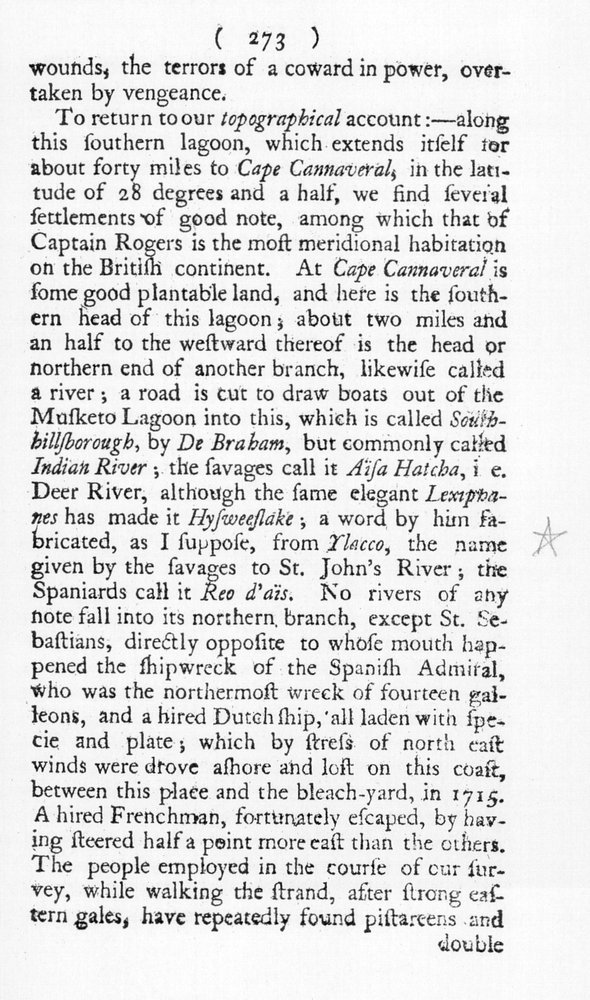
You are probably familiar with the name Bernard Romans, who published a book in 1775 concerning the natural history of Florida and in the process mentioned shipwrecks observed along the Treasure Coast and including a map.  For those of you who are not intimately familiar the Romans book, I decided to post a couple of excerpts from pages 273 and 274.  Here they are.


Not only did Romans see the remains of the wrecks, but he also made note of the fact that "pistareens" were repeatedly found by those walking the beach after "eastern gales."  He goes on to speculate that more would be found on the wrecks.  Remember, he wrote this in 1775, sixty years after the sinking of the 1715 Fleet.  

Here is the link to a facsimile edition of the book which you can read online.


Romans saw wreckage.  I read somewhere that wreckage besides ballast stones was visible still in the 1940s and 50s.  Today there is little left to see.  A lot of the ballast stones have been removed - some very systematically.

---

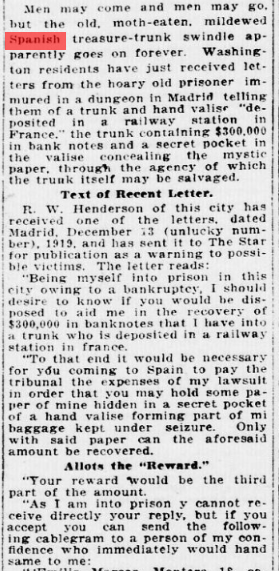
Here is another item from the "nothing new under the sun" category.  The email scams you see today were going on long ago - just without email.  The following excerpt is from a 1920 issue of the Washington D.C. Evening Star.


The letter goes on to tell the reader how to receive a reward amounting to one/third the amount stored in the trunk.

Who would guess todays email scams are just updated recycled scams.

----

Happy hunting,
Treasureguide@comcast.net

Sunday, September 6, 2015

9/6/15 Report - Bernard Romans And The 1715 Fleet. Tropical Storm Grace.


Written by the Treasureguide for the exclusive use of treasurebeachesreport.blogspot.com.


You might know the name Bernard Romans.  In 1775 he wrote the book, A Concise Natural History of East and West Florida.  As luck would have it, he turned out to be a well known name in treasure history.  It wasn't his intent.  He wasn't a treasure hunter.  He just happened to mention the shipwrecks of the 1715 Fleet that littered the area around Sebastian River back in the 1770s.

In 1962, the University of Florida Press reprinted his book, and it became a resource that was read by those seeking more information about the shipwrecks and the pistareens mentioned by Romans that were found in the sand after "strong eastern gales."

As is the case so often, history is produced by the alignment of circumstances.  Some moments become highlighted in the story of man - disproportionately so - sticking out in memory like stars in a night sky.   Many more moments, just as important and just as necessary, fade from memory and are never told.  The fact that they fade into oblivion makes them no less important and no less necessary to the flow of events.

Isn't it the little things we do, the countless moments, tasks and dreams that fill the vast space between the few over-remembered times and events that really makes us who we are?

Everyone knows the name Shakespeare, but who actually knows the man?  Who really cares? Is he anymore than a name?  He is not your grandma, brother, wife or son.  He doesn't touch your life like any one of them.   And he doesn't touch other's lives like you do today.

We need statues and monuments,  They may be hollow, but they are shared.  As much myth as fact, they provide the tapestry of human consciousness that unites us with a sense of common story.

Hidden in life are countless precious moments much like gold coins buried under sand. Many remain undiscovered.  They just don't grab our attention at the time.  They are just there.

Maybe moments like that are not important to anyone but you, but that makes them all the more unique and rare.  They belong to you and are to be shared with those you care about the most.  Take the time to seek out those moments, dig them up, hold them, admire them, jump up and down, share, and celebrate, like they were the most precious treasure you ever imaged.

---

I certainly didn't know where that was going when I started.  I'll leave it there for now even though it may seem a rambling meaningless mess to many of you.  It is more me than most of what I write.

Back to Bernard Romans.  He was a historical figure in many ways, though most of us know him for his mention of the 1715 Fleet.  He was a real person - a complex and many talented person at that.  He was a botanist, engineer and participant in the Revolutionary War.

The original printing of his book is rare and valuable.  Those who later used it for research undoubtedly read the 1962 reprint.  The original is that rare.

I highly recommend reading the Introduction to the reprint edition written by Partick Rembert.   It tells a lot about Romans and his work.

You might find much of the book of interest.  Romans mentions other shipwrecks and hurricanes as well as many interesting observations on the nature of Florida at the time.

Here is a link to the complete online book.

http://ufdc.ufl.edu/UF00095971/00001

Here is a sample page.  At the bottom of this page you will see his mention of the pistareens.

A concise natural history of East and West Florida - Page B-273
As you can see, they use "f" for "s."

It is an interesting book.

Thanks to the University of Florida Press for reprinting the book and making it available online.

---

On the Treasure Coast we'll have a one foot surf for the next couple of days.

Fred is sputtering out in the mid-Atlantic.

We now have Tropical Storm Grace that could head this way.  Here is the projected path of Grace.


Happy hunting,
TreasureGuide@comcast.net