Showing posts with label detecting. Show all posts

Tuesday, September 25, 2018

9/25/18 Report - The Complete Beach Hunter. Treasure Coast Surf to Decrease and Then Increase Again.


Written by the TreasureGuide for the exclusive use of treasurebeachesreport.blogspot.com.

There are times when I spend a lot of time and thought selecting just the right word or phrase.  There are other times when I make less of an effort to be as precise as possible. On those occasions I put it out there and hope that the reader will get the gist of what I am trying to say.

Yesterday I used a a few words that were very carefully chosen.  You would never guess how much thought I put into choosing those words.  They don't seem like anything complicated or special, yet a a lot of thought went into choosing them.  The words I'm talking about are "complete beach hunter."  There were a lot of other choices.  And maybe some of those other choices would have been good choices, but I don't think they'd be as good.  I won't get into all of the reasons leading to my choice, but I want to elaborate a little on what I meant by "complete beach hunter."

A complete beach hunter is a person who does not look for one kind of treasure or a limited number of types of treasure.  The complete beach hunter is open to whatever type of treasure might be there. He has a very wide and continually expanding breadth of interests, including metal objects of various types and ages, but also an equal interest in other things such as fossils, shells, sea glass, bottles, Native American artifacts, antique toys, and basically anything of interest or value that might be found on a beach..  As I've said many times, you can find almost anything on a beach, and to appreciate the value or significance of those things can be a never-ending educational process.  In my opinion, it is impossible to be informed on every type of treasure that might be found on a beach.

I find myself after many years of beach metal detecting, still  learning as much as I ever did, and  perhaps more.  I need to consult those who have more knowledge in various areas, and continue to conduct research on items years and even decades after they were found.

I like finding fossils, for example, but am very far from being any kind of expert on fossils.  I consult those who are experts and appreciate their help very much.

As a detectorist (what some people would call a "coin shooter") I've run across a lot of things on the beach, and simply do not like the idea that I might have overlooked the most valuable thing I saw all day simply because I was ignorant about that type of item.  I know I have done it, and people do it all the time.  Its unavoidable, but if you continue to study you can minimize that type of mistake.

You probably heard stories about people on the Treasure Coast picking up what looked like black flat stones after a storm and skipping them back into the ocean.  Some were actually throwing away pieces of eight.  That might seem incredible, but I have no doubt it is true.  They were throwing away treasure.

I once saw a couple fellows with a metal detector looking for silver cobs.  I showed them what to do and where to look, and they found their first.  That was probably thirty or forty years ago.  They picked up the half reale, and with a puzzled look on their face, looked at each other.  They expected to see a nice shiny silver piece of eight.  They couldn't believe that what they were looking at was actually a three-hundred-year-old coin from a sunken treasure ship.  I'm sure they would have tossed it if I didn't tell them what they found.

I've also told the story about my first silver find on the Treasure Coast.  When my wife took it out of my scoop, she started to toss it.  It was a what some would call a "razor," which is a flat thin piece of silver without any markings.  I didn't know for sure it was silver until I took it home and tested it.  Today I'd quickly identify most pieces of silver - marked or not.

People always really like one or more types of treasure and target those.  That is natural and unavoidable, but the complete treasure hunter is open and always trying to learn about more kinds of treasure. As a result they find more and come to realize the significance and value of more things.

It seems I'm learning as much or more after a decades as I did as a beginner.

It wasn't until fairly recently that I started to learn about modern US coin varieties and errors.  I'm still very much a novice at that, but have learned a lot.  I found valuable error coins that I would never have identified a year or two ago.  Some of the coins I found long ago and kept because I thought they might be valuable, were not, and some of the coins that I didn't think were anything special, were.

The same thing goes for other types of treasure.  There is a lot to learn.  You'll never learn enough to completely avoid making the mistake of passing up perfectly interesting or valuable treasures.  You'll never be able to recognize everything of value or interest that you might find on a beach.  And you'll undoubtedly pass up things of value, just because you don't know enough about them.

I enjoy eye-balling as much as metal detecting.  To me, you aren't a complete beach hunter if you aren't using your eyes as much as you listen to your detector.  Only some detectorists who work the beaches are complete beach hunters.  It would not be uncommon for a detectorist to unknowingly trample underfoot treasures more valuable than those he seeks.

Being a complete beach hunter is a matter of attitude.  It requires being open and appreciative of a broad range of objects.  It requires continual learning.   Much of it occurs in the days and years after the finds have been made.

----

Source: MagicSeaWeed.com.


Things have turned out pretty much as expected.  Unfortunately the system out to the east of Florida hung around and is now going north to dump more rain on the Carolinas.  That was predicted by the wind maps of Ventusky.com.

According to the surf predictions, the Treasure Coast surf will decrease and then increase again in a few days.

Happy hunting,
TreasureGuide@comcast.net

Tuesday, December 26, 2017

12/26/17 Report - Over-hunted and Worked-Out Beaches. Different Types of Sites. Santa Dead?


Written by the TreasureGuide for the exclusive use of treasurebeachesreport.blogspot.com.

I'm not always extremely careful with the wording in my posts.  I do too many posts too quickly for that.  I am usually pretty clear. I think, but sometimes I need to clarify what I meant and how I define the terms that I use.

In a post not long ago I used the term over-hunted.  For me, over-hunted is not exactly the same thing as hunted-out.  I use those terms slightly differently.  Over-hunted is relative.  It means that a site is hunted more than is warranted by the number of targets relative to other available sites.  Hunted-out, on the other hand, means to me,that the good targets (however that is defined for the situation) have been removed.  That is not relative to other available hunting sites.  There are simply no targets in detector range at such a site.  There will be some good targets on over-hunted sites, but fewer than at other local sites that could be detected.

Hunted-out sites might be hunted out, but things can change over time.  Any site that has a good number of visitors that lose things will be over-hunted rather than hunted-out. Over-hunted beaches will generally remain over hunted even if there are a good number of visitors because they are hunted heavily relative to the rate of replenishment.  So the number of available targets is kept low.  That does not mean that you can not find anything on an over-hunted beach.  It just means that you could find more at beaches that are not so heavily hunted.

If you are targeting old items on a shipwreck beach that has few visitors other than detectorists, that type of beach is much more likely to qualify as hunted-out because replenishment will occur much less often.

Any beach that has a good number of visitors that can lose things will be replenished on a regular basis and finds will be made.  The real question then is, are there other beaches where you could make more good finds. There are a lot of factors that can be involved in site selection.  I've discussed many of them before and won't try to get into all of that again now.

Hunting modern items is different than hunting old shipwreck items in several ways.  If you are hunting modern items, they can be anywhere they are lost.  Knowing how things are lost and where most good things are lost is the most important thing in that case.  When hunting old items, knowing how items get moved by nature over time is a more important skill.  Of course that knowledge also can be useful when hunting modern items if the modern items have been on the beach a while and especially if the the site was popular for years or decades.  If a site like that has been heavily hunted for years or decades and you are hunting mostly recent drops, knowing how items are moved over time is obviously less important.

If you are near a popular beach and hunt modern items, you can hunt the same beach daily and still make good finds without any special knowledge other than knowing how to use a metal detector. Just cover the same area daily and pick up whatever is there.  You'll eventually get to know that beach very well and it can work for you.  You'll even pick up some rare or strange items if you stick at it long enough.  The big thing is to be there and spend the time.  Targeting items that are centuries old is different.  You will be depending more on conditions changing to bring old items within detector range.

Some beaches have both old items and new items.  One such beach is Wabasso.  It occasionally produces old shipwreck items, but also has a resort and a good number of daily visitors.  That makes things easier, however it is also heavily hunted, as you would expect of such a beach.

What appears to one person to be a hunted-out beach might not be for another more skillful person.  On the other hand, an over-hunted beach is an over-hunted beach regardless of your skill level.

I hope that helps to clarify how I use those two terms.  There is a significance difference between the two terms and the way I use them.

As I said, site selection depends upon a lot of factors, and personal preference, style and convenience are just a few of them.

---

I always liked trying new and different types of sites.  I often learned something when I visited a new site.  While you might learn something from trying a different kind of detecting or a new kind of site, there is one short-term disadvantage.  When you try a new site you obviously won't know the site very well.  Therefore you will probably not be as effective at the new site as you would be at a site that you detect all the time and know very well.  In time you'll learn to detect the new site more effectively, and there will also be the bonus of being able to take what you learned and applying that new knowledge or skill to your old sites.

Sometimes you can hit a super good find through nothing dumb luck.  You just wander over to an area where there is no real reason that there should be anything good, and bingo.  That happens more with recent drops than old items on a beach.  Very old beach targets seldom show up any place other than where the forces of nature put them, whether you understand those forces or not.  There are exceptions, of course, such as when someone else finds the old item and then drops it again.  That is one example of how an old item can end up where you would never expect it to be.  In that case, it becomes what I would call a "recent drop" even if it is a very old item.  It happens.

---

Santa dead?

Bones thought by some to be the bones of Saint Nicolas have been dated to the correct period of time.

Here is the link.

http://www.foxnews.com/tech/2017/12/06/santas-bone-dates-to-time-st-nicholas-scientists-discover.html

---

We had some wind from the direction of the North Pole yesterday, but I did't get out to any beaches check.

Happy hunting,
Treasureguide@comcast.net

Thursday, September 7, 2017

9/7/17 Report - Hurricane Irma Predictions. Dangers and Difficulties of Detecting a Beach After a Hurricane.


Written by the Treasureguide for the exclusive use of treasurebeachesreport.blogspot.com.

Track of Irma So Far
Source: Wunderground.com
Above you can see the curvy track of Irma.

Below is the cone from NHC after the 5 AM advisory.  That track takes the eye right over Fort Pierce and the Treasure Coast.  It will still be a very strong hurricane.


NHC Cone After 5 AM Advisory.
Source: nhc.noaa.gov

Of course, there isn't 100% certainty of the future track.  

Probability of Tropical Storm Force Winds.
Source: nhc.noaa.gov
Above you can see the probability of tropical-storm-force winds hitting the Treasure Coast.  It shows that at the time of the prediction, there was a 80 - 90 percent chance that the Treasure Coast would receive tropical-storm-force winds.  The probability of hurricane-force winds, as estimated at about the same time, was less than 50 percent.

The point of that is that there is still uncertainty about the track of Irma.  Although both the Euro and FGS models are very similar now and have the eye-wall passing over or very close to Fort Pierce, it could vary.  As you can see above, the cone still extended well out into the Gulf and into the Atlantic, so it still could end up going right over us or into the Gulf or out in the Atlantic.  I really don't want the eye-wall over us or real close to us.

---

I've heard from detectorists from out of state that want to run down to the Treasure Coast on Sunday and do a little detecting.  That could be a very serious mistake.  HURRICANES ARE VERY DANGEROUS.   Hurricanes kill people and cause serious damage and real human suffering. 

I can tell you right now that I will not be out there Sunday. I will be taking care of people who need assistance.  I probably wouldn't be out there Sunday even if I didn't have those other responsibilities. There will likely be many people who really need some assistance.

When the storm passes, unless it passes way off the present predicted course, things will be a mess. There is likely to be downed trees and power  lines across the road.  People will be coming out and looking at the damage and wondering how they are going to go on.  Beach accesses will be closed. Roads and bridges will be closed.  Roads might be flooded or washed away.  You might not be able to get where you want to go.

There could be massive power outages.  Gas stations could be closed.  And authorities won't want you out on the road to get in the way of emergency efforts.

It is easy to get excited hearing about gold coins on the beach, but hurricanes are dangerous and not totally predictable.  There might be good detecting or there might not.    Last year,  Matthew didn't hit where they thought it would.   

This will be especially tricky because there are three hurricanes out there.  Hurricane Jose is following closely after Irma, so after Irma passes and everything looks bright and sunny, you might just encounter Jose.

If the beaches are badly damaged, it probably won't be easy to get there, and when you do, you'll encounter other dangers. The high surf could be very dangerous.  After a hurricane, the surf contains a lot of debris.  Anybody who has been on the beach immediately after a hurricane, probably has a story about nearly getting taken out by a tree trunk thrashing around at the edge of the water.  The backwash coming off the dunes can be powerful and dangerous.  It doesn't take a hurricane to cause that.  It can easily catch you off guard and knock you off your feet and sweep you out.  I know of more than one person who has lost a metal detector or other equipment to a rough surf.  

I'm especially concerned about people who have never been through a hurricane and unknowingly putting themselves at risk.  There are many dangers, and you might not know about the dangers or what you are getting yourself into.

In short, I want you to realize that hurricanes are dangerous and that you should not think of trying to face the storm winds or the dangerous surf after a hurricane for a few coins.  I don't want anyone to run out to the beach not knowing what they are getting into and getting hurt or worse.  I'd rather you volunteer to help with the recovery efforts.  I know I'm being a downer right now, but I want you to realize the very real danger.   If you want golden memory for the rest of your life, volunteer and help people who need it.

Another thing people don't realize is that hurricane ravaged beaches can produce for days or even weeks after the hurricane passes.  Some of the most amazing finds have been made when the detectorist thought it was too late to find much of anything.  Be sure that conditions are safe and you are prepared before you even think about running out to the beach to find some coins.

Be safe,
TreasureGuide@comcast.net

Monday, March 6, 2017

3/6/17 Report - Treasure Beach Conditions Report. Wreck of the Neva Explored.


Written by the TreasureGuide for the exclusive use of treasurebeachesreport.blogspot.com.

Looking South From Turtle Trail Access Sunday Afternoon.
Down around the bend to the south there was a little bigger cut and just the top of a few bags were showing.

Looking North From Seagrape Access Sunday Afternoon.
I also looked at Rio Mar and Pepper Park Sunday afternoon.  Rio Mar was about the same as the above two locations.  Pepper Park showed even less promise.

I talked to one nice fellow at Turtle Trail who had looked at most of the beaches from Bonsteel down to Turtle Trail, and he said none of them looked much good.

As you might have noticed, the wind has shifted.  It is more now out of the east and tomorrow supposed to be more from the southeast.

I took a look at some of the South Hutchinson Island beaches this morning and they had not improved at all the past couple of days.

John Brooks Monday Morning.
John Brooks is not any better than it was too days ago - maybe a little worse.  Note the seaweed.

Most of the beaches I've looked at the past few days have a big protective pile of sand in front of the beach.  At low tide the surf is crashing on the front of the bar.

The surf will be decreasing daily for a week or so now.  I'm going to lower my Treasure Coast Treasure Beach Detecting Scale back to a 1 (poor).

 ---

Archaeologists located the first traces of the Neva in 2012 when remains of cooking fires and Russian axes were found along the rugged coast of Kruzov Island. Beginning in August 2012, several attempts at underwater survey were conducted through the use of a marine magnetometer, sonar, and scuba dives. The dense kelp, iron-laden rocks, and frequent heavy seas, however, made these efforts all but impossible. Armed with a National Science Foundation grant and working closely with the Sitka Tribe of Alaska and U.S. Forest Service, specialists from the United States, Canada, and Russia returned to the site in 2015. Their excavations uncovered traces of an early Russian-period camp where the scientists recovered period navigator’s chart dividers, ships nails, and battered gunflints likely used to spark warming fires. Pieces of copper hull sheathing were found cut and fashioned into possible awls and a crude fishhook. Burned bone and shell at the site was found to be wild game and shellfish. Many artifacts were clearly those of the lost Neva crew. The team also discovered a previously unknown Tlingit camp, occupied at least 50 years after the shipwreck. 
In 2016 the team returned to further study the site. Eroded from the survivor’s camp was a scabbard fragment of bronze or brass, possibly from a Naval-style dirk or dagger. More scraps of copper hull sheathing were found, hammered into useful survival items. Additional cooking fires and food bones were found, confirming the Neva survivors were organized enough to send out parties to fish, scavenge, and even dispatch deer. The crew appeared to occupy a single large camp, possibly in makeshift tents or shelters salvaged from sailcloth and other wreckage....

Here is the link for more about that.

http://www.capitalcityweekly.com/stories/030117/ae_1273030087.shtml 

Happy hunting,
TreasureGuide@comcast.net


Tuesday, December 27, 2016

12/27/16 Report - Pistareens On The Treasure Coast Beaches In 1775. T. C. Beaches Today. Scams of Old.


Written by the TreasureGuide for the exclusive use of treasurebeachesreport.blogspot.com.

Douglass Beach Looking North Near Low Tide Tuesday.


Heavily Eroded Fort Pierce South Jetty This Near Low Tide

South Hutchinson Island Around Noon.

Another South Hutchinson Island Beach Near Low Tide Tuesday

There were a good number of beach goers out taking advantage of the warm weather after Christmas.  There were no big crowds or anything, but a more people than normal for the Treasure Coast.

The beaches did not look very good for metal detecting.  There was one beach that had a firm front.  I will take another look at it in a day or two.

---

You are probably familiar with the name Bernard Romans, who published a book in 1775 concerning the natural history of Florida and in the process mentioned shipwrecks observed along the Treasure Coast and including a map.  For those of you who are not intimately familiar the Romans book, I decided to post a couple of excerpts from pages 273 and 274.  Here they are.


Not only did Romans see the remains of the wrecks, but he also made note of the fact that "pistareens" were repeatedly found by those walking the beach after "eastern gales."  He goes on to speculate that more would be found on the wrecks.  Remember, he wrote this in 1775, sixty years after the sinking of the 1715 Fleet.  

Here is the link to a facsimile edition of the book which you can read online.


Romans saw wreckage.  I read somewhere that wreckage besides ballast stones was visible still in the 1940s and 50s.  Today there is little left to see.  A lot of the ballast stones have been removed - some very systematically.

---

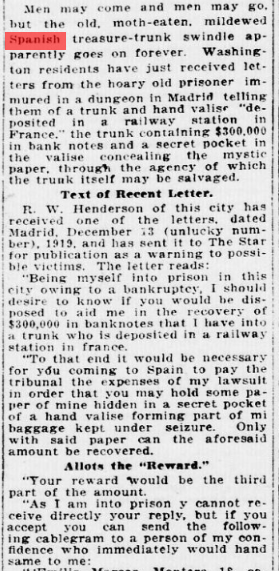
Here is another item from the "nothing new under the sun" category.  The email scams you see today were going on long ago - just without email.  The following excerpt is from a 1920 issue of the Washington D.C. Evening Star.


The letter goes on to tell the reader how to receive a reward amounting to one/third the amount stored in the trunk.

Who would guess todays email scams are just updated recycled scams.

----

Happy hunting,
Treasureguide@comcast.net

Thursday, November 17, 2016

11/17/16 Report - On The Beach Or In The Hills Some Things Remain The Same. Sanitation Workers Find Wedding Ring.


Written by the TreasureGuide for the exclusive use of treasurebeachesreport.blogspot.com.

Showing Recovered Wedding Ring.
Source: See link below.

Sanitation workers dug through tons of trash to find this lady's lost ring.

Here is the link for that story.

http://abcnews.go.com/Lifestyle/ny-sanitation-crew-finds-womans-lost-wedding-rings/story?id=43574824

---

Not long ago I was hunting in the hills of West Virginia.  While I was doing that I noticed several similarities to beach hunting.

It was very hilly.  You can see that in the photo I showed in my 11/14 post.

There was a flat spot about a quarter of the size of a football field.  It was down the hill from an old settlement, and I know that it was heavily used.  There were certainly many thing lost there, yet I found almost nothing there but aluminum.  Why?  Because tons of leaves piled up and rotted there year after year for hundreds of years.  The leaves were piled about a half a foot deep, then under that was partly rotted leaves, and under that very loose new soil.  Anything of any age was deep, except for the stuff like aluminum foil, which remained on top of it all.

That flat area was very much like an area on a beach where the sand is very loose.  The loose sand moves in and covers any stationary objects, just like the leaves covered more stationary objects on the flat spot.

That wasn't the only area that was similar to a beach area.  They had heavy rain there last summer. The rain ran down some of the steeper areas and washed leaves and loose soil off the slope.  The result is that some surface objects were removed with the top lighter soil.  Some things were left behind though.  That area was also very much like a beach in some ways.

You'll might remember my lengthy discussions on "trigger points" and "drop points."   When the force of water is great enough some objects will be moved and others not moved.  The same thing applies to hilly land.  (For more on trigger and drop points, see my 8/30/15 post.)

The top soil and some objects got washed down over the slopes where the slope was great enough and the water flow forceful enough.  It as on such a slope that I found the oldest coin (about 100 years old).

The same slope  was very hard packed.  That was because the looser soil was washed off with some objects.  Whatever washed off the slope ended up at the bottom of the slope, whether that was a flat area or a gully.

I'm sure that if I could move a foot or more of soil, the flat area would produce a lot of older coins and things.  As it was, the older materials were found on the slopes.

One way that that land was different from a beach is that there were roots and a lot of rocks.  The roots and rocks held some of the items that would have been moved by the water.

Old bottles also washed out of the hillside along the gullies.

No matter whether you are on a beach or in the hills, I'm always happy to see erosion.  Erosion can always uncover some older items.  It also moves sand or soil that can cover up items.

---

A six-thousand-year-old underwater site was mapped and artifacts recovered.

Here is the link to that interesting article.

http://www.ibtimes.co.uk/underwater-stone-age-settlement-haven-fishing-yields-mysterious-elk-antler-pick-axe-1591682

---

We're going to have a small surf for a few days, but big tides, at least tomorrow.

Happy hunting,
TreasureGuide@comcast.net

Friday, August 14, 2015

8/14/15 Report - Ancient Irish Gold Discoveries. El Nino Keeping Hurricanes Away. Fake Cobs. Detecting In The Sewers.


Written by the TreasureGuide for the exclusive use of treasurebeachesreport.blogspot.com.

Gold Lunula and Disks

...By hammering gold into thin sheets and then forming it into objects such as sun disks, beads, oval plaques, and lunulas, or crescent-shaped neck ornaments decorated with geometric motifs, they created what were to become the most iconic gold artifacts of the early Irish Bronze Age (2200–1800 B.C.). Some 100 lunulas have been discovered by archaeologists, with more than 80 from Ireland alone, and much more early Bronze Age gold has been unearthed in Ireland than in nearby countries...

...Standish’s team conducted lead-isotope and major-element analyses, which measure concentrations of tin, silver, and copper, on more than 50 early Bronze Age gold artifacts to match their elemental signatures to gold sources in Ireland. Surprisingly, the composition of the manufactured gold products did not match any known Irish gold sources, even though there are a number of locally accessible deposits.

The above picture and quotes are from the following web site if you want to read the entire article.

http://archaeology.org/issues/188-1509/trenches/3578-trenches-bronze-age-ireland-gold

Of course you can use the same type of analysis to try to determine the source of the gold in manufactured gold coins too.

---

Maybe you've been hearing about El Nino lately.  This year the El Nino effect is unusually strong.

...Forecasts from agencies around the world continue to indicate that this El Niño could be among the strongest ever recorded in the months to come, which will have widespread implications, possibly including keeping the Atlantic hurricane season suppressed. In fact, NOAA just released a forecast that called for a 90 percent probability of a below normal season. It was the highest confidence forecast for a below-normal season that the agency has ever issued, since forecasts began in 1998...

It is also supposed to make for a hard winter up north this year.

Here is a good article abot that.

http://www.washingtonpost.com/blogs/capital-weather-gang/wp/2015/08/12/where-are-the-hurricanes-el-nino-keeps-a-tight-lid-on-the-atlantic-season/

It certainly has been a long time without any storms or rough waves on the Treasure Coast.  We might have another winter with very little wave activity.  I don't want any hurricanes but I sure would like to see some nice storms.

---

Tony (Penzfan) found these on a beach back in early April.  He says they appear to be replicas.


Although it can be difficult to judge from pictures, I'd also say they are replicas.  First, note the ridges around the outside of the coin.  That is the most obvious thing to me in these pictures.  Also they are very round for Mexico mint cobs, and that is the design.   

Fakes can be disappointing.  I've seen some that are very convincing.  And some that were very obvious.  

Look at any suspicious cobs carefully to see if you can find a small or inconspicuous "Copy" or "Replica" stamped on them.  Sometimes the mark is there, but it can be hard to find.

You can often tell by look if they aren't silver or gold.  Sometimes they will have a layer that peels,  sometimes they will be made of lead or other pot metal.

A gold/silver test kit is always a good idea.  If you don't have one, you can get a jeweler or pawn shop to test items for you.

I can usually tell silver from many other metals by simply rubbing it on a touchstone or something similar.  Some metals will squeak.  Silver rubs more smooth and soft.

There are a lot of fakes out there.  They can be a big disappointment at first, but you can learn to identify them by look fairly well.

---

Three men were arrested for treasure hunting in the sewers under New York.  They spent four hours with metal detectors in the sewer system.  There are no details on what they were hunting.

I'd be interested in learning more about what they were up to.

Here is the link I received from Chris S.

http://newyork.cbslocal.com/2015/08/13/sewer-treasure-hunt-flatbush/

---

We've been having a lot of thunder showers lately.  Nothing that would affect beach detecting conditions though.

Happy hunting,
TreasureGuide@comcast.net

Thursday, April 30, 2015

4/30/15 Report - Gold Coin Find - Fake or Real? Suggestions and Reminders On Detecting Etiquette.


Written by the TreasureGuide for the exclusive use of treasurebeachesreport.blogspot.com.

Coin Found and Photographed by Robert H.
 Robert H. found this coin on 4/28.

 Here is what he said.  Not sure if it's real or fake. It's so very underweight and seeing your posts about items being in the ocean like reales being very under weight because of the washing machine type conditions. Closet comparison I was able to find was the 1853 $1 gold coin. Could a item that consist of 90 percent gold and 10 percent copper really be worn down a gram after being in the ocean many years?

While I'm not going to offer an opinion based upon just the photos and an email, I'd say that it is unlikely that a gold coin would lose that much weight without it being very observable.


A one dollar gold coin of that era should weigh in  just over 1.67 grams.  A loss of one gram would be over half of the coin's weight, but the photos do not show that kind of loss.

I can't really make out the third digit in the date.

I commented upon a few other things that I noticed about the coin via email.

If you' like to see the data on a similar gold coin, you can use this link to the NGC coin site.

http://www.ngccoin.com/coin-explorer/gold-dollars-pscid-54/1853-g1-ms-coinid-17521


If you have any observations or comments on this find, please send me an email.   Thanks.

----

As I write the Sedwick Coins auction is going on.  The bidding is good.  I noticed that the two stamped "oro corriente" pieces sold way above estimates.

---

I was hoping to come up with some guidelines for beach detecting etiquette. I didn't get exactly what I was looking for but got something even better.

One thing I was reminded of by those who responded is that detecting courtesy isn't just between detectorists.  There will be other people on the beach, and it is just as important to be courteous to them.  The reputation of the hobby is at stake.

Ron J.said,  Beach detecting courtesy should be no different than than at other places...


That is what it comes down to.  Courtesy is courtesy.  Some people don't show it on the road or check-out counter and some people don't show it on the beach. It is about being aware of the other person, and their situation and treating them as you would like to be treated.  Detecting on the beach does present some unique situations though.
I didn't think of trash when I first posed the question, but it does affect other detectorists as well as other people on the beach.  Picking up trash is one more way to extend courtesy to others, even those that aren't around at the time.  Trash will remain on the beach forever if we don't pick it up.  I know of a few places that run a machine on the beach to pick up the trash, but that is a rarity.  It is up to us, and we should get credit for doing it. 


It was Champ F that said you should act like you are on video and the video will be on the evening news.  Good idea!

Concerning trash, Champ said, You dig it and its yours. Period. Land or sea. Only exception is too big to carry to the trash can... and no leaving the crushed can in the bottom of the hole just because you didn't pull it out, and before anyone whines that their bag is too small for all that trash, you should have brought a larger trash bag or just stop being so lazy and walk the 50 yards to the garbage can.

I mentioned just the other day that some of our beaches are now very clean - cleaner than they have een in decades.  That is a good thing anyway you look at it.  On the other hand, there are some beaches that are getting tons of trash dumped on them along with renourishment sand.
Here is a topic I didn't think of at first, but it is a good topic.  If you detect on crowded beaches you will come into contact with other people.  Although I used to hunt busy beaches, I now seldom visit a busy beach.  I normally go early, late, when its rainy, or to a more quiet beach.   It is an important topic though.


Champ also said, If the cut is a long one, I'd tend to go far ahead and work from the opposite end towards the middle.  By long, I'm thinking one that would take a single detectorist an hour+ to work. 
 
He said if you've established rapport with another detectorist before hitting the beach, you mutually decide who gets which end to start on. If you cant decide, flip a coin...  I personally wouldn't intrude on someone's found hole, but i would use the knowledge to search for a nearby similar spot.
Champ said, Dumping kids that crowd you so bad you can't swing and mob the scoop when it comes up is my pet beach peeve.  I love a short talk with a well mannered kid, but the others I'd like to feed to the sharks along with their clueless parent(s).  My usual method of getting rid of them is to dig a couple of scoops at a spot in the wet sand and declare "well, its a gold ring or pulltab but its just a bit too deep for my scoop".  That never fails to occupy them long enough for a getaway.

I love the possible gold ring in an endless hole ruse.  There are rude adults and undisciplined children.  Handling them with grace is important for our hobby.
  
Thanks Champ!

I enjoy talking to the good kids and even teaching them a thing or two.  The undisciplined monkies are another matter.   


Ron J. sent in some good ideas too.  Here is what he said.

1.Fill holes, remove all junk.

2.Like fishing, don't crowd in on someones spot.

3. Being aware that some detectors cause interference when used too close to another, I always turn off my detector before approaching to talk someone who is detecting.


4. Being aware of whats going on around you can help a lot to avoid conflict.


5. When working the towel line with sunbathers on the towels, don't detect real close to the people, go wide around them and come back when they have left.


That is a good reminder.  Be courteous to beach goers that are not there to detect.  Give them some space too.


6. When the family with kids stops and ask about what I am finding, I really try to take the time to show the kids what I have found (mostly junk).  The kids look at you like , Wow this is really fascinatingly cool!...


Thanks Ron!


SuperRick is from Vegas where he normally detects for meteorites and gold.  He was here on the Treasure Coast  recently and was detecting the beaches.  Here is what Rick said.

I just found this Blog a few days ago and this is the third time that I have to say thanks for all the good information on the Blog. I run a forum in Las Vegas for playing craps that is set up to help others out. I appreciate all of the hard work that who ever is running the Blog puts into it, He does a great job of it.

Thanks Rick!
 
To start with every hole we dig gets filled in and that is one of the first things I tell anybody that I help that is starting out and we can be 60 miles from anybody out in the desert. Face the fact that any hole you dig is a hazard not only to other humans but also any animal that might trip in it.
 
So even if I dig at the water line here on the beach my holes are filled in right away. I want it as I found it. There are so many laws that are made because people didn't do the right thing. Think about that the next time you do something that only would have taken a minute to do!
 
Now if someone is out in the desert with any of us and they find a meteorite or gold we give them all the space the need, if they want to call us over and tell us to check out the area where they found it, then we will hunt after getting permission to do so.
 
Its a common practice out there to give that permission to hunt the area, one guy will hunt out front and the other will hunt to the rear. We want to find the direction that the meteorite came in from. Now as far as gold goes that can be a very different story.  Some guard any gold by not saying a thing about it. The funny thing about that is the meteorites are worth more then the gold if its the right type...
 
The one thing that I would do is make a mental note about the area if they had all kinds of dig hole that I could see and they were cleaning up on finds. That would be so I could recognize the same type of area down the beach. It may have taken the guy that is hunting that area years of hunting to find areas where things collect. Why would I want to take advantage of what he has found without an invitation to hunt that area?   [Underlining added by TG]  That is a very commendable attitude.
 
Now as far as trash goes, every bit of trash that I find is taken to the trash can, it only make common sense to do so, not only are you helping everybody else that hunts that area, you are also helping yourself, the next time you hunt that beach.

Thanks Rick!
 
Just the other day I mentioned how there are differences between inland hunters and beach hunters.  Here are a couple more different detecting cultures - meteorite and gold hunters.  

To summarize it all up in general terms, be considerate of other detectorists and beach goers in general.  It might be difficult to come up with a list of specific rules because there are some many unique situations, but courtesy will guide you well in any situation.  I'll go back to the golden rule.  Treat others as you would like them to treat you.  That will keep you on the right track.

Thanks to all of those who submitted their thoughts.  I'm sure everybody will benefit from reading the various suggestions and reminders.  I did.

----

We'll have one more day of one to two foot surf on the Treasure Coast.  The surf is predicted to begin increasing this weekend and reach something like four to six feet next week.

Happy hunting,
TreasureGuide@Comcast.net
 

Sunday, March 8, 2015

3/8/15 Report - Discussion Of How Coins Sink In Soil. North Wind Saturday But Little Erosion.


Written by the TreasureGuide for the exclusive use of treasurebeachesreport.BlogSpot.com.

Treasure Coast Beach Saturday Morning After High Tide

We had some nice North winds Saturday morning, but it turned before noon.  Around noon it was coming from the East.  The result was no erosion to speak of.

Here are two pictures.  I didn't get the best pictures, but I think you can see some decent waves but no erosion.

-----


A few days ago I asked people to send their ideas about how coins sink in rich soil.  I received a good number of thoughtful responses.  Instead of simply summarizing those emails I decided to post many of them as they were sent.  You might benefit from any or all of them.  There was a very consistent theme.


Beach Saturday Morning After High Tide

Troy T.  sent the following email.

Thanks for the great daily blog. I live on the other coast in Tampa but I like to know what's going on over there regardless. I especially love reading your thoughts on target depth and movement and the other technical aspects of metal detecting.
 
My puzzling experience was when I found an 80's quarter close to a river under about 8" of dirt laying directly on top of a thick layer of clay.  I cut an unnecessarily large plug and the moist soil and the clay separated nicely with the coin in between. I was dismayed to see that a modern coin would be so deep but then I realized that when the river rises to that point the ground becomes a slurry and due to the clay the water has no where to go. A heavier coin like a quarter could, in the right circumstances, work its way down to the clay layer over a relatively short period of time.
 
Thanks again for the great reading and I would love to see some guest reports featured from my side of the state.

I will post reports from the West Coast of Florida, but since I'm not over there very often will depend upon such reports being sent to me via email.

-----
Chris S. said,

I've had experiences such as Joe D. In my case, I was in an area close to a river that floods during hurricanes and such. I was digging state quarters at 9 inches and no silver to be found that should be there. Attributed that to the silt that builds up over time. Of course the opposite could become true under the right circumstances. Let's see what some others have to say.

I should have stated that the coin may not be sinking as much as soil being placed on top. Rich soil as Joe is speaking of would be a common byproduct of a flood.

-----

Robert H. said

I mostly beach hunt and rarely park or land hunt. One thing I've considered why coins sink so quickly is in parks or land sites is when we get a nice down pour and the ground is very saturated or flooded with standing water. I've come across very deep modern coins 5 to 7 inches down and was always thinking how could modern coins sink that fast? Well my main thought is hard down pouring rain and flooding turns the dirt into muddy soup. Guess where the coins will settle? At the bottom of that soupy mess. That's my thought.

-----

William M. had the following to say.

The first thing that comes to my mind is why is the soil so rich? How was the lot cleared originally? Was it root raked? box bladed?.. was the tree and other wood material mulched on site?... I believe there's something different going on there and it's not coins sinking fast because of earthworms.. sounds like really bad drainage at very least it may have been a marsh of sorts at one time.

----

Russ P. said, Here are my thoughts:
 
I've certainly spent a lot of time thinking on this issue.  It is, I believe, a complex one with many factors at play, similar to thinking about where a coin might be found on the beach.

Instead of thinking about a coin "sinking", I come at the problem from a  slightly different perspective and that is the position of the coin relative to the surface.  This is an important distinction because often there are two major forces at play:  those factors that cause a coin to actually sink and those factors that lead to additional soil or debris on top of the coin.  There are many factors contributing to each of those forces, but I'd like to briefly mention a general observation.

In my opinion, in rich soil the factors leading to soil creation, thereby adding soil to the top of the coin which causes relative "sinking", is the predominant factor at play.  Several observations have supported this hypothesis through the years.  First, if one looks at sidewalks in old areas or leading up to old houses, they often look like they were dug out, almost a slight valley between berms on either side.  Years of mowing and grass clipping has increased the height of the ground on either side of the sidewalks.  As one moves a few feet to either edge of the sidewalk the difference can be easily 4 inches or more.  Human activity accelerates this phenomenon.   In well-manicured lawns with St. Augustine grass the difference is even more pronounced.   Second, finds discovered after concrete pavement is removed are often very near the surface, even those those finds may be extremely old.  This suggests to me that those finds remained in a very stable position from the moment the pavement was poured.

There is a question that I don't have an answer to yet that I would like others opinion.  In typical Florida conditions, do coins or other objects eventually reach a stable point where they don't sink any further?  It would seem to me that, with soil creation, objects would continue to "sink" indefinitely, but now, based on some experience, wonder if there is a typical depth that essentially is a steady state, above which soil creation and possible soil destruction (if it exists) is balanced.  I've done some recent sifting which seems to suggest that possibility.

Hope this helps.  It would take quite a long blog entry to tackle this issue in a comprehensive manner!

-----

Bill H. said,

In Michigan where I normally hunt in summer, it is generally thought that coins drop at least an inch for every ten years time.  This takes into consideration the creation of new 'dirt" in the form of rotting leaves and grass clippings and the gradual drop in soft dirt.

There are so many factors,however, that I  don't think there can be any one rule. Tree roots can bury or lift up old coins. Adding top soil can bury them deeper for sure. Roto-tilling a garden/lawn certainly can either raise up or lower coins. I have found 1980s coins at 4 inches and 1800s coins an inch down. The clay/stone base also obviously plays huge.

But if you give me an old farm house without any of the above, I'd expect an inch every ten years down to about 4-5 inches, then after that  perhaps an inch in 20 years. The drop seems to slow down the deeper they go. I used to keep accurate records and on virgin land this was the rule. Then I decided that hunting was much more fun than record keeping and I just go for it.

Thanks for the great site- I have hardly missed a day in three years.

-----

When I originally received an email asking how fast coins sink in rich soil I responded that it might not be so much a matter of coins sinking as it is a matter of the coins getting covered or buried.  That is a theme you see in many of the emails I received too.  The person who asked the question wrote back and said that seemed like it could be the case.   He then mentioned that the area in question was under a banyan tree.

Much of what you read would seem to suggest that coins simply sink in dirt over time.  It often sounds like it is a very passive process that requires little or nothing more than gravity.  I believe that that when coins sink in soil it is a more active process. 

In this blog I've reported on experiments that show how coins sink in sand.  I've shown that coins simply laying on sand that does not move do not sink.  Gravity alone isn't enough.  The sand has to be moved.  I'm convinced that the situation is similar for coins in soil.

I'm not saying that coins do not sink in soil.  I'm only saying that much or all of what appears to be sinking is actually a process of covering or burying.  I know that may be nothing more than semantics to some, but I am making a distinction.   In other words, when things sink (work their way down through existing material), there is something at work besides gravity - something that agitates the soil in one way or another.  The emails posted above mentioned various processes such as rain, floods, root growth, worms, etc.

William M. asked an important question when he asked what made the soil so rich.  In this case it appears that one thing is rotting leaves.  William also listed a variety of other things that could happen to the soil.

I was surprised that people emphasized the burying process so overwhelmingly. 

The observations of Russ relative to the sidewalks were helpful.  One of those, the observation that items under concrete do not seem to sink much, is thought provoking.  The soil under a sidewalk would be prepared before the sidewalk was poured.  A sidewalk would be poured on a packed hard base.  Besides that, the sidewalk itself, would protect the ground under it against other forces such as rain.

The idea of a slowing rate or limit on sinking (if that is what you call it) is also interesting.   Even at one inch per year, it is what I would call a slow process - too slow for me to conduct good field experiments.

On a beach coins can disappear very quickly.   The tides come and go daily and the sand moves a lot.  It can happen fast - even while you watch.

As you know, I occasionally do detect up north.  I've told about a few of those hunts in this blog.  One place I hunt is heavily wooded and is very hilly.  A lot of leaves, limbs, bark, etc. falls and decays, continually producing new soil.  In depressed areas where decaying matter accumulates I find very few coins.  I've even tried raking the top layers.   Inches can accumulate in a single year there.  I tend to focus on areas where the wind or rain moves the loose material and does no allow new soil to form and accumulate.  An 1829 large cent that I found there was probably less than two inches deep,

I appreciate all of the responses I received.  They were all helpful and thought-provoking.  I hope you now have a more complete understanding of the factors involved and gained some new insight from the discussion.  I did.

Thanks to all who sent responses as well as that one person who  initiated the discussion by asking the question.

----

We'll have a fairly rough surf on the Treasure Coast today (somewhere around four or five feet), but I'm not expecting much improvement in beach conditions at all.

Happy hunting,
TreasureGuide@comcast.net


Thursday, January 8, 2015

1/8/15 Report - Treasure Coast Beach Detecting Conditions Upgrade. Cut Scallops All Along Treasure Coast Beaches. Signal Finds.


Written by the TreasureGuide for the exclusive use of treasurebeachesreport.blogspot.com.

I have a lot to report today but will hold much of it for some later time.  Today I'll get to the most important and timely information.

I took a look at a number of beaches this morning just after high tide.  All of the beaches that I looked at looked very similar.  There were similar scallops and cuts from South Hutchinson Island to Wabasso.

Douglass Beach This Morning After High Tide.
Seagrape Trail Looking South.

Seagrape Trail Looking North.
 Notice the detectorist between the two sets of stairs.

Wabasso Beach Looking Towards Disney

It isn't very often that the beaches look so similar from Fort Pierce to Wabasso.

The sand in front of the cuts was mushy.  Cuts were about three foot high at the highest.

The water didn't get very far back on the beach.  That was disappointing.

The waves were highest at the Fort Pierce buoy around 5 AM this morning, decreased after that, and then have been increasing again.

This NOAA web site shows the data coming from the Fort Pierce and Sebastian buoys.  Take a look.  You can get a lot of information from this web site.

http://www.ndbc.noaa.gov/station_page.php?station=41114


My increase in beach detecting conditions rating is only up from a 1 to a 2.  I only expect a very very few scattered cobs to be found.

The Turtle Trail access was closed.

North of Seagrape Trail there was a lot of very small iron pieces just below the cuts.   Pulse machines will be detecting barely visible pieces of iron.

I've talked about "signal" finds before.  I found some of those today too.  See photo below.

Lead Bullet "Signal" Finds
These small caliber lead bullets appear to have been shot into sand.  Sorry - not the best photo.

I've found many of these at Turtle Trail when the back dunes were eroding and found them in areas and at times when cobs were found on the beach.  I take them as one indicator that detecting conditions are improving.

I know for sure that many of these come from the dunes.  I've tracked them.

The surfing web site is predicting a higher surf through tonight and then decreasing slightly through tomorrow.

Happy hunting,
TreasureGuide@comcast.net

Saturday, January 3, 2015

1/3/15 Report - Shipwreck Finds From Dredged Renourishment Sand. Thousand-Year-Old Coins Found Worth Near $1.5 Million.


Written by the TreasureGuide for the exclusive use of treasurebeachesreport.BlogSpot.com.


Copper Religious Medallion
Find and photo by William B.
Yesterday I wrote about dredging and renourishment projects.  I mentioned that sometimes old items end up on the beach in the new sand.  It wasn't long ago that I showed you one of those finds. 

William B. sent photos of these three very nice examples that he found in beach renourishment sand.

He said, I found these 3 artifacts on South Florida beaches either during or shortly after beach renourishment projects. The sand was being dredged from directly offshore of the beaches, not trucked in as they do on other beaches. All three artifacts were found on different beaches within a 3 mile stretch of coast.  


Napoleon’s 7th infantry Button
Find and photo by William B.
The copper religious medallion was found right in from a wreck that went down in the 1800’s. I believe it was Cuban. You can see an angel standing over a child. 

The button is from Napoleon’s 7th infantry. The brass key is about 3 inches long and was bent when I found it. You can see the marks on the shaft from the vice grips that I used to straighten it. 

It wasn’t until 4 years after finding it that it dawned on me that the key was probably in the lockbox when the ship went down, and the box slammed into something causing the bend in the key. It took a lot of force to straighten it.

Nice Old Key.
Find and photo by William B.
 
 
All of the artifacts were found after rough seas, but there was still plenty of new sand on the beach.

Of course this is all speculation, but finding 3 very old artifacts in front of an offshore dredging operation seems to be more than just coincidence, if you ask me.  
HH. William B.

Thanks much William.  Great finds! 

Yesterday I also mentioned the tons of junk that was in the Fort Pierce South Inlet renourishment sand.  Dan B. wrote and mentioned all of the aluminum junk in the renourishment up by the Sebastian Inlet, something that I'm sure many of you have noticed.

Near Amber Sands Beach access there was also a lot of aluminum in the renourisment sand, but also silver US coins.

It can help to know where the renourishment sand is coming from. 

--------

Detectorists participating in a group hunt found over 5000 ancient worth over $1.5 million in a farm field.  The coins were in near mint condition and dated back over a thousand years.

Here is the link.

http://www.dailyrecord.co.uk/news/uk-world-news/ancient-coins-worth-more-1million-4906211

-------------


I've received several different ideas about the round mystery object that I posted not long ago.  Some time soon I'll post the ideas that have been submitted.  Thanks to all who submitted their thoughts.  Its not too late to submit yours.

--------

 If you are an experienced diver who knows how to use a detector and will be available for treasure diving during the upcoming season, send me an email telling me what you have done.   I'm not promising ANYTHING, but might be able to forward your information where it MIGHT be considered.

--------

On the Treasure Coast we'll be having a couple of days of two-foot surf. Swells will be coming from the south.


Happy hunting,
TreasureGuide@Comcast.net


Thursday, December 18, 2014

12/18/14 Report - Another Type of Once-In-A-Lifetime Find. Calm Surf and Poor Beach Detecting Conditions.


Written by the TreasureGuide for the exclusive use of treasurebeachesreport.BlogSpot.com.


There are once-in-a-lifetime finds.  They aren't always big things like the Atocha or Queen's Jewels.  Sometimes they are little things, but you just don't expect to ever find another one.

Here is one of those for me.  It isn't a gold coin.  I don't really consider them once-in-a-life time.  I've found two of them in one weekend.  One was from the 1900s and one from the 1700s.   I don't ever expect to find two from two different centuries in one weekend again.  But what I'm talking about today is something different.

You can see it here.  You probably can't tell what it is.  It isn't the best picture.  I haven't been able to get a really good picture of it. 

It is a wax seal.  I'll try to point out some of the detail in another picture. 

When you look up wax seals you'll mostly find the lead or carved stones that are used to make an impression in the wax.  This is the wax with the impression on it.

I don't ever expect to find another.  I find it hard to believe that I even found one.  It was eye-balled  at the edge of the water on a calm surf day, very much like today.  The sky was blue and the water was calm. 

It was found at Turtle Trail.

But the thing that amazes me is that the wax lasted so long.  It was evidently covered by sand and protected.  I don't think it could ever have survived very long in rough surf.

I tried to highlight some of the details in this picture.

The shape seems to be four double lobes. See the red outline.

Inside is an eagle.  To the right, I drew a red line around the one wing.  You can see it best in the picture.  I outlined the head of the eagle, some of the body and the leg feathers.

Below is another image of a wax seal which is similar but not the same.  It shows about the same type of eagle, with wings spread, leg feathers, turned head, etc.


There are no words that I've been able to see on the wax seal I found.

----------


The surf on the Treasure Coast today was very calm.  It was almost like a summer beach again. 

The cuts that I showed a few days ago are mostly filled again.

The front of the beach shown in the first picture below had a lot of new mush sand on the beach front.

Treasure Coast Beach As Seen Near Low Tide This Morning.


The above video shows the calm surf gently lapping at the beach.

There were some shells and pieces of fossils.   There might be a surprise like my wax seal.  You never know.

Happy hunting,
TreasureGuide@Comcast.net