Showing posts with label Garrett ATX. Show all posts

Sunday, May 17, 2020

5/17/20 Report - One of the Time Factors in My Formula For Success. Talking About Two Metal Detectors.


Written by the TreasureGuide for the exclusive use of treasurebeachesreport.blogspot.com.

Tropical Storm Arthur.
Source: nhc.noaa.gov
So we had the first named tropical storm of the year - Arthur.  Unfortunately Arthur didn't do a lot for us and is heading north and away from us.

I was glad to recently put in a few hours of metal detecting time, even if it wasn't the most productive.  My weak spot in recent years has been the amount of time I've spent on metal detecting.

As you probably know, the TreasureGuide formula for metal detecting success has several factors, and the one that I rank as the second most important is the time factor.  The time factor is second only to the location factor.

I posted my most recent version of my formula in my 5/4/20 post.  The formula is Amount of Success = L + T + Sk + E + D+ N + A.  I won't go over all of the factors again now.

My time factor can be broken down into three factors: time scouting (Ts), time detecting (Td), and time gathering and assimilating information (Ti).

Not being able to spend a lot of time in the field, I haven't done much scouting around.  When I was doing my most serious detecting, which was between my consulting and teaching jobs, I spent a lot of time detecting, but I also spent a lot of time scouting beaches.  I closely monitored a lot of beaches along nearly a hundred miles of coastline.   When I decided to detect a beach a few miles away, I would stop to take a look at some of the other beaches in between, and might detect beaches several miles apart on the same day.

If you are metal detecting during low tides, you can still do some scouting during high tides.  Although you might not be able to see the lower beach at high tide, you will be able to see enough to give you a good idea if the beach is cutting or how it is developing.  

I was glad I got to put in some good time metal detecting this week, but I am not sure I was at the best location because I had not been doing a lot of scouting.  I didn't know what some of the other beaches were doing because I didn't spend hardly any time other than the time I spent metal detecting.  I did take a look at one or two other beaches, but not many.  I would have liked to have known what some of the other beaches were doing.

---

The other day I mentioned using both the Equinox and ATX.  One person essentially asked if one is better than the other.  It is not that simple.   It depends upon a variety of factors, including where you are working and what you are trying to accomplish.   How well you use your detector is another important factor.  Sometimes it is more about how you use a metal detector rather than the detector's capability.

To give a quick answer to the question, for doing a quick scan on a Treasure Coast shipwreck beach I'd choose the Equinox over the ATX, but if I was focusing in on a small area I might choose the ATX.  I might also use more than one detector on the same hunt  (See my post on 7/24/14 post, for example.).

The ATX is in my opinion a very good metal detector, but it is very heavy, and when I was having a lot of back trouble I decided to get a lighter detector with the thought that it might not put as much strain on my back.  Well, this year my back has been doing fine and I'm glad about that, but the Equinox has proved to be a good detector.  I've heard other people say that they didn't like the Equinox or that it wasn't very good, but I have no problem with it.  As I've shown, I've found a variety of targets with it, including a very undersized half reale and other very small objects.  I feel confident when using the Equinox, which is important.  You have to feel confident with your metal detector.  That, of course, means learning to use it well and using it enough to know what it can do.

I also like the ATX, but the ATX, besides being heavy, will respond to the smallest and deepest pieces of iron.  You can turn the sensitivity down if you want to.  It also has an iron check feature, which works, but takes a little extra time.  The sensitivity to iron can actually be a good thing in some situations.

I found a lot of cobs before I ever found a shipwreck spike.  I'm sure I went over them but never dug them up.  Back when I was doing mostly jewelry hunting, I was usually using metal detectors that nulled over iron or were not very sensitive to iron.  That didn't bother me much then, because of what I was doing.  In fact most of the time it was a good thing.  There are times, though, when I do not want to miss iron.

To sum it up, I like the Equinox, especially for covering a lot of ground and doing a fast scan.  The ATX I might use when I tighten up and focusing in on a smaller area and certain types of targets.  I might use it when targets are scarce.  You will not be digging a lot of junk then anyhow.

Of the twenty or so metal detectors that I've used, they are all good for something, but not ideal for everything.  They have their advantages and disadvantages, or as you might say, indications and contraindications.

---


 I think I mentioned that the COVID data is not much good.  According to CNN, Birx agrees.

Specifically, Birx believes the way the CDC gathers data on the coronavirus is antiquated, causing inaccurate and delayed numbers on both virus cases and deaths...

Here is the link.


You can't do good science with bad data.


Happy hunting,
Treasureguide@comcast.net

Saturday, May 16, 2020

5/16/20 Report - Metal Detecting a Couple Beaches Today. Meager Finds.


Written by the TreasureGuide for the exclusive use of treasurebeachesreport.blogspot.com.

Wabasso Saturday Morning.

The waves had good height at Wabasso this morning.  It was nice and rainy - the kind of day I like - so I went metal detecting.  I also wanted to see if I could follow up on yesterday's finds.


Wabasso Saturday Morning.

I was hoping the beaches would improve a little, but they didn't change much since yesterday.  Most of the places I saw had more sand than yesterday.  There was one area that lost a little sand.


Turtle Trail Saturday Morning.
The bags down near the second flag pole were more exposed Saturday than the day before.  You can see that in these two photos.


Exposed Bags at Turtle Trail Saturday.

Despite the loss of sand, I didn't find much there.  Targets were scarce.

I did find a couple iron spikes and a small lead ball before quitting for the day.

Below are a couple photos I took at Turtle Trail Friday.  It wasn't looking good, yet I managed to find a few things yesterday, including the bronze spike and a lead strip.

Turtle Trail Friday.
I didn't photograph the same areas, so you can't really compare them.  In fact I almost forgot to take beach photos yesterday.


Turtle Trail Friday.
Here are some meager finds from today.  I was hoping for more beach improvement and some better finds.


Saturday Finds.

I did manage to get in some good field time.  I haven't put in a lot of time the past couple years and I needed the practice.

I used both the Equinox and ATX today.  I hadn't been using the ATX much lately and really needed some time with that detector.

Yesterday I showed some finds, including the bronze spike.  Below is a closeup of the crust on the spike.  I just thought it was colorful.


Encrustation on Bronze Spike.
And below is the void where a dissolved iron object had been.  I think I might be able to make a mold of that to recreate the shape of whatever was in it.

Crystal Filled Void in Corroded Iron Lump Found Yesterday.

Overall, I got in some much needed field time and got reacquainted with my ATX.  It seems if I don't use it much for a while, it takes me a while to get back in tune with it.  It is very different from the Equinox.  I wish I had more targets today so I could get a better comparison on the two detectors under real field conditions.

Seagrape Trail was still closed today.

I didn't get to look at many beaches, but it looks like this weather system didn't do a lot for us, and I think it is probably about over.

Oh, I forgot, I did manage to luck onto a modern gold band, but that isn't the kind of thing I was looking for today.

Source: MagicSeaWeed.com.

Will have to take a different approach as we get into summer conditions, but hopefully we'll have some nice storms that stay offshore and cut the beaches without doing much property damage.


Happy hunting,
TreasureGuide@comcast.net

Saturday, August 11, 2018

8/11/18 Report - New Projections For The 2018 Hurricane Season. Metal Detector Choice and Ambient Noise. Restoring Precious Artifacts.


Written by the TreasureGuide for the exclusive use of treasurebeachesreport.blogspot.com.

Notable Hurricane That Hit In August or Later.


Some good news from top hurricane forecasters: The 2018 Atlantic hurricane season should be quieter than normal, according to a new predictionreleased Monday.

Meteorologist Phil Klotzbach and other experts from Colorado State University – regarded as the nation's top seasonal hurricane forecasters – predict 10 named tropical storms will form, of which four will become hurricanes.

That is a sharp decrease from their forecast in April, when they said 7 hurricanes would form. One system, Subtropical Storm Alberto, already formed in May...


Here is the link for more of that article.

https://www.usatoday.com/story/news/nation/2018/07/03/hurricane-season-2018-forecast/755215002/

It only take one, and hurricane season is far from over.

There is one disturbance in the Atlantic now, but at this point it closer to Africa than.  I'll keep an eye on that one for any development.

On the Treasure Coast today we had a smooth surf and big tides.

---

I think everybody knows that there is no "best" metal detector.  The detector that is best depends upon a variety of factors including but not limited to where you are going to hunt and what you want to find.  While the Garrett ATX is a much more expensive and under most circumstances a much more capable metal detector than the Garrett Ace, yet there are times when the Ace might be the best choice.  One such place is a site where there are nearby power lines, cables and a lot of ambient interference.  I was reminded of that today when I visited a place where there was a lot of interference.

Yes the ATX has a frequency scan function, but under those circumstances, the Ace does a decent job, barely being affected by the interference without going through any special procedures.  If you are on a beach, especially with wet sand, you'll most likely get way better performance from the ATX, assuming you know how to use it.

I just mentioned two particular detectors, but what I'm talking about isn't just those two metal detectors.  You always have to evaluate a metal detector relative to the situation and application.  The detector that will be best in one situation might be a poor choice in another situation.

The Excalibur and Sovereign were not especially sensitive to ambient electrical interference.  If I correctly recall, the White's Dual surf was more sensitive.

There are some places on Treasure Coast beaches where you might run into erratic performance due to interference.  If you go south from the beach access at Rio Mar, when you get near the bend, there is one location where you might run into interference.  There is also one south of the Turtle Trail access.

The interference at some of those locations seem to center around particular houses.  I think sometime marine or other radio communications can cause noise too.  There are times when it is worse than other times at the same location.

---

Treasure hunters seek, discover, recover and perhaps clean nice old artifacts.  We hope those items are still in good condition, but the fellow in the following video actually restores precious artifacts and works of art.

https://www.gloria.tv/video/oEmvDEMFuq624iLvwVRkKPCo6

---

Happy hunting,
TreasureGuide@comcast.net

Monday, October 16, 2017

10/16/17 Report - Impressions of the Garrett ATX Metal Detector After A Lot of Usage. Fossil Bone.


Written by the TreasureGuide for the exclusive use of treasurebeachesreport.blogspot.com.

I thought I'd give my impressions of the Garrett ATX with 10x12 DD coil after using it for quite a few hours.  A lot of metal detector reviews are done after a few hours of experience with the metal detector.  You can't tell anything from that.  And I've explained the many problems with air tests, test gardens and other attempts to quickly assess and summarize metal detectors.

It took me a long time to learn to use the ATX well.  Like with any metal detector, it is not difficult to turn it on and go, but that doesn't guarantee that you are getting anything close to best performance.  Ignorance can be bliss.  You can use a metal detector for a long time and feel that it is doing well without really testing things out and making sure you are getting the best performance out of the detector.

How well a metal detector performs depends a lot upon the person using it.  I think that is especially true with the ATX.

I can't tell you exactly why it seemed to take me so long with the ATX.  I guess in some important ways it is just different from some of the detectors I've used in the past, but it did take me longer to become confident that I was using it well and getting great performance out of it.

One of the first things you will notice about the ATX is how heavy it is.  It is heavy.  It swings lighter than it is, yet it is still heavy and I can't think of a heavier metal detector that I have used.

The first thing you might notice performance wise, is its sensitivity to iron.  It is easy to end up digging very deep holes for iron targets and tons of holes for very small pieces of iron.  Again, operator skill comes into play.

There is an iron check function, but it doesn't identify iron in a lot of cases.

If you want a detector that gives a lot of discrimination or target ID, this is not the detector for you.  This is what I call a power detector.  It detects.  It detects deep targets and small targets.  There is a lot of digging with this detector.  If you are a skilled operator, and I do mean skilled, you can cut down on the digging, but it does require a skilled operator.

The ATX can pick up a lot of electrical interference around power lines, cables etc., but the frequency scanner does a good job of selecting a frequency to adjust noisy environments.

It is a deep seeking detector and responds very well to small gold and silver targets.  It is better than most detectors if you use it well, can handle a heavy detector and are not afraid of detecting some junk targets.

I'm not going to give you air test results or anything like that.  I've talked about the problems with such tests in the past.  I will say, it will detect small and deep targets very well if you use it well.

It is difficult to explain why it took me so long to feel like I mastered the ATX, but I would not describe it is a turn-on and go detector.  Part of it was the fact that I really explored and tested the various operating modes and settings.  

With the coil and configuration I use, pinpointing is not quick and easy.  With most detectors, I can pinpoint fairly well without taking the time to stop and switch to pinpoint mode.  The ATX seems to give such a big broad signal to anything but the smallest targets, that pinpointing seems to take longer.  I really have never used a detector before that I had to take so much time pinpointing.  The ATX pinpoint mode is good, it is just that in the past I seldom had to slow down and use pinpoint mode so much.

With the ATX I like to manually ground balance, especially in wet sand.  I pay more attention to ground balancing and spend more time ground balancing with the ATX than I have ever done with any other detector.  

Non-motion mode will give you some added depth, but it takes a fairly skilled operator to use the non-motion mode in wet sand or shallow water.  The ATX will give you excellent depth on deep and small targets. 

There are a variety of reasons it took me so long to feel that I mastered the ATX.  Part of it is because of the detector itself.  It was partly because it is significantly different than a lot of the detectors I've used extensively in the past.  And part of it is that I just wanted to make sure that I explored everything and was getting the best out of the detector and its various modes and settings.

To summarize, the ATX will detect deep targets and small targets as well or better than any detector I have used, however it is not the easiest detector to learn and it is not the easiest detector to use.  It is definitely not a good detector for a beginner, and it is definitely not for everybody or every situation.  If I primarily wanted to make sure I was not missing deep or small targets, it would be my choice.  If I was hunting the average dry beach, I would probably not select the ATX.  There are other detectors that would do a good job and make the task easier.
---

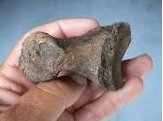
A couple of days ago I showed  the following picture and asked what kind of fossil bone you thought it was.

Fossil Bone Find.

Below is a larger but similar bone.  It is a sloth toe bone.  From what I've seen, it could be a sloth toe bone, but that is just my wild guess.

Source: internet photo.

---

Just a 2 - 4 foot surf on the Treasure Coast right now.  That might increase a little in a few days.

I had to take a family member to the hospital this weekend, but all seems back to normal now.

Happy hunting,
TreasureGuide@comcast.net


.

Saturday, August 19, 2017

8/19/17 Report - New Video To Show How To Identify Target Shape From Audio Signal Alone. Tropical Activity and Predictions.


Written by the TreasureGuide for the exclusive use of treasurebeachesreport.blogspot.com.

Source: nhc.noaa.gov
Harvey is going to cut across the Yucatan and then back out into the Gulf again.

L92, which is the next one to the east of Harvey is headed towards us.  The question is how strong it will be.  It did not strengthen last night.  It has a ways to go yet though.

Right now the surf is only one to two feet on the Treasure Coast.  Nothing big is predicted at this point.

The tides are pretty big.  There are some nice negative tides.

---

ATX Coil Over Broken Iron Shipwreck Spke.
Source: See link to video below.
I've talked a lot about how much you can tell about a buried target from the audio signal alone even if you are using an All Metals or Pinpoint mode.  The audio signal will tell you a lot about the target's shape, size and depth if you really understand your detector.

I made a video that demonstrates how you can tell something of the shape of a buried object from the audio signal alone.  In the video I used a quarter (just for comparison), along with a fairly large bolt, smaller screw, piece of an iron shipwreck spike, and an odd shaped piece of metal that responds a little bit like a fish hook.  I usually can identify fish hooks by the sound of the signal.

I used a Garrett ATX, although you would get the same type of results with many other metal detectors.  I used this same technique to identify target shapes before I ever got the ATX.  It worked exactly the same when using an Excalibur, for example.

I put the items on a board so you could see them well.  I also cut the sensitivity of the Garrett ATX down to less than half, just to temper down the signal, and used Motion mode, although the results would be similar using the Non-motion mode.

When you run your coil over a long straight object you will get a different type of signal depending upon the direction you move the coil.  You'll see that clearly in the video.

When you move the coil over the long object from one end to another, you'll get a double signal.  One towards each end of the object.  And if you move the coil over the object at 90 degrees to that, the signal will sound very much like a coin-shaped object.  So if you swing in one direction and get a regular signal and then change the direction of your sweep 90 degrees, you'll get something like a double signal.  You can also get an idea of the length of the object something by the amount of time between the double blips.  There will be more time between the blips when the object is longer.

Here is the link to the video.  There is really a lot of good useful information in this video if you really study the objects and signals they produce.  If you don't want to dig nails, you don't need a target ID meter on your detector.

https://youtu.be/Mu7sbkrLC1k

If you move the coil too fast, you might not always catch the double blip.  You can gather additional information by varying how fast you move the coil too.

All of this is does not have to take extra time.  You can do it while pinpointing.

If you dig all targets, you don't have to do it at all, but if you are at a site littered with nails or other long narrow objects, you might want to be more selective.  This is a type of target ID that does not require a ID meter or any particular metal detector mode or function.

Notice that on the last object, there is a break.  I don't know what to call that thing right off, but you get what I'm calling a double blip when you sweep the coil in both directions.  The latch on the object is open.  You get the double blip in both directions, instead of just one direction like you would get with a bolt or nail or other long thin object.

My main point is that if you learn to analyze your signals, you can get a lot of information from just listening to the audio signal.  I always say that the human brain is a better processor than the detector's circuitry.  You can also learn to get a good idea of the targets depth and size from just the audio signal.


Happy hunting,
TreasureGuide@comcast.net

Tuesday, May 19, 2015

5/19/15 Report - Garrett ATX Review Part 1. Introduction To How To Hunt A Beach Rewind.


Written by the Treasure Guide for the exclusive use of treasurebeachesreport.blogspot.com


Garrett ATX Detector
Every once in a while I evaluate a detector and post a review.  I haven't done a review in a while, but I recently evaluated the Garrett ATX for beach detecting.  The ATX is used by a lot of gold nugget hunters, and I think was designed with that type of hunting in mind, however I wanted to see how it would do as a beach detector.

I didn't do one of those quickie evaluations that people sometimes do.  They assemble a detector and in short order take it out in the field for a couple of hours.  Those kinds of evaluations aren't worth a whole lot.  While you can do that with some detectors, maybe most, it takes longer to really evaluate a detector like the ATX.   My experience says that the ATX will do a lot better in the hands of a someone that has put in a good number of hours with it.  That is what I did.

I tested the Garrett ATX Extreme PI with the standard 10 x 12 inch DD Coil.  Optional coils are available.

There is no way that I would classify the ATX as a beginner's detector.  It took me longer to get to understand the ATX than any other detector that I have ever used.  Maybe that is partially because I really got into the details more than ever before.  I wasn't satisfied with simple impressions.  I did a lot of precise testing.

First of all, the ATX is a pulse induction detector.  Some of what you know about pulse induction detectors is true of the ATX.  It is definitely hot to iron.  You can detect microscopic iron with the ATX.

The ATX has discrimination.  But this is not the right detector for anyone who typically uses discrimination.  If you are going to crank up disrimination on the ATX, you should have selected another detector because you will be diminishing what this detector does very well.

There are two modes - motion and non-motion.  If you have read my posts, you probably know that I almost always use a non-motion or pinpoint or all-metals mode.  That is true with the Excalibur, for example.

The Excalibur's discrimination mode and the ATX's motion mode are similar in some ways even though they are very different types of detectors.

For good performance, the ATX requires the right settings for the situation.   If you have the wrong settings, performance can be way off.  You can say that of many detectors, but I was more aware of that with the ATX.  Perhaps that was because I did a whole lot of testing and was constantly aware of the level of performance that I was getting.

Just like with the White's Dual Field Surf detector, the threshold setting is very important.  Setting the threshold either too high or too low can make the ATX much less effective.

Let me get down to the two very important conclusions.   (1) If you like discrimination you will not like the ATX.  (2) If you like a detector you can turn on and operate in most environments without making adjustments, this detector is not for you.

Like the Excalibur (again, even though they are very different detectors) the ATX can be really sensitive in non-motion mode.  If you are not accustomed to operating in salt sand or salt water in an all-metals mode, this will take some practice.  That is a skill of its own.  You will have to learn to work with signal drift and hearing the effect of salt mineralization etc.

Yes you can run up the discrimination and decrease sensitivity and get a very steady quiet and steady threshold, but that diminishes the power and effectiveness of the ATX.

Most people will not want to use the ATX in the dry sand.  And they will not want to use it on a junky beach anywhere.  Most beach hunters do not have the patience to run such a detector hot without discrimination, and as I said, if you want to use a lot of discrimination you'll diminish the power of the detector so much that you should have bought another type of detector.

The DD coil is said to provide good target separation.  That is not what I found. One of my biggest complaints with the ATX is how wide the signal seems to be.  That took some getting used to.

The ATX does have a pinpoint mode, which is effective, but pinpointing is difficult, to say the least, in the motion mode.  You can however learn to pinpoint fairly effectively in the motion mode without using the pinpoint mode.  That takes a lot of practice though.  I don't particularly like slowing down so much to pinpoint.  With most detectors I can pinpoint very well without slowing down to go into a pinpoint mode.  Remember that with the Excalibur, for example, I always hunt in pinpoint mode anyhow.

This is starting to get a bit long already.  I'll have to finish it some other time.

----

I've done this blog for a few years now.  I never expected it to be so popular. It could be much more popular and receive much more visibility, but I've turned down opportunities to have it published in some other places.

Anyhow, I was looking back at some posts from the early years and thought it might be a good idea to repost some of those older posts that got buried by hundreds of new posts.  There are so many posts now that I don't think anybody is going to go all the way back to look at the oldee ones.  Below is part of one post that got hundreds of views back in 2010.

-----

Let me begin to address the question even though I'm sure I can't do the question justice in a single post and probably not in a hundred posts. I'm not sure I can do the question justice at all, but I'll give it a shot and maybe something of value will come of it.

Before I begin, let me say that I'm really not suggesting that I have the "right" answer, and I want you to know that the following is nothing more than my opinion. Maybe it will help someone.

First there is no single way to properly hunt a beach. There are different strategies and techniques, and some can be applied to one situation while others might better be applied to other situations.

Some of the most important factors to consider are what you want to find, where you are hunting, and the local beach conditions. Much of the intent of this blog is to provide information on beach conditions.

Before really getting into the meat of the subject, I need to provide some background.

Success can not be guaranteed on any one outing, but you can over the long haul learn to succeed more frequently. It is about probabilities and doing what ever you can to improve the probability of success on any given outing.

There is way too much beach for anyone to cover completely. Therefore, it becomes a matter of spending your time in the right places. Some places are much more productive than others.

First you have to define your own idea of success. Some people want to find things with the highest economic value, other people want to find old things, other people want to find things of historic interest, and other people are perfectly content to go out, get some exercise and fresh air and pick up a few coins.

Your goals should match your personality, goals and circumstances. Most people would like to find something like the treasure of the Atocha, but most people do not have either the optimism, patience, and abilities and resources or commitment to do something like that. High value targets like that usually require tons of perseverance and commitment, and many people would give up way before finishing the task.

Besides personality, situation plays a role. If you want to pan or mine for gold and live in Fort Pierce, your situation doesn't match your goals very well.

Where you live has a lot to do with what you should target, unless you are willing to travel or move.

If you live in South Florida, you should be able to learn to do well hunting modern jewelry. If you live on the Treasure Coast, hunting modern jewelry is not as economically productive as in South Florida.

The Treasure Coast has the famed shipwrecks but hunting shipwreck coins and artifacts isn't easy. Unless you dive and work with someone that has a lease,you are pretty much confined to hunting the beaches, and most of the time the conditions are not good for that.

My main point of all of that is that you have to have some clarity about your own personality, your situation, what you are willing to invest in time, effort, and expense, and your goals before you can maximize the probability of success however you define it.

If you don't have too much patience and easily get discouraged or give up, set goals that are realistic and more easily achievable. Expand the number of things that you target. And learn to enjoy the hunt.

Given all of that, once you decide what you want to find then you can begin to learn the best ways of being successful in finding that particular kind of thing. There are different things to find, and many of them require different strategies an techniques.

One of the things you can do to improve your success rate is to be adaptable. Learn to hunt a variety of different types of things. That requires more knowledge and a variety of different strategies and techniques.

Learn to identify the conditions that are best for different types of hunting and adapt to the current conditions. Take what the beach is offering.

----

No change in Treasure Coast beach conditions on the horizon.

Happy hunting,
TreasureGuide@comcast.net

Wednesday, April 15, 2015

4/15/15 Report - Different Detectors For Different Beach Hunting Jobs. Rosie and Merc.


Written by the TreasureGuide for the exclusive use of treasurebeachesreport.BlogSpot.com.


Two Silver Dimes With Different Patinas.


Before I start my main topic for today, here are two dimes with different patinas.  The Rosie is a 1963 that was graded by a coin dealer as proof.  The Merc is a 1944 and was graded AU.

The Rosie has a lot of lustre.  The Merc is more the color that you might expect, but the surface is duller.

Under magnification you can see that the bluish color on the Rosie is a very thin coating that has not affected the sharpness of the coin's details.   Both have been stored in a plastic coin holder for a good twenty plus years.

Just an example.  Now on with my main topic for today.

-----

Yesterday I began a comparison of three different types of metal detectors that could be used for beach hunting, but I only got the first done.  Today I'll get to the other two.

The purpose of talking about these three detectors isn't so much about the three specific detectors, it is more about how different types of detectors have different strengths and weaknesses and about how strategic decisions of detector selection should be made.  This discussion is therefore not a detailed analysis of each of the detectors or a analysis of depth or performance, but rather more of a discussion of features and how those features help determine how different types of detectors might be used strategically.

I started with the Ace 250 yesterday, which is a detector that would be a decent choice if and when the strategy is to quickly sift through dry sand for modern coins and jewelry, especially when there is some junk.  The disadvantage of the small stock coil on the Ace is compensated by the ability to quickly pinpoint and identify targets and the ability to hunt close to metal obstacles such as beach chairs.

The Excalibur is used by many Treasure Coast beach hunters who tend to be more oriented to old shipwreck items.  Treasure Coast beach hunters, as contrasted with South Florida beach hunters, tend to focus more on targeting old shipwreck items and generally hunt less crowded beaches that are visited by more conservative beach-goers.

The Excalibur, of course, costs about four or five times what the Ace costs.  The Excalibur is water proof and can be submerged for water hunting.   That makes it more versatile.  If you want similar performance at half the price and don't need a waterproof detector, the Minelab Sovereign would do about the same job while costing less.

Unlike the Ace, the Excalibur has simple linear discrimination.  One discrimination knob is used for discrimination and another for sensitivity.

The Excalibur is simple to operate.  There is no ground balancing.  It performs about equally well in dry sand, wet sand and under water.  It will do a good job almost anywhere on a Florida beach.  You can start in wet sand and decide to scan a little dry sand or go into the water and dive with it. That is all good and easy.  You can discriminate but even with no discrimination, the Excalibur is not as hot for iron as some detectors.

The biggest difficulty that I see with the Excalibur is with the casual detectorist who tries to use the Excalibur in the wet sand in motion mode.  The less experienced detectorists can find detecting difficult where the water is coming and going.

I once had a guy come up to me and ask me what settings I was using because he saw me working the wet sand where the water was moving in and out and he was trying to do the same and was having trouble.   The main difference was that he was working in the motion mode and hadn't made any other adjustments, while I was using the pinpoint mode, as I almost always do with the Excalibur.

Anyhow, the Excalibur is a good sturdy general-purpose detector with some discrimination that has a good response to gold and small targets such as small cobs or small gold rings.  If you are hunting shipwreck items in wet sand, it is an easy choice over the Ace, whereas if you are hunting the dry sand, the Ace might be the best choice in some situations.  The Ace is also much lighter to swing on dry land.

While the Excalibur is used by many on the Treasure Coast, the Minelab CTX 3030 is very prominent on South Florida beaches.  The CTX costs about twice as much as an Excalibur.

The CTX has a lot more features and settings than the Excalibur, including a screen for target ID, various program selection, GPS, etc.  Instead of a few knobs, the CTX provides a lot of flexibility and options.

South Florida beaches have a lot more valuable modern jewelry and that is what the hard-core guys down there focus on most of the time.   It is also easier to justify the additional cost of a more expensive detector in South Florida where you can hunt in the water more of the year and where there is a lot more expensive jewelry to be found.  The additional expense can often be paid off by a single find.

I mention the relative prominence of the Excalibur on the Treasure Coast as compared to the CTX in South Florida only to point out how situations affect detector selection.

The third detector that I want to discuss is the Garrett ATX.  The ATX is often used in the gold fields and has good sensitivity to small gold.  The cost of the Garrett ATX (just over $2000) is close to that of the Minelab CTX.

The ATX is very different from the Ace, the Excalibur and the CTX, which I just discussed in passing.

I've discussed the ATX some in recent posts.  The keep it short, the ATX is a not the easiest detector to use straight out of the box - at least not if you want to be absolutely sure that you are getting good performance from it.

The ATX is a Pulse Induction detector and is very sensitive to small iron.  If you are someone who likes using a lot of discrimination, the ATX is not for you. The Excalibur is not overly sensitive to iron, but the ATX is very sensitive to iron.  Yes the ATX offers discrimination, but if you use much of it, you will really reduce sensitivity to good low conductive targets and negate the very features you paid for.

The ATX has both a non-motion and motion mode.  The non-motion mode is the most sensitive, but also the most difficult to use.  Even the manual states that the non-motion mode is not for beginners.

To get near optimal performance out of an ATX requires experience and skill.  If you want maximum sensitivity and depth, which is considerable with the ATX, you need to get the settings right.

So when would you use the ATX on a beach or in the shallow water?  My answer is, When you want the best depth on small valuable targets and have the patience and skill to deal with junk.  

The ATX will detect near microscopic pieces of iron, but it also gives you good sensitivity to small gold.  It will detect a small gold ring deeper than it will detect a clad dime. You will get good depth on small gold IF you use the ATX well.

There are a lot of options and settings on the ATX.   Careful adjustment and proper use will pay off in good performance.

There are times when the ACE, costing around $250, would be the better choice than the ATX, which costs about ten times as much.  The ACE might well be the choice in dry sand when you want to quickly skim for modern finds, as one example.

This post is not about three or four detectors.  It is about making calculated strategic decisions based upon how features of different detectors match the circumstances and your goals.

----

Odyssey Marine Explorations stock has really fallen off as they are being sued by the Securities and Exchange Commission. 

-----

On the Treasure Coast we have another couple of days of smooth surf and South winds.  Nothing new or exciting about that.

Happy hunting,
TreasureGuide@Comcast.net