Showing posts with label strategies. Show all posts

Monday, April 9, 2018

4/9/18 Report - Martin County History Including Bottling Plant. State Park Maps. Don't Be Too Patient.


Written by the TreasureGuide for the exclusive use of treasurebeachesreport.blogspot.com.

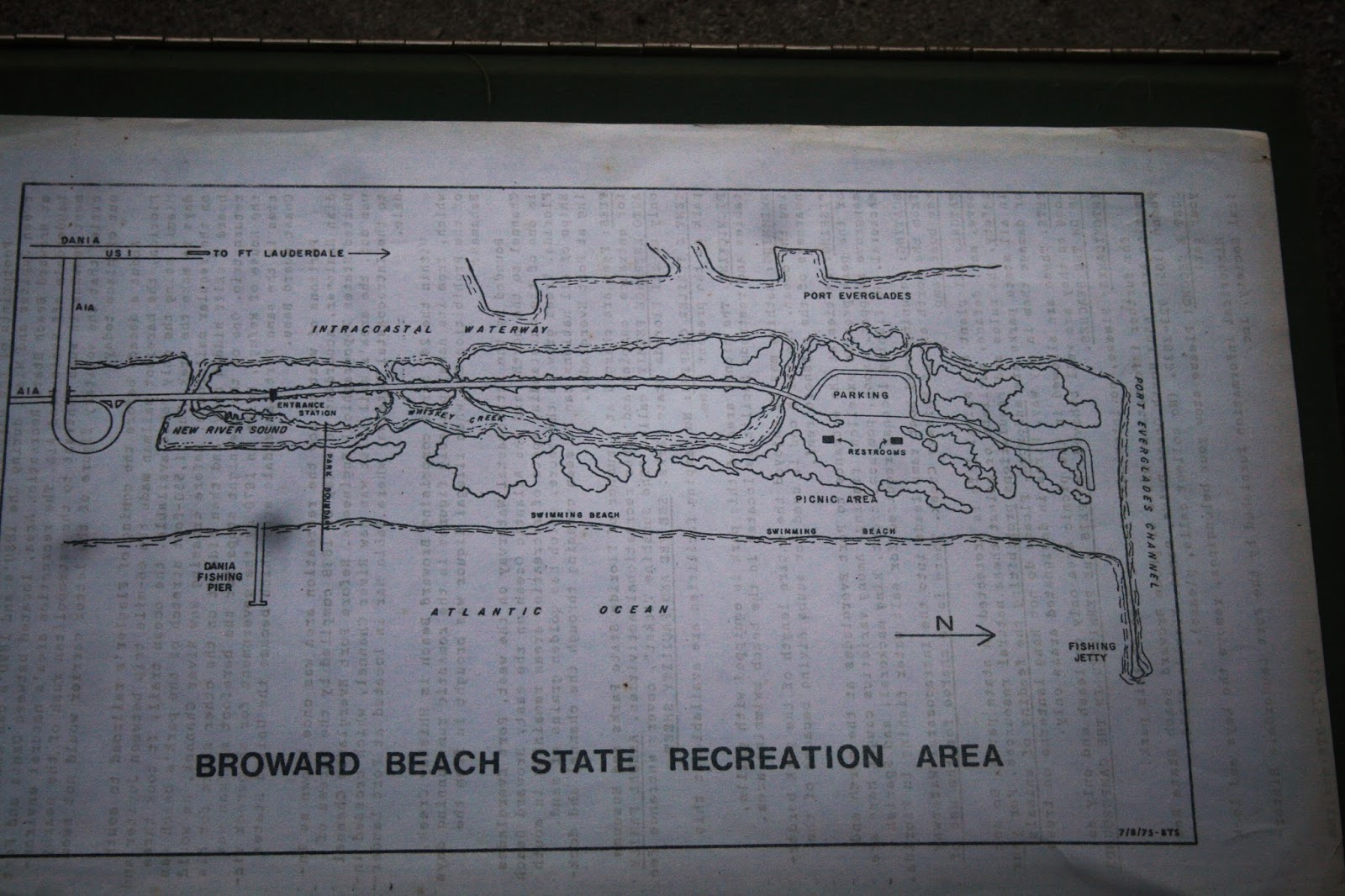
Map of Old Broward Beach State Park.

The above map shows the state park just below the Fort Lauderdale inlet into Port Everglades. The name has been changed.

I once found a large binder with maps and information on the Florida State Parks in a thrift store.  The maps and information was from the early 70s. Although some of the information is outdated, it is still a useful reference.

On the above map you shows Whiskey Creek, for example.  Other maps show historical sites along with a few notes.

It can be worth browsing through thrift stores.

---

In my opinion, one of the best posts I ever published was the recent post on sifting an entire city lot.  How many people would have guessed that one small suburban Florida lot that was the site of one modest working-class house would conceal nearly 500 coins?   Not many I would bet!  But one person proved that to be true by sifting the entire lot in addition to using a metal detector.  I posted the detailed results of that study on  3/26.  In my opinion every detectorist should have eagerly studied that post, and it should have been the most read post of my blog.  That post actually told how many coins were in the ground compared to how many were found with a detector  You usually don't find out how much is missed - just how much is found.  This was the exception. 

Nearly 500 coins were found in that one small lot!  That is what I want you to remember.  The next time you pass a lot and think there is probably nothing there, think again.  Less than half of those coins were found after many metal detecting sessions failed to get them.  There were still many good coins left in the ground long after most detectorist would have given up on the site.

Patience is a virtue, but too much patience can a problem too. You need patience to stick it out when things are slow  You need patience when you are tempted to give up and quit, but there are also times when you need to quit and move on to another location or another strategy or technique.  There is a fine balance.

A site can quit yielding much, but sometimes it isn't the fault of the site.  Sometimes another method is required.  Decisions should be made analytically and strategically, rather than emotionally.  A big part of the fun of detecting for me is figuring out what is going on and how to do things more effectively.

When I was doing a lot of detecting in shallow water, I couldn't work the water when it got very rough.  It was a real pain.  The waves would knock my ear phones off and give me a headache.  Then I learned another technique.

Water is powerful.  You can't really fight it.  It is better to work with it. I learned to go with the flow rather than trying to fight the waves and trying to remain stationary on the spot.  Some people use weights to help them, but I learned to feel the surges coming and knew when to pick up my feet so that each surge would carry me in one direction before coming back and dropping on the spot where I started.  Fighting the waves was futile.  That new technique allowed me to work the rough water when I otherwise couldn't.

Impatience can be a virtue at times.  It can be a virtue when you won't settle for the status quo and learn to do things more effectively.

---

I recently asked about the Stuart Bottling Works when I posted a picture of one embossed bottle from that plant.   Joe P. sent me the following link to some historical vignettes of Martin County published in TCPalm (See link below.).


Stuart's first bottling plant

In July 1913, James Elersly Weir, Jr., purchased a pitch pine wooden building owned by Joseph A. Lucas, a real estate developer, located on an isolated dirt road (Decker Street) south of Stuart; he had it converted into a bottling plant, Stuart Bottle Works. Soft drinks were bottled, sealed with large snap off caps and distributed in Stuart, Palm City, Jensen, Salerno, Hobe Sound, even to Fort Pierce and Jupiter. Weir only remained in Stuart a few years, joining family in West Palm Beach, in the plastering business and later, an auction house.

The bottling plant building was eventually owned by Ira L. Decker, who operated a concrete manufacturing business and was used primarily for storage. In the afternoon of Feb. 6, 1933, while Decker and local firemen were battling a brush fire nearby, the building caught fire. The wooden structure quickly went up in flames making it impossible for Ira to retrieve equipment, vehicles or machinery.

At least two bottles from the plant survive, clearly marked Stuart Bottling Works, one of which can be seen at the Stuart Heritage Museum.


Here is the link.

http://archive.tcpalm.com/news/historical-vignettes-some-of-martin-countys-firsts----part-2-ep-306511173-342350261.html

Thanks much Joe!

I've found at least four of those bottles south of Fort Pierce.  I think probably six.  I sold one or two of them.

I think anyone interested in local history will enjoy using that link to read the various Martin Country firsts.

---

The surf is only two feet today and the tides are flat.  Thursday the surf will be bigger.

Happy hunting,
TreasureGuide@comcast.net

Wednesday, December 20, 2017

12/20/17 Report - Hoard of Silver and Gold Coins Found. Basic Stages of a Systematic Hunt. Recognizing Various Types of Treasure.


Written by the TreasureGuide for the exclusive use of treasurebeachesreport.blogspot.com.


Hoard of Gold and Silver Coins Uncovered by Archaeologists.
Source: See Sci-News link below.

A hoard of 21 Islamic gold dinars, 2,200 silver coins, and gold artifacts dating to the 12th century CE has been unearthed by archaeologists digging at the Abbey of Cluny, a former Benedictine monastery in Cluny, SaĆ“ne-et-Loire, France...


Source: See link below.

Here is the link for more about that.

http://www.sci-news.com/archaeology/cluny-abbey-hoard-05433.html

---

I recently saw an episode of the Oak Island TV program in which they used an ROV to explore one of the submerged pits.  Finally!  That is one of the things I was amazed that they didn't do long ago.  I

It also seems like the equally long overdue systematic drilling has pinpointed the area that they refer to as "the real money pit."   That will help them focus their efforts better.

I don't remember if it was the same episode, but I cringed as a mattock was used to retrieve a detected target.  That reminded me of several instances of beautiful artifacts being damaged or destroyed by careless recovery techniques.

I haven't talked much about search strategies lately.  I talked about that kind of thing more in the past, and I don't like to repeat too much.  As a result I probably don't repeat enough.  People probably don't remember what I said some years ago anyhow.

My first step is always research.  After that is visual analysis.  There are too many beaches and the beaches are too big to cover completely.  You have to be selective, and it is best to select on the basis of reason and data.  To spend your time well, whether you are on a beach or not, you always need to know something about what you are going after, the area, and the signs or clues that will help you narrow down your search.

After your research and scanning the area visually, the third thing is to do some sampling.  After you eliminate some areas and identify others as more promising, it is time to verify your visual observation by doing some systematic sampling.

Some people grid an area before they test it. That is fine, but I usually want to collect some data by checking an area out a little with my detector before deciding to spend that kind of time.  Analysis of  finds made during sampling, both good and junk finds, can tell you a lot, and it might not take very long at all to gather that additional information.

There is a lot that could be said about sampling including search patterns and analysis of finds, but that is not my intent now.  During sampling you will also more closely inspect the area visually and with your other senses.  You'll see the type of sand and other small objects such as shells or pot shards as you check the area with your detector, as well as feel how compact or lose the sand is, for example.  You might then choose to switch search patterns and/or detectors.

I've also described multi-stage searches in which the surface targets or junk targets might be removed first and then the search strategy refined as the same area is covered more thoroughly in stages.

The same basic process can be used on either beach or inland hunts, large scale project or jut a trip to the beach.   I always prefer a thorough systematic process even though a quicker scan and analysis can be the first step.

----


That toy shown above sold for over $85,000.  I tell you that to remind you that treasure comes in many forms and it is good to be aware of the significance and value of many types of treasure.

People polish crotal bells like the find I showed yesterday and put a nice red ribbon on them and sell them for a good price.  The Polar Express movie made bells like that very popular.  You can get brand new ones or nice vintage bells.

Here is the source link for the picture above.

http://bangordailynews.com/2011/07/01/living/fine%C2%A0cast-iron-toys-can-bring-top-dollar/

---

I haven't been saying much about beach conditions lately.  There hasn't been much change.

It looks like we might get some bigger surf after Christmas.  That is what the MagicSeaWeed web site is showing.  I'll keep watching that.

Happy hunting,
TreasureGuide@comcast.net


Monday, December 4, 2017

12/4/17 Report - Focus, Goals, Feedback Loops and Analysis For Improving Metal Detecting Success. Perspective.


Written by the TreasureGuide for the exclusive use of treasurebeachesreport.blogspot.com.

Focus, Objectives and Strategies.

I don't think there is anything that improves the chance of success in anything more than a good clear specific statement of the objective.  I used to teach that a lot when I did consulting for fortune 100 companies and government agencies.   It is very obvious that you need to know exactly what you want to accomplish, yet most people don't see the need to develop a good clear specific statement of the objective.  I'm not just talking about having a a general idea of what you would like to happen or what you would like to accomplish.  There is a great benefit in thinking it out completely and being able to specify the goal in very specific terms along with some kind of quantitative measure of success.

It is perfectly OK to just go out and bop around and see what pops up, if that is what you want to do, but if there is something you really want to accomplish then you need to be clear about exactly what that is.  If, for example, you really want to find a Spanish shipwreck coin, then set that as a goal, and make decisions based upon that goal.  If you want to find a big glitzy diamond ring or a lot of glitzy rings, that is an entirely a different matter, and you might want to choose a different type of detector and visit a different set of sites.

If you watch what people do over any length of time, you can often tell that they don't have a very well defined goal.  They don't have focus.  They jump around from one thing to another and seldom make any real progress.  That is what I see on the Oak Island TV show.

One of the things that drives me crazy when I watch that show in particular is the apparent lack of focus, goals and strategy.  They only go far enough in any one direction to come up with new questions.  That might be OK for keeping a TV show going, if that is their primary goal, but it is not the most efficient way to accomplish a serious goal of any type.  At different times they express different goals, and that is one reason the search appears to be such an unfocused hodge podge of unanswered questions and dead ends.  I'm sure the goals of the TV production company adds to the apparent disorganization.  They want to keep the excitement level up. and to do that they encourage wild unwarranted assertions that do little but keep the viewer watching.  It doesn't bother them when someone picks up a find and excitedly exclaims that it is a gold coin even when it is a plated button.

Whatever happened to the shipwreck spike and plank found in the swamp?  Not important?

Exploring the TV side of things for a minute, they have to keep it interesting while the big longer term projects plod along.. They have to find something to get excited about every once in a while.  An endless series of frustrated attempts and questions without answers would be too much for most TV viewers, so the production company has found a savior in metal detecting, which, while not recovering anything near the magnitude of the Holy Grail or treasure chests overflowing with gold, at least it provides something to entertain the viewers, even if it is nothing more than broken toy guns, chunks of iron, spikes without ships, with some old coins and buttons thrown in, all of which is standard detecting fare for any location with history that has not been cleaned out by detector wielding hoards. 

What does all the metal detected surface trash and treasure have to do with the money pit or answering the big questions?  Very little.  Maybe there might be some clue discovered that actually answers an important question, but most of the metal detected finds are little more than momentary diversion to keep viewers entertained while the big finds remain elusive.  It has little to do with what I would suspect is the major objective.

How does that relate to you?  First, if you want to accomplish something, it helps to be very clear about exactly what that you want to accomplish.  Secondly, it helps to have a quantitative measurable way to evaluate your progress.

When I started metal detecting, I wanted to find a lot of coins.  I kept records of each hunt.  I could tell how I was doing and if I was improving.  Then I started keeping track of the value of the coins I found.  That is slightly different than finding a lot of coins.  Later my goal was to find a lot of gold items.  Then high value gold items.  As I improved, I changed my goals.  But it was important to have a way to measure progress.

In these days when AI and robotics are talked about so much, you probably know that the feedback loop is an important element.  You can't make the best adjustments unless you have some way of measuring analyzing performance.  You need to keep on track.  That is the function of the feedback loop.  If you have a very clear objective (or objectives) and some way of measuring progress, you can keep track of how you are doing and continually make improvements.

For example, I look at the number of hits and page views on my blog daily.  That helps me get an idea of what people are interested in and what they like.  The total number of page views is near two million now, and the daily hits are usually somewhere between 500 and 1000.  Of course, I also use other things, such as emails.

It isn't always simple to analyze the data.  Some people love certain posts, but the posts that some people really like are not always the ones that get the most views.  They touch certain individuals powerfully but don't particularly appeal to the mass audience.  There are various reasons for that and I won't get into all of that now.

In summary, I'd encourage you to be real clear about what you want to accomplish, and come up with some measurable way to keep track of your progress.  I know I won't get a lot of people to do that, but if you do, I think you'll be happy with the results.

I don't really think this will be one of my most popular posts, but to me it is probably one of the most important and can help you a lot if you take it to heart.

---

I thought I might need to add some perspective.  If my Ole Timer Talk post about Clint's finds back in 1984 and 1991, you might be tempted to conclude that those were the good old days, and now it is all gone.  If that is what you think, what you are missing is the rarity of those times.  Thanksgiving 1984 is known as an exceptional time for treasure hunting on the Treasure Coast.  It doesn't happen all the time.  And did you notice that Clint went from 1984 to 1991.  That is a period of seven years.  When it is hot it is hot, and when it is not it is not.  There are times when the beaches are exceptionally good, and when they are not.  You can't take blowers and remove all of the sand from the beach.  You have to wait, and hopefully you'll be at the right place at the right time.  That is why I put so much attention on the wind, waves and surf.  If you keep up on that, you'll have a better chance of being there at the better times.  You can spend everyday on the beach for a year and not get as much as you would in a week when the conditions turn good.  We've had some better beach conditions a few times this year and finds were made, but it wasn't anything like Thanksgiving of 1984.  2004 was good after Francis and Jeanne.  Some of the other hurricanes since then didn't do nearly as much for metal detecting.

----


They've been running the Shooter movie a lot lately.  It is an interesting movie, but I found it more interesting and less far-fetched than when I saw it about a year ago because of the current political environment and what we've learned about the intelligence agencies the past year.

---

We're having some nice big tides but the surf is only running around two or three feet.  The winds aren't particularly favorable.

Happy hunting,
TreasureGuide@comcast.net

Wednesday, October 11, 2017

10/11/17 Report - How The Competition Can Actually Help You If You Effectively Analyze Your Finds. A Twist on the Spanish Conquest.


Written by the TreasureGuide for the exclusive use of treasurebeachesreport.blogspot.com.


As you know I cover a wide variety of topics.  Once in a while I get on a particular topic and stick to it for a while before changing again.  For a few weeks I was on the weather and developing beach conditions.  Sometimes I'll be on beach dynamics or treasure coins, or metal detectors or strategies techniques or equipment.  Sometimes even things like fossils, sea glass or Native American artifacts.

Lately I've been talking about one 8-mile stretch of beach that I detected a lot in the past.  I'll  talk a little more about that today, particularly two of the better modern jewelry beaches.

The first I described as "a very narrow swimming beach where a lot of people crowded on nice days.  It produced a lot of good quality jewelry on a regular basis."  The jewelry finds were generally good quality and seemed to be a good representative sample of what the people wore there.

On the other hand, there was another jewelry beach that I described as " a good hole.  It was in front of an active high-scale resort.  Not as many items as in zone 1, but higher quality.  Some very good finds came from there even though there was known competition.  I believe that it was resort staff.  A fellow stood and watched me working the water one day and left cursing when he saw me dig a gold chain in very shallow water.  I could tell that  a lot of my finds from there were not the easy finds and were things somebody could easily miss."

The things I found there were not things that were easy to detect.  The average and large size things never appeared.  It was always a very thin gold ring with a good gem, or a small gold chain, or something else that might easily be missed by the detector.  Finds were not frequent but they were good. There was no junk and very few coins. 

If you carefully analyze what is being found or not found, you can tell a lot about a site and modify how you hunt accordingly.  Since I knew there were very few junk targets and few big targets, I could really pump up the sensitivity turn off discrimination and hunt slow and listen for the small signals.  Overall, it was very productive hunting.

Once I was traveling on business and stopped at a roadside beach with a couple picnic tables near Pensacola.  There were four posts marking out a square area in front of the picnic tables.  I started hunting found the are within the square marked by the posts thoroughly cleaned out so I moved just outside the square area and found three gold rings in a very short time.  Whoever was working that area on a regular basis, worked the square but left the area just outside the square untouched.

My point is to carefully analyze finds and junk to determine what is going on and then make adjustments.  The competition can actually help you out if you figure out how to take advantage of what they are or aren't doing.

---

Monday was Columbus Day, and as you would expect, in response to any mention of a celebrated historic or national cultural event that at one time played any roll in fostering national identity, we are treated to a parade of contrary boring poorly-thought-out  incessantly-repetitious emotion-driven arguments by dissenters for their "favorite" group, skin color, nationality, ideology or whatever.  I am all in favor of presenting "the other side."  In fact I highly recommend and encourage exactly that.  I only want the argument to be thorough, consistent and justified by something other than myth, repetition and emotion.

Victim-hood attracts sympathy.  I understand that, but being a victim does not automatically make you right.  It does not grant merit.

The Spanish ( or Europeans or Whites - however you want to define your favorite group or your favorite hate group) conquistadors did terrible things.  I am not defending that at all.  However, the Maya and Aztec, foe example, appeared to have little aversion to violence, human sacrifice, war, slavery, or territorial expansion, all of which existed in the New World before Columbus arrived.

The difference is not that one group was evil and the other inherently good.  The big difference came down to the fact that one group was more successful in effecting the evil in their heart.  I have no reason to believe that if the Aztecs, for example, had the ships, army and war technology to project power overseas, that they would develop a non-violent non-aggressive culture and limit the evil they would do.   I see no reason to believe that if they had the power to project domination that they would not have done the same thing to North America and Europe and we might be speaking some strange language today.

I accept that the more powerful group is responsible for the greater damage done, but not having the ability to do more damage hardly makes you a better person.  It was not that one group was completely good and the other completely evil.  No group is completely good or evil - especially not any group defined by such superficial simplistic things as skin color, ancestry, race, national identity or culture.  We have to learn to look at things in less simplistic terms, and we need to start looking at people as individuals - not just group members.  We need to get over this obsession with skin color, race and nationality.   No person is perfect.  Neither are groups.

---

The poll is progressing nicely.  Not much longer to get your responses in.  I know that some people have not responded because I know of some finds in areas that still have zero votes. 

Please respond before it is too late.  I think this is one of my more interesting polls.

Thanks!

---

Compared to September there isn't much excitement.  The surf isn't huge, yet it isn't real small now.

I haven't been able to get out lately, but hope you have.

Happy hunting,
TreasureGuide@comcast.net


Thursday, July 20, 2017

7/20/17 Report - What Might You Be Missing: Trade-offs and Strategic Metal Detecting Strategies.


Written by the treasureguide for the exclusive use of treasurebeachesreport.blogspot.com.

Three Shipwreck Spikes and Some Modern Coins
What kind of items would you most likely miss?  Different people miss different things.  Everybody misses some types of items.   Your detector and settings and hunting style will be more tuned for some types of items, but that will mean that there will be other things you will miss.

There are always some trade-offs.  Your hunting style might be near optimal.  You might be finding the types of things you want to find while not missing much that you don't care about.  But do you know?  Do you know what you might be missing?  When you decide to discriminate or skip one type of item, are you aware of what else you might also be skipping?

You may never know what you left in the ground.  There might have been a few surprises.  I bet there were.

The number of watches I find has always been surprising to me.  I was surprised, first of all, by how many are lost, and secondly, how long they seem to remain on heavily detected beaches.  The thing is that they aren't identified by detector meters and they can sound like junk.  If you leave a watch in the ground, you might be leaving the most valuable thing you passed over all day.  That is just one example of the kind of thing I'm talking about.

There are some things that I'm sure I would have found years sooner, except they were in my "blind zone."  I didn't realize it for a long time, but it was the result of the characteristics of my metal detector and the items that I was targeting at the time.  I was focusing on gold jewelry, and as a result, there were other things that I was missing.

You can not avoid making some trade-offs when you focus your hunting on certain types of finds.  It is wise to focus your time and efforts.   Your decisions can save you time and optimize results.  You might be perfectly fine with deciding to accept one type of error in order to save time and optimize your overall results, but you need to be aware of the effect of your decisions so you know you aren't missing things that you'd really rather find.

Here is a little quiz.  Which of the items in the photo at the top of the post do you think a detectorist would most likely fail to find if it was in the metal detector's range and the coil was right over it?  

I'm going to talk about this in generalities today.  Assume all of those items were all at the same shallow depth. And I'm not going to go by any particular metal detector or the particular settings you might use.

You might think that size is the primary determinant, but in this case it probably wouldn't be the smallest of these items that most detectorists would miss.

I'd say that probably fifty percent or more of the detectorists that hunt the Treasure Coast would not detect the second item from the left.  It is a broken iron spike.

If I'm talking about another area of the country where other types of detectors predominate and where there are more relic hunters, for example, the results would not be the same.

You'd think that most detectors would detect a shipwreck spike, but many will not, even one of the ones that is very commonly used on the Treasure Coast shipwreck beaches will miss them.  You might run full sensitivity and no discrimination and it will still not respond to iron targets like this.

Years ago I wondered why I hadn't found iron shipwreck spikes even though I found all kinds of other shipwreck finds, including small cobs.  The simple reason is that I wasn't digging iron at the time, and the particular detector I was using at the time would null out on iron.  If you aren't digging iron, you won't find iron, and there might actually be a few iron items that you'd prefer to have. Again, it is good to be aware of the effect of the decisions you make.

The first spike in the photo is an interesting one to me.  It was bent over then clenched in, but then the head pulled through the wood.

The iron spike in the photo, is broken, as you can see.  The smaller spike to the right of the iron spike is copper, like the first one shown in the photo, and I think more Treasure Coast detectorists would dig the copper spike than the iron spike.

Of course, some metal detectors are very hot to iron and would easily detect the iron spike.  Most people do not like to detect with a lot of iron sensitivity and so either choose another type of detector or use some type of discrimination.

I'm talking about this to encourage you to get to know your detector and the possible results of different detecting strategies.  You might want to test your detector and the way you detect to see if what I am saying is true for you.  You should know if your detector is hot to iron or not.  Don't just complain about the iron junk.  Make a calculated decision.


Another Selection of Finds.
Here is a second grouping.  Which item in this photo do you think the most people would miss?

Again, you have to know what they are made of.   The first is copper; the second bronze; the third is lead, and the fourth object is lead.

The copper, bronze and lead will usually give a good strong signal on many metal detectors.  The one that many people might miss would be the third item: the lead stylus.  ( It has been identified as a stylus, although other people think otherwise.  I've recently talked about the difficulty of identifying artifacts.)

The lead stylus is surprisingly stealthy to a lot of detectors, while the crumpled lead sheathing gives a huge signal. 

What I said today might or might not be true for your detector and how you detect. My primary purpose with this is to make you think about different types of targets, and your detector and how you hunt.  I'm convinced that trade-offs are unavoidable, but can be good.  You just have to make informed decisions.

It is easy to miss certain types of items and never know it.  That might include a few of the types of items that you might prefer to find.  That is why it is important to know your detector and experiment with a variety of types of objects.

If I figure out how to get my detector sound recordings into blogger, I might give you some examples for two or three specific detectors.

---

Tropical storm Don has disappeared and there is now no tropical activity in the Atlantic or Gulf.

Expect a one to two foot surf for several days.  We are having some decent negative tides.  Every tidal cycle, some sand in the very shallow water and at the water's edge gets shifted.

Happy hunting,
Treasureguide@comcast.net


Tuesday, May 19, 2015

5/19/15 Report - Garrett ATX Review Part 1. Introduction To How To Hunt A Beach Rewind.


Written by the Treasure Guide for the exclusive use of treasurebeachesreport.blogspot.com


Garrett ATX Detector
Every once in a while I evaluate a detector and post a review.  I haven't done a review in a while, but I recently evaluated the Garrett ATX for beach detecting.  The ATX is used by a lot of gold nugget hunters, and I think was designed with that type of hunting in mind, however I wanted to see how it would do as a beach detector.

I didn't do one of those quickie evaluations that people sometimes do.  They assemble a detector and in short order take it out in the field for a couple of hours.  Those kinds of evaluations aren't worth a whole lot.  While you can do that with some detectors, maybe most, it takes longer to really evaluate a detector like the ATX.   My experience says that the ATX will do a lot better in the hands of a someone that has put in a good number of hours with it.  That is what I did.

I tested the Garrett ATX Extreme PI with the standard 10 x 12 inch DD Coil.  Optional coils are available.

There is no way that I would classify the ATX as a beginner's detector.  It took me longer to get to understand the ATX than any other detector that I have ever used.  Maybe that is partially because I really got into the details more than ever before.  I wasn't satisfied with simple impressions.  I did a lot of precise testing.

First of all, the ATX is a pulse induction detector.  Some of what you know about pulse induction detectors is true of the ATX.  It is definitely hot to iron.  You can detect microscopic iron with the ATX.

The ATX has discrimination.  But this is not the right detector for anyone who typically uses discrimination.  If you are going to crank up disrimination on the ATX, you should have selected another detector because you will be diminishing what this detector does very well.

There are two modes - motion and non-motion.  If you have read my posts, you probably know that I almost always use a non-motion or pinpoint or all-metals mode.  That is true with the Excalibur, for example.

The Excalibur's discrimination mode and the ATX's motion mode are similar in some ways even though they are very different types of detectors.

For good performance, the ATX requires the right settings for the situation.   If you have the wrong settings, performance can be way off.  You can say that of many detectors, but I was more aware of that with the ATX.  Perhaps that was because I did a whole lot of testing and was constantly aware of the level of performance that I was getting.

Just like with the White's Dual Field Surf detector, the threshold setting is very important.  Setting the threshold either too high or too low can make the ATX much less effective.

Let me get down to the two very important conclusions.   (1) If you like discrimination you will not like the ATX.  (2) If you like a detector you can turn on and operate in most environments without making adjustments, this detector is not for you.

Like the Excalibur (again, even though they are very different detectors) the ATX can be really sensitive in non-motion mode.  If you are not accustomed to operating in salt sand or salt water in an all-metals mode, this will take some practice.  That is a skill of its own.  You will have to learn to work with signal drift and hearing the effect of salt mineralization etc.

Yes you can run up the discrimination and decrease sensitivity and get a very steady quiet and steady threshold, but that diminishes the power and effectiveness of the ATX.

Most people will not want to use the ATX in the dry sand.  And they will not want to use it on a junky beach anywhere.  Most beach hunters do not have the patience to run such a detector hot without discrimination, and as I said, if you want to use a lot of discrimination you'll diminish the power of the detector so much that you should have bought another type of detector.

The DD coil is said to provide good target separation.  That is not what I found. One of my biggest complaints with the ATX is how wide the signal seems to be.  That took some getting used to.

The ATX does have a pinpoint mode, which is effective, but pinpointing is difficult, to say the least, in the motion mode.  You can however learn to pinpoint fairly effectively in the motion mode without using the pinpoint mode.  That takes a lot of practice though.  I don't particularly like slowing down so much to pinpoint.  With most detectors I can pinpoint very well without slowing down to go into a pinpoint mode.  Remember that with the Excalibur, for example, I always hunt in pinpoint mode anyhow.

This is starting to get a bit long already.  I'll have to finish it some other time.

----

I've done this blog for a few years now.  I never expected it to be so popular. It could be much more popular and receive much more visibility, but I've turned down opportunities to have it published in some other places.

Anyhow, I was looking back at some posts from the early years and thought it might be a good idea to repost some of those older posts that got buried by hundreds of new posts.  There are so many posts now that I don't think anybody is going to go all the way back to look at the oldee ones.  Below is part of one post that got hundreds of views back in 2010.

-----

Let me begin to address the question even though I'm sure I can't do the question justice in a single post and probably not in a hundred posts. I'm not sure I can do the question justice at all, but I'll give it a shot and maybe something of value will come of it.

Before I begin, let me say that I'm really not suggesting that I have the "right" answer, and I want you to know that the following is nothing more than my opinion. Maybe it will help someone.

First there is no single way to properly hunt a beach. There are different strategies and techniques, and some can be applied to one situation while others might better be applied to other situations.

Some of the most important factors to consider are what you want to find, where you are hunting, and the local beach conditions. Much of the intent of this blog is to provide information on beach conditions.

Before really getting into the meat of the subject, I need to provide some background.

Success can not be guaranteed on any one outing, but you can over the long haul learn to succeed more frequently. It is about probabilities and doing what ever you can to improve the probability of success on any given outing.

There is way too much beach for anyone to cover completely. Therefore, it becomes a matter of spending your time in the right places. Some places are much more productive than others.

First you have to define your own idea of success. Some people want to find things with the highest economic value, other people want to find old things, other people want to find things of historic interest, and other people are perfectly content to go out, get some exercise and fresh air and pick up a few coins.

Your goals should match your personality, goals and circumstances. Most people would like to find something like the treasure of the Atocha, but most people do not have either the optimism, patience, and abilities and resources or commitment to do something like that. High value targets like that usually require tons of perseverance and commitment, and many people would give up way before finishing the task.

Besides personality, situation plays a role. If you want to pan or mine for gold and live in Fort Pierce, your situation doesn't match your goals very well.

Where you live has a lot to do with what you should target, unless you are willing to travel or move.

If you live in South Florida, you should be able to learn to do well hunting modern jewelry. If you live on the Treasure Coast, hunting modern jewelry is not as economically productive as in South Florida.

The Treasure Coast has the famed shipwrecks but hunting shipwreck coins and artifacts isn't easy. Unless you dive and work with someone that has a lease,you are pretty much confined to hunting the beaches, and most of the time the conditions are not good for that.

My main point of all of that is that you have to have some clarity about your own personality, your situation, what you are willing to invest in time, effort, and expense, and your goals before you can maximize the probability of success however you define it.

If you don't have too much patience and easily get discouraged or give up, set goals that are realistic and more easily achievable. Expand the number of things that you target. And learn to enjoy the hunt.

Given all of that, once you decide what you want to find then you can begin to learn the best ways of being successful in finding that particular kind of thing. There are different things to find, and many of them require different strategies an techniques.

One of the things you can do to improve your success rate is to be adaptable. Learn to hunt a variety of different types of things. That requires more knowledge and a variety of different strategies and techniques.

Learn to identify the conditions that are best for different types of hunting and adapt to the current conditions. Take what the beach is offering.

----

No change in Treasure Coast beach conditions on the horizon.

Happy hunting,
TreasureGuide@comcast.net

Friday, July 11, 2014

7/12/14 Report - Some Views On Metal Detectors and Metal Detecting & Claddagh Ring


Written by the TreasureGuide for the exclusive use of treasurebeachesreport.blogspot.com.

Gold Claddagh Ring Detector Find

As I've pointed out in the past, Claddagh rings are among the more common ring designs.  Claddagh rings have been made for centuries.  You'll find them in both silver and gold.  If you detect very long you'll find a few.


James F. has been detecting for around 45 years.  He started, like I did, down in South Florida.

Here are some of his intelligent and thoughtful views as expressed in a recent email to me.

I thought you might be interested in some of my views along the same lines. I agree that many of the high-end machines with all the bells and whistles are not for everybody, and it depends, a lot, on the type of hunting they are going to do and where they are going to do it. I, for one, still have at least one thirty-year-old machine still in use, but all things being equal, I have no love loss for the old machines, though they were the top of the technical ladder then, and we were quite mesmerized by their performance at the time. I run pretty much on all metal nowadays when searching any beach anyway...as the computerized E-Trac still gives you information on the target composition, (and runs on 28 frequencies simultaneously) thru both a digital value and audio, and the Excaliber, running on 17 different frequencies, gives you some pretty accurate tonalities along the same lines. My single frequency older machine goes bonkers near damp sand soaked with salty water...sure I can continually ground balance the thing, and set the discrimination way up so it somewhat ignores the mineralization, BUT I lose a good portion of my detecting range and thus the targets I seek. The old machine has one tone fits everything...just a beep on target acquisition...same beep on a gold ring, candy wrapper, bottle top, poptab, zinc, copper, silver you name it...thus you dig literally EVERYTHING. You can, of course, set the discrimination up high enough to blank out most of the trash, as well as blank out most of the jewelry. So I think the newer more capable machines are quite an advancement over the old days IF you take the time learn how to use their capabilities and practice a bit. At least that's my view...I do have friends that use some pretty old equipment and seem quite satisfied with the performance and finds they get in general, so there's that.

Thanks for sharing James.  

One of the key lines above is when James says it depends on the type of hunting they are going to do and where they are going to do it.    That is very true and very important. 

I don't disagree with anything that James says.

I had some exceptionally good detectors that were custom made for exactly my type of hunting.   Also I tend to use what I believe to be a fairly unique strategy, and that strategy has a lot to do with what I want out of a detector.

The metal detectors I used a lot back around thirty years ago were like those that I showed a couple of days ago.  They did one thing very well - detected small gold deep. Those detectors also detected coins and other things very deep in wet sand and salt water, as well as on dry land, but I specifically targeted gold.

They did null on iron, but that is the extent of the discrimination for those detectors.

I was not really interested in most coins.  I would give up bunches of coins for one piece of gold most any day.  That was part of my strategy and had something to do with how I hunted.  I'll elaborate on that in a future post.

I would quickly purchase either of the two old detectors that I showed the other day today if they were available at a reasonable price.  A more recent version of one of those is available today.  It is the successor to the Turbo, but it costs over $5000.  But that isn't the reason I don't buy it.  The problem is that only one person provides service for that detector, and I understand he is not good to deal with.  As a result I'll settle for a new major brand detector. 

If the guys that made my old detectors were still around, I would still be using one of their detectors today.

I remember back about twenty plus years ago I ran into a Treasure Coast detector dealer on a Treasure Coast beach.  He didn't know me at all.  He told me he would never use a detector made in a garage.  I just laughed and told him that is all I have used for the past ten or fifteen years.

I did own and on rare occasion use a couple brand name detectors for special situations back then, but 99% or more of the time I used those home-made or modified detectors.   I was targeting gold in wet sand and in the water and those old detectors blew away anything else that I had seen up to that time and were as good, or better in most cases, for that one purpose, in my opinion, than anything I've seen today. 

The thing is that those old detectors were constructed exactly for the type of hunting I did.  They suited how I hunted.  How I hunt, including the strategies I use, made those detectors a perfect fit for me.

I won't try to describe how deep they detected.  I didn't do precise measurements, and it wouldn't sound real to some of you anyhow.  Just let it be said that they did the job very well.  

The most important thing, however, that distinguishes my style of hunting, is my search strategy.  The search strategy that I typically use is the thing that makes discrimination and such features so unimportant to me. 

I'll try to explain my search strategy better some time in the future.


A statue purchased for two dollars is worth $150,000.

http://www.aol.com/article/2014/07/08/antiques-roadshow-small-statue-sells-for-over-150-000-dollar/20926672/


On July 12 we will have what is called a Thunder Moon or Buck Moon.  The moonrise will be around 8:30 PM Easter Time.   There will be a 4-foot plus high tide that will occur around 8:41 p.m. Eastern Daylight Time along the Florida East Coast. 

Here is the link if you want to learn more about the Thunder Moon.

http://space.brevardtimes.com/2014/07/next-full-moon-is-super-moon-in-july.html

On the Treasure Coast we're still stuck with a 1 to 2 foot surf, but we will have a good high tide.


I've been working on what I think will be a very good post.  Hopefully I'll have it ready in a day or two.


Happy hunting,
TreasureGuide@comcast.net

Thursday, July 10, 2014

7/10/14 Report - The Math of Metal Detecting and How It Can Assist Decisions and Strategies


Written by the TreasureGuide for the exclusive use of treasurebeachesreport.blogspot.com.

Old Class Ring Found With Metal Detector
Source: Online

This is one of those class rings that was lost for a good number of years, but was recently found and returned.  I'll post the source of the article and photo if I can find it again.


Today I want to talk a little about the math of metal detecting, especially as it affects the strategies you might use.  This discussion will of necessity be very general because there are simply too many factors that can affect your results, and I won't be able to get real specific in this one post.   Each person's situation differs in a variety of ways.  Therefore this discussion should not be considered precise or final in any way, but it should help you to think about how you hunt and different decision strategies that you might use.

I have more reasons than one for presenting this topic.  You might decide to modify your detecting strategies as a result of this discussion.

If I remember correctly, the average face value of clad coin finds is about 7.5 cents.  That number should be close enough for this discussion anyway. 

Many things can affect that average for you.  Maybe you discriminate out nickels, for example.  Maybe you discriminate out zinc pennies, or maybe your detector is more or less sensitive to certain denominations.  Or maybe it is where you hunt or how you hunt that makes the difference. 

I'm sure some locations will produce proportions of different denomination coins than others.  For example, if there is a parking or entrance fee that is something like $2.50 cents, the number of quarters you'll find will probably be higher.  People will get often get fifty cents back in change.  That will increase the number of quarters and the average face value of coin finds.

All things considered, for discussion purposes I'll adopt 7.5 cents as the average face value for clad coin finds.

Using that number, if you want to pay for your a detector that cost you $1000, you'd have to find over 13,000 coins to pay for it that way.   Of course, that doesn't include any other items of value you might find, but that is a lot of coins.  You would be doing very well indeed to find that many coins in a year. 

If you find one Rolex (lets say a Rolex that you could sell used for $15,000, which is not the highest or the lowest) that is worth something like over 200,000 clad coins.  

Here is one thing I want you to see.  If you find one Rolex like that, the value would be higher than the value of coins that you might find for a period of several years.

So what would you rather do, dig a couple hundred thousand coins or a Rolex?

If people want to dig a couple hundred thousand coins, that must be the reason they air test their detector with clad coins.  Right? 

And that must be the reason they always talk about how deep they can detect a coin.  Right?

For me, the economic value of clad coins is not a lot better than what you could get for a bucket full of aluminum pull tabs or the lead from a bunch of sinkers.

If you'd rather find a Rolex than clad coins, or if you'd rather find gold rings, as another example,  adjust how you do things.  Air test your detector using the kind of things you really want to find.  Do your tests and practice with the kinds of things you want to find.   Again, I don't much care how deep a detector will detect a clad coin.  That is not my primary target.

If you would like to find a Rolex watch, practice running your coil over watches and see how they sound.  And go where Rolex's can be found. 

There are some places where it is much less likely that you will ever find a Rolex.   I'm just using the Rolex as an example, but I'm really talking about deciding whatever it is you really want to find and adjusting your behavior and strategies. 

If you want to find gold rings you might consider air testing with a gold ring instead of a coin, and setting your detector's settings to maximize the response to those types of targets instead of clad coins.

Of course there are many things that have a value between clad coins and a Rolex.   There are rings of various sizes and values, and all kinds of other things.

Below is a little chart I made.  The vertical axis shows the frequency of different types of finds, going from common inexpensive finds at the top to less common and higher value finds at the bottom.  The horizontal axis shows the value of different types of finds, going from one cent on the left to $100,000 on the right.


To the left of the curved line is worthless junk. 

The line starts high on the left because very low value targets are very common and very frequently found.  Hunting like most people, you'll find many pennies, nickels, dimes, etc. and not as many gold items.  

As the value increases (line going from left to right) the frequency they are found generally decreases (line goes from high to low).

Just to the right of the beginning of the downward sloping line there is a curve as you get into targets of increasing value such as silver rings, small gold rings, better rings, etc.   

Silver rings and gold bands fall largely in this big curve area.  They are less common than coins, but more common than more valuable finds.

The line gets pretty flat way out to the right.  There is not much difference in the probability of finding a $30,000 ring or a $40,000 ring.  That is why the line gets flat.  The frequency (or probability) does not decrease much at the very high level.  They are all fairly rare at that level.  How rare depends to some extent on where you hunt.

Lets say you find a gold band weighing one tenth of  a troy oz.  That is not the smallest you could find and it is way smaller than the heaviest you could find.  I would say it is not an uncommon weight.  You might get $60 or more for one tenth of an oz. of 14K gold at today's prices.  A ring like that would be worth something like 800 clad coin finds.

Of course you could find a ring weighing a full oz. or more, or it might have good quality diamonds, taking you up in the tens of thousands of dollars.

Low value targets are very common, but it seemingly takes forever for the value to accumulate to anything very significant.   Therefore, when deciding what you want to target you might want to make a calculated decision about where and how you want to hunt.  Maybe an area that produces fewer coins but more high value targets would be worthwhile.

You have to remember that low value targets have value other than economic value though.  For example, they can be signs or indicators about how the beach is sifting and sorting items.  That is an entire additional topic.   They also have a psychological value for some people because they at least keep it interesting when the hunt for higher value targets drags on.  Some people need the low value finds to keep them interested between higher value targets.  Not everybody can tolerate long periods of finding very little.

For me the "sign" or "indicator" value of coins is by far the most important.  In that regard they are again very much like pull tabs and types of metallic junk.  They tell you something about how the beach is sifting and sorting, and therefore also something about where you will or will not find the gold.

Economically, clad coins aren't worth a great deal more than the aluminum in a bucket of pulltabs or the lead in a bucket of sinkers.  

I'm not talking here about coins that have a value beyond their face value.

Here is a main point.  People often behave and detect in a way that would suggest that what they most want to find is clad coins.  

When you figure out which sites are best, don't forget to figure in the probability of large value finds.  At some locations the probability of a large value find might be near zero.  At locations where they are possible but not likely, don't entirely discount them because when they do occur the value is soooo much more significant that it will really make a difference in your totals.

I think a lot of people figure that if they go out and meander around and find some coins eventually they'll get a ring or something better, but if you want to maximize the economic value of your finds, you need to figure in the probability of higher value finds, which will affect your totals much more than clad coins. 

As I attempted to show with the calculations above, it takes relatively few high value finds to drastically change the total value of your finds.  Don't under weight high-value finds when you decide where and how you are going to hunt.  I'd rather hunt locations where I can target higher value finds.   One or two of those quickly adds up to more than many low value finds. 

If you intentionally target high-value finds, you will not necessarily find much else.  Some places have a good mix of coins and gold.  Sometimes there is a lot of gold where there are a lot of coins.  And at some places there are good high-value finds such as gold but almost no coins.  At first it might seem like that type of location holds nothing.   There might only be a few targets, but it only takes one high-value find to make a good day.

Condominium beaches are not like park beaches, for example.  People in condominiums normally don't fill their pockets with coins before going out to the beach.  Whereas people who have to put money in meters or pay an entrance fee or buy hot dogs, will have and lose more coins, but not necessarily good jewelry.

I am encouraging you to be specific about what you target.  Sample different locations.  Make some observations.   Collect data.  Make decisions more methodically, and hunt strategically.

Back to the economics of the issue.  Lets say there is a good chance of getting a $10,000 find at one location, and a good chance of getting a plain gold band of around one tenth an ounce ($60) at another location about once in every five hunts.  Your estimate might be that you would hit a quality ring of about $10,000 value once in 20 hunts and at the other location a gold band once every other hunt.  You'll find gold more often at the second beach, but look at how that works out. 

Expected value per hunt at the location with the probable high value ring = 1/20 x 10,000 = $500.
Expected value per hunt at the location with the probable gold band = 1/5 x $60 = $20.

Even though it might take much longer to hit a high quality ring at one location, it would average out to way more value than lower quality rings at another location even though on average you find them 4 times as often.

You can't evaluate a location based upon a single item, but you can see from this analysis how a piece of gold can heavily influence your average expected value at a site - certainly much more than common coins.   Figure other significant items in to the analysis as appropriate.

A site yielding a fair number of heavy class rings might produce a higher average value than a site producing a lot of wedding bands. 

Again, there are too many factors for me to address them all now.

I'll wind this up.  Here are some of my main points.   Be clear about what you target and why.  Adjust your decisions and strategies according to your target.  Be aware of the trade-offs.  Select sites based upon your best data and estimates and don't underestimate the value of high value targets.

Well that took a while.  I still had to really cut things down to make it semi-understandable.

That is as much as I'll get into today.

On the Treasure Coast the surf is still small but the tides are increasing a little. 

Happy hunting,
TreasureGuide@comcast.net
Wednesday, August 7, 2013

8/7/13 Report - Detecting Strategies, How To Cut Down Your Digging & More


Written by the TreasureGuide for the exclusive use of treasurebeachesreport.blogspot.com.


Gold and Diamond Beach Find.

This ring is a nice heavy man's 14K ring with a good diamond.  


Not too long ago I wrote about putting a wood handle on a long handled steel scoop, or should I call it a sifter?  It is a sifter.   After all, that is what the holes are for.

If you read some of the things that I posted from our State officials and the Florida Public Archaeology Network, they, like many other people, think detectorists go around digging a lot of big holes.  As I've explained in the past, a lot of detector finds will actually be very near the surface, some covered only by a thin layer of sand, and some plainly visible.  If you have a keen eye and know where to look, you can find coins and things without a detector.

And don't think all surface finds are new.  I've seen a lot of old stuff on the surface, including 1715 Fleet cobs.  The better you are at hunting out the right spots, the more surface finds you'll encounter.

There were times when I have gone out eye-balling.  Eye-balling is challenging for sure, but some targets will be exposed.   Many other targets are covered by only a thin layer of sand.  Absolutely no digging is necessary to recover many shallow targets, especially those in dry sand or those in the water that can be fanned.

As I've explained before, one of my primary hunting strategies is to locate areas where items have been uncovered or recently deposited so that they are very near the surface.  I will often walk down a beach and look for a surface coin or two.  If I find an area where coins or things are being uncovered, then I stop and use my detector to thoroughly cover the area.  In my opinion it is poor time management to heavily detect areas where targets are scarce or too deeply buried.

If there is one thing that I believe many detectorists put way too much emphasis on, its depth.  They brag about how many inches down a target was found.   Of course there are some targets that are deeply buried, but my primary objective is not to set a record for the amount of time spent moving sand to get to a target.  Going deep is a last resort for me.  And I am not usually interested in spending an hour to pick up the last few targets on a hunted out beach.  There are rare exceptions.

If you were hungry where would you rather hunt game, where the game gather in large numbers or where there are only a few wiley ones left?   If I was hungry, I'd take the former.  If you want the challenge, you might choose those that are more scarce and hard to find.

I'm not saying, that there is no value in having a deep seeking detector, but I am saying that it is more effective to locate the areas where the targets are near the surface than to go around trying to find the deepest possible targets.  It is a matter of strategy and emphasis.  Of course I wouldn't want to pass up a good target at any depth, but I'd much rather find the coin holes and coin lines where targets are laying very near the surface in numbers where I can recover a high number of good targets in a small area.  I'd generally much rather do that than spend my time where the targets are so deep that most can not be detected.  

As long as sand is moving there will be places where objects are being uncovered.  During poor beach detecting conditions, those spots will be harder to find, but they can be found.

When sand goes to one place, it is coming from someplace else.  I've said that in the past, and it is always true.  The trick is to find and go where the sand is uncovering targets that were previously gathered but have been uncovered.

Back to my point about digging holes.  On a dry over-hunted and heavily-populated beach like a lot of the detectorists hunt all the time, the targets are so near the surface that you seldom have to dig at all.  Most of the time you can kick a target out with the toe of a boot without any digging at all.  It helps if you are good at pin-pointing. 

A lot of digging is caused by poor pin-pointing.  If you are not very good at pin-pointing, practice to improve.   It is worth it.  Try to kick targets out without using your sifter.  It will reduce the amount of wasted time.

I didn't get to some of the points I wanted to make today.  I'll get to those some other day.  Among other things I have some tips for fanning.  You might be surprised how quickly you can move sand.  And I plan to address a technique for using your scoop that you've probably never tried.


Here is an article about an early Russian settlement in California at Fort Ross.

http://siberiantimes.com/science/casestudy/features/siberian-links-to-california-could-be-unearthed-by-archeological-dig/


Some think that the price of gold is headed down to $1000 an ounce.  Of course nobody knows but here is a very good analysis of gold prices and gold demand.

http://goldnews.bullionvault.com/silver-and-gold-new-divergence


I hope you'll consider doing some genealogy research as I suggested yesterday.  I think you'll find it interesting.  And with all the resources on the internet, it is easy to find a lot of stuff.


On the Treasure Coast it is a bright hot day.  The wind is from the southeast.  The surf is still pretty low - down around one or two feet.  The surf will increase just a touch for a day or so.

The low tide this afternoon is around 3 PM.  Looks like the low tide won't be real low.

Beach conditions remain poor.

Happy hunting,
TreasureGuide@comcast.net