Showing posts with label Miami. Show all posts

Saturday, December 7, 2019

12/7/19 Report - Analyzing Cultures For Metal Detecting Locations. A Few Finds. College Inn Bottle. Surf Coming.


Written by the TreasureGuide for the exclusive use of treasurebeachesreport.blogspot.com.


Where you metal detect has a lot to do with what you find.  That isn't surprising at all, but it is worth noticing the extent to which it is true.  If you blindfolded me somehow so I didn't know which place I was at but just showed me the targets I was digging, it would be easy for me to tell you if I was in Pensacola, Miami Beach, Minneapolis, or any of a variety of other places where I spent a fair amount of time detecting.  It would be easy.  

Yesterday's news brought back a lot of memories.  I used to do a lot of work at the Naval Air Station where there was a shooting, and I lived for quite a while at Miramar, where the UPS truck was highjacked and more people were shot and killed.  

When I went to Pensacola, I always took my metal detector.  This was about thirty years ago, I would guess, and when I went to that area I would often detect Pensacola Beach, but also other nearby areas such as Gulf Breeze, Milton, or Ryerson State Park.  

In those days air travel was much easier.  It didn't hurt that I was among the top five percent of frequent flyers for Eastern and Delta Airlines, which usually got me a free upgrade to first class, but airport security was not such a big thing.  I remember one time when the security people looked at my metal detector and didn't know what it was, but just shrugged their shoulders and that was that.

But to my point - when I first metal detected in Minneapolis, I waded into one of the lakes in my wet suit and immediately started hitting old coins.  The lake was full of silver coins, and other silver including a lot of silver religious medallions, but few rings, and little gold.  Some of the lake bottoms were not easy to detect because of the rocky bottoms, but some of those lakes had obviously not been hunted much before, if at all.  The finds were very different from the glitzy Miami beaches, where you would find a lot of gold, including a lot of very expensive jewelry.  The people and cultures of Minneapolis and Miami are very different, and the finds show that.

The finds in Hollywood Florida and Miami were also different.  I don't know if that has changed since then, but back then you could find a lot in Hollywood but the finds would not be as expensive as what you would find in Miami.  In Hollywood you'd find some gold, but it would generally be 10K gold, or gold plated rather than 14K, 18K or higher.   The value of the items on average was simply a few steps lower in Hollywood.

If you think about it there are differences in the people and cultures of the different locations.  That is something that is worth paying attention to.  Some cultures wear more gold and wear different types of gold.  You won't find as many people wearing big hulking diamond rings in Minneapolis as compared to Miami.  There are cultural differences and there are practical differences.  When the weather is below zero and you are wearing gloves around, it is not easy to wear gloves over big diamond rings, and what would be the sense of doing that anyhow, especially if you come from a frugal Scandinavian background.

I think you get my point and I don't need to go into much more detail.

You can still take your metal detector on the plane when you travel, but these days I prefer to just ship my detector ahead when I want to detect somewhere that I'm going.  I always enjoyed detecting new places even though there is always a learning curve.  You might find some good spots right away, but you might have to spend more time finding a decent place to detect.

---

It amazes me how much stuff is out there to be found.  I didn't have time to go to the beach yesterday so I took a look at an area close by.  First I found a small cork stopper type bottle, so I got out my detector and found an old metal door knob.   So then I tightened up my search and found the little gold stud ear ring.  I'll have to hit that area some more some other day.


---

A couple days ago I posted a COLLEGE INN bottle that Joe D. was hoping to learn more about.
I found a similar bottle online that had the same embossing, the same patent date and a very similar shape.  Here is what the description said.

Rare,Early 1930's,Excellent Condition, 7 and 1/8th " Tall,University of Maryland Laboratory Dairy,That was Located at College Park,Maryland,Heavily Mottled,Strapped Across the Center,Footed Chocolate Milk Drink Bottle,with a tapered ring neck and a small,single ring collar,that takes a metal cap,embossed on a 3/4 " high,clear strap around the center" COLLEGE INN COLLEGE INN ",in thick,solid strike.Embossed on the base" DESIGN PAT.FEB.24 - 31 ".A very hard to find bottle,filled at the Maryland University Laboratory Dairy in the early 1930's,and sold at the campus soda shop and motel,"The College Inn".In the bottle was a short-lived,"YooHoo"-like,chocolate milk drink,that was slighly popular for a lttle while,but only lasted a few years,like the dairy and the College Inn,and that's why the bottles are so hard to find.I found three together,with a Lab.Dairy,and a St.Elizibeth's Hospital Dairy.I've never seen another before or since.A very rare bottle,with a lot of character,and history behind it. (Source: www.worthpoint.com)

I also found a College Inn brand that is still in operation today.  Today that College Inn brand sells now mostly things like beef and chicken stock and gravy.  It seems it began in 1923 as the College Inn restaurant in Chicago.  This might have some relationship since other 1931 College Inn bottles that I've seen online are definitely not soda bottles but may be for something else like chocolate milk or gravy.

---

I was having trouble with my camera, which is why I didn't get anything posted yesterday.  It just seemed like things wouldn't cooperate.

The weather is absolutely beautiful for being outside even though the beach conditions for finding anything old are not ideal.

It does look like in another week we could get another bump in the surf.


Source: MagicSeaWeed.com

Happy hunting,
TreasureGuide@comcast.net


Wednesday, May 15, 2019

5/15/19 Report - River Boat Parts Exposed by Low Water. My Favorite Beaches From My Days In South Florida.


Written by the TreasureGuide for the exclusive use of treasurebeachesreport.blogspot.com.

Riverboat Parts Exposed During Low Water.
Source: See link below.


Take a walk along the Yukon River in Whitehorse these days, and you might spot things you rarely see — historical objects and structures that are typically well hidden under water or ice.
"Like, there's a log cradle here, or a crib, that was used to support sternwheelers when they were hauled out of the river in the winter," said Yukon government archeologist Ty Heffner, as he walked along the riverbank.
Water in the Yukon River system is very low this spring. Vast gravel bars flank the stream in many areas, and Heffner says lots of artifacts can now be seen in the mud and rocks.
That might include anything from old rusty nails and wooden logs and planks, to iron fixtures...
The article also states that some of the items you can now see along the river could be of historical significance.  I guess that might be true, but I wonder what kind of significance or how significant they might be.  It seems that archaeologists like to make everything over a few years old into something significant.  That makes it easy to make "significant" discoveries.
But how much can those items really add to the body of knowledge?  They already know there were steamers on the river, and they probably know a lot about those steamers and the stories of those steamers.  So what information can those parts add?  There might be some earth-shaking new information in them, but I really doubt it.


For me, there is a difference between interesting and significant.  Sure, you can study the  items and perhaps learn something from them, just like we do here all the time, but will it really add anything to the body of archaeological knowledge?  That is just a question.
I also wonder if whatever might be learned from those items will ever benefit the public.  Will the items be seen by the public, and will the results be published for the public.  In the mean time, the items rust and deteriorate.

Lowered water levels can always reveal interesting things, just like erosion.

https://www.cbc.ca/news/canada/north/yukon-river-historic-artifacts-1.513459
---

I woke up thinking this morning about my earlier days of metal detecting.  I was living in Hollywood when I really got started, and hunted coins at first.

My first serious detector was a White's that I got from a Sears catalog.  I sent it back for some reason and got a Fisher Aquanaut.  In one year with the fisher I found enough value coins to pay for the Fisher, just counting the face value of the coins.  As I recall, that was about $640.

Like a lot of things, I was pretty intense with my new hobby, and tried to see what I could accomplish.

I was living in Hollywood, so that was the beach I went to most at first.  It later became a beach that I would visit when I didn't have much time to go somewhere else.  There were a lot of targets there, and a lot of jewelry, but the targets weren't high value targets.  The gold rings were mostly bands without gem stones, and mostly 10K instead of something better.

Anyhow I was thinking about the locations I hunted.  Hollywood was the most frequent because it was closest to my home, but I spent a lot of time on beaches ranging from Key Biscayne to Fort Lauderdale.

A lot of the beaches down there were crammed with people, and I suppose they still are.

My favorites were Key Bicayne, North Miami Beach, Bal Harbour, Hallandale, and Fort Lauderdale.

There were a lot of good areas to choose from, and I'd hit one heavy for a while when it was producing and then focus more on another when things changed.  To rank my all-time favorite from back then, it would be Bal Harbour.

I occasionally went down the Keys, and of course up to the Treasure Coast.

I enjoyed Jupiter when the banks were eroding.  Virginia Key was also real good at times.

I had enough places to choose from that I would pick the one that was producing at the time.

There were specific spots that produced frequently.  At Fort Lauderdale, there were three spots that I liked to work.

I had jobs that allowed me time to get out and I detected almost everyday back then.  Both university teaching and consulting allowed time to get out.  Even when I traveled on business I took my detector and always like detecting in the Pensacola area and the lakes in the Minneapolis area.  There was a good bit of silver in the lakes, but not a lot of gold.

There was some good hunting at John Lloyd park for a short while.  I hit fifteen rings there in a four hour period one day.  I think that was the  number.  Maybe it was thirteen, but it was a lot.  I think I have a photo of that day's finds somewhere.  I understand that you can't detect there anymore.

---

Concerning the little vase referred to as a medicine bottle in the article I referred to yesterday, Bruce B. said he,  ... happened to see the first photo of a so-called medicine bottle. I say that because I happen to own some bottles just like it, but what they are are dollhouse vases, which the Spanish made for the female children of noble families throughout Europe as furnishings for their dollhouses. At least that's what it appears to be.  

Thanks Bruce.

---

Happy hunting,
TreasureGuide@comcast.net

Thursday, August 25, 2016

8/25/16 Report - Invest 99-L Still Heading Towards Florida. Octant Find. Fisher News. IRC History Books.


Written by the TreasureGuide for the exclusive use of treasurebeachesreport.blogspot.com.

Wind Prediction for Early Sunday Afternoon
According to wyndyty.com.
The biggest news for me is Invest 99L, a low pressure area, coming our way.  I ran the wyndyty.com prediction out to Sunday, and from that it appears that the storm could develop and come in around the Miami area, as shown above.

Notice that according to this prediction, the system has a nice tight center by Sunday afternoon.  Also notice that the strongest winds are to the northeast.

If this is what happens, we won't get very much wind from the north or northeast.  After it passes we'll be getting a lot of South winds.

Of course, this is just a prediction and things could change significantly.

Source: nhc.noaa.gov
Above you can see where things stand at the Thursday 8 AM update.  At this point, there is still just a 50 percent chance of the low pressure area becoming a cyclone in the next 48 hours.  

---

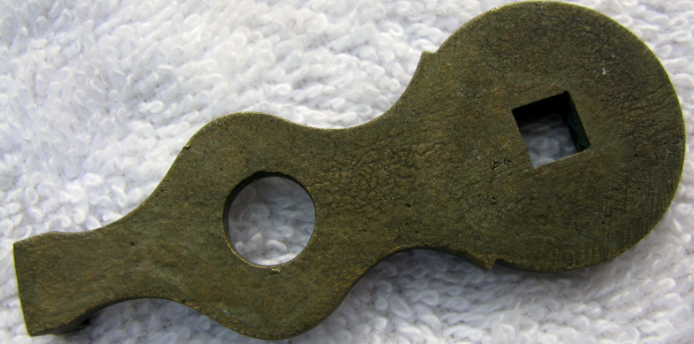
Here is a really nice artifact found by Darrel S. years ago.  He said, I have found some late 18th century items. I found the part to an octant south of Turtle Trail. Image (bottom) is from Sedwick's auction for reference.
Part Of An Octant Found by Darrel S.
Photos submitted by Darrel S.

Below is a picture of a complete octant as shown in a 2010 Sedwick auction listing.  You can see a part like the one found by Darrel on that octant. 
Source: Sedwick Oct. 23, 2010 Auction Listing.

That is the kind of item that an inexperienced detectorist might find and discard as being of no value. As I often say, if you don't know what an object is, hold onto it until you are very confident that you know what you have.  .

Very nice find Darrel!  Thanks for sharing.

---

Recently I showed a chisel that was found on the Treasure Coast.  The J.B. Magruder recently found an iron chisel along with some other items on the Atocha site.  The Magruder will be moving down to the Atocha Main Pile to look for emeralds.

The Dare continues to explore targets identified by Dolores an the EM metal detection system.  They might move North to the Lost Merchant site.

The Fishers are adding Captain Dan Porter and his Sea Reaper to their Key West salvage operations.

---

Here is something really useful.  It is a listing of Indian River County local history books in the Indian River County library system.


You'll find many more related books (hundreds) by using the following link.

http://www.irclibrary.org/genealogy/irchistorybooks.pdf

Happy hunting,
TreasureGuide@comcast.net

Wednesday, August 3, 2016

8/3/16 Report - Tortugas Wreck Mortar. Zika Virus in Florida. What You Can See In A Cockle Shell. Tropical Storm Earl.


Written by the TreasureGuide for the exclusive use of treasurebeachesreport.blogspot.com.


Yesterday I showed a couple of mortars that the Capitana crew recently found. Here is a mortar found on the Tortugas Wreck, thought to be from the 1622 Terra Firme Fleet.  It appears to be about the same size as those I showed yesterday.  This one was displayed by Odyssey Marine, and is one of two found on the Tortugas Wreck.  The fact that the ones found on the Tortugas Wreck and the ones found recently were found in pairs might be significant.  As I said yesterday, they could be used for pharmaceutical, culinary or for other and possibly multiple purposes.

The Odyssey web site says "These utensils are commonly interpreted as surgeon’s mortars, undoubtedly due to their depiction in paintings such as Interior of a Dutch Pharmacy by the School of Terborgh dated to 1665 and in The Surgery by Gerard Thomas, 1663-1720. However, these objects enjoyed an equally broader function for basic food preparation. The precise "Tortugas" type of bronze mortar is extremely common in still life works by the Seville school in the Golden Age, typified by Diego Velázquez’s Kitchen Scene with Christ in the House of Martha and Mary of 1618, Christ at Emmaus of c. 1620 and Two Young Men at a Table, assigned a date of 1623-24 ."

The one shown here today was located just beyond the hull in the starboard stern.  This one is heavily decorated.

The Odyssey web site also says, "The origin of the "Tortugas" wreck’s bronze mortars and pestles is unverifiable, but a letter written in 1549 in Seville reveals that a metal mortar weighing 9lbs cost 1½ real per pound and a pestle 2 reales. Since the record is concerned with how “To transport the containers from Triana to the apothecary shop” (in this instance perhaps revealing usage for grinding medicinal herbs), production within Seville may be hypothesized."

The alabaster one shown yesterday could well have a different origin.

Here is the Odyssey link.

http://www.shipwreck.net/tortugasartifacts-treasures.php

---

You have probably heard of the Zika virus.  It is a virus being spread by mosquitoes in Florida, specifically the Miami area.  People who are pregnant or thinking of having children are particularly at danger.  CDC provides a number of precautions, including not traveling to the Miami area if you are pregnant.

In any case you will want to avoid mosquito bites and take steps to prevent mosquitoes from breeding.

Here is a link for more specific information.

http://www.cdc.gov/zika/intheus/florida-update.html

---

They say if you listen to a conch shell you can hear the ocean.  Of course it is not the ocean you are hearing, unless you are at the ocean.

When you find a cockle shell, you might want to look into it.  Here is what I saw in a cockle shell.

I highlighted what I saw with paint so you could see it too.


---

We now have a tropical storm named Earl (shown below).

Source: nhc.noaa.gov
Earl won't affect us much.  The projected path takes Earl across the Yucatan, Belize and into Mexico.

We are supposed to have a one to two foot surf for the next several days.

Happy hunting,
TreasureGuide@comcast.net

Friday, November 6, 2015

11/6/15 Report - Treasure Coast Compared To South Florida For Detecting Modern Gold. Submarine Found Off Highland Beach.


Written by the TreasureGuide for the exclusive use of treasurebeachesreport.blogspot.com.

Small Cuts Along A Treasure Coast Beach Yesterday.
Notice the remnant of an earlier cut at the top right of the photo.

Walton Rocks Not Showing Any Cuts Yesterday.
There was a nice cut here back a a few weeks ago.  It is gone now.  Just to the north, though, the beach was steeper than it was before.  Sand had been lost, but there were no significant cuts.

It can be difficult to recognize when a beach gets cut back and slopes at a steeper incline.

At another beach, there was a fresh new one or two foot cut, but the new cut was in sand that accumulated just a few days ago over top of an older and deeper cut.  The new cut was a good foot or two above where the old cut was.  If you didn't know where the old was, you might have found the new cut more interesting.

Below is a picture of a submarine-like tube found floating near Highland Beach.

Submarine-Like Tube Found Floatin Near Boca Yesterday.
It had a small propeller and motor.

They thought it was for transporting either drugs or immigrants.  My bet is on drugs.

Photo of The Propeller.
---

Someone asked me why it is so much easier to find gold jewelry down south than it is on the Treasure Coast.  It is easy to answer that.  There are a number of reasons.

First, look at the pictures of the Treasure Coast beaches shown above.  You can see down the one beach for a long distance and you will only see two beach-goers.  There aren't a lot of people on the Treasure Coast beaches.  The Miami/Fort Lauderdale area has hundreds of resorts and hundreds of times more beach goers.  There are only a few beaches where people really congregate on the Treasure Coast, and you get nothing like the Miami crowds on any of those.  Instead of tons of large beach-side resorts, there are very few big resorts on the Treasure Coast.  You also won't see the parasailing and other concessions that are so common down south.

Not only does the Miami/Fort Lauderdale have a lot of big resorts, but they have had them for decades.  I remember back when Fort Lauderdale was the place to be for Spring Break,  The beach towels were so close together on the beach that you could hardly walk down to the water.  The crowds were that densely packed.

Secondly, the people on the Treasure Coast do not wear a lot of gold jewelry.  It is a not a glitzy showplace.  It doesn't have the same culture.  Many beaches on the Treasure Coast are frequented by those who either want a more private or natural beach or a low-cost vacation.

Third, how many people swim on the Treasure Coast beaches?  Not many.  I seldom see people wading or swimming along the Treasure Coast, and when I do, there are just a few.  The Treasure Coast beaches are not the type of beaches where people wade and play a lot.  The Treasure Coast beaches do get some surfers, but they don't wear a lot of expensive jewelry.

A lot of the beach-goers on the Treasure Coast are either residents, part-time residents, or frequent visitors.  They are familiar with beach life and are generally more careful.  They are not here to get drunk and party.

Fourth, despite the low number of beach-goers on the Treasure Coast beaches, there are a lot of detectorists.  There are a lot of detectorists down south, but the relative number of detectorists on the Treasure Coast is much higher.

As one example, I saw maybe twenty or thirty people total on three Treasure Coast beaches yesterday morning.  At the same time I saw three other detectorists.  That is a high number of detectorists compared to the low number of beach-goers.

The Treasure Coast ocean beaches often have a rougher surf - very often too rough for most water detectorists, and much of the water is off limits to detectorists because of the salvage and exploration leases.  As you know, a lot of the jewelry finds are found by shallow water hunters.

There you have it.  I could name a couple more factors, but they are not as significant, so I'll leave it at that for now.

---

Expect a two or three foot surf on the Treasure Coast for the next few days.

Happy hunting,
TreasureGuide@comcast.net