Showing posts with label New World. Show all posts

Sunday, February 4, 2018

2/4/18 Report - Lost Coins of Early Americans: A Book to Preview. Significance of Find Discrepancies. Super Bowl Prediction and Other Foolishness.


Written by the TreasureGuide for the exclusive use of treasurebeachesreport.blogspot.com.


It's Super Bowl Sunday.  Today would normally be a holiday for me, but I'll do a little post anyhow.

 I wanted to add add a few comments to yesterday's post.  First I used coins in my illustration, but you don't have to have such detailed records in order to notice significant differences in what you are or are not finding.  I first learned how important that could be when I changed my discrimination setting and started finding more valuable small rings with expensive gem stones.  Before that I had been using discrimination and finding mostly rings with larger bands, which were mostly men's rings.  I thought that men lost a lot more rings than women but learned that wasn't true after I dropped my discrimination setting.  I originally thought I was getting a lot men's rings but few women's rings simply because there were more men's rings lost, but it was really because of how I was hunting.  Also, because I was hunting primarily rings when I started hunting shipwreck items, for quite a while I was finding smaller items like reales and things made of precious metals but not spikes or things like that.  The reason for that was also because of how I was hunting: I was still hunting the same way I hunted when I hunted modern jewelry.  My detector and methods were good for finding small items made of precious metals, and that was the reason I was not finding spikes.  Again, there are reasons why you find some things and not others.

---

Here is an interesting book which you can preview free online.


This book has some of what I hoped to find in the Numismatic Archaeology of North America book. It discusses money used and found at New World and early American sites.  It also tells how you can find such coins to collect, along with some idea of the likely prices.  Looks interesting.

Check out the free preview by using the following link.

https://books.google.com/books?id=mrmWA14x52AC&printsec=frontcover#v=onepage&q&f=false

----

Here is my Super Bowl prediction.  The Patriots win with the help of the referees.  The only way the Eagles have a chance is if they are not penalized way more than the Patriots, but my prediction is that they will be.  With today's passing game and the rules the way they are, penalties are too much of a factor.  Here is another prediction.  James Harrison makes sacks even though playing only situationally.

---

A few things I learned from TV this week. 

1.  When people go through a black hole, they grunt.
2.  If an NFL team is in need of a nose tackle, they should check out some of those brides at Kleinfeld's on Say Yes To The Dress.
3. Most of the journalists can't correctly interpret a compound sentence.
4. TV needs Battlebots back.  They could intermix it with other shows such as Say Yes To The Dress.  Wouldn't it be much more interesting if the Say Yes To The Dress brides had to save their chosen dress from being destroyed by an arena full of Battlebots.  The bride that saves her dress from the Battlebots would get it free.  If that was playing, no one would turn to the Super Bowl.

---

OK.  Enough fooling around.  I have some other things that I'll do some other day.  Super Bowl Sunday begins now.

Let the games begin.
TreasureGuide@comcast.net

Tuesday, August 23, 2016

8/23/16 Report - Storm Aiming At Treasure Coast. Iron Shipwreck Objects. French in Pacific New World.


Written by the TreasureGuide for the exclusive use of treasurebeachesreport.blogspot.com.

Tropical Wave Heading Our Way
Source: See link below.
This is the big news for me today.  The weather system following Fiona is heading our way.  You can see that in the picture above.  It is still a few days away.  The strength and possibly the track could change before it gets here.

Here is the link to that.

http://blog.spiritdaily.com/news-links/tropical-wave-could-develop

Fiona is still heading north of us, and Gaston is expected to become a hurricane soon, but is still expected to head out into the North Atlantic.

Below is the relative position of all three.

Source: nhc.noaa.gov
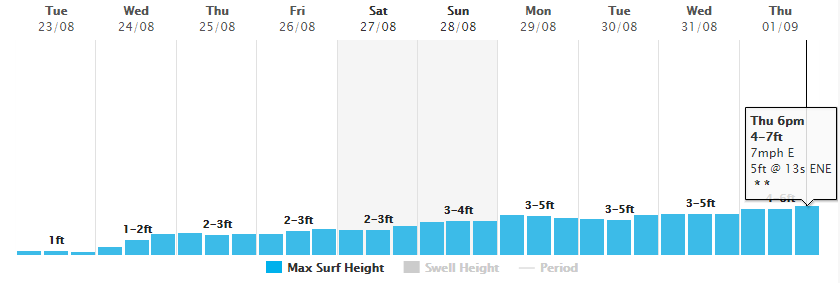
The surf is expected to increase daily for several days.  See the chart below.

Surf Predictions For Fort Pierce
MagicSeaWeed.com

---

Here is some good reading.  It isn't about the Treasure Coast, but it does relate to the exploration and discovery of the New World.

It is the 1918 text of the Annual Publication of the Southern California Historical Society - a lengthy but interesting bit of history about the French and the Pacific trade.  Take a look.

https://archive.org/stream/annualpublicatio19181920hist/annualpublicatio19181920hist_djvu.txt

---

Collection of Iron Finds by Darrel S.
Photo submitted by Darrel S.
Here is what he said about the photo.

Image from my personal collection. Fortunate to have John Powell and Lance restored my ferrous artifacts. Some took years, others less time. From Corrigans over past 25 years. You will see an awl as well as a double pointed object believed to be used as an enscriber (I believed part of crossbow.) I will send images from McLarty Museum later of both possibilities.


The double pointed object that he refers to is at about the five o'clock postiion.

Happy hunting,
TreasureGuide@comcast.net

Thursday, November 5, 2015

11/5/15 Report - More On The Heart-Shaped Cobs and The Sacred Heart In The Old and New Worlds.


Written by the TreasureGuide for the exclusive use of treasurebeachesreport.blogspot.com.

Source: See link below.
I shouldn't try this today.  It isn't refined yet, and it is something that really should be done well.   Nonetheless, I'll go ahead and give it a shot.  Maybe some day in the future I'll take another shot at it when it is more ready.  Here goes.

A lot of people  found the heart-shaped cobs interesting.  I'm one of those.  They suggest some interesting questions - questions that might lead to some good answers.

I've read several different thoughts about why the heart-shaped cobs were made and how they might have been used.  Sewall Menzel suggested that they were presented as awards to those in religious positions. Laura Strolia thinks that perhaps they were used as images to help evangelize the native populations.  Someone else (I forget who) wrote that they were used as votive offerings, but somewhere else I read that the archaeological evidence doesn't back that up.  At this point it seems no one really knows.


Katleen Deagan in Vol. 2 her book Artifacts of the Spanish Colonies of Florida and the Caribbean, 1500 - 1800 says, "The profound influence of the Catholic Church in shaping both daily life and public policy in the Spanish colonies can not be overemphasized."  She devotes an entire chapter to religious artifacts and includes a table showing the number of religious artifacts shipped to the colonies from 1511 to 1613.  Her sources show that 5246 rosaries were shipped in that time period.  11,671 crosses, medallions and other images were shipped in that time period.  The vast majority of those, 11,512, were shipped in one year - 1603.  Obviously there was a purpose for that shipment.

It is tempting to believe that the Sacred Heart devotion was brought from Europe to the New World. Laura  Strolia, however, pointed me to an article that suggests that the devotion may have started in Mexico and then eventually made its way to Europe (See link below).  Here is an excerpt.

Late in the seventeenth century, a French nun of the Visitandine Order, Marguerite-Marie Alacoque (1647-1690), in the Monastery of Paray-le-Monial in Burgundy, had visions in which Christ appeared to her holding out his heart. She narrated these experiences in writing. In June 1674, she described one of her visions: “the divine Heart was represented to me in a throne of fire and flame, shining on all sides, more brilliant than the sun, and transparent as crystal. The wound that he received on the Cross was visible. There was a crown of thorns around this Sacred Heart and a cross above …”2 To this vivid description was added the admonition of a French Jesuit, Joseph de Galliffet, who in 1726 published a book about the mystical experience of the visionary nun, and gravely pointed out that many pious persons “find more devotion in honoring the Heart of Jesus Christ as it really is in the sacred chest of the divine Savior.” 

Notice the dates in the above paragraph.  In 1674 the vision was described.  Not knowing if that was the first time or if was the time that led to the adoption and spread of the devotion, it provides a rough marker.  

Although I've read that the heart-shaped cobs were first produced in Potosi around 1640, all those in the recent auction, as I recall, were produced after 1700.

Here is another excerpt from the same article.

Thus, hearts pierced, bleeding, intact, and miraculously resplendent, were a common religious symbol in Mexico a century before Marie-Marguerite had her visions in a French monastery cell. Direct evidence between Mexican sacred hearts and the European devotion to a realistically depicted Sacred Heart, says Kehoe, “must be buried in some archive or priestly memorabilia.” But enough circumstantial evidence exists to propose that, consciously or subliminally, the minds of the foremost religious leaders were influenced by what theologians were doing in Mexico and reporting in a flood of written works that the European priests certainly read. The cult of the realistically drawn flaming heart of Jesus started in Europe and coincided with the peak of those publications. In sum, Kehoe marshals sundry arguments to show that, by a process technically known as “stimulus diffusion,” the inspiration to make the flaming heart of Jesus “an embodiment of the new humanistic Catholicism” may have actually originated in Mexico, and extended from there to France.

My thinking on the subject is just beginning to develop.

Here is a paragraph from Wikipedia.

During the pre-Coumbian era human sacrifice in Maya culture was the ritual offering of nourishment to the gods. Blood was viewed as a potent source of nourishment for the Maya deities, and the sacrifice of a living creature was a powerful blood offering.  By extension, the sacrifice of a human life was the ultimate offering of blood to the gods, and the most important Maya rituals culminated in human sacrifice...

Heart, blood, and sacrifice are words and symbols central to both Christianity and the Mayan and Aztec religions.  You can find Mayan images of a priest holding a beating heart and offering blood sacrifices.  Those archetypal images are central to both Christianity and Mayan cultures, if not the psyche of all mankind.

I feel certain that the Spanish missionaries would use those symbols to communicate with the native populations.  Those images, already invested with meaning and feeling, would be used to convey Christianity in a way similar to how pagan holidays in Europe were modified and assimilated into Christianity.

I don't have any idea whether it was Europe or Mexico that originated or most influenced the Sacred Heart devotion. What I do feel confident about now is that there is a common experience in the core of all mankind that transcends time and place.

Every human has a heart.  The heart beats from a time before birth and is associated with life.  And once it stops, so does life.  That is a common core experience for all mankind - just one of many.

Similarly, a sense of the sacred is universal.  Men worlds apart feel it.  Men worlds apart know it.  The few that don't feel it fight it, try to explain it away or just wonder about it.

I have to cut this short.  I know that I didn't do the topic justice.  I couldn't possibly do it justice in a post.

But one thing I want to leave you with is that the things you find often have a message.  It might be easy to see or hidden.  It might be simple or deep.  In either case, it can lead you on a journey.

Here is the link I mentioned above.

http://www.hektoeninternational.org/index.php?option=com_content&view=article&id=8

That is all for now.

Happy hunting,
TreasureGuide@comcast.net

Tuesday, October 6, 2015

10/6/15 Report - 16th and 17th Century New World Shipbuilding. Sampling and Detecting Strategies.


Written by the TreasureGuide for the exclusive use of treasurebeachesreport.blogspot.com.


Some Artifacts At The Conservation Lab.
You have to make decisions.  Hopefully they are good strategic decisions based upon information.

One decision is which detector to use.  I'm not talking about which detector to buy, although that will determine what you have available to use.

As you probably know I talk about detectors as being something like gulf clubs.  Sometimes one will be the best choice and sometimes another will be the best choice.

Yesterday I was digging a lot of deep holes. It was tiring, but I had a reason for doing that.  I thought there might be some shipwreck spikes to be found, and  I wanted to know if there might be shipwreck material in the deeper layers of sand.

As it turned out I didn't find any spikes.  I did find some iron rods and things, but nothing definitive.

If I just wanted to quickly skim the coins I would have put away my driver and pulled out my putter. Of course sometimes coins are deeper, but most often when coins come out of erosion, they are not very deep.  In fact, they are most often in the first inch or two.

By digging big deep holes I got a good look at the deeper layers.  Under about a foot of sand there was a layer of modern junk along one stretch.  It got covered maybe back some years ago.

I often do some sampling and then make decisions based upon what I learn.  In some cases it takes longer to get a good sample than other times.  Once you get a good sample, you can then change strategies.

---

A couple cargo ships went down in the Bahamas during Hurricane Joaquin.  It appears that lives might have been lost as well as the ships and cargo.  Don't forget that hurricanes cause a lot of problems.

---

Below is a link to an interesting article on ship manufacture in the New World.

New Spain provided great lumber, but the iron had to be brought from Spain.  The large trees of South America actually allowed larger beams to be constructed from one tree rather than assembled as would be the case if the same ship was constructed in Europe.

Spanish Ships and Shipbuilding in the Atlantic Colonies, Sexteenth and Seventeenth Centuries, by Chuck Meide, Dec. 2002.

http://www.academia.edu/3258279/A_Plague_of_Ships_Spanish_Ships_and_Shipbuilding_in_the_Atlantic_Colonies_Sixteenth_and_Seventeenth_Centuries

When you go to this site it looks like you have to register to download it, but you can read it online without doing all of that.

Here are just a couple interesting excerpts.


That will give you some idea of the type of information you might find in this work.

---

There was a shark bite at Pepper Park yesterday.  It was on the foot and in shallow water.  They closed the park, but it is probably open again.

---

Happy hunting,
Treasureguide@comcast.net