Showing posts with label 16th century. Show all posts

Friday, July 19, 2019

7/19/19 Report - Latest 1715 Fleet Finds . 16th Century Florida Artifacts. Detecting a Battle Site.


Written by the TreasureGuide for the exclusive use of treasurebeachesreport.blogspot.com.

Reales Recently Salvaged by Captain Jonah and the Crew of the Bottomline.
Photo submitted by Jonah Martinez.
Captain Jonah said these new reales were found in areas that had previously been worked over, and that just goes to show how much treasure remains to be found from the 1715 Fleet.

Thanks Jonah!

---

16th century artifacts are being uncovered by archaeologists on private property in St. Augustine at a construction site.

Included are ceramics, a lock, and items from a print shop.

“We have found evidence of the print shop. We found at least four typesets, newsprint typesets, which is pretty cool. ... I think we found an N, and a C and an H,” White said.

Here is the link.

https://www.staugustine.com/news/20190717/centuries-old-ceramics-other-artifacts-found-at-st-augustine-construction-

---

DJ sent me a link to an excellent report on the Custer battle site.  It provides some excellent insight for detectorists, including the use of historic topographic maps and metal detectors.  Here are just three paragraphs from a report that you might find very interesting.

A preliminary assessment of various historic maps was conducted to determine which may be the most reliable in depicting the 1876 river channel. The method involved georeferencing the historic maps to the modern topographic and aerial photography and establishing a root mean square error calculation. This objective analysis was coupled with a subjective analysis of the river channel and terrain features depicted on the subject map. A preliminary assessment of the historic maps suggests that Maguire Map 8 and the Norris map have potential to aid in sorting out the 1876 river channel if used judiciously. The 1883 Blake map may show the river meanders most accurately in the area of the Custer field than other maps preceding or post-dating it. The 1891 topographic map seems to be generally correct except for the location of the southernmost oxbow at Custer field, which is the one currently threaten by erosion.

The absence of metal in the detectable range and the preliminary assessment of the historic maps suggest the oxbows are not likely to contain archeological evidence of the battle.  However, no formal geomorphological investigation of the river channel, abandoned river channels, or the oxbows has been undertaken to date. It is recommended, before determining if additional mitigation measures are required a professional geomorphological study of the river channel is done. Such a study has the potential to posit chronological changes in the riverbed and more accurately define the 1876 channel, as well as determine if historic surfaces may still exist as buried soil horizons.

Since field time permitted a more formal test of the capability of the VLF and PI metal detectors was undertaken. Two previously inventoried areas were redetected. One test area encompassed a known warrior fighting position and the other was a known soldier position. Each area yielded additional artifacts.  Fifty-seven percent of the artifacts were not battle-related, 43% were battle related, 90% were found by the VLF machines, and 10% were found by the PI metal detector alone. The test indicates the 1984 sample strategy was sound in that it did recover a representative sample of the range of artifact types present.  The PI metal detector did find about 10% more than the VLF machines. Most of those items were either deeper than the capability of the VLF machines or were items that were very small and were missed by the VLF machines. The test grids indicate the PI metal detector has the potential to increase artifact recovery in areas where materials may include very small or deeply buried artifacts.


https://www.friendslittlebighorn.com/LittleBighornOxbowArcheologicalReport.pdf

Not long ago I encouraged the use of topographic maps to determine changes in the beach over the  years and decades.  That can tell you how the beach has been changing, including where it has been building and eroding over a period of time.  That kind of information will tell you a lot about where targets of different time periods might be found.  If done well, it can give you an idea of how deep to expect old targets in various areas.

As you can see, the article discussed the relative effectiveness of different types of detectors.  Although interesting, I wouldn't draw too many conclusions from that.  A lot depends upon how the detectors were used.  That is as important or more important than the capabilities of the detector.

In any case, I think you'll find the article interesting.

---


(CNN)A heat wave is expected for much of the eastern half of the US in the coming days -- and it has the potential to be deadly.


More than 130 million Americans are under a heat watch, warning or advisory, with the heat index expected to reach 115 degrees in some areas. The widespread heat wave will hit its peak Friday and Saturday with dozens of records possible...

https://www.cnn.com/2019/07/18/us/heat-wave-survival-tips-wxc-trnd/index.html

Take stay hydrated and take precautions to avoid heat related illness.  

---

A one to two foot surf is expected for the next few days on the Treasure Coast.

There is currently not tropical cyclone activity in the area.

Happy hunting,
Treasureguide@comcast.net


Saturday, April 6, 2019

4/6/19 Report - 16th Century Shipwreck. Reader Firsts. Scientific Approach To Treasure Hunting.


Written by the TreasureGuide for the exclusive use of treasurebeachesreport.blogspot.com.

Copper Sheets From 16th Century Shipwreck.
Source: See nltimes link below.

Researchers found a Dutch shipwreck from early in the 16th century while cleaning up containers that went overboard from the MSC Zoe on New Year's eve. This is the oldest shipwreck ever discovered in Dutch waters, the National Cultural Heritage Agency said on Wednesday...

During the container salvage operation, copper plates and wooden beams were found. An archeological investigation was immediately launched. According to the Cultural Heritage Agency, the wooden beams came from a ship with a smooth hull that was likely around 30 meters long. The wood was further examined and this revealed that it was felled in 1536 and that the ship was built in the Netherlands around 1540. It sank while transporting copper plates.
Investigation into the copper plates dated them to around the same period. An interesting detail is that the plates are marked by the Fugger family, who had a monopoly on copper production in the 16th century. "The find is of very high cultural and archeological value", the Cultural Heritage Agency said...
Here is the link.


I had this article for a few days but put it on hold to discuss some other things first.

---

I like to find different kinds of things.  Some seem special.  There was my first ring, my first Rolex watch, my first Spanish treasure coin, and my first gold nugget, to name just a few.  I often mention reader firsts.  Last month DJ experienced some firsts and shared them with me in an email.  Here is what he said.

... I have decided that your blog is an encyclopedia of information, much of which I was able to use in March. Thank you for sharing this information, it makes the hobby all the more rewarding.  

A list of firsts: First time I found lots of targets, jewelry, first silver ring, green clad lying on top of the sand and first square copper/brass nail. 

Also helpful were the strategy of reading the beach, checking, making myself check another beach if things are not too good where I am. Many examples exist and were put into play this trip...

Congratulations on so many firsts in such a short time DJ.   Many more to come!

I'm delighted that you are making such good use of the blog.

There were others who recently sent me emails of thanks.  I sincerely appreciate them all.  It keeps me going.

Thanks guys!

In a world filled with so much discord and hate, I'm encouraged daily by the fine kind people I meet through the blog. 

---

Coming from a scientific background, it was only natural that I would bring a scientific attitude to my metal detecting and treasure hunting.  While a treasure hunter will usually not want to conduct any kind of formal scientific experiments, adopting a "scientific" approach is recommended.  To a large extent that means being abundantly cautious, systematic, thorough, disciplined, reserving judgement, and highly valuing evidence, or data.

There is a lot more to science than laboratories, test tubes and experiments.  Science requires a number of traits and attitudes. It requires a real desire to understand, creativity, objectivity, logic and skepticism.

That might sound like a lot, but you undoubtedly already possess and use some of those traits, and others can be developed and improved.

I can't do a comprehensive treatment of the subject in one post, or even a lot of posts, but I'll discuss some things that I've found very helpful and recommend that you at least consider them.

You'll often see someone make a find and without any serious thought or study, proclaim what the item is.  There are usually a variety of possibilities that should be considered.  I always like to try to think of as many alternative explanations as I can.  It is important to develop theories and hypothesis, which can be tested or evaluated.

They say, "You don't know what you don't know," but I know a lot of things I don't know.  It is important to have an awareness of what you don't know. A scientific approach requires having a deep respect for  how much you don't know.  I wouldn't want to have brain surgery conducted by a podiatrist.  Over-confidence can be deadly literally as well as figuratively.

No matter what you think of the TV treasure shows, they provide a lot of examples and illustrations that many of us have seen and can discuss.  Sometimes you will see a hap-hazard, disorganized, poorly considered approach.  They look here and look there and find this and that, most of which has no significance, and come up with conclusions that are little more than wild speculation.  That creates drama, which is something a TV show must do, but for me, it is not the way to solve a problem.  That is the reason I am so critical at times.

A number of seasons ago on Gold Rush, Parker finally got Tony to drill some test holes to sample some ground.  I thought, its about time.  Sampling is a scientific strategy that I use all the time in a different form.  It is a systematic method of collecting data.  That is just one of many examples.

Don't get me wrong.  A skilled professional who has tons of experience on a specific type of activity can be successful without all the stuff I am talking about today.  My father-in-law was in coal mining his entire life and could tell by just looking at the land where there was going to be good coal.  There is no substitute for that type of experience. You can find that type of experience and skill on the Treasure Coast.

A more scientific approach used by a relative novice will lose to vast professional experience every-time.  However, I believe anyone who wants to and makes the effort can benefit by taking a more scientific approach.  It will dramatically increase the learning curve for the less experienced and prevent costly mistakes and increase efficiency for those who are already skilled.

Taking a scientific approach is not a quick path to success.  Neither can it replace long hard work.  It will help though.  In some cases it might be absolutely necessary - depending upon what you want to accomplish.

Some people will not be interested at all in a scientific approach.  For some, it just will not mesh with their personality, philosophy or goals.

Some people are just out for a little relaxation.  Some people like to go by feel or hunch.  That is fine.   And if you disagree with everything I just said, that is fine too.

I haven't even began to scratch the surface on this topic and may or may not get into more detail in the future.  I suspect I will from time to time.

---

We now have a slightly negative low tide.  Other than that there is not much change to report concerning beach conditions.

Happy hunting,
TreasureGuide@comcast.net

Tuesday, January 10, 2017

1/10/2017 Report - Beach Conditions. 16th Century Shipwreck Study. Another Surf Increase Predicted


Written by the TreasureGuide for the exclusive use of treasurebeachesreport.blogspot.com.

Jupiter Inlet Beach
Photo by Joe D.
I didn't get any reports from the Vero or Sebastian areas yet, but did get this report from Jupiter.

Joe D. sent the photo and the following.

Joe  said, Erosion is minimal for now, wind needs to change direction to have an impact! Wave height good though!

Thanks much Joe!

---

The readers of this blog are amazing.  They are extremely accomplished and knowledgeable.  I post many of their contributions, but not all of them.  Sometimes they tell me that they don't want their emails posted or that I should keep some comments private.  Even when I can't post something, I'm still glad to get the information and it adds to my knowledge base.   I'm proud to have such knowledgeable readers.  Whether I post their names or comments directly or not, you still benefit from their contributions.

---

Not long ago I talked about spikes and in another I talked about wood.  Here is an exceptionally good study of a 16th century Biscayan ship.

There are a variety of reasons or any serious detectorist to become familiar with old ship construction materials and techniques.

Here is a brief excerpt from the 16th century Biscayan ship study.

The second characteristic of 16th-century Biscayan shipwrecks is the use of a combination of oaken treenails and iron nails to fasten the hull planks and frames. The treenails are about 25 mm in diameter and the iron nails are about 10-12 mm square in section. At each joint of a frame timber and a plank, two iron nails and two treenails are typically found. The use of both iron and wooden nails distinguishes Biscayan shipwrecks from more northerly wrecks, such as the Mary Rose, which have only treenails and from more southerly wrecks, especially from the Mediterranean, which have only iron nails. João Baptista Lavanha, a Portuguese naval administrator who died in 1620, left a manuscript on shipbuilding which states that in countries whose ships sailed in cold waters, wooden nails were used, while in countries whose ships sailed in warm seas, iron nails were used. He explained that in warm waters, wooden nails were destroyed by taredo worms and each treenail became a leak5. In Biscay, both oak and iron were plentiful and readily used as nails by shipbuilders. Analysis of the Red Bay ship has shown that the iron nails were used...

And here is the link for the rest of the study.


---

I was listening to the radio and heard what is a very common statement concerning how Southerners respond to cold weather.  They say that your blood thins.  That is not exactly what happens.

Back in the 70s I was conducting research in biofeedback and discovered that the normal response to cold is for the blood to redistribute from the extremities (fingers and toes, for example) to the body core to preserve heat.  I found out that people who lived in South Florida seven or more years, lost that cold adaptation response to a large degree.  So it isn't that the blood "thins." People eventually lose the cold adaptation response.  My fingers really felt the pain of that Monday.

---


Here are the surf predictions for the Fort Pierce area.  We'll get a decrease and then an increase around Friday if the predictions are correct.  Something good might happen.  We'll have to wait and see.

Happy hunting,
TreasureGuide@comcast.net

Tuesday, September 13, 2016

9/13/16 Report - 16th Century Spanish Dagger Found on Treasure Coast. Beach Conditions Pretty Poor. Tropical Storm Ian.


Written by the TreasureGiude for the exclusive use of treasurebeachesreport.blogspot.com.


Here is an interesting item.  It is for sale for $1550 online, and is described as a 1715 Plate Fleet dagger.

The item description says, 16th Century Spanish, Toledo Steel dagger, found in a Spanish salvor's camp in southern Brevard County, just inshore from Florida's Treasure Coast.  The camp was either a survivor's camp or a salvor's camp which salvaged the 1715 Fleet in 1715-16.  The handle was probably replaced in the early 18th Century with Mesquite wood, obtained in the New World (Mexico), and pinned with a bronze pin, the back being filled in with lead.  A rare and unique dagger! The inscription is early Spanish - pre 16th Century.  Comes with COA from the original salvor.

That is the description.  Of course I can't verify any of that, but it is interesting.

Really remarkable condition for being buried hundreds of years.

Below is the link to the web site which has a variety of other old nautical items for sale.

http://www.nelsonshipwreckpirate.com/NauticalAntiquities.html

---

John Brooks Beach Yesterday Near Low Tide.
We have a disturbance hanging over South Florida right now, but it isn't expected to develop.  I think all we'll get out of it is some more rain.  (See map below.)


Same Beach Looking South.
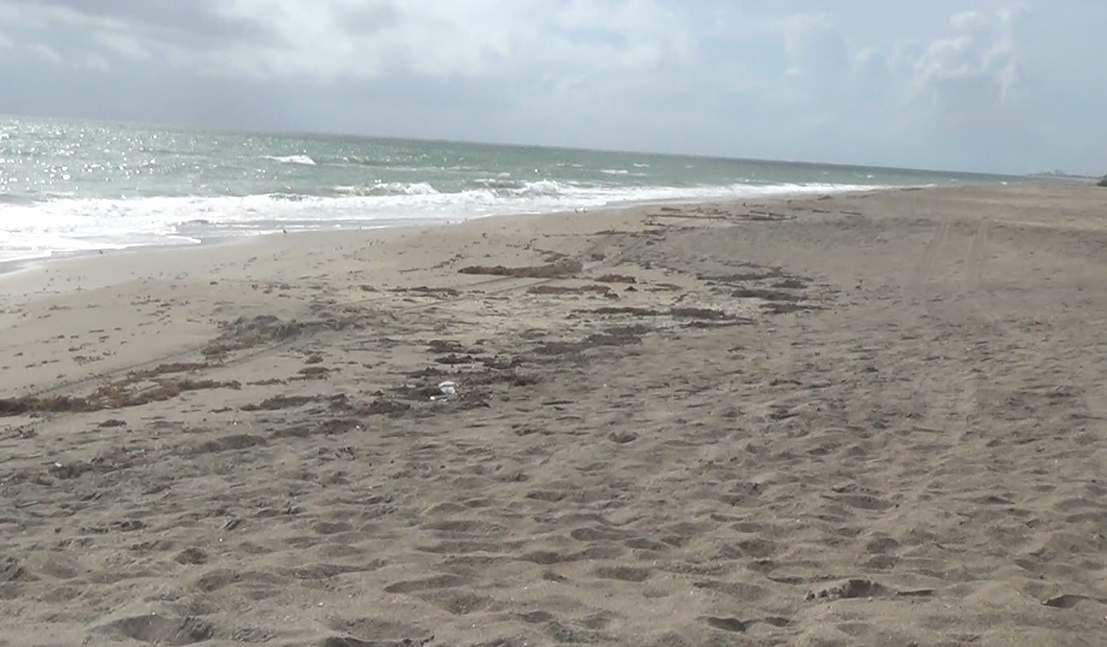
You can see where the high tide got to.  Notice the sea weed, which is usually a sign that the beach is building rather than eroding.


Tons of Sea Weed At Low Tide At Walton Rocks.
There are times, though rare, when there is sea weed on a beach that is producing.  What happens is that a beach cuts and then the wind shifts and the sea weed comes in a covers the cut.  I've seen that happened, but only a few times.

When there is heavy sea weed on a productive beach, you either have to detect through inches of sea weed or move the sea weed.  A few inches can make a difference.

Another problem is that aluminum and light junk can be in with the sea weed.  It is a mess but not always to be avoided.  Usually, though you find it when the sand is being dumped onto the beach.

Hurricane Ivan and Two Disturbances.
Tropical Storm Ian is supposed to stay out in the middle of the Atlantic.

There is a new disturbance coming off of Africa.

Happy hunting,
TreasureGuide@comcast.net


Monday, May 9, 2016

5/9/16 Report - Mandala Designs: European and Aztec Cultures. 16th Century Gold Imports to Spain. Adventures of Cabeza de Vaca.


Written by the TreasureGuide for the exclusive use of treasurebeachesreport.blogspot.com.


Example of Mandala.
https://redice.tv/news/on-the-nature-of-four-jung-s-quarternity-mandalas-the-stone-and-the-self

You probably have heard the word "mandala."  It seems every major culture has used mandalas. Sometimes they are referred to as "squared circles."  Some of them seem to me to be more like quartered circles - circles divided into four parts. Above is one of an infinite variety.  This particular example can be found all over the internet.

Just the other day it occurred to me that the design displayed on many cobs is that of a mandala.  Below is an example.  Not the absolute best example, but it will serve.

1711 Mexico One-Escudo From The Curren Sedwick Coins Auction.

Another example would be the Aztec calendar wheel below.


Is this all just coincidence or making too much of nothing?  Or is it something more?

I can certainly see how an Aztec or Incan might see something familiar in the design of a cob, and how the cob might become an object of meditation for the mystically inclined from either the Old or New World.

---


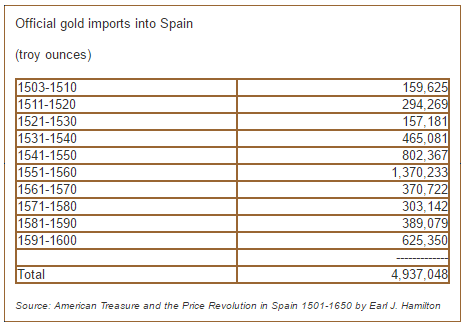
Conquest of Peru by Francisco Pizarro brought the destruction of the fine gold treasures of the Chimu and Inca peoples. The ransom for the Inca emperor Atahualpa alone yielded around 150,000 ounces. Total looting of wonderful ornaments in South America may have provided over 250,000 ounces, reflected in the jump in Spanish imports 1531-40 (see box). Most ornaments were melted down for coin.

The above table and paragraph are from the following linked site where you can learn more about gold supplies.

http://info.goldavenue.com/info_site/in_arts/in_mill/16thcentury.htm

There was an edict in the 16th century that the gold ornaments sent to Spain would be melted and made into coin.  The Seville mint produced that coinage made from New World sources.  Of course then some of that coinage would find its way back to the New World.

---'


In this excerpt from La Relación, published in 1542, the Spaniard Álvar Núñez Cabeza de Vaca relates how he and several others escaped their enslavement by an American Indian tribe on the upper Gulf Coast of present-day United States. As they come upon another town of Indians, the Spaniards are taken as faith healers and welcomed. Cabeza de Vaca and his compatriots—Andrés Dorantes de Carranza, Alonso del Castillo Maldonado, and an enslaved Moroccan Berber named Esteban—were the only survivors of an expedition launched by Pánfilo de Narváez in 1528. They journeyed from present-day Florida and through the American Southeast, finally arriving in Mexico City in 1536.

Below is the link to the excerpt describing some of the adventures of Cabeza de Vaca in the New World.  He was shipwrecked, became a slave and then a healer to the natives, and was later appointed to office in South America.  Really good reading.

http://www.encyclopediavirginia.org/The_Healers_an_excerpt_from_La_Relacion_by_Alvar_Nunez_Cabeza_de_Vaca_1542

If you want to read more about this  fellow, look up La Relacion.

---

I started a few new object cleaning projects and will have photos of those for your soon.  

Happy hunting,
TreasureGuide@comcast.net

Tuesday, October 6, 2015

10/6/15 Report - 16th and 17th Century New World Shipbuilding. Sampling and Detecting Strategies.


Written by the TreasureGuide for the exclusive use of treasurebeachesreport.blogspot.com.


Some Artifacts At The Conservation Lab.
You have to make decisions.  Hopefully they are good strategic decisions based upon information.

One decision is which detector to use.  I'm not talking about which detector to buy, although that will determine what you have available to use.

As you probably know I talk about detectors as being something like gulf clubs.  Sometimes one will be the best choice and sometimes another will be the best choice.

Yesterday I was digging a lot of deep holes. It was tiring, but I had a reason for doing that.  I thought there might be some shipwreck spikes to be found, and  I wanted to know if there might be shipwreck material in the deeper layers of sand.

As it turned out I didn't find any spikes.  I did find some iron rods and things, but nothing definitive.

If I just wanted to quickly skim the coins I would have put away my driver and pulled out my putter. Of course sometimes coins are deeper, but most often when coins come out of erosion, they are not very deep.  In fact, they are most often in the first inch or two.

By digging big deep holes I got a good look at the deeper layers.  Under about a foot of sand there was a layer of modern junk along one stretch.  It got covered maybe back some years ago.

I often do some sampling and then make decisions based upon what I learn.  In some cases it takes longer to get a good sample than other times.  Once you get a good sample, you can then change strategies.

---

A couple cargo ships went down in the Bahamas during Hurricane Joaquin.  It appears that lives might have been lost as well as the ships and cargo.  Don't forget that hurricanes cause a lot of problems.

---

Below is a link to an interesting article on ship manufacture in the New World.

New Spain provided great lumber, but the iron had to be brought from Spain.  The large trees of South America actually allowed larger beams to be constructed from one tree rather than assembled as would be the case if the same ship was constructed in Europe.

Spanish Ships and Shipbuilding in the Atlantic Colonies, Sexteenth and Seventeenth Centuries, by Chuck Meide, Dec. 2002.

http://www.academia.edu/3258279/A_Plague_of_Ships_Spanish_Ships_and_Shipbuilding_in_the_Atlantic_Colonies_Sixteenth_and_Seventeenth_Centuries

When you go to this site it looks like you have to register to download it, but you can read it online without doing all of that.

Here are just a couple interesting excerpts.


That will give you some idea of the type of information you might find in this work.

---

There was a shark bite at Pepper Park yesterday.  It was on the foot and in shallow water.  They closed the park, but it is probably open again.

---

Happy hunting,
Treasureguide@comcast.net

Thursday, April 3, 2014

4/3/14 Report - $50,000 1715 Fleet Escudo & History of 16th and 17th Century Spanish Florida


Written by the TreasureGuide for the exclusive use of treasurebeachesreport.blogspot.com.


The upcoming SedwickCoins auction catalog for the upcoming auction is now online.  I took a look through the catalog and a few things stuck out. 

The escudo with the highest estimated price is the one shown here.  It has a starting price of $25,000 and a pre-auction estimate of 25,000 to $50,000, which is the high estimate of the escudos.

The auction begins on May 1, and the first session will be the gold cobs.  There are 75 lots in that session.

There are several gold cobs with pre-auction estimates of up to $30,000.   There are also a number of escudos that are estimated to go below $2000.


Here is the catalog description for this rare Lima 8 escudo.

Lima, Peru, cob 8 escudos, 1701H, Philip V, extremely rare, from the 1715 Fleet. S-L25a; KM-38.1. 26.95 grams. Almost round, evenly struck and perfectly centered, this would be an exceptional specimen for any date, let alone one that is missing in Calico and the State of Florida collection (theirs is Charles II). In fact we can trace only one other example for Philip V, an AU 55 of demonstrably inferior strike but with perhaps slightly more evidence of the coins' having been created from a modified 1700 die. The present coin is at least AU 58 but bears areas of red staining and gray coral that preclude professional encapsulation. What is more important is that the strike is nearly perfect--well centered and even--and the effect in hand is sheer beauty. From the 1715 Fleet.

The shield shows in the top row and L for the Lima mint, an 8 for the denomination, and then the assayer initial.

The second row shows the abbreviation for Plus Ultra.

The third row shows the last three digits of the date.


The source of these photos and catalog description is the following link.

http://auction.sedwickcoins.com/Lima-Peru-cob-8-escudos-1701H-Philip-V-extremely-rare-from-the-1715-Fleet_i19334312


There are very few individual half reales offered in this auction.  Most of the reales in this auction are 8 or 4 reales.   The few half reales in the auction are mostly included in lots.

There also seems to be more maravedis for sale this time.

It seemed to me there weren't as many interesting artifacts this time either.

There is plenty to see.   It seems to me that like with most collectible categories these days, the more common items are losing value while only the rare and remarkable are appreciating.


The Unwritten History of Old St. Augustine consists primarily of  letters and reports from Pedro Menendez to the King of Spain.  The letters and reports were found in the archives in Seville.  It makes very good reading and provides a number of treasure clues and detecting leads.  It concerns the events of the 16th and 17th Centuries.

Included is information about lost ships, pirates, battles, and the natives, along with daily life in and around the colony.

Here is the link.

https://archive.org/details/unwrittenhistory00broo


Some of the first home sites of old St. Louis are being investigated.  Here is the link to that.

http://news.stlpublicradio.org/post/first-evidence-french-colonial-homes-discovered-under-poplar-street-bridge


On the Treasure Coast the tides are becoming more normal.  The surf is around three feet or so.

Who can't love this weather besides me?

The wind is out of the Southeast.   I hope that doesn't last long.  It could with summer coming up.


Happy hunting,
TreasureGuide@comcast.net


Sunday, December 5, 2010

12/5 Report - Mourning Ring and 1877 Indian Head


Silver Possible Mourning Ring Found On a Treasure Coast Shipwreck Beach.

I think this might be a mourning ring. Mourning rings often held a hair or something and were worn in memory of a deceased loved one. They were especially popular in Great Britain in the 17th through 19th centuries. Often there was an enameled skull somewhere on the ring.

The ring shown in the photo above is silver and seems to have glass over some other type of hard surface. Whatever was held under the glass has evidently deteriorated or disappeared. Sometimes there were miniature portraits under the glass.

It is one of those things that I don't know very much about. I've never personally seen a good similar example to go by.

Below is a photo of a mourning ring containing a woven hair pattern. Of course it has never been exposed to salt water and is in very good condition.

I just don't know about the above example - if it really is a mourning ring or not, and I don't know if it came from a wreck or not. I suspect not.

As always, if you have any thoughts on this I'd like to hear them.


Good Example of a Mourning Ring.

Have you ever heard of a coin that is worth more as a MS-65 than a Proof 65 coin. There is one. It is the 1877 Indian Head Cent. And in MS-65 conditions, worth about $13,000.

Check out your Indian Head finds.

If you'd like to know more about the 1877 and why it is so valuable, check out this link.

http://numismaticnews.net/article/1877_cent_seen_as_one_to_hold_on_to/

A few days ago I gave a link to a site that discussed some of the military training that took place on Hutchinson Island during WW II.

You can still see many signs of that activity. For one thing you'll see concrete foundations where watch towers or other structures once stood. There is one such foundation just north of John Brooks Park just south of the condos.

A variety of junk can be seen to litter the area there. Some of it has been picked up or covered up in recent years.

There is also a concrete foundation on the beach south of the condos I'd say a couple hundred yard or more that has been uncovered on a couple of occasions. People with PI detectors often mention that there detector goes crazy up there. It is because of the buried foundation and rebar.

You can see another concrete foundation about a hundred yards north of the Blind Creek access at the back of the beach. And there are a few others that I can think of.

That is to mention just a few.


There is one of the Treasure Coast shipwreck treasure beach maps now listed on ebay that has a bid and will conclude on Monday. One day remaining.


Not much has changed on the beaches the past few days and I don't have much new to say about that today. I'd still be checking out the low tide areas. Also you might want to hunt out some of those WWII sites. I showed a nice found canteen a few days ago.

I know I keep saying this but shipwreck cob hunting has to improve someday before long.

Until then watch for the non-metallic items and other artifacts.


Happy hunting,
TreasureGuide@comcast.net

Saturday, November 20, 2010

11/20 Report - 16th Century Gold Pendant Found by Metal Detector


16th Century Gold Pendant Found With Metal Detector.

A young boy found a 16th century gold pendant using a metal detector. The pendant is said to be worth over 3 million dollars. The article says the pendant shows the Virgin Mary, but it could actually be St. Helena. I would also guess the boy was receiving more than a little help with his detecting.

http://www.batangastoday.com/16th-century-old-gold-pendant-treasure-found-by-4-year-old-boy-james-hyatt/6084/

Nice looking pendant.

That web site seems to be a little touchy. You might have to juggle around on the page before getting the text of the story.

That story also reminds that there are places to find gold besides the beach.

Beach hunting is different than land hunting in a variety of ways. The beach is a different type of environment that requires specialized knowledge for best results.

While the constant change that occurs on a beach is sometimes a problem it can also be a benefit. Old items can suddenly surface on a beach that has been hunted to death for decades when a storm finally stirs things up. The beach is a very dynamic environment.

I received an email from Daniel Sedwick giving notice that they are currently seeking items for the upcoming April 2011 auction.

You can find information about consigning items for that auction by using the following link.

http://www.columnarios.com/pillars/design.html

They also mention the upcoming Tampa show in January and New York coin show where you could possibly arrange a meeting.

* Here is what they are looking for.

* High-grade gold and silver Latin American coins (specially large collections)

* World Gold coins including US and early British and Dutch

* Rare early Spanish colonial cobs (collections or single coins)

* 1715-Fleet gold and silver dated cobs.

* Shipwreck coins and cobs in reasonable condition with original certificates

* High-grade silver cobs & pillar dollars

* Artifacts from shipwrecks (well documented and properly conserved)

* Silver and gold ingots from shipwrecks

http://www.sedwickcoins.com/consign.htm


Archaeologists are excavating an Native American home in St. Augustine that was part of a mission community.

Here is the link for more information.

http://staugustine.com/news/local-news/2010-11-17/native-american-home-uncovered


Forecast and Conditions.

Conditions look pretty much the same even though the seas are rough and the wind is blowing. It doesn't look like the waves will hit the banks today, but they do seem to be churning up the front beach.

I got a look at a couple of St. Lucie County beaches and they were both pretty sandy yet.

I would rate conditions as being poor, however there are some interesting items being found around the Treasure Coast. No cobs that I know of.

The high tides are still nice and high.

The seas will be backing off through the weekend and the rest of the week.


Happy hunting,
TreasureGuide@comcast.net