Written by the treasureguide for the exclusive use of treasurebeachesreport.blogspot.com.
 |
Dug Gold St. Jude Thaddeus Medallion
|
Don't forget the cookout today. Check my previous post for details.
This 14K St. Jude medallion was found in the dry sand on a beach that had been recently detected. It was left behind by a detectorist who picked up the clad coins and most of the junk from the area.
There are three general zones that most people detect at the beach. Those zones can be divided into smaller zones, and there are other zones that are not as often detected. Today I'll talk a little about the dry beach.
The three most general zones for beach metal detecting are the dry beach, the area between the high tide line and water line, and shallow water. Each is different. The wet sand and shallow water are more similar to each other than they are to the dry sand area.
The water action moves the sand a lot more in the shallow water and the wet sand areas. That means your strategy should be different for the wet sand and dry sand areas.
On the dry sand, even the heaviest items (or more correctly, the more dense items) sink slowly and you have a much greater mixture of types of items near the surface. In the wet sand and shallow water, items get separated and classified more quickly according to density.
Pull tabs as well as gold rings can all be found together in the top inch or two in the dry sand. Dense items will remain shallow for a longer time in this zone unless there is something else that disturbs the layers of sand - for example a beach cleaning machine or beach replenishment project. But unless something like that is going on, things will remain fairly close to where they were lost for a good amount of time.
One big factor in the dry sand is the number of other detectorists and their habits. A busy beach can get pretty well cleaned up by multiple detectorists on a daily basis. Many of them will detect the dry sand. There are always a few things left though. Some good targets will be protected by things such as trash or beach chairs.
One thing that you should get to know on a heavily hunted beach is the habits of the competition. Every detectorist has tendencies or habits, and those can be identified and exploited.
You can usually tell in a short time where others have detected and something about how they detected.
Observe where there is a disproportion of different items, no matter if it is trash or treasure. Sometimes you will see a disproportionate number of nickels, for example, or zinc pennies, or pop bottle caps, or only deep targets.
Observe what type of trash others leave, where they hunt and what they miss. If they leave the deeper targets, that is fine. Once the surface is cleaned up, you can focus on the small signals. That is just one example of how you can adjust your strategy.
If you want to hunt a heavily hunted beach, and there are certainly good alternatives to that, there will probably be a good day of the week and a better time of day.
I know the foot prints and habits of many of the regulars at the beaches that I detect on a regular basis.
I told you just a couple of days ago about how I recently stopped at a heavily hunted beach and started detecting right in front of the beach walkover, which is where many people pass through and also where most detectorists would start detecting. In front of that walkover, it was clean except for four pop bottle caps. I could tell that someone had recently detected the area. The clad and most trash had been removed, but a gold medallion was found hiding several inches directly under one of the bottle caps.
I could quickly tell that someone had recently detected that area and cleaned up most things. Moving down the beach a short distance, I could tell from the remaining clad that that area had not been so recently detected.
It shouldn't take long to identify areas that have and have not been recently detected and how well.
One reason that I don't use much discrimination, is because I want to know what items are on the beach and how they are distributed. I want to know things such as where others had detected and how they detected. I want to know something about how items are layered, and what the deeper layers contain. Then I adjust my hunting strategy.
I don't worry much about competition. When I don't decide to detect more overlooked or inaccessible areas, I'll simply analyze what has gone on before I got there and adjust my strategy.
I can guarantee that nobody will cover the entire beach and clean out everything. When you really know your competition, they can be your best friend as you learn to exploit their tendencies.
While I'm on the topic of dry sand, one way you can save a lot of time and still clean up a beach is by selecting the right scoop for the job and perfecting your speed recovery technique.
It is easy to quickly remove either trash or treasure from dry sand. For the typical shallow target, it shouldn't take more than about four seconds.
If you consider the time it takes to get a good reliable readout on a graphic display and determine to dig or not, you could remove the typical shallow dry sand target nearly as quickly.
I'll try to make a video on that someday.
In dry sand sifting is normally quick. Select a quick-sifting scoop with a handle long enough so that you can swing it with one hand skimming the top inch or two of sand in one motion. One quick jerk of the scoop should then reveal the target.
Of course accurate pinpointing of the location and depth of the item is necessary. That is a skill that most people have not sufficiently developed.
If you use your foot like most people and push the scoop in farther than necessary to dig shallow targets you will waste a lot of time digging and sifting. One swing and jerk should do the job on surface items in dry sand.
If you dig junk to be removed, you don't even have to take the time to take it out of your scoop after each recovery. Just leave it cradled in the bottom of your scoop and accumulate several items until you pass a trash can and dump them all at once or empty them into your trash bag.
I've seen people take more time getting an accurate read out and deciding if they want to dig or not when they could have more quickly removed the item if they had good pinpointing and recovery skills
Of course, if you are in wet sand you can't always get such a quick sift and recovery. But in wet sand I wouldn't normally be wasting much time in areas where there is a lot of trash either.
And don't forget that if you leave an item, there is a chance you'll go over it a again, and maybe even several times in the future. Groundhog day all over again!
Mike M. and Tim M. said my fish skeleton was a cow fish or box fish. They are simple little creatures. Thanks for the help guys!
Never wash ivory. Collectors tend to like it original.
I once showed an ivory and silver Spanish Colonial higa.
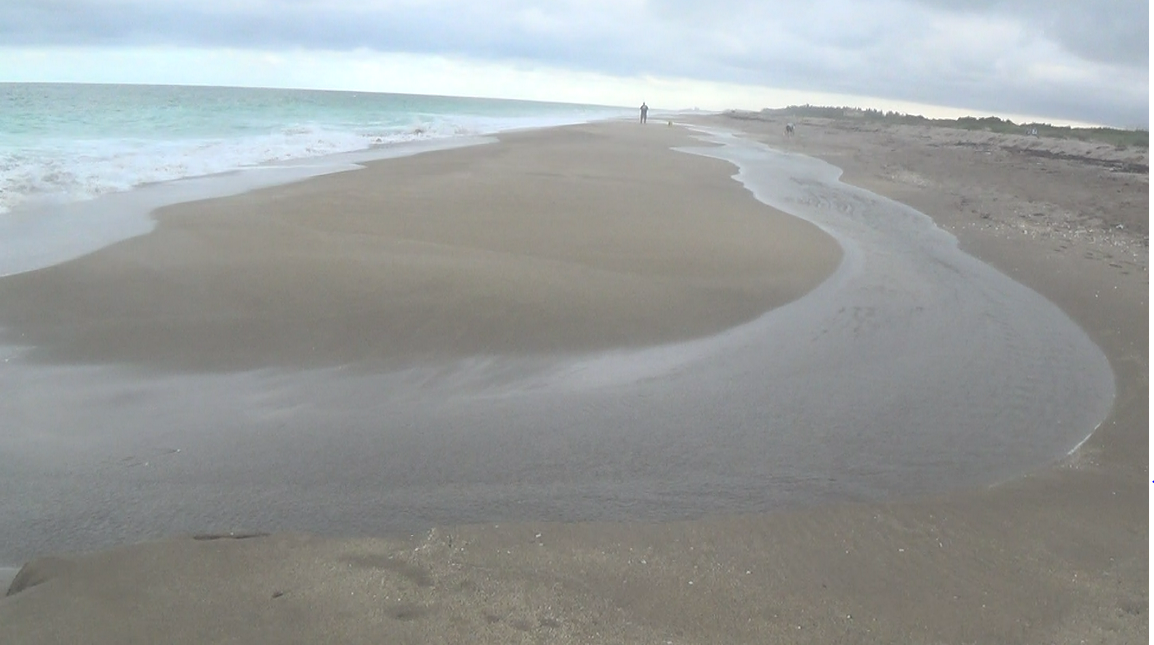
On the Treasure Coast today the high tide will be unusually high, however the surf is very small. It is still very sandy.
Remember that my beach detecting conditions rating scale is for old objects. Conditions are poor for finding old objects on the beach now.
Happy hunting,
TreasureGuide@comcast.net