Showing posts with label ingots. Show all posts

Tuesday, October 8, 2019

10/8/19 Report - Interesting Treasure Coin Lots in Latest Sedwick Auction. Teeth in the River. Storm Activity.


Written by the TreasureGuide for the exclusive use of treasurebeachesreport.blogspot.com.

Gator on Lagoon Side of Indian River Drive Across From Old Fort Park in Fort Pierce.
Photo by Joe D.
Gators are not uncommon in the Indian River.  I almost ran into one that was submerged in the muck. There are also sharks in the river. 

---

The 26th Sedwick Treasure Auction is now online.  Here are some of the lots you might be interested in.

Gold Cobs begins with The John Pullin Collection of Dated Mexican Gold Cobs from the 1715 Fleet, an important assemblage of choice coins with clear dates recovered from 1715-Fleet wreck sites, including a 1714J 8 escudos that was photographed in the famous January 1965 National Geographic article that first brought fame to the 1715 Fleet (lot 3). The section then continues with other gold cobs struck by Spanish and Spanish colonial mints across all periods and reigns.


The Shipwreck Ingots section contains many gold, silver, and copper ingots of various weights and shapes representing the sporadically ill-fated means of transporting the wealth of the Americas across the Atlantic Ocean. Three gold “finger” bars and seven(!) large silver ingots represent the ever-popular Atocha, while the historically important “key bar” from the “Tumbaga wreck” plated in both Armstrong’s and García-Barneche’s books is offered as lot 88.


Shipwreck Coins has an array of silver coins recovered from wrecks like the Capitana, 1715 Fleet, Rooswijk, and SS Republic as well as gold coins from the Luz, SS Central America, and SS Brother Jonathan. Atocha collectors will want to pay particular attention to the Atocha Classics Collection, an unprecedented numismatic compilation of top-quality cobs from the Atocha, including examples of the first coinage of Lima and Potosí, plus dated Potosí cobs by die variety, many quite rare.


The Mexico Silver Cobs section commences with The John Pullin Collection of Dated Mexican Silver Cobs, a date run of all denominations where most boast pedigrees to the 1715 Plate Fleet, including a desirable 1715J 8 reales. The section continues with several Charles-Joanna “Early Series” 4 reales, shield-type 8 reales and even a Royal 1715J 8 reales (lot 407).


The Lima and Potosí Silver Cobs sections contain many rarities, like a Lima 1659V 8 reales struck using a Royal obverse die (lot 437) and an abundance of Potosí Royal coins (plus a couple Hearts), including a very rare, unholed 1704/3Y 8 reales (lot 509). The Potosí section also features many Philip II cobs this time, chief among them being a choice assayer-L 8 reales (lot 450).


In Other Silver Cobs, highlights include a Santo Domingo Charles-Joanna 2 reales (lot 542) and a Panama Philip II 1 real (lot 544), both key coins that are considered among the finest known. Ferdinand-Isabel coins from mainland Spain feature prominently.

---


Source: nhc.noaa.gov
There is still activity in the Atlantic, and some of it isn't too far away from us.  That system up by North Florida has a 40% chance of developing in the next 48 hours.

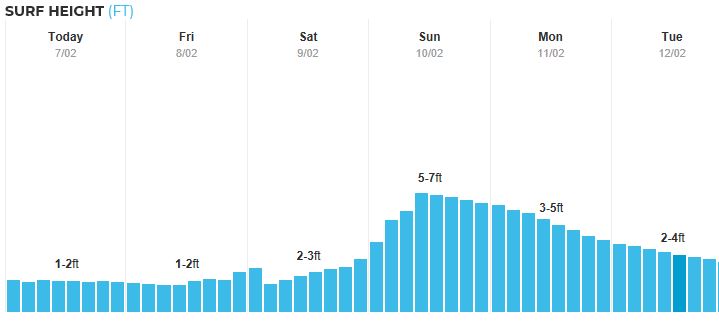
As a result, it looks like we'll get another bump in the surf later this week.

Source: MagicSeaWeed.com.

Take a look at Friday.

It isn't too late in the year yet.  We could still get some good storms.

Happy hunting,
TreasureGuide@comcast.net

Thursday, February 7, 2019

2/7/19 Report - 14th Century Sword Found. Waterways Book. Ingots From the Keys. Bigger Surf Coming.


Written by the TreasureGuide for the exclusive use of treasurebeachesreport.blogspot.com.

Sword Found in Denmark
Source: See TheLocal.dk link below.


A plumber and a machine operator in Aalborg made a sensational discovery when they discovered an intact and well-preserved sword while at work on Tuesday..
Kenneth Nielsen, an archaeologist from the museum, examined the 1.1 metre-long sword and quickly concluded it was of 14th-century Medieval origin.
The sword was found in ground on top of the oldest layer of paving on Algade, one of the northern city’s central streets...
Here is the link.

https://www.thelocal.dk/20190206/danes-pull-medieval-sword-from-ground-in-aalborg-street

Here are a couple fellows that turn up a 14th Century sword without even a metal detector.  There is a lot out there to be found.  

---

Gaylen C. wrote the following about the Waterways and Byways of the Indian River Lagoon book that I mentioned yesterday.

The book "Waterways and Byways of the Indian River Lagoon" is available at 2 Indian River County Libraries. There are 2 copies at IRC Main Library, 1 circulating (currently checked out), and 1 held in for the reference section. There are also 2 copies available at the North Branch in Sebastian. Those both appear to be available for circulation.Pretty expensive on Amazon. Barnes & Noble had the best price I saw...
Gaylen.

---

I received an email from someone wondering why I seem so unimpressed with the Oak Island finds.  The answer is very simple: they aren't very impressive.  The finds are nothing more than what I would expect from any similar island having a so much history that has been turned upside down and searched for centuries.  I've not seen any part of the Ark of the Covenant or anything like that yet.  So far, the stories are a lot bigger than the finds.

Back in the day, big land finds were usually kept secret.  They weren't produced for TV.  One day some forty years ago, for example, I was sitting in a metal detector shop waiting for the tide to turn, and through the side door came a couple of guys struggling to with some large ingots.  At the time, I was told the ingots were lead.  I knew better than that, and later I learned the whole story.  They were silver ingots dug on a land site in the Florida Keys by a fellow I got to know better over the years when I was hunting down south.  That kind of thing was not as uncommon as you would think.  If you do some research, you'll read of other finds like that.

Just look at the story at the top of this post.  Two fellows working on a street or something pulled out a 14th Century sword.  I post those kinds of stories almost everyday.  The point is that there is a lot out there to be found.

---

The only reason I talked about Oak Island the past couple of days, is that I received emails on the subject.

Did you know that when I started blogging, my first blog was not about treasure hunting?  When I started this blog it just took off.  Now there are over 1.5 million hits on the hit counter, and more than 2 million page views, and all without any PR or promotion.  

It still looks like we will get a bigger surf this weekend.

Source: MagicSeaWeed.com

It looks like Sunday will be the peak.

Happy hunting,
TreasureGuide@comcast.net

Friday, April 20, 2018

4/20/18 Report - Cobs, Ingots and Artifacts Available in Latest Sedwick Auction. Prohibition and Rum-Running In Florida. Bigger Surf Coming.


Written by the TreasureGuide for the exclusive use of treasurebeachesreport.blogspot.com.


The 23rd Sedwick Treasure auction is now online and available for registration and bidding.  There are already a number of bids, including one bid of $29,000 for a large silver ingot.

The artifacts section has a little bit of everything it seems including some items you might not expect to see in a Sedwick auction including an antique book and a 1950s Tiffany pill box.  As you would expect there are the usual musket balls, cannon balls, candle stick holder, fork, etc.

There were also non-metallic artifacts that seemed more typical of an archaeological dig than a treasure salvage operation, such as Spanish Colonial glass jewelry fragments, jet beads, and a stone bird shot mold.  Sometime not long ago I talked about jet and glass Spanish jewelry items and mentioned how common they appeared to be in documentation and archaeological digs, but how uncommon they are as beach finds.

Of course there are the seemingly endless lots of cobs that are good for study even if you are like me and prefer to find things rather than buy them.

Here is the link if you want to register, bid or just browse.

https://auction.sedwickcoins.com/Treasure-World-U-S-Coin-and-Paper-Money-Auction-23-May-15-16_a34033_p8?m=all

---

For drinkers and those who surreptitiously supplied them during Prohibition, the thrill of obtaining smuggled liquor was a quintessentially American custom bringing to mind the rebellious streak of the nation’s founders and their defiance of the oppressive laws and taxes imposed by a tyrannical monarch. Floridians were not immune to the lure of smuggling.  Freckled along the state’s Atlantic seaboard and extending out among the islands of the Bahamas and the Caribbean lay bays and inlets ideal for the trade, which would famously become known as rum-running. It also helped that in the 1920 Census, the Florida counties along the 250-mile long stretch of coastline from Titusville in northern Brevard County to Florida City near the southern border of Dade (now Miami-Dade) County, had a combined population of only 82,843, with more than half of the population clustered in the Miami area. (Today, incidentally, the seven counties along that stretch of coastline have a combined population of 7.9 million. The proximity of so many people hasn’t brought smuggling to a halt, but nowadays the illicit cargo is more likely to be drugs than booze.)
Also helping the smugglers was the fact that the southernmost portions of Florida’s Atlantic seaboard were not far from the Bahamas, then a British colony. Most of the rum and other illegal booze of all kinds entered Florida through the Bahamas, where the sale of liquor remained legal. Nassau, on New Providence Island, further cemented its historic reputation as a hub of piracy and crime by becoming the bootleggers’ paradise during the 1920s. Nassau served as the depot for alcohol shipped there from all parts of the world. From Nassau, rum runners would transport their illegal goods to the infamous Rum Row, which was created by one of Prohibition’s biggest celebrities, William “Bill” McCoy. Rum Row was a stretch of ocean that lay just beyond the U.S. territorial limits along the Eastern seaboard. At that time, the territorial limit was a mere three miles off the coast. Long chains of vessels carrying liquor of every sort tossed their contraband to contact boats assigned to deliver the smuggled cargo to accomplices on the mainland, all the while avoiding the interference of customs officials and other lawmen...
Here is the link for more about that.

http://floridaverve.org/prohibitionists-domain-and-smugglers-paradise-floridas-peculiar-status-during-prohibition/

You've heard the expression, "Real McCoy" and you probably know how it is used, but do you know where the expression came from?

Rum-running also saw a revival as a trade in the United States. Liquor was smuggled in station wagons, trucks and boats from Mexico, Europe, Canada and the Caribbean. The term “The Real McCoy” came out of this era. It’s attributed to Captain William S. McCoy who facilitated most of the rum running via ships during prohibition and would never water down his imports, making his the “real” thing. McCoy, a non-drinker himself, began running rum from the Caribbean into Florida shortly after the beginning of prohibition. One encounter with the Coast Guard shortly thereafter stopped McCoy from completing runs on his own. The innovative McCoy set up a network of smaller ships that would meet his boat just outside U.S. waters and carry his supplies into the country...

Here is one link for more about that.

https://www.metrojacksonville.com/mobile/article/2011-oct-bootlegging-and-rum-running-in-jacksonville

---

The low tides have been nice and low lately.  That can be a big help at times.

The surf has been small lately but will increase up to around 4 - 7 feet this weekend.  I'm eager to see that.

Happy hunting,
TreasureGuide@comcast.net

Thursday, November 19, 2015

11/19/15 Report - Thanksgiving Before The Pilgrims. Gold Coins and Ingots. The Real Treasure.


Written by the TreasureGuide for the exclusive use of treasurebeachesreport.blogspot.com.

A press release dated Nov. 18, 2015 claims Spanish settlers celebrated the "first" Thanksgiving, in St. Augustine 50 years before the Pilgrims arrived in the New World on the Mayflower. If you follow that same line of thought, the "first" Thanksgiving could have actually been celebrated on the North American continent by Chinese or Norse sailors if you don't count the "Native Americans" who must have eaten numerous meals thankfully tens of thousands of years earlier.  Just another attempt by a supposed "scholar" to make news and appear scholarly by challenging tradition with a pseudointellection proposition.  If you really want to talk "first" Thanksgiving, credit a monkey who was happy a banana fell on his head and gladly consumed it.  The monkey would have been nearly as likely to utter something resembling the word "Thanksgiving" as would Pedro Menendez de Aviles. Hey, we get it.  Cultural traditions are seldom or never totally factual, but there are "real" reasons they have become continuing traditions.  Don't overlook that.

Here is the link to the article about the first real Thanksgiving that we all really celebrate without knowing it.  Really?!

http://news.ufl.edu/articles/2015/11/before-the-pilgrims-floridians-celebrated-the-real-first-thanksgiving.php


----

Chinese archaeologists on Tuesday discovered 75 gold coins and hoof-shaped ingots in an aristocrat's tomb that dates back to the Western Han Dynasty (206 BC - 24 AD).
The gold objects -- 25 gold hoofs and 50 very large gold coins -- are the largest single batch of gold items ever found in a Han Dynasty tomb. They were unearthed from the tomb of the first "Haihunhou" (Marquis of Haihun) in east China's Jiangxi Province.
The coins weigh about 250 grams each, while the hoofs' weights vary from 40 to 250 grams, said Yang Jun, who leads the excavation team...
Here is the link for the rest of that article.

http://news.xinhuanet.com/english/2015-11/17/c_134826435.htm

---

As I pushed my elderly mother around an amusement park in a wheel chair the other day, I couldn't help noticing the many parents pushing their small children in strollers.  I thought about how rolls change with the passing of time.  Someday some of those the children will be pushing their parents like I was.

One of the most joyful things in life is to watch a child become strong, capable and more self-sufficient, and to me, one of the saddest things is to watch a parent go the other way.

As I held the hand that once held me up, I felt no strength in it.  It was now a hand that it seemed would crumble if I held it too tightly.

That was the hand of a person who loved me, dressed me and fed me.  It is my privilege to try to return some of that love while I can.  I won't have that privilege long enough.  I rather hold that hand than a thousand gold coins.

Give thanks and celebrate.

---

Here we go again.  Thursday of next week MagicSeaWeed is predicting a seven to eleven foot surf for the Treasure Coast.  Will it happen?  I doubt it.  But here is to hoping.

In the mean time we are having something more on the order of a four foot surf.  That is better than nothing and better than what we had all summer.  You might be able to find a few spots of small erosion, but they will be few and small.

Happy hunting and finding,
TreasureGuide@comcast.net

Friday, January 16, 2015

1/16/15 Report - Royals: Why Were They Made. Gold Figurines Found. Fisher Boats Waiting For Improved Weather.


Written by the TreasureGuide for the exclusive use of treasurebeachesreport.blogspot.com.


One of a Few Gold Figurines Found In Burial Mound.
See source link below.

Maybe you haven't found one but you know what it is.  I'm talking about Royals - the most exceptionally well made cobs.  They are near perfect in design and manufacture - round, complete detail, and well struck.

But really what are they?  Why were they made?  It seems no one can answer that question in great detail.

You will often read or hear it said that Royals were made as special presentation pieces for the king.  And that could be true, but it seems we don't know that for sure,   Daniel Frank Sedwick says they became known as Royals when one fellow who had one for sale said they were made for kings, not the public.  In other words the origin of the term could have been the result of sales hype (See source link below.).

Sedwick suggests that it is unlikely they were made for royalty because first, there were too many made, and second, and more convincing (too me), most of them never left the New World.  Still the name stuck, and as Sedwick admits, there could be some royal connection.

There are a variety of possibilities.  Perhaps they were made for high ranking or influential individuals.

Maybe they were proofs.

Maybe they were made as examples to instruct apprentices or demonstrate skill or mastery.

A great majority are holed and some have gilded surfaces.  Were they a type of jewelry?

Maybe there was some type of church connection, such as was the case with the "Heart" cobs.

When wealthy individuals were required to convert ingots to coins, did those wealthy individuals want something finer than the average cob for their commission/

One thing we know is that Royals are beautiful examples and still highly desired.  And there might be one out there waiting for you.

Here is the link to Daniel Frank Sedwick's more complete discussion of the subject of Royals.

http://www.sedwickcoins.com/articles/royals.pdf

-------------

 Here is the link to the article about the gold figurines, including the one shown above.
The Fisher organization didn't get the weather they were expecting and the boats are in port watching for the weather to improve.
As soon as they get a chance, one salvage vessel will be working on the Margarita "Main Pile."  The Main Pile hasn't been thoroughly detected.

The Dare, on the other hand, will be checking a few large magnetometer hits.

-----------

On the Treasure Coast we have only about a three foot surf.    The wind is from he North.  Tomorrow the surf will be a touch higher.

There is at least one Treasure Coast beach that has a lot of shells now.

I'm confident we'll get improved beach detecting conditions sometime before long.

Happy hunting,
TreasureGuide@comcast.net