Showing posts with label wood handle. Show all posts

Sunday, May 10, 2020

5/10/20 Report - Eight-Reale Kicks Off 2020 Salvage Season. Old(?) Wood Handle Fork Find. 18th Century British Indiaman Wreck. Surf Building.


Written by the TreasureGuide for the exclusive use of treasurebeachesreport.blogspot.com.


2020 started off as a good year for beach hunting.  A good number of reales were found on Treasure Coast beaches January through March, and then came the beach closures.


Now the 2020 salvage season has begun.  The calm surf allowed an early start to the salvage season and at least one eight-reale was found off of Douglass Beach already.  The 1715 Fleet find was made by Queens Jewels, Jason and Joey Gooch working on the M/V Blackwater salvage vessel.


Congratulations!


---

Two Tine Fork or Skewer.
As I mentioned yesterday, I decided to go back and look at some tableware that I found in the past and never researched much.

Here is a peculiar two-tined fork or skewer.  I believe it is probably a skewer rather than a fork simply because of size and feel.  It also shows very little wear, but it could have been repaired.  I'll show you why I think that might be the case.

There are no maker's marks or anything like that on this one.  It does not appear to be very well made.  There is some obvious asymmetrical grinding on the back near the base of one tine.

Wood Fork Handle With Wood Pins.

The rivets are not metal.  Wood pins hold the handle to the tang.  I haven't seen that on any other tableware that I've found.  Mostly they seem to have metal rivets.

The handle appears to be a relatively soft wood and very square - not nicely shaped for the hand.

Poorly Fitting Tang and Handle.

Notice how square the edges are and how poorly the tang fits into the handle.

My opinion is that the fork or skewer was either not made by a company that made tons of them or else it was repaired - maybe both.

I'd guess it is old, but don't know much of anything about this one.  It lacks any identifying marks.  The use of wood pins makes me think it is probably older, but it shows little wear as it is.

I don't think I'll ever find out much more about this one.

---

I've found a lot of silverware over the years.  Some came from the beach.  Many of those were in very poor condition.  A good number also came from inland sites where some were dug and some were evidently secreted.  They were generally in better condition.  It is very common to find silverware at home sites.

I recently started researching some of my old silverware finds.  Yesterday I posted a photo of a spoon with a maker's mark I couldn't identify.  Mitch King said the mark is that of the AB&Co., England.  I don't have the dates on that company yet.

Thanks much Mitch!


Spoons have been around for thousands of years, but forks, which took over for knives and fingers, came later.

Forks were the last of the flatware tools to be added to this gastronomic arsenal. The early Greeks were known to use forks, and one was carried to Italy by a Greek princess in 1071. There is some disagreement about when tined instruments first appeared in inventories on the continent. Many credit Catherine de Medici with bringing them from Italy to France in 1553 upon her marriage to the future King Henry II, but gold and silver forks, used only for eating mulberries and other foods that stain the fingers, are listed in the inventory of Charles V of France (1338-1380).

Nevertheless, by the 1600s, fork usage had spread all the way to England, where a gentleman traveler by the name of George Coryat credits himself with the momentous introduction. This may have been a bit of a boast, as Queen Elizabeth I counted them in her inventory. Even so, forks were not readily adopted in England. The Church had frowned on them, ruling that they took glory from God who gave us fingers to eat with, and were seen as effeminate in many corners. However, King Charles I of England declared them “decent to use” in 1633, and the fork slowly but surely gained acceptance at the table...


You might find the following linked article on the history flatware interesting.  It is the source of the above excerpt.

https://rauantiques.com/blogs/canvases-carats-and-curiosities/flatware-history

---

Here is the title and abstract of an article about an early 18th century British West Indiaman wrecked near Soldier Key.  If you know the area around Key Biscayne you'll be familiar with a lot of the history and shipwrecks in that area.  Actual treasure chests were recovered from Key Biscayne, not to mention many other treasures.  I spent a lot of time in that area when I lived down south.


A FINE WRECK IN SHALLOW WATER: INVESTIGATION INTO, AND CONSERVATION OF, A HEAVILY DISTURBED 18TH CENTURY BRITISH WEST INDIAMAN, THE SOLDIER KEY WRECK

Allen Donald Wilson

In the summer of 2012, a team of archaeologists excavated a known shipwreck site in the
submerged bottomlands in north Biscayne National Park. This site had been excavated
previously by John Hall, a professor from the University of Miami, in the early 1980s. Hall never
produced a report on the excavations and did not curate the artifacts recovered. The purpose of
this 2012 research was to document any remaining material culture, determine the best way to
preserve the site, and ultimately to use whatever remaining hull structure and portable artifacts
were available to determine the nationality, previous ports of call, and potentially the name of the

vessel as well as how the ship came to wreck in that location. 

The excavation revealed the midships to stern portion of a British West Indiaman that
dates to the early to mid 18th century. The sparse artifact assemblage suggests that the vessel
was coming from Jamaica en route to England when the ship succumbed to a hurricane.
However, a large number of ships wrecked in the region during the time period the Soldier Key
Wreck would have sailed. Unfortunately, no name could definitively be ascribed to the ship. 


Here is the link.

https://www.academia.edu/19559882/A_FINE_WRECK_IN_SHALLOW_WATER_INVESTIGATION_INTO_AND_CONSERVATION_OF_A_HEAVILY_DISTURBED_18TH_CENTURY_BRITISH_WEST_INDIAMAN_THE_SOLDIER_KEY_WRECK?email_work_card=view-paper


This one is in Biscayne National Park and I do not know of any treasure from the wreck being reported.  Still it is an interesting read.

---

The past couple of days I posted links to some very good studies.  One was a major study on near-shore shipwrecks and another was on privateering.  You won't want to miss those.


It looks like the surf will be building for a few days and maybe get up to five or seven feet.


Source: MagicSeaWeed.com


Happy Mother's Day,
TreasureGuide@comcast.net


Wednesday, July 13, 2016

7/13/16 Report - Scoops and Other Recovery Techniques For Various Difficult Situations.


Written by the TreasureGuide for the exclusive use of TreasureBeachesReport.blogspot.com.

Alternate Scoop Design For Deeply Buried Targets In Shallow Water.


A couple days ago I mentioned a target that was too deep for me to recover. Deep targets in the water and near the water can be difficult to recover.  Most people live and die by the scoop even though there are other good tools and techniques that can be effective.

The scoop on scoops is that the technology hasn't changed much in decades. There are some that are bigger and there are some that are stronger, but they really haven't changed much.

There are a variety of types of scoops, but they all work pretty much the same.  The scoop can be bigger or smaller and maybe shaped a little differently, but that is about it.

Years ago I described the benefits of having a wood handle and the disadvantages of metal handles. You don't see many scoops with wood handles, but a few manufacturers now offer scoops with wood handles.  I'm surprised more people don't use them.

It can be very difficult to recover deeply buried targets in soft or silty sand especially when there are currents.  Sometimes a scoop just won't work.

One method that will work at times is using your scoop like a hoe and fanning with it.  You can put down your detector, turn your scoop over and frantically hoe with it.  It can be tiring but you can really move a lot of sand that way.

If you are working in loose sand or silt and currents, trying to get too much sand in your scoop can actually work against you.  If you lift a heavy scoop full of sand out of a depression quickly, it will cause currents that suck the surrounding sand back into the hole.  Lifting a full scoop quickly will also cause the some of the sand and possibly the target to fall off the front or top and back into the hole. There are techniques to reduce that effect.  I've discussed those before.

After assessing the situation and getting a good idea of where the target is, you might choose another technique that often works well.   Put down the detector and scoop, get down on your knees and work your hand down through the sand and feel for the target.  This often also works very well on the beach when the target is under the water table.  This technique is not as easy when there is a layer of shells.  Be careful not to cut your hand on glass or other sharp things. You might be surprised by how easy it is to work your hand down to feel the target.

One technique I prefer is foot fanning.   You can move a lot of sand, as well as shells and rocks and other things - even when the bottom is packed rock.  Foot fanning, is one of my favorite techniques when a lot of sand needs to be moved to get to the target in water.  It can be tiring.

Some of the best hunting you might ever find occurs when there is a rock bottom.  Most other techniques can be nearly impossible when that happens.  Fanning will pick the sand up from between the rocks, and then the loosened rocks will come up.

Again you have to be careful.  A fishing lure can pop up and stick in your foot.  Therefore it is best to have some type of foot wear.

In every case, determining the targets location, depth and size, will help a lot.

If you are wading and have a long handled scoop, use the handle to support yourself, and then frantically fan with one foot until you have moved enough sand.

One challenge for recovering deep targets with a scoop in moving shallow water is getting the scoop to penetrate into the sand far enough.  I've found that I can wiggle the scoop as I push it in and continue working the scoop down down through the sand.  It will then be tough to pull the scoop out, but it can be done, and if done correctly can get targets from deeper layers.

Just pushing a scoop into the sand doesn't get you very far.  And the hole can refill nearly as quickly as you dig out the sand.

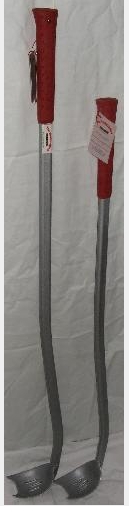
Rock hounds use another type of scoop.  You can see it here to the left.  These are about three feet long.

These are called treasure scoops, but as you can see, they don't have much of a scoop and aren't made for sifting.  They are good for collecting surface finds, but they would also be useful in other situations, such as reaching in under bushes, roots or rocks.

It is difficult to get a regular scoop pushed down through the sand to deeper layers. The type of scoop shown here will penetrate more easily and deeper, but you really have to pinpoint very accurately to be able to pull a small target out.

I won't discuss things like dredging or air lifts now, since detectorists usually can't use those techniques, but I've played with a few different designs specifically designed for recovering deeper targets in difficult situations.

At the top of the post is a illustration showing a tube, much longer than a typical scoop, that can be pushed down into the sand.  I've imagined a screw type mechanism to move the sand and articles up and through the tube, but haven't worked that out.  Probably a more practical method would be to leave the back of the tube open until the tube is suspected to be around the target, then the back of the tube closed before the tube is withdrawn.  That might pick up the material in the tube.  I can think of a couple other ways to try to make that work too.   I'll have to do a little testing.  I have some other ideas I won't mention at this time.

By the way, a rake or tool with tines can work better than a scoop when the target is a chain.

For now, my best overall technique in shallow water, and one that requires no additional equipment, is foot fanning.  Like with every technique, there are some tricks that you can learn to make it more effective.  It is almost always effective, but can require a lot of energy.

---

I hope you will respond to the blog post that you will find on the main blog display.

---

It sure has been hot.  I'd like to see something change.

Happy hunting,
TreasureGuide@comcast.net