Written by the TreasureGuide for the exclusive use of treasurebeachesreport.blogspot.com.
 |
| Artifacts Found and Displayed by Sebastian Steve. |
Below is the email message that accompanied the above photo sent to me by Sebastian Steve. You'll enjoy it.
Hey "Boss"!
It’s been a long time since we shared a story of this one “old, bold diver” who beat the odds. Remember the old (but often quite true) adage:
“There are old divers, and bold divers.”
“But never any “old, bold divers.”
I credit surviving about 30 years of the deep 150-200’+ deep shipwreck diving on over a hundred wrecks, to a couple key factors...
The blessings and Safety Net of Our Lord and Savior, Jesus Christ. “He” got me out of many a terminal jam...period.
Respecting the weather... no matter what the cost per day of just sitting around.
Never even “suiting up,” if you don’t feel 100%. If you’re not feeling well now on the surface, how to do think you’ll feel at 150 feet???
Highly respecting not only your computer with the modern algorithms, but comparing and backing that up, with the good ole “NAVY TABLES”. Memorizing your decompression stops, regardless if your computer would fail. And yes... I had diving computers fail twice on me.
It goes without saying that you have a backup depth gauge to monitor your bottom time and ascent rate. And always remember the simple rule to come up no faster than your medium sized bubbles.
Sorry...this is not diving school, but if any of this helps one person in need...know my words are set in stone...accurate and correct...simply from experience!
Did we make mistakes? Of course...dozens of them...and serious mistakes too. Like the time in the early 70s, when deep water regulators were first arriving on the scene for pleasure scuba diving.
But the engineers at Scuba Pro and Aqualung had never considered anyone would want to take these regulators down deep in ice cold water... 140-200’ deep in 38-40 degree water.
But down at 170-180’ deep, the air was already like pulling on a straw filled with maple syrup. You had to be extremely careful to not out breathe your regulator! No hard exertion of any kind...because the gasping sneaks up on you from behind. One breathe is fine, the next hard to pull. And the next having you pull for air and starting to panic if not extremely careful. Because the harder you tried to pull air, the more desperate the situation became!
Often the Best was to simply grab onto the wreck and close your eyes, and try to relax and catch up. Or the safest, if near the ascent line, was to “bail out,” and immediately work to reduce the depth until the breathing was easier.
And often in that heavy breathing, now you had another monkey on your back to contend with!!! The heavy volume of air passing through the 1st Stage of your regulator (the part clamped onto the tank top) would literally “ice up.” Just as you feel the cold of quickly releasing air from under pressure from a tank or tire...so the divers regulator chills until it freezes!
And it would freeze open to where if you ignored the bubbling you hear in the background besides your own breathing, each breath you take exasperates the situation. Faster and faster the free flow! Until you had a massive “run away” that could drain your tank in only a minute or two at depth.
And so a “free flow” situation was to be avoided at all costs. So the regulator manufacturers knew little themselves how to prevent this in the early years. So we experimented. Our best hope was to fill a small rubber boot on the 1st Stage. What to use...that was the question...
And so we all agreed that a good choice for a non-toxic “antifreeze” would be “Bacardi 151 RUM”!!! I was the first to test the ole “151” in other than the normal oral fashion! I can still remember the “burning shots.” Actually lit on fire B4 you drank them! Oh...what us foolish “children” all did at 18!
So I have the “151” installed in the little freeze cup and off I went to see the ship’s wheel on the sailing schooner “Silver Lake” in 207 feet. A line had been tied from the main mast out horizontally to the wheel.
So I came down the main mast that started at 90 feet deep. But at 130’ there was an ugly, heavy trawl net tangled in the main mast, still catching fish...sad. But a fish is still far better than a diver. The net was somewhat still open in parts, so you had to swim back, away from the mast, keeping a wary eye on this net.
After you passed the net...you could rejoin the mast to take the “elevator” on down to the deck. The mast was smooth and slippery, with nothing to hang you up, until you hit the pile of wooden sail hoops stacked at the base of the mast.
Well as I neared the deck in about 180’ deep, I spotted the line running aft to the wheel. Off I went for a glimpse of the ship’s wheel and a little exploring.
Then everything went wrong!!! Right out of the blue...or should I say BLACK...because it was PITCH DARK other than my light. Here I am half way out this line, about 50 feet in 180’ of water... and one breath was perfect, easy and smooth.... .... .... .... and the next NOTHING!!! ZERO, NO AIR WAS AVAILABLE! I think I sucked that regulator out the back of my skull!
Now...as I weighed my options knowing this was clearly a “life or death situation”... I knew I had to find my way back to the mast. Because the mast and only the main mast had the ascent line up to the boat. The firm, taught line that I so desperately needed now... for my decompression stops at 20 and then 10 feet!
I let my light go, hanging by the tether, and raced hand over hand along that line to rejoin the main mast! Finally...there it was! And all this while...not one tiny sip of air...NOTHING!!!
And so I started heading up, now having to watch my speed for both the bends or an air embolism.
The bends from rising too fast B4 the nitrogen taken on during the dive in the blood stream can go back out into solution. Like a soda bottle uncapped. Still under pressure, you can shake it gently and nothing happens. But now pop that cap off, and look out! Same thing with the divers body... the bubbles form in your joints and lungs and heart and spinal cord, and can hurt and cripple you up so bad...the early divers laid on the salvage boat decks, literally “bent up” in excruciating pain, that is how the “bends” got their name.
And rising to fast can also damage your lungs or even kill you. Literally the bursting of your lungs from over expansion. The little air sacs in your lungs begin to rupture. A very serious condition!
Thankfully through all my P.A.D.I., professional training, I had reached my “Advanced Diver” Status in 1971.
And so I continued up the mast. But now trying to get a grip on myself...I could slightly feel the residual air trapped in my lungs beginning to expand. Slightly backing off the burning need to breathe. Because we were headed straight up at a brisk clip. Thankfully, I had the peace of mind to remember the trawl net, still waiting with her cold arms outstretched to —embrace me—and hold me in her arms forever...
I thrusted back and away from the net but maintained a forward, upward momentum . I punched through ninety feet.... and like magic... like nothing had happened, a sunny day in the park... THE REGULATOR KICKED BACK IN WITH A HEAVY BURST OF THE BEST AIR I HAVE EVER GOT MY MOUTH AROUND! Sweet fresh air... I just may live Yet??? Praise the Lord and oh I Did...again and again.
The remainder of the ascent went normal and by the book. As did the decompression stops. Plenty of air to finish my stops. And after a total dive time of about 50 minutes, I exited the water ok but totally exhausted. I never did see that wheel. Nor have I drank a shot of “151” Run. Powerful Stuff... but just not right for deep divers.
And so another 100% True Tale has been told of the old salvage days primarily on The Great Lakes. But I have also worked in Central & South America, The Philippines, and the Caribbean Sea.
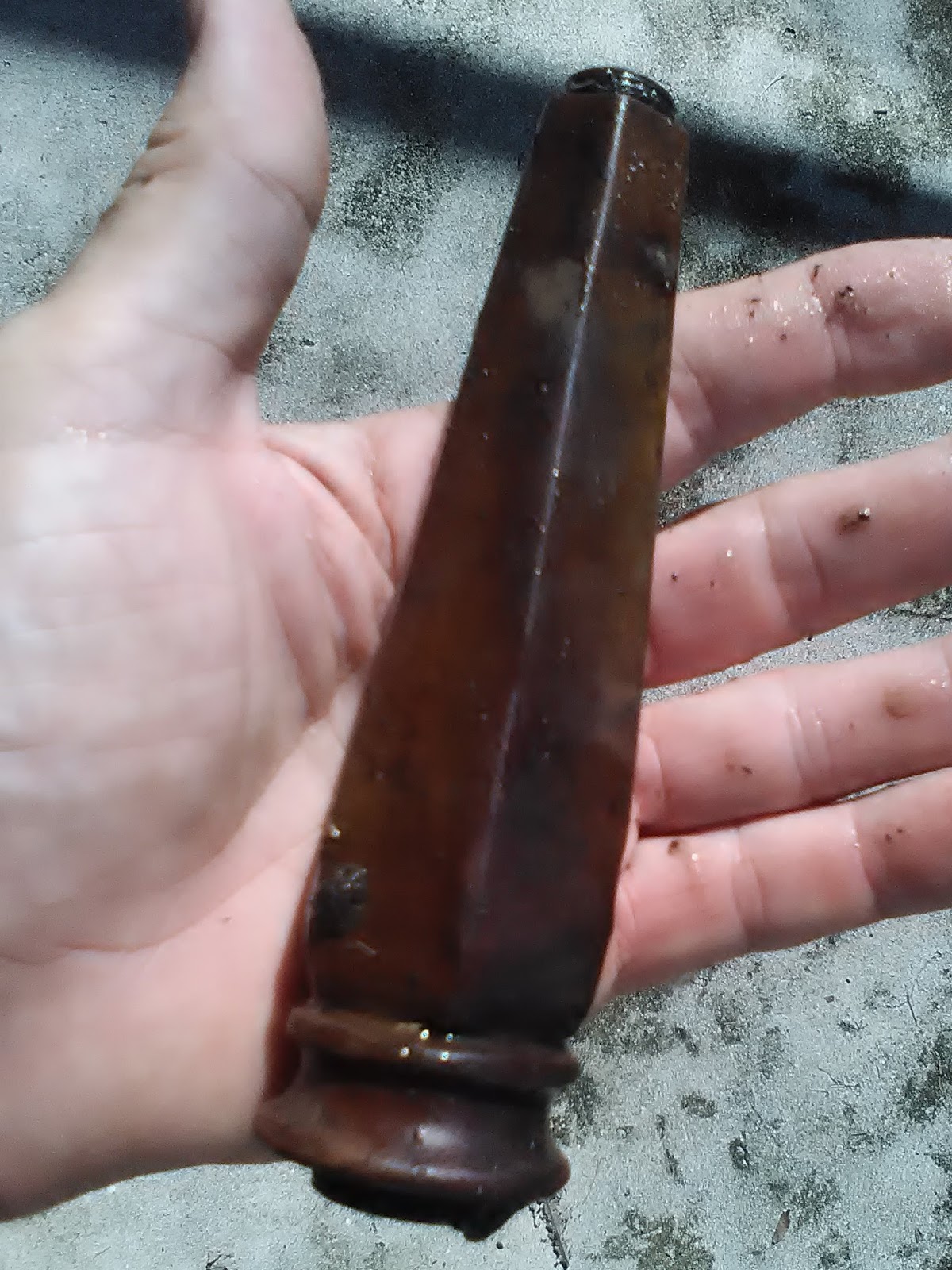
The showcase below is some of artifacts recovered from all over The Great Lakes primarily. To be truthful... these are my left-over actifacts that have not been sold to privately funded museums and individuals with a great appreciation in our early days along our waterfronts.
It would be nice to say “I can financially afford to donate these items to maritime museums. But the truth of the matter is that these old, bold divers...are not given a pension to assist in their later years. So what is carefully disbursed among the public... you know your artifacts have found very, very, good homes!
This set of shelves is literally my leftovers that have not sold. And so until interest arises in any one piece...or the remaining collection as a whole...these artifacts will remain under my watchful eye...shining off into the dark.
Thank you,
SebastianSteve
Thanks for sharing Steve. I know that everybody enjoyed your 100% true story and your artifact display.
---
LYNN HAVEN, Fla. — Mayor Margo Anderson drove through the neighborhoods of her small bayside city on Sunday to deliver some unwelcome news: The electric power knocked out nearly a week ago by Hurricane Michael might not be restored for two months.
Behind the wheel of a black golf cart, she made the rounds as shellshocked neighbors emerged from houses with busted windows and walls and front porches, the damage from the punches of fast wind, rushing waters and toppled trees.
“Just about every tree is down,” said Ms. Anderson, a fifth-generation citizen who was elected mayor of Lynn Haven, Fla., three years ago. “The power lines are destroyed. The transformers are destroyed. The power grid is destroyed. We have to start over.”
Here is the link for the rest of the article.
https://www.nytimes.com/2018/10/14/us/hurricane-michael-florida-power-electricity.html?action=click&module=Top%20Stories&pgtype=Homepage
---
There is only that one system on the NOAA map this morning. It has a 40% chance of becoming a cyclone in the next 48 hours. That one is almost exactly where Michael formed. Michael hung around down there for quite a while before shooting up through the Gulf. Hopefully this one won't do the same thing.
Steve made my job real easy today. I'm hoping to get photos of artifact and coin displays from other readers. It doesn't have to be a big collection, and don't think you have to be able to write like Steve. It would take a Mark Twain to do that. Just send in a photo of your favorite display. It can be a single item or a large collection.
Happy hunting,
TreasureGuide@comcast.net
It’s been a long time since we shared a story of this one “old, bold diver” who beat the odds. Remember the old (but often quite true) adage:
“There are old divers, and bold divers.”
“But never any “old, bold divers.”
I credit surviving about 30 years of the deep 150-200’+ deep shipwreck diving on over a hundred wrecks, to a couple key factors...
The blessings and Safety Net of Our Lord and Savior, Jesus Christ. “He” got me out of many a terminal jam...period.
Respecting the weather... no matter what the cost per day of just sitting around.
Never even “suiting up,” if you don’t feel 100%. If you’re not feeling well now on the surface, how to do think you’ll feel at 150 feet???
Highly respecting not only your computer with the modern algorithms, but comparing and backing that up, with the good ole “NAVY TABLES”. Memorizing your decompression stops, regardless if your computer would fail. And yes... I had diving computers fail twice on me.
It goes without saying that you have a backup depth gauge to monitor your bottom time and ascent rate. And always remember the simple rule to come up no faster than your medium sized bubbles.
Sorry...this is not diving school, but if any of this helps one person in need...know my words are set in stone...accurate and correct...simply from experience!
Did we make mistakes? Of course...dozens of them...and serious mistakes too. Like the time in the early 70s, when deep water regulators were first arriving on the scene for pleasure scuba diving.
But the engineers at Scuba Pro and Aqualung had never considered anyone would want to take these regulators down deep in ice cold water... 140-200’ deep in 38-40 degree water.
But down at 170-180’ deep, the air was already like pulling on a straw filled with maple syrup. You had to be extremely careful to not out breathe your regulator! No hard exertion of any kind...because the gasping sneaks up on you from behind. One breathe is fine, the next hard to pull. And the next having you pull for air and starting to panic if not extremely careful. Because the harder you tried to pull air, the more desperate the situation became!
Often the Best was to simply grab onto the wreck and close your eyes, and try to relax and catch up. Or the safest, if near the ascent line, was to “bail out,” and immediately work to reduce the depth until the breathing was easier.
And often in that heavy breathing, now you had another monkey on your back to contend with!!! The heavy volume of air passing through the 1st Stage of your regulator (the part clamped onto the tank top) would literally “ice up.” Just as you feel the cold of quickly releasing air from under pressure from a tank or tire...so the divers regulator chills until it freezes!
And it would freeze open to where if you ignored the bubbling you hear in the background besides your own breathing, each breath you take exasperates the situation. Faster and faster the free flow! Until you had a massive “run away” that could drain your tank in only a minute or two at depth.
And so a “free flow” situation was to be avoided at all costs. So the regulator manufacturers knew little themselves how to prevent this in the early years. So we experimented. Our best hope was to fill a small rubber boot on the 1st Stage. What to use...that was the question...
And so we all agreed that a good choice for a non-toxic “antifreeze” would be “Bacardi 151 RUM”!!! I was the first to test the ole “151” in other than the normal oral fashion! I can still remember the “burning shots.” Actually lit on fire B4 you drank them! Oh...what us foolish “children” all did at 18!
So I have the “151” installed in the little freeze cup and off I went to see the ship’s wheel on the sailing schooner “Silver Lake” in 207 feet. A line had been tied from the main mast out horizontally to the wheel.
So I came down the main mast that started at 90 feet deep. But at 130’ there was an ugly, heavy trawl net tangled in the main mast, still catching fish...sad. But a fish is still far better than a diver. The net was somewhat still open in parts, so you had to swim back, away from the mast, keeping a wary eye on this net.
After you passed the net...you could rejoin the mast to take the “elevator” on down to the deck. The mast was smooth and slippery, with nothing to hang you up, until you hit the pile of wooden sail hoops stacked at the base of the mast.
Well as I neared the deck in about 180’ deep, I spotted the line running aft to the wheel. Off I went for a glimpse of the ship’s wheel and a little exploring.
Then everything went wrong!!! Right out of the blue...or should I say BLACK...because it was PITCH DARK other than my light. Here I am half way out this line, about 50 feet in 180’ of water... and one breath was perfect, easy and smooth.... .... .... .... and the next NOTHING!!! ZERO, NO AIR WAS AVAILABLE! I think I sucked that regulator out the back of my skull!
Now...as I weighed my options knowing this was clearly a “life or death situation”... I knew I had to find my way back to the mast. Because the mast and only the main mast had the ascent line up to the boat. The firm, taught line that I so desperately needed now... for my decompression stops at 20 and then 10 feet!
I let my light go, hanging by the tether, and raced hand over hand along that line to rejoin the main mast! Finally...there it was! And all this while...not one tiny sip of air...NOTHING!!!
And so I started heading up, now having to watch my speed for both the bends or an air embolism.
The bends from rising too fast B4 the nitrogen taken on during the dive in the blood stream can go back out into solution. Like a soda bottle uncapped. Still under pressure, you can shake it gently and nothing happens. But now pop that cap off, and look out! Same thing with the divers body... the bubbles form in your joints and lungs and heart and spinal cord, and can hurt and cripple you up so bad...the early divers laid on the salvage boat decks, literally “bent up” in excruciating pain, that is how the “bends” got their name.
And rising to fast can also damage your lungs or even kill you. Literally the bursting of your lungs from over expansion. The little air sacs in your lungs begin to rupture. A very serious condition!
Thankfully through all my P.A.D.I., professional training, I had reached my “Advanced Diver” Status in 1971.
And so I continued up the mast. But now trying to get a grip on myself...I could slightly feel the residual air trapped in my lungs beginning to expand. Slightly backing off the burning need to breathe. Because we were headed straight up at a brisk clip. Thankfully, I had the peace of mind to remember the trawl net, still waiting with her cold arms outstretched to —embrace me—and hold me in her arms forever...
I thrusted back and away from the net but maintained a forward, upward momentum . I punched through ninety feet.... and like magic... like nothing had happened, a sunny day in the park... THE REGULATOR KICKED BACK IN WITH A HEAVY BURST OF THE BEST AIR I HAVE EVER GOT MY MOUTH AROUND! Sweet fresh air... I just may live Yet??? Praise the Lord and oh I Did...again and again.
The remainder of the ascent went normal and by the book. As did the decompression stops. Plenty of air to finish my stops. And after a total dive time of about 50 minutes, I exited the water ok but totally exhausted. I never did see that wheel. Nor have I drank a shot of “151” Run. Powerful Stuff... but just not right for deep divers.
And so another 100% True Tale has been told of the old salvage days primarily on The Great Lakes. But I have also worked in Central & South America, The Philippines, and the Caribbean Sea.
The showcase below is some of artifacts recovered from all over The Great Lakes primarily. To be truthful... these are my left-over actifacts that have not been sold to privately funded museums and individuals with a great appreciation in our early days along our waterfronts.
It would be nice to say “I can financially afford to donate these items to maritime museums. But the truth of the matter is that these old, bold divers...are not given a pension to assist in their later years. So what is carefully disbursed among the public... you know your artifacts have found very, very, good homes!
This set of shelves is literally my leftovers that have not sold. And so until interest arises in any one piece...or the remaining collection as a whole...these artifacts will remain under my watchful eye...shining off into the dark.
Thank you,
SebastianSteve
Thanks for sharing Steve. I know that everybody enjoyed your 100% true story and your artifact display.
---
LYNN HAVEN, Fla. — Mayor Margo Anderson drove through the neighborhoods of her small bayside city on Sunday to deliver some unwelcome news: The electric power knocked out nearly a week ago by Hurricane Michael might not be restored for two months.
Behind the wheel of a black golf cart, she made the rounds as shellshocked neighbors emerged from houses with busted windows and walls and front porches, the damage from the punches of fast wind, rushing waters and toppled trees.
“Just about every tree is down,” said Ms. Anderson, a fifth-generation citizen who was elected mayor of Lynn Haven, Fla., three years ago. “The power lines are destroyed. The transformers are destroyed. The power grid is destroyed. We have to start over.”
Here is the link for the rest of the article.
https://www.nytimes.com/2018/10/14/us/hurricane-michael-florida-power-electricity.html?action=click&module=Top%20Stories&pgtype=Homepage
---
 |
| Source: nhc.noaa.gov |
There is only that one system on the NOAA map this morning. It has a 40% chance of becoming a cyclone in the next 48 hours. That one is almost exactly where Michael formed. Michael hung around down there for quite a while before shooting up through the Gulf. Hopefully this one won't do the same thing.
Steve made my job real easy today. I'm hoping to get photos of artifact and coin displays from other readers. It doesn't have to be a big collection, and don't think you have to be able to write like Steve. It would take a Mark Twain to do that. Just send in a photo of your favorite display. It can be a single item or a large collection.
Happy hunting,
TreasureGuide@comcast.net