Showing posts with label shoreline. Show all posts

Saturday, September 30, 2017

10/1/17 Report - Pelican of Piety. Two Finds. Effect of Changing Shoreline and Shifting Sand. High Surf This Week.


Written by the TreasureGuide for the exclusive use of treasurebeachesreport.blogspot.com.

Source: usedchurchitems.com

Some of the greatest and most meaningful 1715 Fleet finds have been religious items. I found the web site of a company that they are "devoted to preserving Catholic 'Traditional Latin Mass' church items, and invite you to experience the passion and quality of liturgical antiquities from our past."
Here is that link.

http://www.usedchurchitems.com/

One of the items I saw pictured on their web site was the lectern shown at the top of this post.  Look familiar?  It looks very much like the gold pelican of piety found by Bonnie Schubert on the Nieves site.

If you aren't familiar with the pelican of piety you should take a look at my  11/4/12 post in which researcher and author Laura Strolia described the significance of the item.

http://www.surf-forecast.com/breaks/Wabasso/forecasts/latest/six_day

See also the following article describing the original find.

http://archive.tcpalm.com/news/vero-beach-mother-daughter-team-find-solid-gold-bird-statue-from-1715-treasure-fleet-off-fort-pierc--345668992.html

And here is a link that will give you more about the meaning of the pelican in heraldry.

http://www.sacred-texts.com/lcr/fsca/fsca41.htm

---

Civil War Bullet and 18K Ring
Find and photo by Duane C.
Duane C. sent the above picture of two finds that he found on the same recent hunt.  That is quite an unusual combination of finds.

Congratulations Duane!

---

Brian B. send this link to a good site that gives good surfing and weather information.  Take a look.

http://www.surf-forecast.com/breaks/Wabasso/forecasts/latest/six_day

---

I've been talking a lot about the changing shoreline in recent posts.  The movement of sand and other items is something that I've talked about a lot in the past.  It is one of  the most important things for a beach hunter to understand.

As the shoreline changes items will be brought into metal detector range or covered and put out of detector range.  There are some places where you have a more-or-less progressive loss of sand or a progressive accumulation of sand.  Where there is a long-term progressive erosion, you'll have a good shot at finding older items.  These days they do so much beach renourishment that it is not easy to find areas that are continually eroding and uncovering newer materials.

When you get erosion of the back dunes, old items can easily wash out and down onto the beach.  That mostly happens on the narrow beaches with cliffs on the face of the back dunes.

Sometimes coins and things wash up and onto the beach.  I've described how that happens in the past.  However before items can wash up onto the beach, they have to be uncovered.  That might sound obvious enough, but it is important.  As long as items are covered by sand, they aren't going to wash up.  Therefore, when the shoreline is moving east (on the East Coast), more items are being more deeply covered.  That covering of sand will have to be moved before those items can wash up.

One of the things I see on many of the Treasure Coast beaches now is a lot of sand in front of the beach in the shallow water.  Not only does that sand cut the force of the waves before they hit the beach, but it also covers and protects buried items.  If sand is eroded from a beach, it can end up directly in front of the beach and more deeply cover old items there.  You can therefore see a beach that is eroded but find no old coins on the beach because they are deeply buried in the shallow water and also not being washed out of the dunes.  Those are the two main sources of old coins on a beach: those washed up from in front of the beach, and those washed out from the dunes.  A third source includes old coins that were originally deposited when the beach was eroded or previously washed up onto the beach and then subsequently got uncovered before either being dragged out into the water again or getting covered again.

---
Source: MagicSeaWeed.com

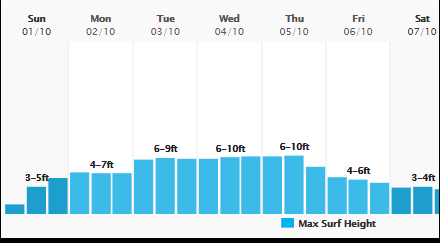
This should be an interesting week.  If the predictions are correct, the surf starts to build Sunday then stays high for a few days.  Even if we don't get favorable winds or swells, the surf might be high enough to do some good.

Please add your response to the blog poll.

Happy hunting,
TreasureGuide@comcast.net

Wednesday, September 27, 2017

9/27/17 Report - Lost Gold Ring. Jupiter Beach to Cocoa Beach. Shoreline Changes, Obstacles, and Special Opportunities.


Wtitten by the TreasureGuide for the exclusive use of treasurebeachesreport.blogspot.com.

Jupiter Inlet Beach.
Photo by Joe D.
Joe D. sent me these photos along with the following message.   

After just reading today's post, we have similar conditions here! In fact the beach has added 2-4 feet in places! Same problem; tons of seaweed and a mushy beach all the way up to eroded dunes! Waves from the east and little wind, even though it's large surf! All targets were light aluminum trash!
Some of pics are near same spots as I sent a few weeks ago so you can see the addition of sand
Looks like it will take a few week to normalize!


Joe D.

Thanks for the great photos and report Joe.  It does indeed look very much like the Treasure Coast.


Beach at Jupiter.
Photo by Joe D.
So what is it like just north of the Treasure Coast?  Dan C. sent the following.

... I have been hunting mainly Cocoa Beach due to its convenience -proximity to Orlando.
The post Irma hunting was good , meaning at least one gold find per 5-6 hour hunt.
The Post Maria hunting is not good.
You mentioned seaweed in your recent blog.
Actually, in the case of Cocoa Beach, it is about 80-90 percent Mangrove roots and branches, mixed with some seaweed.
Where did all these tree roots come from ? Indian River ? FL. Keys ? Bahamas ?
It would be kind of interesting to know where this stuff originated.
Or perhaps it is some variety of trees that grow in the dunes....... hard to tell as they are so pulverized, but the stumps are multi branched, the roots are short and fat.
There is enough of it to fill a dump truck for every 100 feet of beach.
It has formed clusters where it holds the sand, even in the wash zone- the waves don't break it up.
So, today hunted from 4 am to 930 to catch the low tide.
A few shell piles were formed close to the waters edge, produced nothing.
The shell line produced one stainless ring, one silver/enamel tiny pendant, one fake earring, a silver toe ring.
Higher up on the beach, I can see about a foot of new sand since last week, which came from Maria. I know it's at least a foot since it is full of those branches/roots even down deep.
Basically it's now all sanded in. Very little in the way of targets, even trash.
Perhaps if I can catch a flat day I will try a water hunt next.


Take care,
Dan in Orlando.


So these clumps of whatever are to be found at least from Jupiter to Cocoa. They were heavy on the Treasure Coast beaches today.  I also wondered where they came from.  Maybe we have a marine biologist or someone that can tell us.

On the Treasure Coast the biological materials, whatever they are, were catching sand and shells and in some cases being covered by sand.

One thing I should mention, and I haven't lately, is that when I talk about beach detecting conditions, I'm usually talking about finding shipwreck cobs and treasure coins.  I used to say that often and make it clear when I was giving a numerical beach conditions ratings.  At other times I might not always make that clear.

There is a correlation between beach conditions for finding old shipwreck items on the beach and finding more modern items, but the correlation isn't perfect.  Very old things surface less often than things that are just years or decades old..

Also when I give a rating or talk about beach conditions, I'm talking about general conditions.  I'm most often talking about those stretches of beach that produce shipwreck coins when the conditions are right.  You shouldn't forget, though, that when overall conditions are not great, there can still be small nooks and crannies where there is a chance to find something very good.  Often those places are beside a sea wall, jetty, rocks or foundation or something that provides an obstacle and opens a small pocket.  You might want to look around for some of those nooks or crannies.

Historic Shoreline Changes Around Present Day Fort Pierce Inlet
Source: marine.usgs.gov/coastalchangehaardsportal/
Here is the color key that goes with that.


Dark blue indicates the shoreline in 2012, and dark orange indicates the shoreline in 1830.

First you'll notice that the inlet was not open in the early 1800s.  The orange and yellow lines indicating the shoreline goes right through the inlet.

One thing I want you to see is that the shoreline north of the inlet has been moving out while the shoreline south of the inlet has been moving west.  They have tried to stop the erosion to the south of the inlet in recent years by dumping new sand there every year. Obstacles, like the jetty, large or small, disrupt the flow of sand and create what I call special opportunities.

There are some important lessons you can get from this illustration.  One very general principle is that when sand accumulates in one place, it leaves another.  That seems very obvious, but a lot of people don't appreciate the importance of that.  When sand builds one place, always ask yourself where it is coming from.  It is good to find where the sand is coming from and check where the sand is leaving.

You might have noticed that I posted some old wood finds since Irma hit our area.  There was the sheave and some other pieces.  That tells you something if you think about it.  Why did that old wood suddenly show up after all that time?  It was uncovered.  Where?  It could be from the beach, but we have not seen much beach erosion, or it could have been uncovered in deeper water and floated in.  Again stating the obvious, wood floats and therefore can travel very quickly and far once it is uncovered.

There is a lot to think about.  I'll stop there for today.

---

I just wanted to add this as soon as I found out.  Someone just reported that they lost a gold Claddagh wedding band in the John Brooks or Frederick Douglass beach area. Please help get it returned.

Thanks much.

---

Happy hunting,
Treasureguide@comcast.net