Showing posts with label state parks. Show all posts

Sunday, May 3, 2020

5/3/20 Report - Details on State Park Openings. Slide Bracelet Watch Find. Checking Rolex Watches. Watch History.


Written by the TreasureGuide for the exclusive use of treasurebeachesreport.blogspot.com.


Laser Inscribed Rolex Mark Around Inner Rim of Genuine Rolex.

A few days ago I did a post on finding watches.  Then I followed that with a post on identifying fake and counterfeit watches, especially Rolex.  I decided to show a bit more about that today.

Counterfeiters are becoming more and more skilled.  They can even change serial numbers these days.  But one of the most difficult things for a counterfeiter to reproduce is the high resolution laser-inscribed "Rolex" that you will find around the inner rim of the dial (Above and below.)

Source: DetectAFake.com.  See link below.

I posted a photo I took of a genuine example at the top of this post.  I was really surprised that I was able to capture it so well in a photo.  It wasn't easy shooting at an angle through the crystal, so I was very proud of the result.

Here is a link with excellent tips on detecting fake Rolex watches.


---

Of course there are many other types of interesting watches that you might find.  I've referred to some of those in the past, but here is one find that I like.  It is a watch with a slide bracelet.  They are unique

Watch With Slider Band.

You can purchase individual "slides" to be placed on the chain.  Individual slides can be silver, gold, or less expensive materials, and have emeralds or other precious gems.  You can find them online selling for hundreds of dollars each for the ore valuable slides.

Three "Slides."
You can create a very unique and personal bracelet, very much like you can do with Pandora charms, but these slider bracelets predated Pandora.

---

A bit of wrist watch history.

Watch-barcelets were created for ladies of wealth beginning around 1790.  Small miniature watches had been made earlier though.  David Rosseau made a watch about the size of a dime in the late 1600s.

Mass production of wrist watches was started around 1880 by the Girard- Perregaux factory to  be used by officers of the German Navy.

The Swiss introduced wrist watches to the United States around 1895, but they weren't popular at first.

Around 1907 the Elgin and Illinois watch companies were manufacturing wrist watches and by 1912 Hampden and Waltham had started.


From Shugart and Gilbert's Complete Price Guide to Watches.
---


Early 5/3 At Sebastian Inlet
Source: webcam

Effective Monday, May 4, DEP will implement phase one to reopen the Florida State Parks. As these parks are re-opening, DEP will be taking measures to ensure the protection of staff and the public. During this early phase of re-opening, visitors should expect limited hours, capacity and amenities.

Phase one includes approximately 80 parks and trails throughout Florida. Portions of these parks and trails have been identified that can be reopened for day use with limited risk to visitors and staff.

Here is the link for details on specific parks.

https://www.floridastateparks.org/learn/safety-updates

Sebastian Inlet Park will be open.

By looking at that web site I also learned that Indian River Lagoon Preserve is state land just south of Frederick Douglass park.

---

Today the surf is two feet, and Tuesday and Wednesday it will be down to one foot.

Happy hunting,
Treasureguide@comcast.net


Monday, April 9, 2018

4/9/18 Report - Martin County History Including Bottling Plant. State Park Maps. Don't Be Too Patient.


Written by the TreasureGuide for the exclusive use of treasurebeachesreport.blogspot.com.

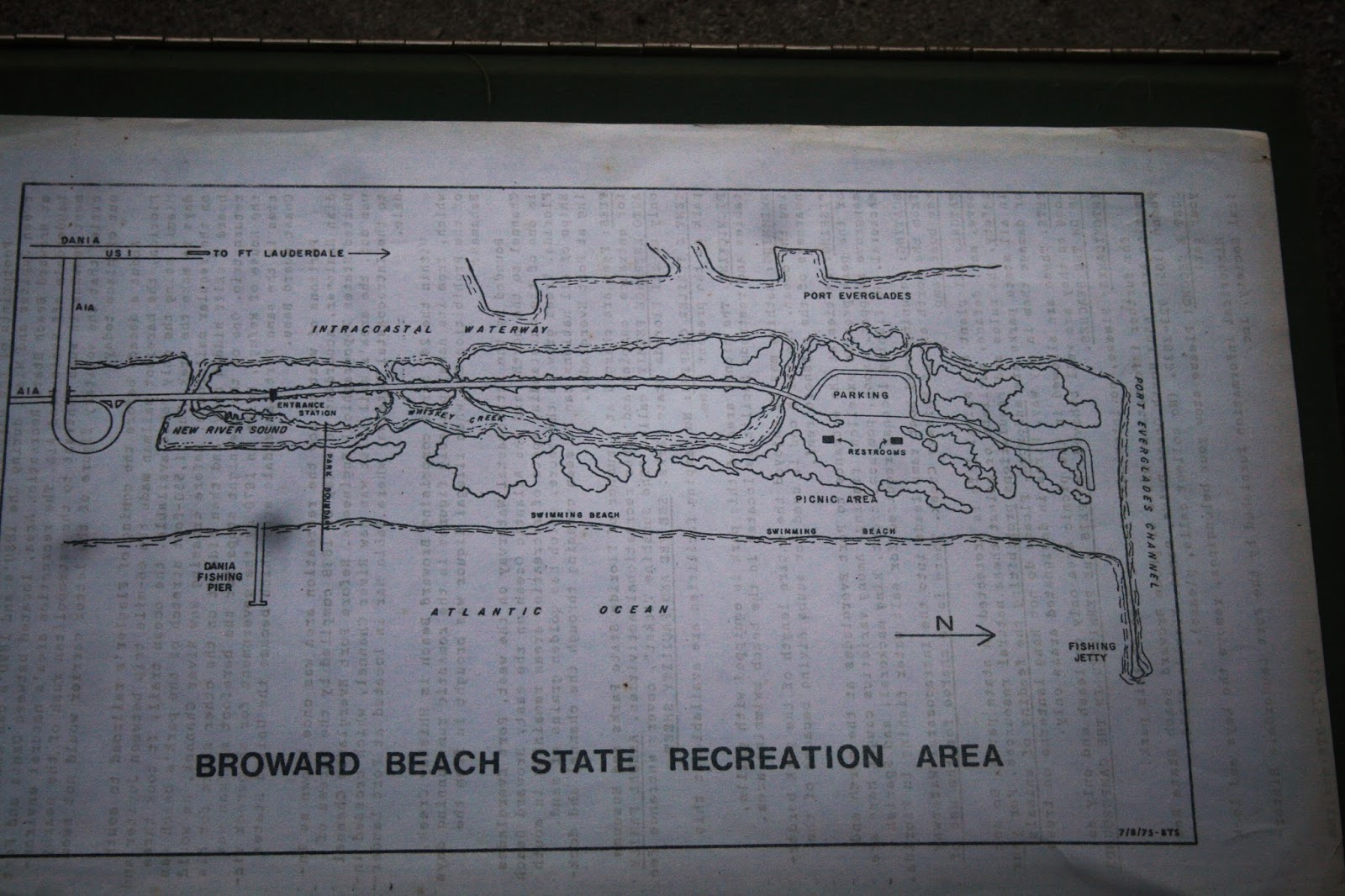
Map of Old Broward Beach State Park.

The above map shows the state park just below the Fort Lauderdale inlet into Port Everglades. The name has been changed.

I once found a large binder with maps and information on the Florida State Parks in a thrift store.  The maps and information was from the early 70s. Although some of the information is outdated, it is still a useful reference.

On the above map you shows Whiskey Creek, for example.  Other maps show historical sites along with a few notes.

It can be worth browsing through thrift stores.

---

In my opinion, one of the best posts I ever published was the recent post on sifting an entire city lot.  How many people would have guessed that one small suburban Florida lot that was the site of one modest working-class house would conceal nearly 500 coins?   Not many I would bet!  But one person proved that to be true by sifting the entire lot in addition to using a metal detector.  I posted the detailed results of that study on  3/26.  In my opinion every detectorist should have eagerly studied that post, and it should have been the most read post of my blog.  That post actually told how many coins were in the ground compared to how many were found with a detector  You usually don't find out how much is missed - just how much is found.  This was the exception. 

Nearly 500 coins were found in that one small lot!  That is what I want you to remember.  The next time you pass a lot and think there is probably nothing there, think again.  Less than half of those coins were found after many metal detecting sessions failed to get them.  There were still many good coins left in the ground long after most detectorist would have given up on the site.

Patience is a virtue, but too much patience can a problem too. You need patience to stick it out when things are slow  You need patience when you are tempted to give up and quit, but there are also times when you need to quit and move on to another location or another strategy or technique.  There is a fine balance.

A site can quit yielding much, but sometimes it isn't the fault of the site.  Sometimes another method is required.  Decisions should be made analytically and strategically, rather than emotionally.  A big part of the fun of detecting for me is figuring out what is going on and how to do things more effectively.

When I was doing a lot of detecting in shallow water, I couldn't work the water when it got very rough.  It was a real pain.  The waves would knock my ear phones off and give me a headache.  Then I learned another technique.

Water is powerful.  You can't really fight it.  It is better to work with it. I learned to go with the flow rather than trying to fight the waves and trying to remain stationary on the spot.  Some people use weights to help them, but I learned to feel the surges coming and knew when to pick up my feet so that each surge would carry me in one direction before coming back and dropping on the spot where I started.  Fighting the waves was futile.  That new technique allowed me to work the rough water when I otherwise couldn't.

Impatience can be a virtue at times.  It can be a virtue when you won't settle for the status quo and learn to do things more effectively.

---

I recently asked about the Stuart Bottling Works when I posted a picture of one embossed bottle from that plant.   Joe P. sent me the following link to some historical vignettes of Martin County published in TCPalm (See link below.).


Stuart's first bottling plant

In July 1913, James Elersly Weir, Jr., purchased a pitch pine wooden building owned by Joseph A. Lucas, a real estate developer, located on an isolated dirt road (Decker Street) south of Stuart; he had it converted into a bottling plant, Stuart Bottle Works. Soft drinks were bottled, sealed with large snap off caps and distributed in Stuart, Palm City, Jensen, Salerno, Hobe Sound, even to Fort Pierce and Jupiter. Weir only remained in Stuart a few years, joining family in West Palm Beach, in the plastering business and later, an auction house.

The bottling plant building was eventually owned by Ira L. Decker, who operated a concrete manufacturing business and was used primarily for storage. In the afternoon of Feb. 6, 1933, while Decker and local firemen were battling a brush fire nearby, the building caught fire. The wooden structure quickly went up in flames making it impossible for Ira to retrieve equipment, vehicles or machinery.

At least two bottles from the plant survive, clearly marked Stuart Bottling Works, one of which can be seen at the Stuart Heritage Museum.


Here is the link.

http://archive.tcpalm.com/news/historical-vignettes-some-of-martin-countys-firsts----part-2-ep-306511173-342350261.html

Thanks much Joe!

I've found at least four of those bottles south of Fort Pierce.  I think probably six.  I sold one or two of them.

I think anyone interested in local history will enjoy using that link to read the various Martin Country firsts.

---

The surf is only two feet today and the tides are flat.  Thursday the surf will be bigger.

Happy hunting,
TreasureGuide@comcast.net

Monday, September 23, 2013

9/23/13 Report - Why Do The Two Sides of One Coin Sometimes Corrode So Differently? Florida State Parks & More


Written by the TreasureGuide for the exclusive use of treasurebeachesreport.blogspot.com.

Big One Penny

I dug this big Queen Elizabeth penny the other day.  It isn't old, only 1967, which is only four years off of what the state considers to be a historic artifact, as simple as that might sound.  It isn't valuable by any sense of the imagination.  In the online references it is listed as bronze.

When I first dug it up I thought it was a half dollar.  I couldn't see the other side at all and didn't take the time to really look at it very good.  I just tucked it away thinking it was probably a half dollar.

The reason I mention it is because the two sides of the penny were very different.  I'm not talking about design but the patina and corrosion.

The side you see in the photo is basically how it looked when it was dug.  The opposite side though, was covered with a thick green crust that obscured all of the coin.

Why would two sides of the same coin look so different?   That was my question.

I've seen a similar thing happen before.  I saw it on a half reale that was dug down at Jupiter some years ago.

That half reale is shown below.

Dug Half Reale With Sand/Shell Crust

Different metals corrode differently and you can often tell something of the composition of the coin by how it corrodes.  Copper and bronze will often have some green on them, like the penny above had.

This half reale though just had a crust of sand and shell on one side and the typical black appearance of a sea seasoned cob on the other. 

When the cob was dug I could easily see the cross etc. on the other side.


You can see the other side pretty much as it was dug below.  There is some crust on the other side, but very little as compared to the side shown above.

Other Side of Same Half Reale
It is possible that the heavy crust only accumulated on one side and not the other.  Or I guess it is possible that there was a heavy crust on both sides but the crust on one side was worn off after the cob got uncovered.

I think the first theory is most likely.  I think that the very heavy crust was formed on one side maybe because of how the cob was positioned for all those years.


The heavy crust turned out to be a benefit because it kept the detail of the cob from being worn down.

See photo below showing detail revealed when the heavy crust was removed by acid.

Like I said, the bronze penny also had two very different sides.  The one side had a heavy green crust while the other side is as shown above.

Unfortunately  I didn't think to take a photo of the green crust before I removed it.

Same Half Reale Showing Detail Preserved by Crust.
Another possibility besides one side reacting differently because of its buried position, or the surface being cleaned by movement of sand and water after being eroded out of the bank, is that the coin or cob could have been buried next to something that protected it either physically or electrogalvanically.

What is your idea?

Here is a photo of the half reale showing the side that was heavily encrusted after the crust was removed.  Notice how well the heavy crust protected the cobs surface and preserved the detail.


..................................................................................

I believe that the cobs that were recently found and shown in this blog were actually pushed up onto the beach weeks ago, not recently.  From the circumstances, William thinks that might well be right.

I also felt that was true of some of my recent finds.  

If you hunt the over hunted places, you won't find things like that, but they can remain for a long time after washing up in locations that are less frequently hunted.

.........................................................................................

I just just read yesterday somewhere that Sebastian Inlet State Park is the second most visited state park in Florida.  That is quite a distinction.   The McClarty Museum is part of that.

 Right off I don't know which is first most visited.

Here is a link that will introduce you to all of Florida's State parks.

http://www.floridastateparks.org/thingstodo/default.cfm

Which have you been to?

An Audubon Society report said the following.   Florida’s park visitors provide a critical economic boost in the communities where they are located – and that’s more important now than ever. For every 1,000 people attending a state park, the total direct impact on the local community is more than $43,000, a 2008 DEP study found. 


Trying to find out which was the most visisted, I found a 2012 listing in HolidayTripper that didn't have the same order.  Here is what they had.

The most visited state parks in order are:
  • Honeymoon Island State Park, Dunedin
  • Gasparilla Island State Park, Boca Grande
  • St. Andrews State Park, Panama City Beach
  • Lovers Key State Park, Fort Myers Beach
  • John Pennekamp Coral Reef State Park, Key Largo
  • Anastasia State Park, St. Augustine
  • Bill Baggs Cape Florida State Park, Key Biscayne
  • Sebastian Inlet State Park, Melbourne Beach
  • Stump Pass Beach State Park, Englewood
  • Bahia Honda State Park, Big Pine Key

After researching some more I found that Honeymoon Island consistently shows up as number one.  I've seen different things for Sebastian Inlet, but is always listed among the top few.

How many of those have you detected?  I can only list three.  There is one on there that I detected many more times than Sebastian.  I've mentioned it in past posts.


Low tide on the Treasure Coast will be around 5:30 PM today.

We'll be having a 1 - 2 foot surf for a few days.

Happy hunting,
TreasureGuide@comcast.net