Showing posts with label techniques. Show all posts

Monday, April 9, 2018

4/9/18 Report - Martin County History Including Bottling Plant. State Park Maps. Don't Be Too Patient.


Written by the TreasureGuide for the exclusive use of treasurebeachesreport.blogspot.com.
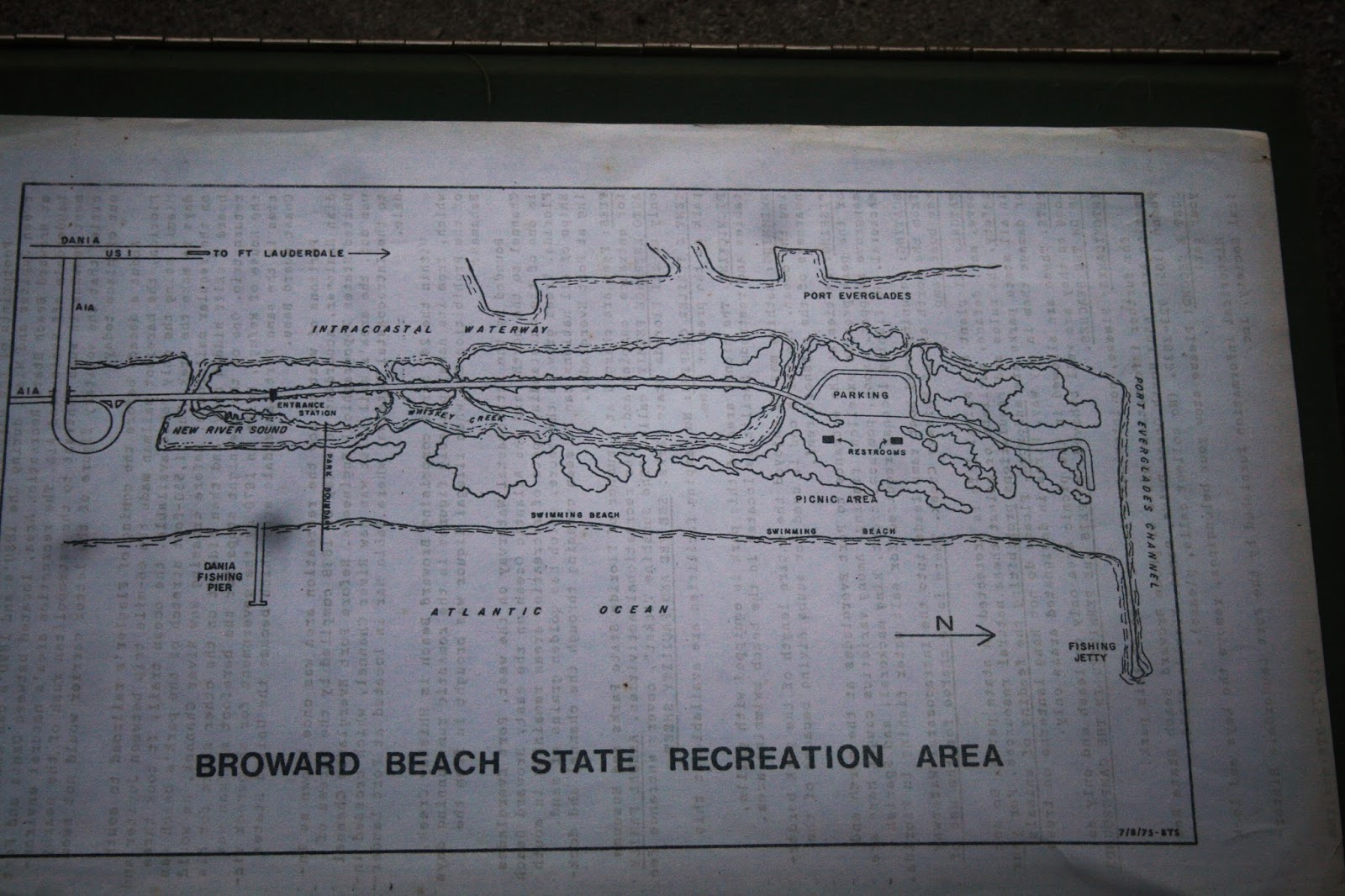
Map of Old Broward Beach State Park.

The above map shows the state park just below the Fort Lauderdale inlet into Port Everglades. The name has been changed.

I once found a large binder with maps and information on the Florida State Parks in a thrift store.  The maps and information was from the early 70s. Although some of the information is outdated, it is still a useful reference.

On the above map you shows Whiskey Creek, for example.  Other maps show historical sites along with a few notes.

It can be worth browsing through thrift stores.

---

In my opinion, one of the best posts I ever published was the recent post on sifting an entire city lot.  How many people would have guessed that one small suburban Florida lot that was the site of one modest working-class house would conceal nearly 500 coins?   Not many I would bet!  But one person proved that to be true by sifting the entire lot in addition to using a metal detector.  I posted the detailed results of that study on  3/26.  In my opinion every detectorist should have eagerly studied that post, and it should have been the most read post of my blog.  That post actually told how many coins were in the ground compared to how many were found with a detector  You usually don't find out how much is missed - just how much is found.  This was the exception. 

Nearly 500 coins were found in that one small lot!  That is what I want you to remember.  The next time you pass a lot and think there is probably nothing there, think again.  Less than half of those coins were found after many metal detecting sessions failed to get them.  There were still many good coins left in the ground long after most detectorist would have given up on the site.

Patience is a virtue, but too much patience can a problem too. You need patience to stick it out when things are slow  You need patience when you are tempted to give up and quit, but there are also times when you need to quit and move on to another location or another strategy or technique.  There is a fine balance.

A site can quit yielding much, but sometimes it isn't the fault of the site.  Sometimes another method is required.  Decisions should be made analytically and strategically, rather than emotionally.  A big part of the fun of detecting for me is figuring out what is going on and how to do things more effectively.

When I was doing a lot of detecting in shallow water, I couldn't work the water when it got very rough.  It was a real pain.  The waves would knock my ear phones off and give me a headache.  Then I learned another technique.

Water is powerful.  You can't really fight it.  It is better to work with it. I learned to go with the flow rather than trying to fight the waves and trying to remain stationary on the spot.  Some people use weights to help them, but I learned to feel the surges coming and knew when to pick up my feet so that each surge would carry me in one direction before coming back and dropping on the spot where I started.  Fighting the waves was futile.  That new technique allowed me to work the rough water when I otherwise couldn't.

Impatience can be a virtue at times.  It can be a virtue when you won't settle for the status quo and learn to do things more effectively.

---

I recently asked about the Stuart Bottling Works when I posted a picture of one embossed bottle from that plant.   Joe P. sent me the following link to some historical vignettes of Martin County published in TCPalm (See link below.).


Stuart's first bottling plant

In July 1913, James Elersly Weir, Jr., purchased a pitch pine wooden building owned by Joseph A. Lucas, a real estate developer, located on an isolated dirt road (Decker Street) south of Stuart; he had it converted into a bottling plant, Stuart Bottle Works. Soft drinks were bottled, sealed with large snap off caps and distributed in Stuart, Palm City, Jensen, Salerno, Hobe Sound, even to Fort Pierce and Jupiter. Weir only remained in Stuart a few years, joining family in West Palm Beach, in the plastering business and later, an auction house.

The bottling plant building was eventually owned by Ira L. Decker, who operated a concrete manufacturing business and was used primarily for storage. In the afternoon of Feb. 6, 1933, while Decker and local firemen were battling a brush fire nearby, the building caught fire. The wooden structure quickly went up in flames making it impossible for Ira to retrieve equipment, vehicles or machinery.

At least two bottles from the plant survive, clearly marked Stuart Bottling Works, one of which can be seen at the Stuart Heritage Museum.


Here is the link.

http://archive.tcpalm.com/news/historical-vignettes-some-of-martin-countys-firsts----part-2-ep-306511173-342350261.html

Thanks much Joe!

I've found at least four of those bottles south of Fort Pierce.  I think probably six.  I sold one or two of them.

I think anyone interested in local history will enjoy using that link to read the various Martin Country firsts.

---

The surf is only two feet today and the tides are flat.  Thursday the surf will be bigger.

Happy hunting,
TreasureGuide@comcast.net

Tuesday, April 3, 2018

4/3/18 Report - Coin Hoard. Don't Get Stuck In A Rut. Analyze and Adjust.


Written by the TreasureGuide for the exclusive use of treasurebeachesreport.blogspot.com.

Source: See LiveScience link below.

A hoard of about 119 coins, together with an iron lock that may have sealed them within a container, have been found inside a collapsed building in the harbor of the ancient city of Corinth in Greece.
The discovery leaves archaeologists with a mystery: Why didn't anyone come to retrieve the stash after the building collapsed?
"That is an excellent question and one that has been troubling us," said Paul Scotton, a professor of classics at California State University Long Beach who leads excavations for the Lechaion Harbor and Settlement Land Project. "The coins were found circa 30-40 centimeters [12 to 16 inches] below modern ground level under the collapsed tile roof. With it having been so close to the surface, why someone didn't return for it is a puzzle. Either the owner could not or did not want to retrieve it. Exactly why that would be is only conjecture," Scotton said...

Here is that link.

https://www.livescience.com/62192-ancient-coin-stash-leaves-mystery.html

It is amazing how much is out there.  Here is a hoard of 119 coins that was just about a foot below ground level that has been there around 1600 years.  Not long ago I told about a small city lot in the suburbs of a large modern Florida city that produced hundreds of coins.  There is not shortage of good targets out there, but you might have to do something different to get them.  

There are times when you have to adjust.  One of the most common mistakes made by very experienced detectorists is using the same techniques on different types of sites.  It might be as simple as adjusting your detector settings or using a different detector.  Some people never bother to change their detector settings no matter where they hunt.  I've seen guys that don't do anything except go out to the beach and turn their detector on and start hunting.   They never make adjustments to the beach conditions, part of the beach they are hunting, or anything.   They turn the detector on and go.  That's it.  You can get away with that most of the time, but there are times when it is a big mistake.  You usually don't find out about the big mistakes.  A miss is a miss.

Some good time spent eye-balling can be a big help, whether you are looking at a beach or a land site.  Analyze the situation before beginning.  But there is no reason to analyze a situation unless you are going to make some adjustments.

Metal detecting a busy resort area is much different from detecting an out of the way treasure beach and both are very different from detecting a home site.

In my early days of detecting in South Florida I forced the beach to produce.  I was determined that every day I would find something good and hopefully a lot of it.  One day I remember, I started about sunrise and was determined I was going to find some gold that day.  Well, it didn't happen quickly that day, but I kept at it and finally pulled a gold ring out of a sand bar as the sun was starting to set. I usually didn't detect nearly that long in one session, but I did often go out with that same level of drive and determination.

There was a lot to be found down there.  There were many hotels and beach resorts that were pretty busy almost every day all year long.  If one wasn't working, you could hit the next and the next and the next.  You could move from shallow water to working dry sand and around cabanas or move to an older beach.  There were endless choices.  There were even places, that despite the large number of detectorists, that were seldom, if ever, detected for one reason or another.  I especially like to do the spots that no one else seemed to be hitting.

In recent days, I've told about different kinds of sites and different techniques for exploiting those sites.  There will be a learning curve if you decide to try different types of sites or use different techniques, but it can be worth it.

If you have been doing the same thing at the same places over and over again and finding less than you hoped, it might be a good time to try something different.

---

Source: MagicSeaWeed.com
Looks like we'll get a little bump in the surf on Friday.

Happy hunting,
TreasureGuide@comcast.net

Friday, March 9, 2018

3/9/18 Report - Oldest Message In Bottle. Roman Aqueduct Found. Transferable and Nontransferable Treasure Hunting Skills


Written by the TreasureGuide for the exclusive use of treasurebeachesreport.blogspot.com.

Source: dw.com  (See link below.)

World's oldest message in a bottle discovered in Australia, sent from Germany.  That was the title of the article that continued, More than 130 years ago a German ship threw a message overboard. It eventually buried itself on a remote Australian beach, and turned out to be part of an important worldwide experiment...

German authorities said the bottle was one of thousands thrown overboard during a 69-year-long oceanographic experiment to research global ocean currents and discover more efficient shipping routes...

The bottle containing the message is shown above.  Nice bottle to find, even without a message.

To read more of the article, here is the link.

http://www.dw.com/en/worlds-oldest-message-in-a-bottle-discovered-in-australia-sent-from-germany/a-42840270

----

The remains of a Roman aqueduct dating back to the 1st century have been uncovered in the southern Spanish city of Cadiz in the wake of Storm Emma.

Hundreds of vehicles, yachts and seaside properties were damaged when the storm hit hard along the coast of southern Andalucia late last week, even whipping up a tornado in Puerto de Santa María.

But once the winds died down, the removal of several feet of sand from Cádiz’s Cortadura beach revealed extraordinary archaeological treasures... 


Here is the link for the rest of that article.

https://www.telegraph.co.uk/news/2018/03/06/remains-roman-aqueduct-uncovered-spain-storm-emma/

---

Afew weeks ago a couple Santa Monica, California guys were in Daytona for the races and wanted me to take them detecting on the Treasure Coast.  They offered good money, but I declined.  I wouldn't do something like that unless I could pretty much guarantee that they would find something good and at the time I didn't feel like the chances were real good.  I have a lot of responsibilities and other issues these days that prevent me from scheduling time out anyhow.  When I get out, it is usually a last minute thing.  I just get ready and run out for a few minutes when I can. 

When I started this blog I was getting out a lot.  Of course sometimes the beach conditions weren't that good, but you can always adjust.  When the treasure beaches weren't good, I could go to a swimming beach and look for jewelry or maybe go on a bottle hunt.  I always liked variety and often learned something from one kind of hunting or one place that could be applied elsewhere.

Some skills are transferable.  That means you can use them in different places and situations.  Other skills are more specific and do not transfer as readily.  Detector skills, for example, are mostly transferable.  You can use them at different beaches and different types of sites, etc.

It is important to recognize similarities and differences between different beaches, sites and different types of hunting.  It is important to recognize what knowledge and skills transfer well and which don't.  There are many similarities between hunting jewelry in South Florida and hunting shipwreck treasure on the Treasure Coast, but there are also some big and important differences.  It can be a big mistake to approach them exactly the same.

Although many detector skills are transferable, it is important to change at times too. Don't get too dependent upon one method or technique.  There are even times when a metal detector isn't the right tool.  There are times when you should put the detector down and use a sifter or dredge, for example.

Different beaches are different too.  There are times when poor conditions prevail yet there are one or two small spots that are good.  It can be because of the angle of the beach at that location, or because of rocks or jetties or other peculiarities.

Take Bathtub Beach, for example.  It will erode when others do not.  The rocks to the north that stops the flow of sand.  There are other things about that beach that makes it different too, but they continually dump sand there and it disappears like it was being poured into a black hole.  That is just the way it is.

My point today is that there is knowledge and skill that is transferable from one situation to another, but there are also important differences.  It is important to be able to apply what you learned one place to another when that works, but it is also important to recognize when there are differences that require adapting.

---

The past couple of days I was traveling and did not get to see the Treasure Coast beaches.  I'll have to get out soon to see what has been happening here.

The surf is supposed to continue decreasing today and the tides will not be big at all. The wind will start out west/northwest and end up as north/northeast winds.   I'm hoping to get  chance to take  look maybe later today.

Happy hunting,
TreasureGuide@comcast.net


Wednesday, October 11, 2017

10/11/17 Report - How The Competition Can Actually Help You If You Effectively Analyze Your Finds. A Twist on the Spanish Conquest.


Written by the TreasureGuide for the exclusive use of treasurebeachesreport.blogspot.com.


As you know I cover a wide variety of topics.  Once in a while I get on a particular topic and stick to it for a while before changing again.  For a few weeks I was on the weather and developing beach conditions.  Sometimes I'll be on beach dynamics or treasure coins, or metal detectors or strategies techniques or equipment.  Sometimes even things like fossils, sea glass or Native American artifacts.

Lately I've been talking about one 8-mile stretch of beach that I detected a lot in the past.  I'll  talk a little more about that today, particularly two of the better modern jewelry beaches.

The first I described as "a very narrow swimming beach where a lot of people crowded on nice days.  It produced a lot of good quality jewelry on a regular basis."  The jewelry finds were generally good quality and seemed to be a good representative sample of what the people wore there.

On the other hand, there was another jewelry beach that I described as " a good hole.  It was in front of an active high-scale resort.  Not as many items as in zone 1, but higher quality.  Some very good finds came from there even though there was known competition.  I believe that it was resort staff.  A fellow stood and watched me working the water one day and left cursing when he saw me dig a gold chain in very shallow water.  I could tell that  a lot of my finds from there were not the easy finds and were things somebody could easily miss."

The things I found there were not things that were easy to detect.  The average and large size things never appeared.  It was always a very thin gold ring with a good gem, or a small gold chain, or something else that might easily be missed by the detector.  Finds were not frequent but they were good. There was no junk and very few coins. 

If you carefully analyze what is being found or not found, you can tell a lot about a site and modify how you hunt accordingly.  Since I knew there were very few junk targets and few big targets, I could really pump up the sensitivity turn off discrimination and hunt slow and listen for the small signals.  Overall, it was very productive hunting.

Once I was traveling on business and stopped at a roadside beach with a couple picnic tables near Pensacola.  There were four posts marking out a square area in front of the picnic tables.  I started hunting found the are within the square marked by the posts thoroughly cleaned out so I moved just outside the square area and found three gold rings in a very short time.  Whoever was working that area on a regular basis, worked the square but left the area just outside the square untouched.

My point is to carefully analyze finds and junk to determine what is going on and then make adjustments.  The competition can actually help you out if you figure out how to take advantage of what they are or aren't doing.

---

Monday was Columbus Day, and as you would expect, in response to any mention of a celebrated historic or national cultural event that at one time played any roll in fostering national identity, we are treated to a parade of contrary boring poorly-thought-out  incessantly-repetitious emotion-driven arguments by dissenters for their "favorite" group, skin color, nationality, ideology or whatever.  I am all in favor of presenting "the other side."  In fact I highly recommend and encourage exactly that.  I only want the argument to be thorough, consistent and justified by something other than myth, repetition and emotion.

Victim-hood attracts sympathy.  I understand that, but being a victim does not automatically make you right.  It does not grant merit.

The Spanish ( or Europeans or Whites - however you want to define your favorite group or your favorite hate group) conquistadors did terrible things.  I am not defending that at all.  However, the Maya and Aztec, foe example, appeared to have little aversion to violence, human sacrifice, war, slavery, or territorial expansion, all of which existed in the New World before Columbus arrived.

The difference is not that one group was evil and the other inherently good.  The big difference came down to the fact that one group was more successful in effecting the evil in their heart.  I have no reason to believe that if the Aztecs, for example, had the ships, army and war technology to project power overseas, that they would develop a non-violent non-aggressive culture and limit the evil they would do.   I see no reason to believe that if they had the power to project domination that they would not have done the same thing to North America and Europe and we might be speaking some strange language today.

I accept that the more powerful group is responsible for the greater damage done, but not having the ability to do more damage hardly makes you a better person.  It was not that one group was completely good and the other completely evil.  No group is completely good or evil - especially not any group defined by such superficial simplistic things as skin color, ancestry, race, national identity or culture.  We have to learn to look at things in less simplistic terms, and we need to start looking at people as individuals - not just group members.  We need to get over this obsession with skin color, race and nationality.   No person is perfect.  Neither are groups.

---

The poll is progressing nicely.  Not much longer to get your responses in.  I know that some people have not responded because I know of some finds in areas that still have zero votes. 

Please respond before it is too late.  I think this is one of my more interesting polls.

Thanks!

---

Compared to September there isn't much excitement.  The surf isn't huge, yet it isn't real small now.

I haven't been able to get out lately, but hope you have.

Happy hunting,
TreasureGuide@comcast.net