Wednesday, February 7, 2018

2/7/18 Report - Dug Coins With Holes and Bent Coins: Uses and Superstitions. Snip Pattern On Steve's Mystery Find.


Written by the TreasuerGuide for the exclusive use of treasurebeachesreport.blogspot.com.

Figure From The Book
Numismatic Archaeology of North America: A Field Guide by Aiken et al.
Over the years I dug up a good number of "holed"coins. They include everything from a Charles II half reale to a Lincoln penny.  I don't think I got any of them in circulation.  If I did I didn't notice it at the time.  I think they were all dug coins.  If I'd thought about it, I might have kept them together as a nice little collection of holed coins.

When someone puts a hole in a coin it is often meant to change the function of the coin.  It is no loner used as money but as a pendant, button, token or something else.  I can imagine, though, that coins might be punched to be sewn into clothing for safe keeping and transportation.  I've read of how those escaping persecution in places such as Nazi Germany would sew valuables into their clothing.  I could see why one might do something similar for a long voyage on a cramped ship.  What better way to keep a few coins safe under those circumstances.

It seems that people assume that when they find a holed coin that it was meant to be a pendant.  That might often be the case, but there are other possibilities as well.  The placement and number of holes might tell you something.

The above illustration was published in the numismatic archaeology book by Aiken et al that I've mentioned a few times recently.  The same book also reported on a study of holed coins offered for sale on eBay.

The number of holes can vary from one to several.  The arrangement of holes can suggest the reason for the hole or holes.  A single hole near the edge of a coin suggests that the coin would be suspended, as would be the case with a pendant.  But it would only take one hole for someone to sew a coin into a garment.  It isn't all that easy to make a hole in a coin.  I'd only make as many as necessary.

Below is a picture of a crucifix that was sold in a Sedwick auction a year or two ago.  I personally inspected that item in Orlando before the sale.  I had the feeling and told Mr. Sedwick at the time that I thought it looked like the coins were a later addition.

Illustration From Sedwick Auction Catalog.

As this shows, coins can also be used as religious items and as ornaments.  Notice that the holes are placed so the coin hangs right side up.  Normally the hole would be started from the side that is most likely to show when suspended.

The corpus on the above piece looks to me like it was made by an indigenous silversmith.  I found a similar one of gold on a wreck beach back years ago.

While a single hole might indicate that the coin was to be suspended, two holes might also be for suspension, or when coins are attached to each other to make something like a bracelet.  Two holes can also turn a coin into a button.

Coins were also used at times as good luck tokens or religious medallions.

I used to find a lot of bent coins, especially at one location where there were a lot of rocks that rolled around in the surf.   I used to think the bent coins were probably caused by natural forces, but there are a lot of superstitions and other uses for bent coins.   Some believed a bent coin would change one's luck.  Another tradition is that carrying a bent coin in a purse would keep the purse full.  And then there were "witching coins" and love tokens.  So I guess there are several possibilities.

Here is a an old poem about mentioning a crooked sixpence.

There was a crooked man, and he walked a crooked mile.
He found a crooked sixpence upon a crooked stile.
He bought a crooked cat, which caught a crooked mouse,
And they all lived together in a little crooked house.

---

Concerning yesterday's mystery find from Steve in Sebastian, DB offered the following.


I recognize the snip pattern as those of aviation snips. That could also lead to the mystery itself. I've found several parts of planes as well as the fact there are WWII planes in the water along the Treasure Coast.
 Happy hunting
DB

Thanks much  DB!

---

Not any real change in beach conditions.  I'll have to find time to get out sometime soon.

Happy hunting,
TreasureGuide@comcast.net


Tuesday, February 6, 2018

2/6/18 Report - Mystery Find. Regulated Joseph Edwards Lima Eight-Escudo. Surf Moderate.


Written by the TreasureGuide for the exclusive use of treasurebeachesreport.blogspot.com.


Mystery Object Along With Eight-Reale Included for Size Comparison.
Photo by Steve in Sebastian.


Steve sent the above photo showing a mystery find (darker object) along with the following description of how it was found.

... So Ann and I hit the wet/dry divider line down on one of the Galleon Beaches. Get a fair but leaning toward weak signal on my CTX 3030. Pulled a big scoop, nothing still there. Did another, same result, (and I run a very big scoop with a feather light handle). 3rd pull, she’s out. Detected all 3 piles with no results, I flattened them down with my foot, nothing, carefully scanned the whole works for what I figured by then was a dime sized piece of “can slaw.” Nothing...enough, 3pm already, rain off to the South. Move on. I’m poor at moving on and cutting my losses. Must learn to “move on!”

Repeat the above “to a tee” about 30-40 feet along. Same wet/dry line. This time got down with my “Garrett Carrot” right away. Bingo...good signal but acted like can slaw. Finally had the scrap or “script” in my hand. What stood out was no magnetism, and a very, very low gold level 100% reading of only #12.2, the gold Italian 14 karat bracelet that was featured here was #12.4. Same kind of reading I had at the last spot. Had I considered the reading, I would have stayed put and found it! Period!


So...some alloy gold, took a Dremel knife to shave an edge and a thin curl rolled off that felt like butter. Very soft.


Now the perforations....??? The snips. I have seen and even believe that I have in the past recovered/discovered something similar. “Boss”, ever see that pattern of a trim shears before???
One of the other edges looks like it to was shaved or sheared with a plain conventional knife. Thin, easily bendable, but not magnetic. No discernable pattern on either side. Lucky me...don’t need in the least another Cuban 2 Centavos!!! Hee! Hee!!! (;


See pics and weights. Ideas appreciated. The pic with the 8 Reales coin, just for size comparison. About 7/8” of an inch long, 1.3 grams. •THANKS AND GOOD HUNTING•.


Same Mystery Item
Photo by Steve in Sebastian

If you have any ideas on the mystery object, sent me an email.

---

Below is a coin that will be featured in the upcoming Sedwick auction.


You can see the mark of Joseph Edwards in the bottom left quadrant of the cross. Since coins were in short supply in the colonies, foreign coins were often used. This is an excellent example. How it got to Boston is anyone's guess - undoubtedly a fascinating journey.

I found the following notice by Joseph Edwards.


---


I was told of a fellow that said he doesn't think much of this blog but he still checks it regularly to see what finds and reports there might be. That to me is high praise, since the original purpose of the blog was to issue such reports, and it has evidently achieved that goal, but while providing a little something for everybody, the blog has become something that even people who don't like it have to read. Being useful might be even better than being liked. The google stats say that the blog is getting very close to two million page views. I don't know exactly how that differs from the hit counter, but it does.

---


Source: MagicSeaWeed.com.

As you can see, the surf looks like it will be running around 2 - 4 feet for a while. The tides have also moderated. No more big negative tides.

Happy hunting,
TreasureGuide@comcast.net

Monday, February 5, 2018

2/5/18 Report - Spanish Officer and A Kid From Reign of Philip IV : Paintings For Research. Treasure Dive in the Great Lakes.


Written by the TreasureGuide for the exclusive use of treasurebeachesreport.blogspot.com.


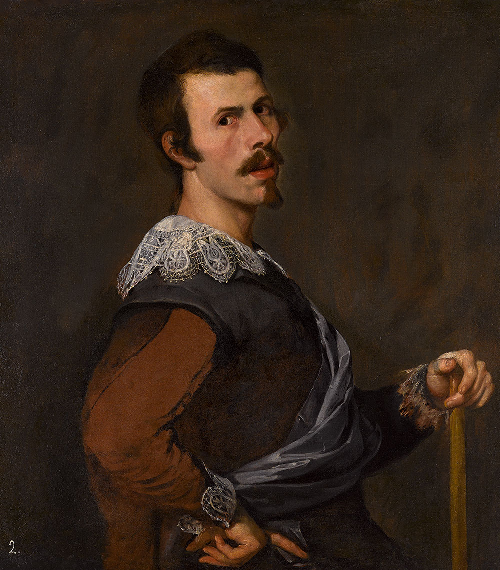
This painting is one of fifteen from a Sotheby's exhibit of Golden Age Spanish paintings. Since you'll never see a photo from the 8th century or earlier, you can learn a lot by looking at paintings from the time period.  This one from the reign of King Philip gives you some idea of what the best dressed child of the day might wear.  Notice the scaled down sword and pike or whatever.

And here is a fellow of the period identified as a Spanish officer.

Painting of Spanish Officer
Old paintings can be valuable for research.

Below is the link if you want to see the other paintings from the Sotheby's Auckland Castle group.

http://www.sothebys.com/en/news-video/slideshows/2018/spanish-paintings-from-auckland-castle.html

---

Here is an interesting and instructive account of a treasure dive in the Great Lakes from Steve in Sebastian.

Anything is possible to those who dream! When everyone and I mean everyone...the best of the best...veteran divers up on the Lakes... would still basically just swim along slowly (the more experience the slower you went) remember at 150+ feet of depth, no matter how well your mind is conditioned...you still were not even close to being 100%. You found yourself locked in patterns of behavior that worked. Example... I'm working a debris pile on the aft deck (that not in the least was by accident on my part, knowing that the original plans showed the Purser's Office was located originally directly above. Now long gone, because the upper decks ("hurricane deck" was always made of lightweight wood to keep the CG low. Often the hurricane deck totally tore off from the collisions and air pressure in the hull. Some were found floating down the lake a hundred miles away, weeks later!

I came across a heavy wood box, but no bottom, heavy like 1" thick, or something tumbled out... hardwood, 12" long, 6" wide, 6-8" high. I grabbed at it... (quite excited... purser's gold box?...why such heavy wood?) but only some engine parts, heavy bearings rolled out. Odd...but that was it. Move on.

How simple at the end of any of my dives (making 2 per day, for 30 days, weather permitting.) to simply tie on my hand reel to these "engine parts" and pull it up and see what it really is! The "hand reel" is a plastic spool with 200' of 5/16" poly line on, with a cut 1/2 through 3' up the bitter end riding up my arm with fishing net floats wire tied to the sides to tie anything heavy on, or to tie to the wreck anywhere for an emergency decompression line. (Although I had mastering holding 10' in free water...for 15 minutes to do all my decompression. You gently slip down to 12-13' constantly holding the depth gauge in front of your face literally, then a couple soft kicks of the fins, then carefully drift to a halt because you are always fighting the quick change in buoyancy that will occur... as the bubbles will expand rapidly in the last 10 feet in your suit, even a dry suit of the type we wore back then. Problem is I often came up at the end...1/2 mile from the boat! Later with the line half cut through at 3' off the tied end, you could cleat it on, and power the boat up, and snap it off when leaving for the day...only losing 3. (:

Anyway back then in the late 70 and 80s, there were really only a couple dozen "good" divers who dove the really deep ones, up to about 210.' So the word got around fairly quickly. Well sure enough I hear the grapevine and it tells me some lucky diver "just looking over the debris in the stern" found the SHIP'S TICKETING MACHINE all in brass with all the brass rollers and thumb wheel amounts and ports of call, etc. A fine, fine nautical steamship 1865 piece I'm sure. I almost wanted to leak it out that he go back and find the hardwood case for it!!! (;
Thanks much Steve! 

---

I'm still thinking of the stupid Super Bowl this morning.  I don't know how we elevate a game to such importance in this world, but I guess it is entertainment.

Anyhow, the Eagles were penalized more than the Patriots 6 to 2, but there weren't as many penalties as I expected and no big game changers.  There was one important non-call that in my opinion went in the favor of the Eagles.  That was a real surprise.  Anyway, Nick Foles is going to Disney World and my prediction was wrong.

---

The tides are a bit more moderate now and the surf is only about two to four feet. 

Happy hunting,
TreasureGuide@comcast.net


Sunday, February 4, 2018

2/4/18 Report - Lost Coins of Early Americans: A Book to Preview. Significance of Find Discrepancies. Super Bowl Prediction and Other Foolishness.


Written by the TreasureGuide for the exclusive use of treasurebeachesreport.blogspot.com.


It's Super Bowl Sunday.  Today would normally be a holiday for me, but I'll do a little post anyhow.

 I wanted to add add a few comments to yesterday's post.  First I used coins in my illustration, but you don't have to have such detailed records in order to notice significant differences in what you are or are not finding.  I first learned how important that could be when I changed my discrimination setting and started finding more valuable small rings with expensive gem stones.  Before that I had been using discrimination and finding mostly rings with larger bands, which were mostly men's rings.  I thought that men lost a lot more rings than women but learned that wasn't true after I dropped my discrimination setting.  I originally thought I was getting a lot men's rings but few women's rings simply because there were more men's rings lost, but it was really because of how I was hunting.  Also, because I was hunting primarily rings when I started hunting shipwreck items, for quite a while I was finding smaller items like reales and things made of precious metals but not spikes or things like that.  The reason for that was also because of how I was hunting: I was still hunting the same way I hunted when I hunted modern jewelry.  My detector and methods were good for finding small items made of precious metals, and that was the reason I was not finding spikes.  Again, there are reasons why you find some things and not others.

---

Here is an interesting book which you can preview free online.


This book has some of what I hoped to find in the Numismatic Archaeology of North America book. It discusses money used and found at New World and early American sites.  It also tells how you can find such coins to collect, along with some idea of the likely prices.  Looks interesting.

Check out the free preview by using the following link.

https://books.google.com/books?id=mrmWA14x52AC&printsec=frontcover#v=onepage&q&f=false

----

Here is my Super Bowl prediction.  The Patriots win with the help of the referees.  The only way the Eagles have a chance is if they are not penalized way more than the Patriots, but my prediction is that they will be.  With today's passing game and the rules the way they are, penalties are too much of a factor.  Here is another prediction.  James Harrison makes sacks even though playing only situationally.

---

A few things I learned from TV this week. 

1.  When people go through a black hole, they grunt.
2.  If an NFL team is in need of a nose tackle, they should check out some of those brides at Kleinfeld's on Say Yes To The Dress.
3. Most of the journalists can't correctly interpret a compound sentence.
4. TV needs Battlebots back.  They could intermix it with other shows such as Say Yes To The Dress.  Wouldn't it be much more interesting if the Say Yes To The Dress brides had to save their chosen dress from being destroyed by an arena full of Battlebots.  The bride that saves her dress from the Battlebots would get it free.  If that was playing, no one would turn to the Super Bowl.

---

OK.  Enough fooling around.  I have some other things that I'll do some other day.  Super Bowl Sunday begins now.

Let the games begin.
TreasureGuide@comcast.net

Saturday, February 3, 2018

2/3/18 Report - Why You Should Keep Track of What You Are and Are Not Finding. Treasure Coast Pirate Fest.


Written by the TreasureGuide for the exclusive use of treasurebeachesreport.blogspot.com.


For more information
http://www.treasurecoastpiratefest.com/

---


I find it useful to pay attention to what I am finding and what I am not finding.  I said something about that just yesterday.  There is always a reason why you are finding some things and not others.  Analyzing your finds will always provide helpful information.

That applies to all finds but it is easiest to illustrate by using US coins.  They are relatively easy to find and there are plenty of them, so that gives you a lot of data points.  It is easier to see patterns ad figure out what is going on when you have a lot of data.

I'm using US coins for my examples, but you so the same type of analysis with treasure coins, artifacts or almost any kind of target for which you have enough data.  I should say before going any farther, that it is a lot easier to develop generalizations about US coins than it is to develop good generalizations about treasure coins, but the same principles apply, and you can actually apply some of the things you learn from hunting modern coins to hunting treasure coins.

There can be a lot of unknown factors involved.  When there are a lot of unknown factors and you can't figure out what is going on, it can seem like pure chance, but there are still reasons even when you don't know what they are.

What you are finding or not finding can tell you something about the site you are searching, or something about how your detector works, or how targets are distributed.

If you keep good records, you will know the proportion of different types of coins you've found over some reasonable time span.  For example, I used to know for certain types of sites how many US coins I would find on average between each gold ring.  As a result I would know when I was long overdue as well as when I was in a hot streak.  I would start to wonder what was going on when I was long overdue.  That meant taking time to think things over and trying to figure out if something was wrong or if something needed fixed.

The main point so far is that there are reasons that you do or do not find certain types of targets, and it helps to know why you are or are not finding those types of things.

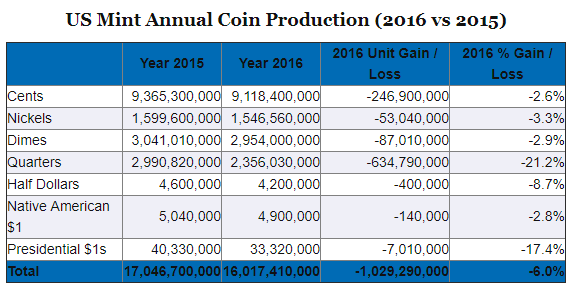
Maybe you haven't kept good records of your finds.  Lets just start with some rough numbers on coins.  Above is a table giving the production of various denomination of coins for 2015 and 2016.  If the production numbers for those years are fairly typical, pennies should represent something close to fifty percent of your coin finds if you are not intentionally discriminating them.  Nickels would be close to 10% of you finds, while dimes and quarters would each make up about 30% of your coin finds.

There are other coins listed such as half dollars and dollar coins, but they are few in comparison and are not found very often for other reasons, so I'll leave the out to keep things simple.

So what if you are finding a lot more quarters than dimes?  Again, there are a variety of possibilities.  Maybe for some reason there are more quarters at that site.  Or maybe you are detecting more quarters because of something about your detector or how you are detecting.  You might think it is hard to believe but some people detect a greater proportion of the larger coins because of their detector settings or how they detect.  A very poor detector, or a high coil and fast sweep speed can cause you to miss a greater proportion of small dimes.

If you know your typical coin distribution as determined by your own records with that detector, you will have a good idea of what to expect and therefore be alert to any deviation that might have a cause that you can address.  You might be able to figure out if it is due to the site, your detector, or something you are doing.

I recently mentioned how when I expected a lot of coins in one area and but was only finding nickels at first, how that told me that someone had probably already detected that area.  It is not uncommon for some detectorists to leave a disproportionate number of nickels behind.  The point being once again, that an unusual distribution of targets can tell you something.  In this case it had to do with the site.  It had already been detected.  Further analysis of finds at the site confirmed that.

To give you another example.  There was one beach where I was finding a lot of dollar coins.  That was unusual.  Anyone would take notice of that even if they didn't have a detailed set of expectations.  I found nearly a roll of silver dollars in one small area.  I thought maybe someone dropped a roll of dollar coins there.   I eventually found out that there was once a gambling casino at that location.  Again, ask yourself if any unusual distribution of coins might be due to the site, your detector or how you are searching.

Unfortunately we can't go from mint production numbers alone.  There are a lot of things that can affect your personal baseline.  My personal experience suggests that some detectors are more sensitive to nickels than others, as one example.  Where and how you detect will also affect your personal baseline.

Parking or park admission fees can have something to do with the distribution of coins at a particular beach, although that is less often true today than it once was.  If there are parking meters by the beach, there would usually be more coins of the type accepted by the meters.  Beaches that had concession stands had more coins.  I think you can see where I'm going with this.  There are quite a variety of things that can affect the distribution of coins at a site.

If we use the above mint production numbers to provide a sample baseline, you might expect something like two dollar coins per every thousand modern coin finds.  I doubt if that happens though.  A lot of the dollar coins go into collections instead of into circulation.  Also people are generally more careful with larger and higher denomination coins, and they are easier to find if dropped.  There are social/behavioral factors too.

I talked mostly about modern coins today, but remember whenever you are finding a lot of one type of thing and very few of another, there is a reason, and it might be worth thinking about.

Just to throw out one final example, I found a lot of reales and precious metal artifacts before I found any shipwreck spikes.  You might think it is a lot easier to find big spikes, but there was a reason I was finding the smaller precious metal items and no spikes.  In fact there were at least two reasons for that.  One had to do with my detector, which was used mostly to find precious metals and was not hot at all to iron,  and the second reason had to do with how I was hunting.  When I first hunted for shipwreck treasure I had for years up until that time been hunting gold jewelry.  I was still hunting like I hunted when I hunted jewelry.  I was disregarding a lot of items that didn't seem like they would be made of precious metals.  As a result I was finding small item made of precious metals but no spikes.  Again, there are reasons, and they can be addressed if you know what they are.

---

We still have some decent tides but the low tides will not be quite so low as they have been recently.  The surf will be something like two to five feet for a few days.

Happy hunting,
TreasureGuide@comcast.net

Friday, February 2, 2018

2/2/18 Report - One Eroding Beach That Serves As A Good Illustration. Best Overall Treasure Coast Treasure Hunting Book. Pirate Fest.


Written by the TreasureGuide for the exclusive use of treasurebeachesreport.blogspot.com.

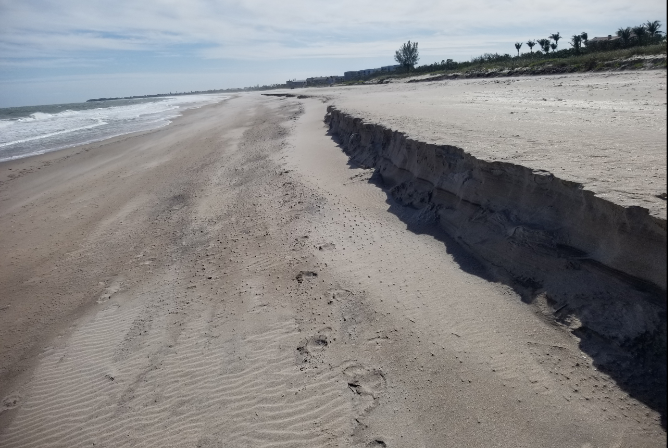
Fort Pierce South Jetty Park.
Photo by Joe D.

I've posted a lot about the Fort Pierce South Jetty Park lately.  While it is not a place where you will find a lot of treasure coins, it is interesting as an illustration of beach erosion.  It erodes a lot!  It seems like they renourish it all the time but it just keeps eroding.

Joe D. sent me these photos along with the following email message.

Just wanted to show you what i saw and why i hunted South Beach Park the other day! This was the only beach i looked at that day that had both a mid beach cut, and a firm beach with shells and rocks! While i didn't spend a bunch of time there, at least i was able to locate some coins and such!

Also, the picture of Ft Pierce South Jetty Park shows a higher tide verson of what Gaylen C. Sent that you posted! I've hunted there before, but this time i noticed that MOST of the rocks that are exposed are not from lower beach erosion (older sand erosion) but from the fill that keeps eroding from the cliff! ( newer sand erosion) It is very rocky fill and can be deceiving, in that it looks older than it is when it runs out toward the ocean! I hope that makes sense! I know its hunted a lot, and i haven't found much there at all!


I was having few issues with my detector setup that day, and was wondering if it was hindering my hunt, or weather the combination of poor conditions, and the number of detectorists that hunt the area where some of the reason for so few finds! So I hunted a park near home with same setup to iron out the kinks! I was there about two hours and did ok, and fixed some issues! ( Pic) So my conclusion is that all factors are correct!...


Fort Pierce South Jetty Park
Photo by Joe D.
There are two steps on this beach.  This is the mid-beach cut that Joe referred to.  The larger cliff is at the back of the beach.

Notice also the small wind blown sand ridges by the footprints.  The ridges will run about perpendicular to the wind direction.

This beach isn't a good indicator beach.  It will erode when there is very little other erosion on the Treasure Coast.

Rocks and Shells Near the Water Line.
Photo by Joe D.
Although the rocks are coming from the fill, they are from very old material.  I think it was dug from the intercoastal near the port, but there is definitely some VERY old stuff in that fill.


Joe's Finds.
I always recommend that you pay attention to what is being found and what is not being found.  The first thing that jumps out to me is the lack of nickels. 

---

I just read through Numismatic Archaeology of North America: a Field Guide by Akin, Bard and Akin, published 2016.  It might be OK for an archaeology student, but it didn't provide any real revelations for me.  There were a few interesting ideas, but it sure wouldn't be worth the purchase price, which is quite lofty.  There wasn't much about actual sites, and nothing about the Spanish Colonial sites or the Treasure Coast shipwrecks.  Most of the author's experience seemed to be related to shell money and Asian money found on the west coast of the United States.

One of the more interesting points was about the various uses of money.  Coins can be many things besides circulating currency.  That discussion was interesting.  A coin, as you know, can be sewn to clothing and used in fashion, or used as a votive or religious offering, and for various other purposes.

One thing they mentioned that caught my attention because I have long wondered how coins found on the beach get bent in half.   I read that coins were sometimes bent as a superstitious way of changing ones luck.  It could be that some were intentionally bent for that purpose, although I think there are ways that they can get bent by nature.  I've mentioned that once or twice before.

As is often the case, the bibliography of the book is the biggest value of the book.

If you want to read about Treasure Coast treasure hunting in general, there is one book that I recommend above all others.  It is The Rainbow Chasers Tricentennial Yearbook by T. L. Armstrong and Tommy Gore.  It is published by Sigmum Ops.  240 jam packed 8.5 by 11 pages.

---

Pirate Fest starts today at Veterans Memorial Park in Fort Pierce.  It runs Feb. 2 through Feb. 4.

---


... The FBI once sent a high-level official to Facebook, begging for some of its personal information — information on private citizens...

And now, besides having our phone numbers and addresses and birthdays and a list of our friends and our personal histories and our credit-card numbers (if we use it for Facebook “boosts”), as well as logging what we read and chat about, Zuckerberg’s company is ready to sell hardware with microphones and cameras that would be placed in your home. Meanwhile, both Facebook and Twitter send certain posts to target customers who they deem are extremists to counter their views....

Here is a link for the rest of that article.

http://spiritdaily.org/blog/commentary/little-big-brother

I don't use Facebook.  I very much resent how companies such as Facebook and Google try to get as much of your information as they can.  They don't need that second phone number, or any phone number for that matter, and they don't need your social security number unless you do a certain amount of business, but they'll get it if they can.  If there is anything to resist these days, I would rank that as being one of the top ones.

---

I don't expect any real change in beach conditions today.  We are still having big tides.

Happy hunting,
TreasureGuide@comcast.net


Thursday, February 1, 2018

2/1/18 Report - 1715 Fleet Burials Question. Gold Treasure To Go On Display. Recovered Treasure Hunter. Shipwrecks.


Written by the TreasureGuide for the exclusive use of treasurebeachesreport.blogspot.com.


I'm going to catch up on some miscellaneous items today.

In an email message Gaylen C. said, Have been doing some research and have noticed that in everything I have read so far there has never been a single mention of finding a grave, or even remains, of the Spanish sailors and soldiers of the 1715 fleet wrecks. Of the say 700 who died, some percentage of them washed up on shore. More died after the camps were established. Some must have been buried somewhere on land. Certainly any burial by the Spanish would look very different from an Ais burial. Have you heard of any of the remains of the Spanish being discovered?

I talked to a few people about this and asked a couple of people and didn't come up with much.  One thing I did find was this from a National Parks Service web site and mention of human bones at the Higgs site found in Tequesta (See link below.).

...The earliest episodes of Spanish, French, and English settlement on the eastern shore of North America followed voyages of exploration in the 16th century. The original attempts at colonizing were made in Florida, the Carolinas, and Virginia. In 1565, the first lasting European community was established by the Spanish on the east coast of Florida, at St. Augustine, which survived attack from competing forces in colonization of the New World. An essential feature of the fortified settlement was the Roman Catholic mission church with its associated burial ground. Where they are uncovered in the course of modern day improvement projects, unmarked burials of the 16th and 17th centuries provide evidence for identifying the historic locations of successors to the founding church sites that gradually disappeared in the layerings of later town development. The archeological record shows shroud-wrapped interments were customary in the city's Spanish Colonial period. Traces of coffins or coffin hardware do not appear in Colonial burials before the beginning of English immigration to the area in the 18th century. Graves of the Spanish colonists occurred in consecrated ground within or adjacent to a church. They followed a pattern of regular, compact spacing and east-facing orientation. These characteristics, together with arms crossed over the chest and the presence of brass shroud pins are a means of distinguishing Christian burials from precolonial Native American burials sometimes associated with the same site...

And here is the mention from the Tequesta article.  

Charles D. Higgs," local historian, came close to discovering its presence some 25 years ago, but although he found quantities of both European and Indian artifacts buried in the site, he failed to associate it with the wreck of the Plate Fleet. His examination revealed for 500 feet along the beach in the wind and tide-eroded bluff a concentration of bones, both animal and human, iron spikes, clay pipes and a peculiar assortment of pottery sherds. On the higher land he discovered evidences of building materials - bricks of red clay, shell mortar and plaster, decorative and roofing tile and wooden stakes..

Here is that link.

http://digitalcollections.fiu.edu/tequesta/files/1966/66_1_02.pdf

I don't know what happened to all of those deceased.  You'd think it would be taken care of as quickly as possible considering the hot humid weather and survival conditions.  I haven't heard much about any graves or remains being discovered other than the above.  If you can provide that information, send me an email.

---

SANTA ANA, Calif. – More than $50 million worth of gold bars, coins and dust that's been described as the greatest lost treasure in U.S. history is about to make its public debut in California after sitting at the bottom of the ocean for more than 150 years... 

Below is the link for more about that.

http://www.foxnews.com/us/2018/01/29/gold-treasure-recovered-from-1857-shipwreck-to-make-debut.html

The remains of a risk-taking treasure hunter who vanished in June searching for $2 million in buried gold have been identified, authorities said.

Eric Ashby was presumed to have drowned in a rafting accident on the Arkansas River in Colorado last June, Fox 21 Colorado Springs reported. A month later a body was found downstream. Last week, a local coroner announced that the body had been positively identified as Ashby’s through DNA...


Here is that link.

http://www.foxnews.com/us/2018/01/29/body-found-in-arkansas-river-in-june-identified-as-colorado-treasure-hunter.html


Thanks to Dean R. for those links.

---

Two shipwrecks, including one possibly dating back to the 14th century, have been found at the bottom of the sea as part of a project to open a new maritime museum in Stockholm...

https://www.thelocal.se/20180126/swedish-divers-find-two-new-incredible-shipwrecks-in-the-baltic-sea

-------

We are still having some unusually high tides along with some excellent negative tides.  The surf on the Treasure Coast is running around three to five feet.

Happy hunting,
TreasureGuide@comcast.net