Tuesday, January 7, 2020

1/7/20 Report - Beach Reports and Photos. Beach and Coin Layer Diagram. Falcon 9 Launch.


Written by the Treasureguide for the exclusive use of treasurebeachesreport.blogspot.com.


Frederick Douglass Beach Monday Morning
Photo by Steve M.
Steve M., who visited Turtle Trail and sent photos to the blog Sunday, visited Frederick Douglass beach yesterday and sent photos and the following report. 

My wife and I went to Douglas beach about 9:30. Hadn’t been here in weeks so not sure how it has changed. An old cut about 4 foot.High tide hits it. Mostly trash and modern coins. Surf is 3 foot and calmer winds today. Real nice cool day.


Frederick Douglass Monday Morning
Steve M.
You can tell a lot from the photos.  Notice the convex beach.  That is not a good sign.


Frederick Douglass Beach Monday Morning.
Photo by Steve M.
Also notice all the little shell pieces.


Frederick Douglass Beach Monday Morning.
Photo by Steve M.

Alberto visited Turtle Trail yesterday (Monday).  Here is what he said.

Read today's post and saw the photos by Steve M. I stopped by TT on Sunday afternoon and saw the cuts and figured maybe Monday early am they might be better, didn't happen like I thought see attached photos. There were 3 other detectorist already hunting at 8 am. I tried but nothing. 


Turtle Trail Monday
Alberto S.

Cuts on the front of the beach like that show very little sand being moved -  It is just a little stirring of sand on the front beach.

Seems like a good time to look at a simplified beach diagram.

Here is a diagram of a beach having high dunes at the back and a flat beach in front of that, which then slopes down into the water.

In relatively calm surf, you have small waves that vary little from the water's surface.  A small cut might be created as shown above.  In that case, the water simply moves a little of the sand down the slope a little way.

The red areas are where the layers of older coins are in this case.  There is a layer from contemporary salvage efforts in the dunes, typically buried about two feet.  A layer under the back beach, which could be deposited either by coins eroding out of the slope at high surf or being washed up during high surf and erosion.  That layer can be changed from time to time as erosion occurs and then the layer is covered again.  Then there is the deepest layer near bedrock, which was exposed during extreme conditions in the past.

For the layer in front of the dunes to be uncovered the erosion has to be farther back than the erosion shown in this diagram.  Coins can end up on the surface when the back dunes erode too.  High surf can undercut the dunes and coins slide down onto the beach, where they can stay until the get covered again.  They can also be swept out into eroded areas on the front beach.

The coins at the deepest layers have to be uncovered before they can be washed up onto the beach.  The amount of sand in the water is important, because it protects those layers and protects the beach.

I just wanted to show that the majority of the time, the various layers of older coins and things are covered.  It takes a good bit of movement to uncover the coins in the water so they can be washed up.  It also takes erosion moving back and deep for mid-beach layers to be uncovered.  And it takes the water eroding the dunes for those coins to reach the beach.

Most of the time the water is only moving the same old sand in and out in the most active area and not affecting the old coin bearing layers at all.  Notice that the green area where the most movement of sand occurs does not touch any of the coin layers (red).

I think the diagram shows something like what was seen at Turtle Trail the past couple of days.

Of course the diagram is a crude oversimplification, but I think it might still help a little.

---

The 9:19 PM Falcon 9 launch from Cape Canaveral was very brightly seen over the Treasure Coast last night.   I saw it, as did my 93 year old mother, who reminisced about how as a child she used to marvel at any airplane flew over their rural area.

You can see many nice photos and articles about the launch online.

https://www.floridatoday.com/story/tech/science/space/2020/01/06/spacex-vaults-falcon-9-to-orbit-from-cape-canaveral-with-60-more-starlink-satellites/2826868001/

---

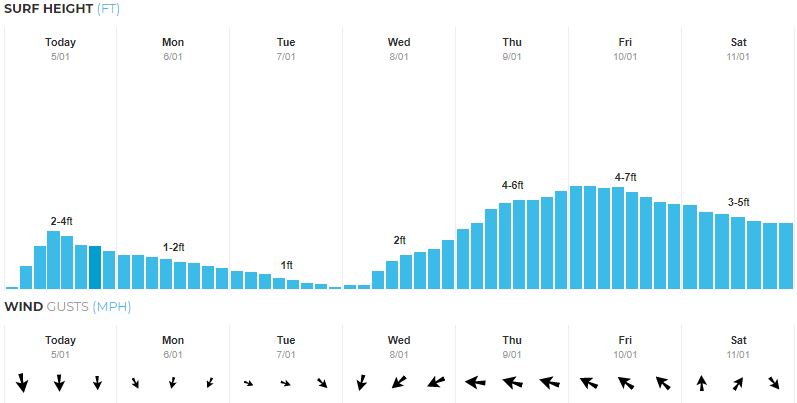
Today the surf is still small on the Treasure Coast.  Thursday and Friday it might be more like 4 - 7 feet.

Happy hunting,
TreasureGuide@comcast.net


Sunday, January 5, 2020

1/6/20 Report - Beach Conditions Sunday. Mystery Find for ID. Time to Consign.


Written by the TreasureGuide for the exclusive use of treasurebeachesreport.blogspot.com.

Turtle Trail Sunday Morning,
Photo by Steve M.

Steve M. visited Turtle Trail Sunday morning and sent these photos and the following report.


Beach had some cuts down near the water about 2 foot.   Beach above that was still high.    About a quarter mile south of the walkover, the green bags are still visible for another quarter of a mile along the middle of the beach.   Just junk and one dime.   Several sharks teeth. Surf was 2 to 3 foot.   Very windy.   Glad I did a great modification to my headphones...   

Turtle Trail Sunday Morning.
Photo by Steve M.

Turtle Trail Sunday Morning.
Photo by Steve M.

Turtle Trail Sunday Morning.
Photo by Steve.
Finds by Steve (left) and his wife (right).
Thanks for showing the types of objects that were found Steve. That helps a lot. Steve also had a good tip on a modification that can be made to your earphones. Here is what he said about that.
I bought some headphones from Harbor Freight that have very good springs.   They keep out the wind and underwater they stay on tight.   Good modification to do.


Earphone Modification As Implemented by Steve M.

Thanks for the great photos and report Steve.  Also I think the earphone modifications is great.  I found the submersible Minelab Equinox earphones loose and noisy.  I think this will help.

---

Captain Jonah sent me the following.

My daughter and I were doing a little river hunting. Finding some neat broken bottles and glass and she dug this up. Not sure what it is or age but thought maybe you could help her ID it with years of knowledge. Thanks for any help.
Mystery Find for ID
Photo by Captain Jonah.
I haven't done any research yet, but I'm thinking the "MADE IN JAPAN" marking puts it in the 1920s or 1930s. If the normal position is as shown on the left, I'd guess maybe something like a restaurant tooth pick or condiment holder. I'm sure somebody can some up with this. Let me know what it is. --- April 29-30 will be the next Sedwick auction. Time to consign.
---

The surf will be decreasing for a few days but increasing again towards the end of the week.

Happy hunting,
TreasureGuide@comcast.net


rare and infrequent events have the largest effect.


1/5/20 Report - Piece of White City History Unearthed. More on Proto-Money. Bigger Surf Coming.


Written by the TreasureGuide for the exclusive use of treasurebeachesreport.blogspot.com.

1815 One Skilling.
Find and photo by Jeff C.

Had to pass on my find from a week ago in White City. As you know it was a settled by the Danish originally in 1839. So I was very excited to find this 1815 2 Skilling coin.. I’ve found many older coins in the area, 3 wheatbacks over 100 years old in one visit. Also a 1923 mercury dime in very good condition. Can’t help but feel the 2 skilling coin was lost by one of the original settlers due to its condition and depth. It was approximately 8-10” deep with several inches of top soil removed from the construction. Found with my equinox 600.

Congratulations Jeff. Thanks for sharing.

Here is a clearer picture of a similar coin from the internet.

1815 2 Skilling Coin.

The community of White City on the southern border of Fort Pierce is named for the utopian Great White City built by architect Daniel Burnham for the 1893 Chicago World’s Fair. The community’s main road is Midway Road after the fair’s Midway.  (Source: visitflorida.com/white-city/)

---

Not long ago I posted an article about "hoe money," supposedly a type of proto-money used in Pre- Columbian South America and Mexico.  The subject intrigued me and I wanted to find out if any had been found on shipwreck sites.  So far I've not been able to find anything about nautical or other archaeological discoveries of axe or hoe money, but I did find one very good article, Aztec Money: An Inquiry into Substance, Sources and Heuristic Value, by Kenneth D. Jacobson, University of Massachusetts.

While the article didn't answer my questions about axe or hoe money, it did provide interesting descriptions of the market place that was in operation upon the arrival of the Spanish.  It also provided thought provoking observations that you might find relevant to today's politics and economics.

Here is the link.


I'm still looking for any descriptions of axe or hoe money found on shipwrecks or other sites.

---

Somewhat related, I did find an article on proto-money, although it is about Celtic ring money, not Aztec hoe or axe money.  Still interesting.

Source: See link below.


Before coinage was introduced to Britain in the Late Iron Age, people had to conduct transactions by bartering their products, goods and/or services.  This process of payment and exchange may have been facilitated by gold “ring money” (most of which seems to date from the late Bronze Age, therefore they are not ‘uniquely’ Celtic and may not have even been used by the Celts as a ‘proto-currency’).

For example, we now know that by the 2nd century BC (the Late Iron Age in Britain) the locals were trading iron “currency bars” shaped like swords, spits, plough-shares and bay leaves.  The use of the so-called ‘ring money’ as a proto-currency may have died out well before this...
Here is the link for the rest of the article.

https://oldcurrencyexchange.com/2015/03/31/what-is-celtic-ring-money/

---

I hadn't watched any of the Oak Island curse TV show for a year or so, but yesterday happened to see that they haven't learned much of anything and are still popping off instantaneous wild interpretations of finds while ignoring any number of more reasonable alternative explanations.   It seems that anything and everything is either "searcher" or "depositor" related. whether it is a piece of wood or rusty metal.  So tiring!

---

Mike F. says he reads Japanese but not Chinese, but recognized a couple of the characters on Steve's ring as being Chinese.

Thanks Mike.

---

I've been observing changes along the Indian River lagoon for some twenty or thirty years and hope to soon discuss how things have changed and what I've concluded from some of those observations.  I need to take some photos before I discuss that topic much, but one general thing I've noticed is that the big changes are rare.  The storms that hit the Treasure Coast in 2004 dramatically changed the west bank of the Indian River and are still predominant even though there have been numerous storms and hurricanes since.   After the 2004 storms I would walk down the river and not recognize where I was.  The storms that occurred since did not cause changes that were as big or as sustained.  Some objects, such as a boat battery, that were deposited in 2004 have been visible since 2004.  I'll try to document some of that kind of thing in a post someday soon.

---

There is a little bump in the surf today, but a bigger surf is predicted in a few days.

Source: MagicSeaWeed.com
Happy hunting,
TreasureGuide@comcast.net


Saturday, January 4, 2020

1/4/20 Report - Outlaw Remains Identified. Messages From Ancestors. Ephemera. Hand and Ink. Bigger Surf.


Written by the TreasureGuide for the exclusive use of treasurebeachesreport.blogspot.com.

Source: See CNN link below.


(CNN)Bones discovered in an Idaho cave in 1979 and 1991 have been identified as the remains of Joseph Henry Loveless, a man who escaped from prison more than a century ago after being arrested for killing his wife. 


The identification, confirmed by the Clark County Sheriff's Office Tuesday, was initially made by non-profit volunteer organization DNA Doe Project, which said in a Facebook post that the "remains were preserved in the Buffalo Cave for as long as 63 years."...

Here is the link for more of the story.

https://www.cnn.com/2020/01/01/us/man-identified-100-years-later-trnd/index.html

---

I mentioned how I am going to send a selection of old foreign coins to a child that seemed to be fascinated with a foreign coin that he found.  Susan B. commented on that and how she was affected by a gift of stamps that she received as a child.

Here is what she said.


When I was young, my father introduced us to stamp collecting. In my stamp book were black and white pages of pictures of stamps for all the countries in the world, and I remember the thrill when I placed my live stamp over the print one. There was a song I’d heard whose first verse said, “Far away places with strange sounding names...are calling, calling me.”

I’ve never lost that interest in what’s out there. That’s the gift you can give by sharing your collections.

Susan B.


Thanks Susan.

When I was once in the hospital as a child, I received a bag of unsorted stamps and a album to put them in.  I still have that stamp album as well as a few more.

Stamp collecting is very much like coin collecting.  Many of the same things apply, such as the importance or rarity and condition.  I found a couple inexpensive and partly filled stamp albums in thrift stores over the years.  I like old postcards too.

I guess I was a collector or treasure hunter long before I became a detectorist.  I liked looking through barns, sheds and attics and basements to find forgotten or lost treasures, and I found a lot of things that I treasure today, including a good selection of post cards, most of which document ancestors and family members that I never knew or only knew as a very young child.

Here is a small selection of New Year postcards that I picked up many years ago.  All were sent to one of my ancestors over one hundred years ago from his relatives.

New Year Post Cards Posted 1910 - 1913.

Today many of us can easily document our family tree by doing a little internet research.  We can get our DNA interpreted, but old post cards, letters and photographs give a more personal touch and add something you can't get any other way.  Like the coins we dig up, they allow us to touch a piece of the past.

Postcard Postmarked Dec. 29, 1912.

It appears somebody removed the stamp from this one.  I wonder if I did that.  Could be.

There is a movement in education to stop teaching cursive handwriting.  I know people will be using electronic signatures and typing on electronic devices rather than writing, but there are benefits to learning cursive.  Among those benefits are the aesthetic element, personal expression, developing eye/hand coordination, and being able to read old documents written in cursive.

Ink well to fountain pen and then to paper, you see the flow of hand and ink, then delivered from one rural home to another for one cent.

I feel fortunate that things like this postcard were saved rather than discarded.  I rescued some of them myself many years ago.  It provides detail to the family tree that DNA can not.

---

John M. found this clump a couple days ago on a shipwreck beach and wondered what it might be.

Encrusted Clump Found by John M.
I told John I think it is probably an EO, encrusted iron object, and the iron might be pretty much dissolved.

---

Sourcea: MagicSeaWeed.com.

Looks like we might be getting some higher surf before long.  The tides are flat today.

I'm still hoping someone will be able to learn something about the symbols on Steve's ring.

Happy hunting,
Treasureguide@comcast.net

Friday, January 3, 2020

1/3/20 Report - Tajaderos: Mexico Hoe or Axe Money Cache Returned. New Years Finds. Roman Coin Repro.


Written by the TreasureGuide for the exclusive use of treasurebeachesreport.blogspot.com.

Source: See MexicoNewsDaily link below.


The United States returned a collection of over 3,500 pre-Hispanic copper coins to Mexican authorities in a ceremony in Miami on Monday.

The coins were used in what are now Michoacán and Guerrero between the years 1200 and 1500, according to Jessica Cascante, spokesperson for the Mexican Consulate in Miami.

A U.S. collector acquired them in Texas at a numismatic fair in the 1960s, she said, but at that time neither Mexico nor the United States was part of a UNESCO convention that guarantees the return of such heritage artifacts to their countries of origin...


Cascante did not divulge the name of the collector who obtained the coins in the 1960s, but said that he did so before it constituted a crime and turned them in voluntarily...


Here is the link for more about that.

https://mexiconewsdaily.com/news/us-returns-3500-copper-coins/


They call these coins, and they were used like coins, but it seems they evolved from tools that were bartered to being used as coins with a fixed value.  Columbus, on his fourth voyage, encountered native traders carrying a large stack of these, and Cortes described the natives using trajaderos in the 1520s.

One source values the "hoe money" or "axe money" at 8,000 cacao seeds.  Another source describes the four of the tajadero as being worth on reale.  The items are unmarked and seem to vary in weight and size.

The shape varies with the location and what you see at the top of this post looks like it might have been from West Mexico.

Similar tools seemed to evolve in proto-money in different parts of the world including, for example, China.

Here is a good resource for more information about "hoe money."

http://www.moneta-coins.com/library/Hoe%20Money%20of%20the%20Americas%20-%20Martin.pdf

I'd be glad to hear of anyone who can point to any examples being found on shipwrecks.

---

Ring and Coins Found by Joe D. On New Years Day.
Photo by Joe D.

Here is how Joe described his hunt.
  

I went out this morning (Jan. 1) before sunrise again! I was determined to start the New Year right! Since the inlet beach is now ruined, i went South a little to have a look! First beach was a total bust, and just a few pop tops after an hour and a half, and multiple passes! The pop tops where all in the shell line! I finally gave in and moved to another beach up the road!

      A few swings in i got a little redemption with a small ring, missing the stone! I think it may be pewter; and not silver, due to the way it looked after cleaning! There are no markings, and it hard to say how old! 

      I only found several newer coins, pop tops, and lead fishing lures after that, and it was time to call it quits!    But good enough for the New Year!


Ring Found by Joe D.
It has a heart on each side of the setting, and it looks like the stone was heart-shaped.

Thanks for sharing Joe.

---

Susan B. was researching Sharon's Roman looking coin and found the following nice site.


Here is what Susan said.  Reverse:  The coin (if it is real) is from Dacia. (See the word “Dacii” just beneath the line near the bottom.). Although it is somewhat the worse for wear, I found on Google Images a Reverse that is close to Sharon's coin.

Here is the link Susan provided.


Thanks for the research Susan.   Everybody benefits from the research.


Just a little later I received a the following email from Sharon.

I took my coin to a coin dealer to be checked out. Unfortunately, it’s a fake electroplated Denarius Roman Coin. He said if it was real, it would be worth $50. So I guess I’m back to hunting, but for a gold coin this time.

Thanks for your help.

Sharon

Thanks for letting us know the outcome Sharon.
--- I hope someone can help Iowa Steve with the marks on his ring (See yesterday's post.). Let me know if you can identify the language or anything. The Treasure Coast surf is still small and the tides pretty flat. We will have some higher surf before long though.
Source; MagicSeaWeed.com
Happy hunting, TreasureGuide@comcast.net

Thursday, January 2, 2020

1/2/20 Report - Gold Coins Found in A Broken Piggy Bank. Mystery Ring. Passing It On


Written by the TreasureGuide for the exclusive use of treasurebeachesreport.blogspot.com.

Source: TimesofIsrael link below.


A hoard of seven ancient gold coins was found hidden inside a small clay juglet during a dig in the area of Yavne, in the central region of the country, the Israel Antiquities Authority said Sunday.

The coins date back to the Earlier Islamic period of the seventh-ninth centuries CE. They were found last week at the entrance to a kiln at the site.

“This may be a potter’s personal savings,” the IAA said in a statement. The jug, which was partially broken, “may have been a piggy bank,” it said...


Here is that link.

https://www.timesofisrael.com/ancient-piggy-bank-of-gold-coins-uncovered-in-yavne-dig/


Jerry P. sent this link to the same story.

https://www.dailymail.co.uk/sciencetech/article-7840507/Hoard-1-200-year-old-Arabian-Nights-gold-coins-discovered-Israel.html

---

Iowa Steve sent the following message and photo.


Got a nice 1917 Walking Liberty half dollar last Sunday in a soybean field
where there used to be a train station. Silver ring last Friday in another
bean field where there used to be a one room schoolhouse. Attached is the
picture of the ring which has some strange writing on it that I can't
figure out. Any idea what language it is?


Ring Found by Iowa Steve.
Photo by Steve.
Can anyone tell the language or significance of the marks on this ring?   Let me know.  It would be interesting to find out something about whoever might have been in the field.

---


A few relatives were visiting with my wife's family on Christmas Eve.   One of the young children was excited with a coin from Aruba that he found in change.  That was the sign I had been waiting for.  I didn't say anything yet, even though I knew what I would do.

I've asked in this blog for ideas about what to do with the miscellaneous foreign coins before.  I received a few ideas, but so far had just kept the coins in waiting.  Now I knew where at least some of them would go.

I'll select a few to send to the boy that showed interest.  We'll see how it goes from there.  Time will tell.

I was surprised that my wife, who has never shown any interest in those foreign coins, started looking at them and got interested too.  I'm sure she was looking at them with a view of sending them to her young relative, but she was amazed by how many different countries there were.  She occasionally asked questions, like which country minted a particular coin, and about the denominations etc., and she was even making a list.  While answering her questions, I realized how much I had learned from those coins.   I had never really thought much about that before.

People miss opportunities simply because they do not share their enthusiasm and interests.  This little boy will be receiving an unexpected gift simply because he openly shared his excitement.  

The Bible tells us to offer hospitality to strangers because we might "entertain angels unaware."  The Anglicized Aramaic word "malachi" refers to messengers, both human and supernatural, as does the Greek word "angelous" of the Septuagint and New Testament.

Art McKee was known for his generosity and willingness to take time to give personalized tours of his museum.  He told about how one day a car of tourists stopped in the museum parking lot when the museum was closed.  Art happened to be there, and asked the visitors if they knew what this (referring to the museum) was.  The driver of the car, not knowing who Art was or what offer was about to be made, gave a quick unfriendly answer.  Art turned and walked away, and the visitors missed an opportunity to receive a personalized tour of Art's museum.  If they had only been a little more open and friendly, they would have received the gift.  Many a helping hand or offer of assistance is unwittingly turned away by a cold or unfriendly shoulder.

It goes both ways.  You can unwittingly miss an opportunity to receive by being unreceptive, and you can miss an opportunity to be a blessing.

The past few days I've described how people have generously helped others with objects or information.  It has been said that we do not own the treasures we find, we are only care-takers.   

I believe that an escudo I found was probably lost and found three times.  It was lost, salvaged, put on another ship that sank, salvaged again many years later, sold by one of the treasure companies and lost and found again.  

All of the items being salvaged from the shipwrecks today were lost at least once, and a few of them will be sold and lost again.  We don't know how many times a particular item might be lost and found.

When you get older you might think more about what to do with things you can' keep forever.   Some of those items will be passed down through the generations.  Maybe you shouldn't wait.  When you find the right owner, it might be time to do something about it.

---

The tides are small now on the Treasure Coast, as is the surf.  That should open up some opportunities.

Happy Hunting,
Treasureguide@comcast.net

Wednesday, January 1, 2020

1/1/20 Report - Happy New Year. History and Calendars. Beach Conditions and Finds. Nice 1965 Report on The Nieves Wreck Site.


Written by the TreasureGuide for the exclusive use of treasurebeachesreport.blogspot.com.

Passing It On.
How time flies.  The above photo was taken some time back in the 1980s.  The little boy is now a middle-aged man, and the other person an old man.  It happens faster than you expect.

I received a great email from one reader that made me think about how we keep track of the years and decades.  He brought up a great point concerning that.

The way I look at things, and I remember telling a psychology class the same thing back in the 1970s, "You can only be accurate to the extent you are willing to accept inaccuracy."  What I mean by that is you can not be totally precise because there is always another level of precision to be achieved.  You might say your weight is some round number, but if you want to be more precise and can measure much more accurately, you'll find that your weight is constantly changing.   As another example, a table might be said to be flat, but if you look at it much more closely, perhaps with a microscope, you'll most likely see that it is not completely flat.  Then taking it to another level and looking even more and more closely, the surface will dissolve into  molecules, atoms, etc. and it will look like there is nothing solid or stable about it at all.  Only in a very general sense is it flat.

If I asked you how many days are in a year, most people would probably say 365, but a solar year is closer to 365.2422 days, which is why we have a leap year to partly correct for that.

But it gets more interesting than that.  Adam didn't start cutting notches in some tree where man has been keeping track of the days ever since.  In fact the Gregorian calendar, which has become something of an international standard, was instituted in 1582, long after the discovery of the New World.  The Gregorian calendar replaced the Julian calendar, but was adopted in different places at different times.

The Roman calendar started the New Year with January 1st being in the Spring, but the Gregorian calendar put January 1 as we have it now, in the winter.

Both the Julian and Gregorian calendars are inaccurate as compared to the actual solar year  I briefly referred to that above.

I'm going back to the seemingly contradictory statement I once made in a post last year, "The more I learn, the less I know." The discussion above might make that statement a little clearer.  You find out that your "facts" weren't as accurate as you thought, and you delve deeper into the unknown.

We generally don't delve deeply into things.  We can function and are happy with a generally acceptable level of approximation.  That is sufficient for daily activities, but but when you try to be as precise as possible, you'll find yourself getting into greater and greater depth and complexity.  You can chase precision, but you can't catch it.  There is always another step.  To me there seems no end to it.  It is infinite and amazing.

So Happy New Year!

---

DJ sent this photo of Turtle Trail as it looked yesterday.


Turtle Trail 12/31
Photo by DJ

DJ described his finds as "paltry" and included the following report and photo below that.


The most notable for me is the “almost looks like an arrow head. “ thing.

And the middle black round item. Hoping it’s a button. It’s magnetic and rang as iron.

The round silver item is what I think is a corroded button battery. Very light.

Tossed out about four stainless deck screws and two hair clips.

TurtleTrail has more dips and scallops but hardly any targets. Just found sea glass . Seagrape seemed less eroded but it is where I found most of the stuff.

The penny and the silver and gold thing was found in a line but nothing else around it or in line with it. I think I was too early still a good day, lots of walking
D Justice


Things DJ Picked Up.


Nice bunch of shells to look through.


DJ also sent me a link to a study of the Nieves wreck site that was authored by Carl Clausen and published in 1965.  I think most of you beach hunters will find it very informative.

For example, you'll find this diagram of the wreck site.

Nieves Wreck Site Diagram
Source: See FloridaMuseum link below.

Of course there is much more to see in the report.  Many of the artifacts are described and illustrated.

Take a look, but remember, much more has been found on the site since 1965.

Here is the link.


Thanks DJ.

---

Sharon says she'll let us know what she learns about her "Roman" coin after she takes it somewhere.

You might find the history of calendars enjoyable if you want to look into that some more.

On the Treasure Coast the weather is very nice.  There is some coolness in the air.

The surf is small though, and conditions aren't great.

From the photos, there does appear to be some places where you might have some luck looking through shells.  DJ found some sea glass, for example.

Happy New Year,
TreasureGuide@comcast.net