Showing posts with label deep targets. Show all posts

Wednesday, July 13, 2016

7/13/16 Report - Scoops and Other Recovery Techniques For Various Difficult Situations.


Written by the TreasureGuide for the exclusive use of TreasureBeachesReport.blogspot.com.

Alternate Scoop Design For Deeply Buried Targets In Shallow Water.


A couple days ago I mentioned a target that was too deep for me to recover. Deep targets in the water and near the water can be difficult to recover.  Most people live and die by the scoop even though there are other good tools and techniques that can be effective.

The scoop on scoops is that the technology hasn't changed much in decades. There are some that are bigger and there are some that are stronger, but they really haven't changed much.

There are a variety of types of scoops, but they all work pretty much the same.  The scoop can be bigger or smaller and maybe shaped a little differently, but that is about it.

Years ago I described the benefits of having a wood handle and the disadvantages of metal handles. You don't see many scoops with wood handles, but a few manufacturers now offer scoops with wood handles.  I'm surprised more people don't use them.

It can be very difficult to recover deeply buried targets in soft or silty sand especially when there are currents.  Sometimes a scoop just won't work.

One method that will work at times is using your scoop like a hoe and fanning with it.  You can put down your detector, turn your scoop over and frantically hoe with it.  It can be tiring but you can really move a lot of sand that way.

If you are working in loose sand or silt and currents, trying to get too much sand in your scoop can actually work against you.  If you lift a heavy scoop full of sand out of a depression quickly, it will cause currents that suck the surrounding sand back into the hole.  Lifting a full scoop quickly will also cause the some of the sand and possibly the target to fall off the front or top and back into the hole. There are techniques to reduce that effect.  I've discussed those before.

After assessing the situation and getting a good idea of where the target is, you might choose another technique that often works well.   Put down the detector and scoop, get down on your knees and work your hand down through the sand and feel for the target.  This often also works very well on the beach when the target is under the water table.  This technique is not as easy when there is a layer of shells.  Be careful not to cut your hand on glass or other sharp things. You might be surprised by how easy it is to work your hand down to feel the target.

One technique I prefer is foot fanning.   You can move a lot of sand, as well as shells and rocks and other things - even when the bottom is packed rock.  Foot fanning, is one of my favorite techniques when a lot of sand needs to be moved to get to the target in water.  It can be tiring.

Some of the best hunting you might ever find occurs when there is a rock bottom.  Most other techniques can be nearly impossible when that happens.  Fanning will pick the sand up from between the rocks, and then the loosened rocks will come up.

Again you have to be careful.  A fishing lure can pop up and stick in your foot.  Therefore it is best to have some type of foot wear.

In every case, determining the targets location, depth and size, will help a lot.

If you are wading and have a long handled scoop, use the handle to support yourself, and then frantically fan with one foot until you have moved enough sand.
One challenge for recovering deep targets with a scoop in moving shallow water is getting the scoop to penetrate into the sand far enough.  I've found that I can wiggle the scoop as I push it in and continue working the scoop down down through the sand.  It will then be tough to pull the scoop out, but it can be done, and if done correctly can get targets from deeper layers.

Just pushing a scoop into the sand doesn't get you very far.  And the hole can refill nearly as quickly as you dig out the sand.

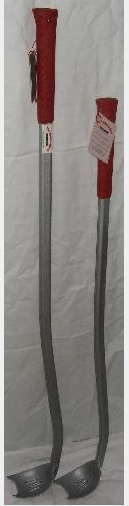
Rock hounds use another type of scoop.  You can see it here to the left.  These are about three feet long.

These are called treasure scoops, but as you can see, they don't have much of a scoop and aren't made for sifting.  They are good for collecting surface finds, but they would also be useful in other situations, such as reaching in under bushes, roots or rocks.

It is difficult to get a regular scoop pushed down through the sand to deeper layers. The type of scoop shown here will penetrate more easily and deeper, but you really have to pinpoint very accurately to be able to pull a small target out.

I won't discuss things like dredging or air lifts now, since detectorists usually can't use those techniques, but I've played with a few different designs specifically designed for recovering deeper targets in difficult situations.

At the top of the post is a illustration showing a tube, much longer than a typical scoop, that can be pushed down into the sand.  I've imagined a screw type mechanism to move the sand and articles up and through the tube, but haven't worked that out.  Probably a more practical method would be to leave the back of the tube open until the tube is suspected to be around the target, then the back of the tube closed before the tube is withdrawn.  That might pick up the material in the tube.  I can think of a couple other ways to try to make that work too.   I'll have to do a little testing.  I have some other ideas I won't mention at this time.

By the way, a rake or tool with tines can work better than a scoop when the target is a chain.

For now, my best overall technique in shallow water, and one that requires no additional equipment, is foot fanning.  Like with every technique, there are some tricks that you can learn to make it more effective.  It is almost always effective, but can require a lot of energy.

---

I hope you will respond to the blog post that you will find on the main blog display.

---

It sure has been hot.  I'd like to see something change.

Happy hunting,
TreasureGuide@comcast.net


Tuesday, June 9, 2015

6/9/2015 Report - Rare Indian Head Penny Found. Olive Jar & Musket Ball. Deep Quarters.


Written by the TreasureGuide for the exclusive use of treasurebeachesreport.blogspot.com.

1872 Indian Head Found by William M.
Photos by William M.


William M. made a very rare find.
He found this 19th Century Indian Head, which is a rare key date -  1872.

You can see what the coinstudy.com site says below.  The 1872 is one of the most rare Indian Heads.  In fact it is so rare, that even worn coins bring a minimum of $80, and the price quickly escalates with condition.


Great find William!

Congratulations and thanks or sharing.


-----

Joe D. sent in a report on the Palm Beach beaches.

Hello, your description on the 6/6 post pretty much matches Palm Beach now. I took my son today to hunt for sharks teeth that were recently discovered after the renourshment. Many people had obviously  been doing the same! I've got to say that I was shocked at the amount of holes that were dug and left open on the beach! Some of the holes were huge! Others were small but deep enough to break an ankle. The sand is full of shells and coral, and is much harder packed than original sand! ...  I think we spent more time covering holes than we did hunting! I Guess we will see what happens here! All the old finds are covered under a million cubic feet of sand now anyway!

Thanks for the report Joe, and for covering holes even though they weren't yours.  Even when a hole isn't dug by a detectorists, detectorists might get the blame.  We don't need that.

----


Olive Jar Bottom And Musket Ball Found
By The Crew of The Capitana.


Yesterday I showed a cannon ball found by the crew of the Capitana on the Treasure Coast.  Here is an olive jar bottom and musket ball that they found.


----

I went out to the beach early Monday morning to do a little detecting.  As soon as I got there I could see it was no different than the three South Hutchinson Island beaches that I showed you on the sixth.

The front beach was higher than it was a few months ago.  And it was littered with sea weed.  Very few shells.

Here are a couple of pictures showing what it looked like.

Treasure Coast Beach Monday Morning Near Low Tide.

I did a little detecting even though conditions looked poor.  I scanned the front beach just to see.

Every target was deep.  The first three or four targets were too deep and close to the water to be removed.  The hole kept filling before I could get the target out.

I did eventually get a few quarters.  They were all a foot or so deep.  It was unusual to get quarters and not hardly any other coins.  I figured that was because the smaller coins were too small to detect that deep.  I'm not absolutely sure any smaller coins were there but it would be unusual for such a high proportion of quarters, so I'm guessing that most everything, including the quarters were under about a foot of sand, and the smaller items weren't detected that deep.

If you pay attention to target depth and what you are getting as well as what you aren't getting, that will help you analyze just what is going on.

Also check the holes for any layers of different types of sand or shells or whatever.

There were no layers visible in the holes this day.  It was all one thick layer of the same type of fine brown sand, undoubtedly accumulated over the recent weeks of unchanging calm surf.

I didn't have much hope of finding much of anything very good, but managed to find one piece of gold, which was only and inch or so deep - evidently a recent drop.

I'm going to be talking more about analyzing a detecting site and how it might have developed  over time.  If you get a good idea of what has been going on, you'll have a better idea of where to spend your time and where you shouldn't spend your time.

As usual, the dry sand had very little.  There were few good targets and very little junk.  As I said recently, some of these beaches have been cleaned up.  I'm proud of how little junk is left at some of these previously junky beaches.

----

A boy was bitten by a shark off Daytona Beach on June 7.

http://abcnews.go.com/US/boy-bitten-shark-florida-beach/story?id=31594612

Shark bites do occur but they are probably much more rare than you might think.

I've seen a few while I was in the water.  One was very large, but seemed startled by me and went the other way.  I always wondered if he didn't sense the metal detector pulses.  Or he might just have left for some unrelated reason.

----

A nuclear physicist and an archaeologist at the University of York have joined forces to produce a unique appraisal of the cultural significance of one of the world’s most important locations for scientific inquiry.

In a paper published in the journal,Landscapes, Professor David Jenkins, of the Department of Physics at York, and Dr John Schofield, Head of the University’s Department of Archaeology, have investigated CERN, the home of the Large Hadron Collider on the Franco-Swiss border.


Situated between the Jura Mountains and the Alps, CERN was established in 1954 to promote peaceful co-operation between nations still recovering from the Second World War.
The study, the product of a visit to the complex near Geneva, focuses on physicality of a location of which researchers say: “It is hard to think of anywhere more significant for all of humanity.” They describe this as an archaeological enquiry, with the buildings, the equipment within them, and a range of everyday objects at the center of their research.

Here is the link.
http://www.york.ac.uk/news-and-events/news/2015/research/cern-heritage/
Is there anything that they do not or will not consider to be an archaeological site?

---

It looks like we'll have another week of calm surf.

Happy hunting,
TreasureGuide@comcast.net

Monday, January 26, 2015

1/26/15 Report - Poor Beach Conditions For Finding Older Items On Treasure Coast Beaches.


Written by the TreasureGuide for the exclusive use of treasurebeachesreport.BlogSpot.com.

One Treasure Coast Beach Yesterday Near Low Tide.
Another Treasure Coast Beach This Morning Just After Low Tide.
Beach conditions were pretty much the same at the different beaches that I saw this morning.
They had small cuts up near the high tide line, while the front beaches were built up.  The front beach continues to accumulate sand.

I got rained on this morning just after my batteries started to get low.

The beach shown in the second photo had a small cut near the high tide line.  If you look at the upper left part of the photo, you can see it in the background.  It was just over a foot high at the highest.

The front beach on this beach was broad and flat this summer.  Now there is a good bit of sand over that.

I did a little (very little) detecting at this beach this morning before the rain came and my batteries ran low.

You can see a nice dip in the water in the second photo.  Notice the deeper water between the white water.  That would be some place to check, although I wouldn't expect much there.

The wet sand did have some targets on this heavily detected beach, but they were deep.  Both junk and good targets were deep.  I have no doubt that this beach has been detected a lot, and mostly only deep targets remained.

The bad thing about having to dig deep targets in the wet sand is that sometimes you can't get to them.  I had to leave some this morning that were too deep to recover down near the water.

Big Lots has some pretty good prices on AA batteries.

K-Mart was charging $14.99 for four rechargeable batteries.  Staples was two dollars cheaper for four rechargeable batteries.

You can get a pack of four "low drain" batteries at Dollar Tree for one dollar, but I haven't tested them well enough to say if you should use them in a detector.  They seem to work OK in the Ace 350, but I haven't really measured performance with those batteries well enough to say if the performance is just as good.  They do work.  I can say that.

On the Treasure Coast we're supposed to have around a two foot surf for the next couple of days.  The wind will be from the West, then it is supposed to turn and come from the North.

I heard that a couple of fronts and cool weather is coming.  That is all for now.  I'll probably add some to this post later today.

For now, Happy Hunting,
TreasureGuide@Comcast.net

Saturday, July 5, 2014

7/5/14 Report - Little Diamond Sparkler Find & How To Recover Deep Targets In Moving Water and Mushy Sand,


Written by the TreasureGuide for the exclusive use of treasurebeachesreport.blogspot.com.


Little sparkler found on the 4th.
You might recall the cobs recently recovered from the Green Cabin Wreck that Captain Martinez of the Capitana showed us not long ago.  Neither showed the denomination, but both are eight-reales.

Captain Martinez said both of those cobs are in the lab now and he'll send more info on them when he gets it.  He also said he'll be sending photos or new finds too.


On the Treasure Coast the seas are still calm.  I did a little hunting Friday morning near low tide.  Some people were out very early to reserve their place in the sun.

In the dry sand were a good number of shiny new clad coins, with just a couple discolored ones.  You can always expect at least some new drops on hot holiday weeks.   It appeared that at least 80 percent were recently dropped and did not show any effects of weathering. 

Now there will be all the new debris from fireworks to deal with on the beaches, such as sparkler wires.

I also sampled the wet sand and shallow water.  The wet sand didn't produce much besides some junk jewelry - no coins and no aluminum. 

There was a lot of sea weed piled up on the beach front and also in the shallow water.

The shallow water produced some junk jewelry too, and one good target (See above.), which was deep and took quite a while to recover due to its depth and the moving water and sand that kept filling the hole.

I stuck at it though.  It always really bugs me to have to leave a target giving a good signal just because I'm not able to get to it. 

While trying to recover that good target I thought of some tips that I should give you for recovering deep targets in moving water and sand in the shallow water. 

The small waves were breaking over the bar just to the East of me and then rushing over the dip, which is where I was trying to recover the target in semi-mushy sand.  It wasn't the most mushy I'd ever seen, just not firm.  The top layer was fairly thick and without any course shell sand.

Anyhow, here are some things to try when trying to recover deep targets in moving water and mushy sand.

First switch to pin-point mode and get a good fix on your target, noting both the position and depth of the object.

Second, remove a scoop of sand right over the deep target.  That little hole will serve to mark the location visibly, or if the visibility is not good, you  can relocate the hole quickly and easily by feel with your foot. 

If the water is rough enough and deep enough to make it difficult to stay in position (it wasn't Friday) try to keep one foot planted at the edge of the hole to keep yourself in good position.

Now, it is time to move sand.  If you got a good fix on the depth of the target, you have an idea how much sand you need to move.  If it is a lot, then I'd recommend foot fanning.

Plant your non-predominant foot (I'll assume you are right handed, or footed.) to the left of the small hole.  Don't anchor your foot too close to the hole because the hole will be expanding.

Take your long-handle scoop and anchor it to the left of your left foot so you can lean on it while trying to stand on one foot and fanning wildly with the dominant foot. 

Once you feel firmly set, start moving your right foot back and forth over the center of the hole until you have fanned enough sand to be getting close to the object.

Warning: doing this bare foot can result in things such as a fishing lure popping up and getting stuck in your foot.  I know.  It is best to have some foot cover.  A trimmed swim fin is excellent for moving a lot of sand.

Check the hole with your detector.  Still in pin-point mode, angle the coil up at about a 45 degree angle and face the coil over the sloping sand on four or more sides of the hole.   If the signal is louder when the coil is angled over the left slope of the hole than when it is over the right hole, then you have a good indication that the object is not in the exact center of the hole but off to the left a little.  If that is the case, or if the hole has expanded so that your left foot is now in the hole, readjust your stance farther to the left.

After fanning a lot of sand, if you fanned too much, the object can now be on the slope of the hole or even outside of the hole, so check with your detector once in a while to see if the target moved.  If visibility is good, keep watching for the target to show up.

The ideal is to fan just enough sand so that the target is just barely covered.  Then use your scoop to scoop it up.    (That is why your estimation of depth is important.)

 If you try to scoop up the object while it is deeply buried, you can scoop it up with so much sand that the object will be on top of a scoop full of sand and can fall out over and over again as you lift it through the moving water.    That is especially true of light objects as well as gold chains. 

Gold chains will very often slide out of the front of the scoop unless you get the entire chain well in the scoop, which is not easy.

Light objects like pull tabs can slide off as you raise the scoop of sand through the moving water.  Light objects like that can also be moved a good distance with the moving water when they fall out of the scoop.  It can take a little time to relocate them.  They will tend to be moved in the same direction as the moving water.

If a target moves a good distance after you try to scoop up, there is a good chance that it is aluminum.
A heavier target won't move as far when you lose it and will often fall back down into the hole.  A target can slip down the side and get reburied by sand refilling the hole.  That can result in the signal becoming more faint.  You might have to take time to relocate the object.

Despite the fact that you are trying to get deep, it is better to not over-fill your scoop when trying to scoop up a deep target in a hole. 

Also, before lifting the scoop, give it a little time and shake it a little while the scoop sits in the bottom of the hole to let the target settle better into the scoop.  Then when you lift the scoop, not so much stuff will slide out as the scoop is lifted.   If your scoop sifts fast that will help too.

I didn't know there was going to be so much to this when I started typing.

The process can be much easier if you have good visibility and can get a look at what is happening under water.  A snorkel mask can help.

One thing I want to emphasize is how to angle your coil up along the various slopes of the hole to identify the position of the object relative to the center of the hole.   When the hole is smaller all you need to do is put your detector in pin-point mode and place the coil angled up the slope from the center of the hole in four or more directions.   If the hole has become bigger, you can sweep up each of the slopes.  There is the possibility that the object has been moved up the slope or even out of the hole, as well as the possibility that it is still buried below the hole.


 A good fix on the location of the object can save a lot of work.  


Thursday night Hurricane Arthur came ashore near the southern end of the Outer Banks as predicted.  

http://news.yahoo.com/hurricane-arthur-scythes-outer-banks-north-carolina-072924809.html

That should have given the guys up there a good opportunity.  Hope they are all safe.

They are very good at predicted tropical storms these days.  The paths are pretty much right on.


I understand there are new rules on taking batteries on planes.  I'll get into that more tomorrow, as well as some other things.

Happy hunting,
TreasureGuide@comcast.net