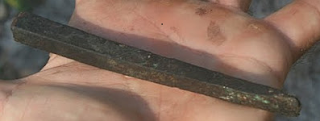
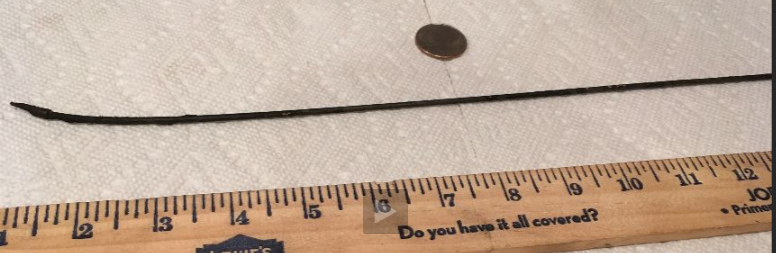
Showing posts with label tools. Show all posts

Tuesday, January 28, 2020

1/29/20 Report - Spikes Found. Diving Neanderthals. Columbus and Caribs. Searchable Database.


Written by the TreasureGuide for the exclusive use of treasurebeachesreport.blogspot.com.


Spikes Found Early Last Week.

Here are some spikes I found last week.

Shipwreck spikes?   Nope.

They are railroad spikes.s

----

Neanderthals went diving for shells to turn into tools, according to new research, suggesting our big-browed cousins made more use of the sea than previously thought.
The study focuses on 171 shell tools that were found in a now inaccessible coastal cave in central Italy, known as the Grotta dei Moscerini, which was excavated in 1949. Dating of animal teeth found within layers alongside the shell tools suggest they are from about 90,000 to 100,000 years ago – a time when only Neanderthals are thought to have been present in western Europe.
The tools had previously been thought to have been formed from shells collected by Neanderthals from the beach where they had been tossed by waves. But now experts have peered at the shell tools through microscopes, revealing many do not show the wear and tear that would be expected from such a fate, such as the presence of barnacles or marks on the shells...
Here is the link for more of that article.

https://www.theguardian.com/science/2020/jan/15/neanderthals-dived-for-shells-to-make-tools-research-suggests

---

Christopher Columbus’ accounts of the Caribbean include harrowing descriptions of fierce raiders who abducted women and cannibalized men – stories long dismissed as myths.

But a new study suggests Columbus may have been telling the truth.

Using the equivalent of facial recognition technology, researchers analyzed the skulls of early Caribbean inhabitants, uncovering relationships between people groups and upending longstanding hypotheses about how the islands were first colonized.

One surprising finding was that the Caribs, marauders from South America and rumored cannibals, invaded Jamaica, Hispaniola and the Bahamas, overturning half a century of assumptions that they never made it farther north than Guadeloupe.

“I’ve spent years trying to prove Columbus wrong when he was right: There were Caribs in the northern Caribbean when he arrived,” said William Keagan, Florida Museum of Natural History curator of Caribbean archaeology.  “We’re going to have to reinterpret everything we thought we knew.”
Here is the link for more about that.


---

I started talking about Kang Hsi porcelain and other pottery and then got off on some other things, but you might find the following web site helpful if you pick up shards.

It is the Florida Museum of Natural History pottery database.

https://www.floridamuseum.ufl.edu/flarch/blog/new-searchable-guide-to-florida-pottery/

---

I thought that blog Followers might get notice of new posts, but someone said he didn't think so. 

I have some topics that I need to address, but they'll have to wait until some other time because they are fairly complex and it will take me a while to get them put together.

For now,
Happy hunting,
Treasureguide@comcast.net


Thursday, November 21, 2019

11/21/19 Report - Lot of Modern Coins On Some Treasure Coast Beaches Despite Lack of Cuts. Shipwreck Survivors Repurpose Spikes. Ancient Village Found.


Written by the TreasureGuide for the exclusive use of treasurebeachesreport.blogspot.com.

John Brooks Beach Thursday Morning

I took a look at a few beaches this morning on South Hutchinson Island.  They all looked pretty much the same.  No cuts anywhere.


Blind Creek This Morning.

The beaches seemed to be back towards the west a little but were smooth and fairly mushy in most locations, with some firm spots, mostly near the water.


Walton Rocks This Morning.

I found a lot of modern coins scattered over two beaches - maybe thirty or so, and a ring.   I'm often surprised by how much is out there.

I wasn't much interested in finding modern change but thought there might be something more interesting since there were so many coins.  The coins were packed closely together though.

One thing about when there is a lot of targets, even if they are junk targets, it tells you something about the distribution of things.

---

Here is an interesting story from a web site I don't know much about.

I’m now convinced that if you want to find the remains of ancient civilizations, the fastest, surest way to do so is to start building a road. Anywhere will do. Just grab that shovel out of the old shed, say out loud “I am now building a road,” and start digging. Chances are you’ll find a 10,000-year-old village. It just keeps happening.  Either that or a school, but a road is easier for a single determined person with a shovel.

The latest ancient village discovered accidentally is in Northampton, Massachusetts. Construction workers excavating a site for a new roundabout discovered arrowheads, spearpoints, knives, and other tools. A private archaeological company, Archaeological and Historical Services Inc., was called in to excavate and analyze the site. Experts now believe that the site dates back to the early archaic period between 8,000 and 10,000 years ago. According to senior archaeologist David Leslie, sites from this period are “incredibly rare,” and this site represents a discovery of importance to understanding the development of the region.

Here is the link for more of that story.

https://mysteriousuniverse.org/2019/11/construction-workers-find-incredibly-rare-remains-of-8000-year-old-village-in-massachusetts/

Thanks to Dick H. for that submission.

---

A few days ago I was talking about broken shipwreck spikes.  I provided my thoughts why so many were shipwreck spikes were broken.  Ron J.  referred me to an article, Search for the Lost French Fleet of 1565 (Canaveral National Seashore 1970-1971, by Douglas Armstrong), which says that spikes were saved, modified and used by shipwreck survivors.  That certainly makes a lot of sense and might account for bent, broken or otherwise modified spikes. Below is a brief excerpt.

It seems clear these spikes were being modified to make tools needed for survival or trade, including hammerheads, points, awls, chisels, and drills. In addition to tool making, these metalworkers were also making jewelry, almost certainly for trade, as they appear in styles (pendants, beads, plummets, etc., many fashioned from reworked French coins) that would have been appealing to the local Indians.


Image from John De Bry
as shown in OceanExplorer.noaa.gov link below.
And below is the description of the items shown in the photo above.

Iron artifacts recovered from the Armstrong Site that were salvaged from wreckage and modified by 1565 shipwreck survivors. At left, there are four examples of ship’s fastener heads which have been cut from their shanks by saw or chisel. Many examples were found, and they for the most part represent debitage from tool making using a forge and tools. Some could have been meant to form hammer heads by insertion into the striking face of a wooden mallet. At right are partially intact ship’s spikes. Each displays clear evidence of using a forge to heat and then tools such as saws, hammers, chisels, anvil, and clamps to remove stock iron for use in constructing new tools. 
And here is the link.


It could certainly be that some of what I thought were broken spikes were modified by shipwreck survivors to create tools or other useful items.

Thanks to Ron J. who hopes to get in some good metal detecting when he arrives in Sebastian from Stuttgard Germany in a few days.

---

Happy hunting,
Treasureguide@comcast.net

Wednesday, October 30, 2019

10/30/19 Report - St. Augustine Lighthouse History. History of Tools. More Thoughts on Troy's Find. Higher Surf Coming.


Written by the TreasureGuide for the exclusive use of treasurebeachesreport.blogspot.com.


St. Augustine Lighthouse Turns 145 This Year.
Source: HistoricCoastCulture.com (Full link below)


This beloved black-and-white-striped lighthouse turns 145 in 2019 but its fascinating history dates back more than 400 years. Its Florida’s very first lighthouse and, along with the structures that preceded it, the oldest permanent aid to navigation in North America.

It has been the site of battles and picnics. Confederate soldiers hid its lens during the Civil War. During WWII, it was occupied by armed guards. It has seen tragic fires and passionate restoration. It may be haunted by four different ghosts. It’s a gathering place and guiding point for St. Augustine...

First built in 1589 by Spain, the tower was under Spanish rule twice for a total of 211 years. The British took control for 20 years following the Revolutionary War. In 1821, Spain ceded Florida to the United States who has maintained ownership ever since...

Here is the link to read more about this history.


----

The discussion of Troy's find chisel(?) find continues. Susan E. suggested making a distinction between what the item was originally made for and how it might have ultimately been used. Here is what she said. The question is whether this artifact was used as a chisel.

I would examine the surface on the flat end, for signs of use.   For example, Troy C. says that it is iron coated with bronze or copper, so if it was struck by an iron hammer we would expect to see loss of the coating (which is softer than iron).   Also, perhaps that end would be a bit smoother than the rest of the artifact due to repeated contact with the hammer.   

Its often difficult to reach a conclusion from a photo.  You can't look at everything you'd like to, and you don't get the same feel for an object that you can hold in your hand.

I thought the plating or whatever looked quite odd in the photo and wondered about the metallic composition.

Bill P. said, I have a hard time believing that any chisel would be made of anything but steel. That pic looks like brass or bronze. Even when chiseling wood the bronze would never hold an edge for very long. It's something else.

Thanks guys.  Great thoughts.


I found a very interesting website on the history of woodworking tools.  Here is a photo of some 18th century tools, including chisels.

18th Century Back Saw, Chisels and Other Edged Tools.
Source: WoodWorkingHistory.com (Full link below).

They were made in Birmingham, long a center for iron and steel metalworking.

Among other interesting facts, you will find this list of reasons why it is often difficult to identify the source or identity of old tools.

first, the tool is an object of daily use, subjected while in service to hard wear and, in some cases, ultimate destruction;

second, a tool's usefulness is apt to continue through many years and through the hands of several generations of craftsmen, with the result that its origins become lost;

third, the achievement of an implement of demonstrated proficiency dictated against radical, and therefore easily datable, changes in shape or style; and

fourth, dated survivals needed to establish a range of firm control specimens for the better identification of unknowns, particularly the wooden elements of tools—handles, moldings, and plane bodies—are frustratingly few in non-arid archeological sites.


That is just a small sample of what you will find at the site.  Some of it is in "olde" English.

Here is the link.


---

If you don't like my philosophizing, you might want to bail-out now.  Fair notice.

A couple times recently I said, "The more I learn, the more I don't know."   On the face, that sounds contradictory and like it could not possibly be true.  When the thought first came to me, I liked it because it had the definite ring of truth, but there was also a feeling of mystery to it.

If you believe in a world in which there are only a finite number of things to be known, when you get to know one of those things, there is one less that is unknown.  That would make the statement false,
but the truth of the statement that originally wasn't clear to me, is that the world does not consist of a finite number of things to be known, and when you take a step down the path of truth what opens up before you is a even larger world in an ever expanding universe of marvelous new possibilities.   It is something like coming to the top of a hill on a clear night and seeing the countless stars like never before.  It is beyond words, logic or reason.  You encounter the incomprehensible infinite and become a part of it.

---

The tides are pretty big now and it looks like we'll have some bigger surf at the end of the week.


Source: MagicSeaWeed.com.

Happy hunting,
TreasureGuide@comcast.net

Sunday, October 27, 2019

10/27/19 Report - Turtle Trail Beach Conditions. A Mystery Item and a Couple Other Finds.


Written by the TreasureGuide for the exclusive use of treasurebeachesreport.blogspot.com.

Turtle Trail Friday.
Photo by Joe D.
Yesterday I mentioned that I hadn't been to the Vero/Sebastian area and didn't know what was going on there.  Joe D. sent these photos of Turtle Trail that he took Friday, which would have been after a lot of the higher surf.


Turtle Trail Friday.
Photo by Joe D.
Thanks for the photos Joe.

Joe said he met a couple detectorists there that were back from a detecting trip to Thailand.

---

Troy C.  found the following item he would like to know more about.

Find Found by Troy C.
Photo by Troy C.
Below is what Troy said.


My name is Troy and recently I had found an item while I was free diving the southernmost edge of the Treasure Coast. I wasn't out very deep but I do believe this item to be an old chisel that was either coated in bronze or copper. I was hoping maybe to get feedback to see if what I had found... If this is something from the 1600s that would be pretty incredible.


Another View of the Same Find.

Let me know what you think about Troy's item.

And any thoughts on age?

---


I made some similar finds in the past.  Below are some of those.  The first seems to be about the same size as Troy's.


I learned a bit from researching those finds.  A reader informed me back a few years ago, that the large item in the second photo is a wedge rather than a chisel.

A wedge is for separating things.  A chisel is for removing material, such as wood or stone.

Both types of tools would be handy on sailing or later ships.

I posted information about that in an old post, which you can find by using the following link.

https://treasurebeachesreport.blogspot.com/2016/08/81316-report-wedges-and-chisels-and.html

That post also provides a nice link or two to articles about tools that you might enjoy.

---

Here is a find that I wasn't sure about for a long time.  Now I'm pretty sure I know what it is.

Mystery Item.

What do you think it is?


---

The high tides are going to be big, but the surf only two to three feet the next couple of days.


Happy hunting,
TreasureGuide@comcast.net

Sunday, August 25, 2019

8/25/19 Report - Tropical Storm Dorian. Finds, Artifacts and Tools. Crime In Space. Great Lakes Water Levels.


Written by the TreasureGuide for the exclusive use of treasurebeachesreport.blogspot.com.

Source: nhc.noaa.gov
We now have a tropical storm that is predicted to become a hurricane - at least for a while.

The system that was over Florida is now moving away, but Dorian is headed in our direction.

Source: nhc,noaa.gov

I think Dorian will fizzle out before getting to us, but that remains to be seen.  Keep watching.

In the mean time it looks like we'll have a two to three foot surf.

---


Finds As An Extension Of A Person And A Reflection Of A Time.

I learn a lot from dreams.  Last night was an excellent example.  I awoke from a dream in which I was in the basement of the home where I grew up.  In the dream the house was mostly empty, but a few things remained.  I was inspecting my fathers tools in the basement where he had his workbench and always kept his tools.  They were the same tools he used to build that house.

The tools were large and heavy - more than needed to just do a job.  Unlike today's tools, they were made to last, and they are just as strong and usable today as they were seventy years ago.

Cast Iron Tools.

So what is the relevance?  Finds - artifacts - are an extension of a person.  My father's tools were an extension of his hands and forearms, and even his personality.  They fit the picture.  More than that, they complete the picture.

There was an anvil and an iron sledge hammer that I could barely lift, let alone use.


Heavy (feels like near 50 pounds) Hammer With Iron Handle.

Everything my father built was overbuilt.  He used what he had.  The car port behind our house was constructed of telephone poles and cross arms.  He worked for the electric utility company.  The car port was way heavier and stronger than necessary.

If you look at the tools in my garage today, you'll see an expression of me.  My tools are wimpy in comparison. They didn't build my house.  They are for repairing, touching up or tinkering - not the same kind of work.  Most people today don't build their own house with their own hands from the ground up.

My tools are an expression of the times, and sadly, perhaps also a reflection of me as shaped by the times.  Things just aren't made like they once were. And they aren't used the same.

This isn't about my father and I.  It is just the example that was no my mind and shows how objects can tell something about the person that owned them and the times when they were used.

Objects were made for a purpose, and how they were made and used tell us about the people and times.  When an object is revealed to you from the sands of time imagine the hands that formed it, held it or used it.  Maybe meditate on it a little, and see if you can get an image of the person who was connected to it.

- - -

Here is a great web site for identifying Craftsman and related tools.

http://alloy-artifacts.org/craftsman-early-tools-p4.html

The pipe wrench shown above is a fourteen inch Dunlap.  The Dunlap brand is listed on the above web site and was used from 1938 into the 50s.

The wrench in the same photo was made by Fairmount Tool Manufacturing that began in Cleveland in 1917 and made a lot of tools for autos.

I think the sledge hammer was military.  It has the number 7157.

---

Detecting tools like the pipe wrench will normally produce conductivity readings form minuses through the teens - very similar to an old anchor except for the amount of area.

---

First criminal act alleged to have been committed in outer space?

Here is that link.

https://www.foxnews.com/us/nasa-astronaut-identity-theft-bank-account-divorce-wife

---

Summer on the Swollen Great Lakes


The lakes rose this year to levels not seen in decades. A 1,234-mile drive around one of them revealed what all that water has left behind — vanishing beaches, closed roads, new islands..
.

And here is that link.

https://www.nytimes.com/2019/08/24/us/great-lakes-water-levels.html?action=click&module=News&pgtype=Homepage

---

Happy hunting,
TreasureGuide@comcast.net
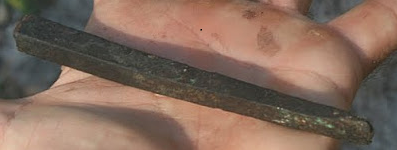
Saturday, December 9, 2017

12/9/17 Report - Hoard Uncovered by Roadwork. Finds: Tools of Sailing Ships and Sail Making. Jacksonville Area Conditions.


Written by the TreasureGuide for the exclusive use of treasurebeachesreport.blogspot.com.

Hoard Uncovered by Road Project.
Source: See RT.com link below.
A Swedish farmer has been awarded thousands of dollars after roadworks on his land uncovered a Viking treasure trove that included hundreds of silver coins.

Here is the link for more about that.

https://www.rt.com/news/412305-viking-treasure-coins-sweden/

Thanks to Norbert B. for submitting this link.

---

Chris N. said, Here is the rather large needle either Upholstery or a Sail Needle, it was rolling in the surf whence I found it. 


Broken eyelet curved needle point, some corrosion, especially on needle point end. I cleaned up best I could with out destroying item.  

Below are three pictures Chris sent of that needle.

 Found Needle

Pointed End of Same Needle.

Other End of the Needle.
I don't know much about sail making tools, neither new or centuries old, but because of recent posts I've been doing some research and learning a little.  

I found the following on a site having to do with sail making.  The author used the name Savage24.

A sail needle has a 3 sided point, like a leather needle, except the edges are rounded off.
They slip between the fibers of canvas or heavy sail cloth without tearing the fibers...
A properly tempered sail needle will last for years I have some that I have been using for 10-12 years. 
They will cost you a couple of dollars each for the larger sizes, but you get what you pay for.
I would recommend from size 12 - 14 for general use. That's about a 3 to 3 1/2 inch needle that will take the inner strands of 550 cord.
As a sailmaker I use them for sewing sails and sailor stuff, they also make a dandy vent pick for your flintlock. 

Savage24 is talking about needles that you can get today, so they might be a bit different than those used centuries ago.

Another source said,

Sail needles are used for canvas repair work by hand sewing, it is generally much thicker as compared to normal machine needles to provide a comfortable finger grip. The body of the needle is triangular in shape with a sharp triangular point for sewing onto the fabric using minimal force. The eye of the sail needle is also ...
While sails were made on land, I would expect tools for maintenance and repairs to be carried on a ship or brought in after a wreck for various uses.

Here is a good list of sail making tools from the boat-building.org web site (See link below.).

The additional hand tools used by a sailmaker are:
  • Sail needle: a strong needle with a sharp triangular point.
  • Sailmaker’s thread: strong thread for sewing up the sails, leech ropes and grommets.
  • Sailmaker’s palm: a strip of leather with a metal pad with an indentation that is used to force the needle through the sailcloth. The strip is strapped around the palm of the hand.
  • Awl, to create a hole in heavy sailcloth or multiple layers of sailcloth before inserting the needle.
  • Pliers, for pulling through a needle inserted into heavy sailcloth or multiple layers of sailcloth.
  • Seam-rubber: a wooden handle with a strong 'scraper', made from strong lignum vitae (tropical type of wood) for creasing down seams in the edges of the sailcloth.
  • Fid: a cone-shaped piece of lignum vitae for splicing rope or opening up holes in the sailcloth. The fid is inserted between the strands of a rope in order to create space through which another piece of rope can be inserted. The fid can also be inserted into a hole in the sailcloth and will open it up wider, so that the hole becomes larger.
  • Marlinspike (also known as a marlingspike): a wooden handle with a piece of metal that tapers to a point in the form of an awl and which has a hollow in it and which is intended for splicing stranded rope. The marlinspike is inserted between the strands of rope, a strand is inserted through the hollow section of the marlinspike and is thus fed through the gap in the rope.
  • Hollow punch: a metal pin with a round hole at one end with a sharp edge and a flat face on the opposite end so that it can be hit with a hammer. Hollow punches are available in various sizes and diameters to make small and larger holes.
It appears that one of the diagnostic features of a sail making needle would be a triangular point.  I can not usually see that in pictures of either new or found needles.

Although I've learned a little, I'm not yet able to say if the needle in question today is a sail making needle or an upholstery needle or how old it might be.  Perhaps somebody more familiar with those types of items can say.  If so, please let me know.  Perhaps the above information will help some one identify the item.

Here is the link I mentioned above.

http://www.boat-building.org/learn-skills/index.php/en/wood/sail-making/

---

Chris N. also sent a beach report from up around the Jacksonville area.  Here it is.

Went out a little bit today,, not very much.. Very sanded in.. this storm is bringing the sand up and covering were all the good material is, except down by the very low water tide line.  I did not stick around to wait.. really early out in the surf in and around Jacksonville. I bet although Anastasia Island and further south conditions may be better...

Bad weather still on the move unfortunate for folks who live in homes by the ocean... Major construction all over Northern Coast from Irma.. there finally establishing Sea Walls for folks who pay for it..

Note* When I find a lot of fossilized bones, larger sharks teeth etc Items I usually get good hits on my detector... "Just a thought".. 


On the Treasure Coast there is lot of thunder, wind and rain this morning.  It looks like we'll just have a two foot surf for a couple weeks on the Treasure Coast.

Happy hunting,
TreasureGuide@comcast.net

Saturday, August 13, 2016

8/13/16 Report - Wedges and Chisels and Other Old Nautical Tools. Iron Artifacts of Port Royal. Conservation of Iron Artifacts.


Written by the TreasureGuide for the exclusive use of treasurebeachesreport.blogspot.com.

Artifacts Found On Treasure Coast Beaches.
There are more than coins and gold and silver to be found on the 1715 Fleet wrecks.  Besides the cargo there were all the necessities of daily life, and the nautical tools that were needed to keep a sailing ship in good working order.  While those things might not be as glamorous or valuable as the queen's jewels they can be just as interesting and meaningful.

After finding information on the awl or fid that I showed yesterday, I decided to research a couple more iron beach finds a little more.  They fall into the category of tools.  They are shown above.

The larger one is not a chisel.  That is what I called it for a while, but then one helpful reader informed me that it is not a chisel.  It is a wedge.

A chisel removes material.  A wedge separates things, like boards on a ship when they are going to be caulked.

I'm not sure if the smaller one is a wedge or chisel.  I suspect it is a wedge too.  If it is a chisel, it would be for wood - maybe stone.

Years ago I found the bronze one shown immediately below.


While doing research on nautical tools, I found a great resource.  It is a master's thesis by Katie Custer, entitled Wrought Iron Hand Tools From The Underwater Archaeological Excavations of Colonial Port Royal, Jamaica, C. 1692.

The thesis is a very informative paper that you will probably want to browse.  As the title suggests, it describes iron tool artifacts having to do with various trades active in Port Royal in the late 17th Century.

Not only does the thesis look at the artifacts, it also considers historical records and inventories.  And of course there is a very useful reference list at the end.

Here is the link.

http://anthropology.tamu.edu/papers/Custer-MA2004.pdf

---

If you learn to interpret and appreciate iron artifacts, you will also want to be able to properly clean and conserve them.

One good reference is a PDF file entitled, The Care and Preservation of Historical Iron.  This article was authored by Clara Deck, Senior Conservator of The Henry Ford Museum.

This one has a lot of good useful information too.

https://www.thehenryford.org/docs/default-source/default-document-library/the-henry-ford-iron-conservation.pdf?sfvrsn=2

---

Horsing Iron.


Here is another web site you might want to look at.  It shows a lot of antique nautical tools, including this horsing iron, which would be used for caulking.

http://www.ageofsail.net/aosbt.asp


---

I wanted to comment on the mystery item that I posted on 8/11.  I received an number of excellent thoughts from helpful readers of this blog.

My opinion is that the item is likely more modern.  A couple of knowledgeable and well-known shipwreck experts told Bob C. that the mystery item could be from a shipwreck.  The item was found near other items that I believe are probably 1715 Fleet. I don't presume to be more knowledgeable than the well-known experts, who also had the advantage of seeing the item in person, but my opinion after viewing the picture, is that it is most likely more modern.  My confidence level is 70 or 80 percent that it is modern.  Of course I could be wrong.

The item might be easier to identify after it is cleaned.

Thanks to all who offered opinions.

---

There is no tropical activity of interest right now and the surf will remain calm for at least a few days.

Happy hunting,
TreasureGuide@comcast.net

Wednesday, July 13, 2016

7/13/16 Report - Scoops and Other Recovery Techniques For Various Difficult Situations.


Written by the TreasureGuide for the exclusive use of TreasureBeachesReport.blogspot.com.

Alternate Scoop Design For Deeply Buried Targets In Shallow Water.


A couple days ago I mentioned a target that was too deep for me to recover. Deep targets in the water and near the water can be difficult to recover.  Most people live and die by the scoop even though there are other good tools and techniques that can be effective.

The scoop on scoops is that the technology hasn't changed much in decades. There are some that are bigger and there are some that are stronger, but they really haven't changed much.

There are a variety of types of scoops, but they all work pretty much the same.  The scoop can be bigger or smaller and maybe shaped a little differently, but that is about it.

Years ago I described the benefits of having a wood handle and the disadvantages of metal handles. You don't see many scoops with wood handles, but a few manufacturers now offer scoops with wood handles.  I'm surprised more people don't use them.

It can be very difficult to recover deeply buried targets in soft or silty sand especially when there are currents.  Sometimes a scoop just won't work.

One method that will work at times is using your scoop like a hoe and fanning with it.  You can put down your detector, turn your scoop over and frantically hoe with it.  It can be tiring but you can really move a lot of sand that way.

If you are working in loose sand or silt and currents, trying to get too much sand in your scoop can actually work against you.  If you lift a heavy scoop full of sand out of a depression quickly, it will cause currents that suck the surrounding sand back into the hole.  Lifting a full scoop quickly will also cause the some of the sand and possibly the target to fall off the front or top and back into the hole. There are techniques to reduce that effect.  I've discussed those before.

After assessing the situation and getting a good idea of where the target is, you might choose another technique that often works well.   Put down the detector and scoop, get down on your knees and work your hand down through the sand and feel for the target.  This often also works very well on the beach when the target is under the water table.  This technique is not as easy when there is a layer of shells.  Be careful not to cut your hand on glass or other sharp things. You might be surprised by how easy it is to work your hand down to feel the target.

One technique I prefer is foot fanning.   You can move a lot of sand, as well as shells and rocks and other things - even when the bottom is packed rock.  Foot fanning, is one of my favorite techniques when a lot of sand needs to be moved to get to the target in water.  It can be tiring.

Some of the best hunting you might ever find occurs when there is a rock bottom.  Most other techniques can be nearly impossible when that happens.  Fanning will pick the sand up from between the rocks, and then the loosened rocks will come up.

Again you have to be careful.  A fishing lure can pop up and stick in your foot.  Therefore it is best to have some type of foot wear.

In every case, determining the targets location, depth and size, will help a lot.

If you are wading and have a long handled scoop, use the handle to support yourself, and then frantically fan with one foot until you have moved enough sand.

One challenge for recovering deep targets with a scoop in moving shallow water is getting the scoop to penetrate into the sand far enough.  I've found that I can wiggle the scoop as I push it in and continue working the scoop down down through the sand.  It will then be tough to pull the scoop out, but it can be done, and if done correctly can get targets from deeper layers.

Just pushing a scoop into the sand doesn't get you very far.  And the hole can refill nearly as quickly as you dig out the sand.

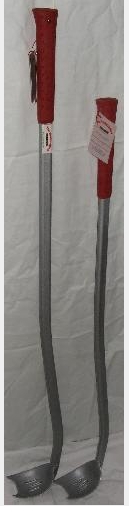
Rock hounds use another type of scoop.  You can see it here to the left.  These are about three feet long.

These are called treasure scoops, but as you can see, they don't have much of a scoop and aren't made for sifting.  They are good for collecting surface finds, but they would also be useful in other situations, such as reaching in under bushes, roots or rocks.

It is difficult to get a regular scoop pushed down through the sand to deeper layers. The type of scoop shown here will penetrate more easily and deeper, but you really have to pinpoint very accurately to be able to pull a small target out.

I won't discuss things like dredging or air lifts now, since detectorists usually can't use those techniques, but I've played with a few different designs specifically designed for recovering deeper targets in difficult situations.

At the top of the post is a illustration showing a tube, much longer than a typical scoop, that can be pushed down into the sand.  I've imagined a screw type mechanism to move the sand and articles up and through the tube, but haven't worked that out.  Probably a more practical method would be to leave the back of the tube open until the tube is suspected to be around the target, then the back of the tube closed before the tube is withdrawn.  That might pick up the material in the tube.  I can think of a couple other ways to try to make that work too.   I'll have to do a little testing.  I have some other ideas I won't mention at this time.

By the way, a rake or tool with tines can work better than a scoop when the target is a chain.

For now, my best overall technique in shallow water, and one that requires no additional equipment, is foot fanning.  Like with every technique, there are some tricks that you can learn to make it more effective.  It is almost always effective, but can require a lot of energy.

---

I hope you will respond to the blog post that you will find on the main blog display.

---

It sure has been hot.  I'd like to see something change.

Happy hunting,
TreasureGuide@comcast.net


Saturday, February 14, 2015

2/14/15 Report - Mystery Item Positively Identified. Santeria Yemana Tools. Smaller Surf Sunday.


Written by the TreasureGuide for the exclusive use of treasurebeachesreport.BlogSpot.com.

Photo source: Papa Jim's Botanica Web Site.
In ,my 2/12/15 post I posted a picture of a mystery item.  The same type of item had been found at two different locations.  I asked for ideas and received quite a variety.

After posting those pictures, I received pictures from Robert H., whose friend also found a similar item.   This third find was accompanied by other items, similar to those that I've seen found on beaches before and also similar to those shown in this picture.  The items included a small metal sun, moon, anchor, and a couple other items.  One item found with the group of items sent by Robert was an object known to be used in Santeria. 

I therefore did a little research on Santeria and before long came up with a picture of some the items in Roberts picture, including the mystery item.  Those items were advertised by a shop that sells things for use in Santeria.  Here is that picture as shown on Papa Jim's Botanica web site.

Notice the two items at the bottom.  Those are exactly like the mystery items.  Mystery solved!

Here is the link listing those items.  They are listed as Yemaya tools.

http://www.papajimsbotanica.com/product_info.php/cPath/35_168/products_id/8781

Thanks Bob for the help!  And thanks to all of you who sent ideas.

I've found most of those items myself, including a metal chicken, sun, moon, anchor, ships wheel, etc.   The chicken, which is not shown in the above picture, is also shown on Papa Jim's web site.

I though I posted some of those items years ago, but couldn't find them in the blog right off.

I suspect those finds are more common in South Florida, but like the finds, Santeria might be spreading out from Miami.

Here is a link that will tell you about Santeria.  It began back as far as the 1700s and is still practiced today.

http://en.wikipedia.org/wiki/Santer%C3%ADa

----------

Its always good to get a positive identity for a mystery item.  In doing so I now know more about some of my old finds.

---------

The surf tomorrow is supposed to be down around three feet along the Treasure Coast.  That will give you a good opportunity to walk along the wet sand and look for "wash-ups" like the one I described yesterday.

Check areas where rocks and large shells are accumulating.  The hot spots will probably be on the lower third of the slope.

Most of the park areas next to the walk-overs seem to be pretty clean.

Happy Valentine's Day,
TreasureGuide@Comcast.net