Showing posts with label mistakes. Show all posts

Sunday, June 28, 2020

6/28/20 Report - Summer Beach Conditions Continue. A Few Finds Including A Fossil. Atlantic Heating Up.


Written by the TreasureGuide for the exclusive use of treasurebeachesreport.blogspot.com.

Fishing On A Hazy Treasure Coast Morning.

I went out to see what was going on.  There were a lot of guys fishing at the beach.  I should've checked the river this morning.

The first thing I dug was this lengthy piece of copper shown with a bottle for comparison.

Piece of Dug Copper.
Bottle for comparison.

I eventually got something old - some fossils, including a snake vertebra fossil (below) if I'm correct, and I think I am after checking some books.


Posterior View of Fossil Snake Vertebra on Quarter and Expaned View.


I several fossils, some were just pieces.  The snake vert, a fish vert and a turtle scute were in pretty good condition.

The snake vert was the most interesting of the three to me.  The fish vert was not nearly as complex or complete and turtle scutes are very common.

Here are some other views of the same snake vert.


Two Views of Fossil Snake Vertebra.


It is intricate and still in pretty good shape.

---

I received this email from Norbert.


Just as a "for what it's worth" I found a heavy men's bracelet on a golf course where worked. I used to run my detector when I monitored the sprinklers at night for watering the greens. I had my hopes up that it would be a good. The clasp had apparently broken when the guy hit his shot and couldn't find it in the tall rough. Back in the golf shop under the light, it was clearly marked "Italy 14K", but was without question some kind of heavy pot metal with most of the gold flaked off. 


I think people are not as surprised by items that are marked higher than they should be. You can see a motive, so that could be intentional deception, but I guess simple mistakes can happen in both directions.

---


There is one system in the Atlantic with a small chance of developing in the next couple of days.


Source: nhc.noaa.gov

Otherwise nothing much new.

Happy hunting,
TreasureGuide@comcast.net

Saturday, June 6, 2020

6/6/20 Report - Bent, Flattened, Squashed Finds. Another Digging Mistsake. Cristobal Now in Gulf.


Written by the TreasureGuide for the exclusive use of treasurebeachesreport.blogspot.com.

Bent Coins.


There are always those unanswerable questions.  Maybe they aren't really unanswerable, but they seem that way at the time.

I've long wondered about the many bent coins I've found.   I probably found 50 or so, and most of them were found in South Florida, but that is where I found the largest number of modern coins.  The vast majority were found in the shallow water or low tide zone near the water line.  A lot of them came from areas where I found a lot of coral rocks packed together, which led me to think they might get caught in the rocks and bent that way.  Another possibility that I considered is getting bent in beach cleaning machines, but some of them come from areas where I've never seen beach cleaning machines.

I've found most denominations bent like that, some more bent than others, but looking at the dime above, for example, it would seem to take a lot of force and although people could do it, it wouldn't be easy.

I don't know why someone would bend a coin like that, but there was a superstition that a bent coin could change one's luck.  Another tradition is that carrying a bent coin in a purse would keep the purse full.  And then there were "witching coins" and love tokens.  So I guess there are several possibilities.  Many of the bent coins were found in areas where Santeria and other religious items were occasionally found.

But it isn't only coins that get bent.  On the Treasure Coast I've found other items that are bent, folded or squashed.  For example this United States Air Force ring was squashed.

Squashed Air Force Ring
It is not silver or gold - just some fairly soft metal.

I left it the way I found it for a long time but eventually got curious enough that I tried to open it to see if there were any marks inside, and it broke.  I found no marks due to the heavy crust and corrosion.


Broken Piece of Ring.
It looks like it was plated at one time.  The metal was brittle.

I can't remember if I've found bent coins on the Treasure Coast, but if I have, it wasn't as many as I found down south.  Other bent and folded metals are found on the Treasure Coast in good numbers though.  This year I've found folded pieces of lead and other metals, but they are much easier to bend than coins.

Folded and Bent Dug Metals.

I still don't have my answers.  I don't know how coins get so dramatically bent, and don't know if it is done by man, nature or both.

---


Bill P had an example of the type of mistake I described yesterday.  Here is his.

I remember one (of many)mistakes that occurred while beach hunting. A couple asked me to search for a diamond bracelet they had just lost. I found it quickly but in my haste, cut it in half with my shovel, oops. Needless to say they weren't thrilled about me even though that could have been repaired easily by a jeweler. 

Thanks Bill.

That made me think of chains, which can be difficult enough to get in your scoop, but you can also dig into them.

---


Cristobal sat over land for a few days but is now out in the Gulf and headed towards Louisiana.  Here is what the NHC is saying.


---

We'll have a one or two foot surf for the next few days.  Now we're having some nice big tides.

Remembering D-Day,
TreasureGuide@comcast.net

Friday, June 5, 2020

6/5/20 Report - Road to Sevilla de Oro Found. One More Mistake to Avoid. Seminole Silver.


Written by the TreasureGuide for the exclusive use of treasurebeachesreport.blogspot.com.

1977 Silver Jubilee One Crown.
Reminder of Mistake.
---

Aurania Resources Ltd. is pleased to report that vestiges of an old road have been found in the central part of its Lost Cities – Cutucu Project (“Project”) in southeastern Ecuador.  The road was discovered by Aurania’s field teams while searching for Sevilla de Oro which was one of two gold mining centres described in historic manuscripts from Ecuador, Peru, Spain and the Vatican.  These records describe the Colonial Spanish operating the two gold mines between approximately 1565 and 1606.  The road discovered by Aurania’s exploration teams is believed to be the one that linked Sevilla de Oro to the other gold mining centre ‘Logroño de los Caballeros’ as described in the historic manuscripts...

Aurania’s Chairman and CEO, Dr. Keith Barron commented, “The historical record names the Treasurers of the “Caja Reales” – the Royal Treasuries – in Sevilla and Logroño, so we know that the gold produced was cast into crude ingots for transport to Quito...

Here is the link for more about that.

https://resourceworld.com/aurania-finds-first-field-evidence-of-colonial-spanish-activity-at-its-lost-cities-project-in-ecuador/


---

A couple days ago I mentioned that I had been thinking back over some of the mistakes I made.  I was thinking of mistakes that were made after the item was located, and in some cases recovered. I talked about one of those and plan to talk about the others.

We all know that we should be careful when digging up an item, but we can still get careless.  We can get careless because we dig up a lot of coins that don't matter much, and we can get in a hurry, and a single scratch can dramatically reduce the value of a fine coin.  

In my first year of metal detecting, I found one very nice coin that would be graded in near mint condition if it did not have a single big scratch that I caused with my scoop.

It was in the habit of hurriedly digging up modern coins, when I was surprised by seeing a silver 1977 Isle of Man Silver Jubilee crown (shown above) in my scoop.  It isn't anything real valuable, but it was the most interesting coin that I had dug up to that time.

That was back in the day when I was trying to find as many coins as I could.  I showed some of my records from those days in this blog before, and remember telling Jerry at the Pot of Gold, the store where I bought my detector, that I more than paid for my Fisher Aquanaut with the modern coins I found in just a few months.  I was finding a lot of coins, but I never expect to find something like the silver crown and still wonder what it was doing on Hollywood Beach.  Judging by the conditions, it couldn't have been there very long.

For those of you who know Hollywood Beach, it was found just a few feet away from the shower in front of the Pizza shop by the handball courts.  The handball courts weren't there then, but that is where this coin was found.  It was such surprise for me at the time that I remember it well to this day.

The coin is almost perfect except for that one big scratch from my scoop, which to my surprise, doesn't seem to show in the photo.  I still have that coin,, which should act as a reminder, but I'll probably still get careless at times.  I've scratched more and better coins since that one.

My main point today is that you never know what you might be digging up, so be careful while doing it.  A pin-pointer is a good idea, but a pin-pointer won't guarantee not scratching or breaking finds.

I could tell a lot of stories about items ruined by careless digging - not all of them by me.  For example, in Fort Pierce at the site of the old fort, Kevin Reilly (now deceased) of Reilly's Treasured Gold, stuck his digger right through a nice silver Seminole head band.

See http://www.nativetech.org/seminole/silverwork/index.php  to see some nice examples of Seminole silver ornaments.

A lot of items are damaged when the detectorist get in a hurry, but hopefully this reminder will save one or two good finds.

---

We had a strong south wind yesterday.  Today the wind is calm and the surf is down around two feet.  However the tides are nice and big.

The weather forecast is showing only a 40% chance of precipitation today.


Happy hunting,
TreasureGuide@comcast.net

Wednesday, July 3, 2019

7/3/19 Report - Old Buttons Cleaning and Preservation. What You Might Need To Know To Be Ready For Your Big Find.


Written by the TreasureGuide for the exclusive use of treasurebeachesreport.blogspot.com.


Back of Flat Button As Found.

This button was found near the 54th Regiment of Foot and 76th Regiment of Foot buttons that I showed recently.  It is a flat button with a gold wash or gilt.  Much of the detail is obscured.  There is no detail on the front, and the gilt is gone from the front.

As I've explained many times, be careful when you clean a coin or other item.  Use the least aggressive or dangerous method that will do the job and monitor the progress very closely to prevent any damage.  If you don't know for sure how to do it, it is better to wait.

Well, this is an example of not doing it right.  I decided to clean this one, and decided to see how a quick immersion in acid would do.  A very quick immersion would have been alright, but I put in the Muriatic Acid and forgot about it, leaving it in overnight.  That was not good.

This is what happened.

Flat Button After Overnight Immersion in Muriatic Acid.

As you can see some of the dirt came off but so did some of the gilt.  That is a good example of what not to do.

You can now see the flourishes but the word ORANGE, which is at the top and bottom between the flourishes.

I've found gilded pieces tricky.  You don't want to lose any gilding, but it can easily be damaged and removed.

I would not have even considered using the acid if the button was one of the better ones, but thought I could get away with a quick dip.  Unfortunately it was more than a quick dip.

Aluminum Jelly or Naval Jelly is often recommended for use on buttons having gold or silver gilt.

The change in color on the above photos is due mostly to a change in lighting.  I should have been more careful about that too.

Here is an article that will help you do it right.  Additional methods are described including heated hydrogen peroxide.


Beside cleaning, buttons will often need some type of treatment for conservation.  Pewter, for example, is fragile.  When you find a pewter button the first thing to do is keep it moist.

After you properly clean it, then you need to protect it, otherwise the edges will start chipping.

If you look at the edges of the two buttons below, you'll see chips around the edges.


People often coat pewter buttons with a 50% mixture of Elmers glue and water or a thin cover of urethane.

Neither of the of the above have been cleaned or preserved yet.

I've learned many lessons the hard way and post them here so you won't have to repeat them.

I once did a post asking "Are you really ready for your big find."

Everybody is eager to make a big find, but there are many mistakes you can make when that happens before you are ready.

These were the first old buttons I found and I didn't have the knowledge or experience to treat them properly.  If you are like me, you will make a lot of mistakes the first time you find different kinds of items.  Here are some of the kinds of mistakes you can make.

1.  Not carefully digging.  You can easily destroy or damage finds during recovery.  That can be very disappointing when you find out that the item was something especially nice.

2.  Not identifying the item correctly.  When an item comes out of the ground, it can tell you something important.  Its age and quality might tell you that the area deserves more serious attention, but if you don't recognize the item, you can miss that important clue, or worse yet, discard an item that has more value or is more interesting than you recognize.

3. Not carrying the item safely.  I broke some nice bottles while carrying them down the beach and lost a gold chain out of a hole in my shirt pocket.  I walked back about a mile and refound the chain, but it was a lot of extra effort.

4.  As I showed today, a nice item can easily be damaged by the wrong cleaning method.

5.  After proper cleaning comes conservation.

6.  You might also fail to record information about the time, location and other details of the find.  Again, if you are like me, after a few years you'll discover that you wish you had done that.

For example, I just ran across some arrowheads I stored in a plastic bag.  I had some information in the bag written on paper with the items.  The paper crumbled and I can no longer read what it said.

More often, I never wrote down the information that I later wish I had.

7.  Then there are legal, partnership and media issues that might need to be handled properly.


In summary, if you don't yet have the knowledge or experience to deal with things well. there are a lot of things that can be done to ruin or diminish what otherwise would be a great find.  In my case, it hasn't been anything huge, but there are many cases when I wish I had done things differently.  Most of those happened early in my treasure hunting days, and many of them were "first" finds of a particular type.


Here is a nice web site showing a lot of button backmarks.

http://relicman.com/buttons/Button9900-Backmark-Index-PAGE2.html

---

I asked people to send in photos of their Native American Treasure Coast beach finds, particularly points, but haven't received any yet.  I know that people find them.  On a couple occasions I've had tourist come up to me and show me an arrowhead they picked up.  One of those was at Wabasso.  A tourist staying at the Disney Resort showed me one she found and asked me about.

---

I was so glad that the Medicare helpline helped Joe Nemeth.  I could just see him hanging on the phone in his Tequesta home waiting for an agent to help him.

And Terry Bradshaw didn't do very well with his Weight Watchers program, but he got a walk-in bath.

---

I plan to do some more posts on old buttons as well as Native American finds.

---

No change in beach conditions is expected real soon.

Happy hunting,
TreasureGuide@comcast.net

Monday, February 12, 2018

2/12/18 Report - Two Types of Metal Detecting Mistakes and Which Is Worse. Marx FIT Lecture. 54th Foot Button.


Written by the TreasureGuide for the exclusive use of treasurebeachesreport.blogspot.con.

Pewter British 54th Regiment of Foot Button
The above button years ago in the West Indies.  It was found near a battle site where the French and British fought in December of 1788.  I'll talk about that more below.

The 54th Regiment of Foot was an infantry regiment of the British Army. Originally formed in 1755 as the 56th Regiment of Foot, it was renumbered as the 54th when the 50th Regiment and 51st Regiment were disbanded. It was renamed as 54th (the West Norfolk) Regiment of Foot on 31 August 1782.


I've made a lot of mistakes and expect to keep making mistakes as long as I walk this earth.  I expect to make mistakes but I try to avoid repeating the same mistakes.

There are two types of mistake that I want to talk about today.  They are opposites.  One is thinking a find is not a good when it actually is, and the other is thinking an item is good when it is actually not.

The first example of the first type of error that comes to my mind is a musket flint that I found.  I detected a very twisted rusted piece of metal that I uncovered, but paid no attention to.  I then saw the flint.  This was my first time that I detected a site like that.  I was accustomed to digging gold rings in those days and didn't know much about hunting artifacts.  I can remember that experience precisely today: where I was, uncovering the rusty metal item, etc.  And I regret to this day that I didn't recognize the twisted piece of rusty metal and flint.  I'd appreciate them much more today than I did then.

Not only do I wish I had kept what I later realized was a musket hammer and the flint, but the failure to appreciate the find in the field resulted in not hunting the immediate area more effectively. Who knows what else might have been found where those items were.  I did find several other nice finds during that hunt including grape shot, soldier art and military buttons ( including the one at the top of this post ) but I still wish I had picked up the flint and hammer.

That is an error caused by not recognizing the possible significance of a find when it was found.  If I had taken the item home but still didn't realize its significance, I could have still lost it or damaged it through improper cleaning.  If you do not treat an item as potentially significant until you prove otherwise, a good find can easily be lost again or damaged beyond repair.

The area had already been studied by archaeologists but the park ranger was interested to see what I could find near the ocean where the archaeologists couldn't excavate.  They had a small museum there, and they kept a grapeshot that I found.

Another example would be a medallion from a  1715 Fleet beach that I did not recognize because when I dug it up it was encrusted and didn't look like anything other than a common coin.  I kept it for quite a while without really studying it and eventually put it in a tumbler with a bunch of modern coins.  When I took it out of the tumbler, it was clean enough that I could recognize it as a religious medallion and it still had some silver gilt on it.  After that it was studied, but the damage was already done.

I could give you more examples of times when I made the same type of mistake, some of them involving even nicer items, but the point is that treating a find as being nothing significant before you know for sure can have disastrous results.

If, on the other hand, you make the other kind of mistake - that of treating an item as valuable or significant when it is nothing - the results aren't nearly as bad.  The biggest thing with that type of error is that you end up getting disappointed when you learn that the item is not as good as you hoped it would be.  That is why I recommend trying to avoid the first type of error even if it means making the second kind of error.

Here are two recommendations that I often repeat.  First, never throw away an item until you KNOW that it is nothing good.  Don't be hasty.  And second, if an item has any chance of being good, treat it as if it is.  As I've shown in the past, it can take a long time to be absolutely sure.  You might never solve the puzzle.  It is better to think a find might be good even if it is not, than to make the mistake of concluding that it is no good and then finding out too late that it is better than you thought. I learned the hard way.  Some of my biggest regrets are the result of not appreciating an item enough to care for it properly.   My advice is that when there is any doubt, keep it and study it until you are absolutely sure.

To give just one example of when I thought a find was good when it wasn't, I once found what appeared to be a gold escudo.  That was back in my early days of detecting.  It would have been my first gold escudo, and it came from a treasure wreck beach, so it seemed possible.  It was encrusted and so I tried to clean it.  I took great pains to carefully clean it.  I got it fairly well cleaned and was confused by the fact that I couldn't identify it.  This was before I was experienced with testing metals, and I didn't have the reference books that I have today.  Eventually I figured out that it was a fake.  Yes I was disappointed, and I wasted time in trying to carefully clean it, but I learned a lot.

---

There will be a free Robert Marx lecture at FIT on February 20.

---

Civilized people should be able to disagree without being disagreeable.

Happy hunting,
TreasureGuide@comcast.net

Wednesday, January 25, 2017

1/26/17 Report - Jupiter Inlet Beach and A Recent Hunt. A Few Common Mistakes. What You Don't Dig Can Hurt You.


Written by the TreasureGuide for the exclusive use of treasurebeachesreport.blogspot.com.

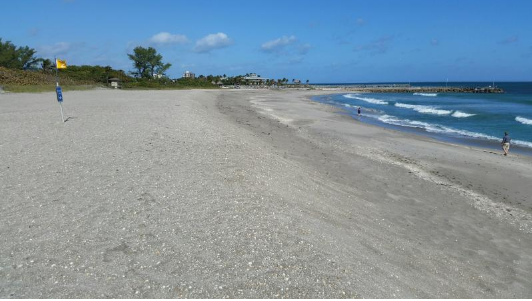
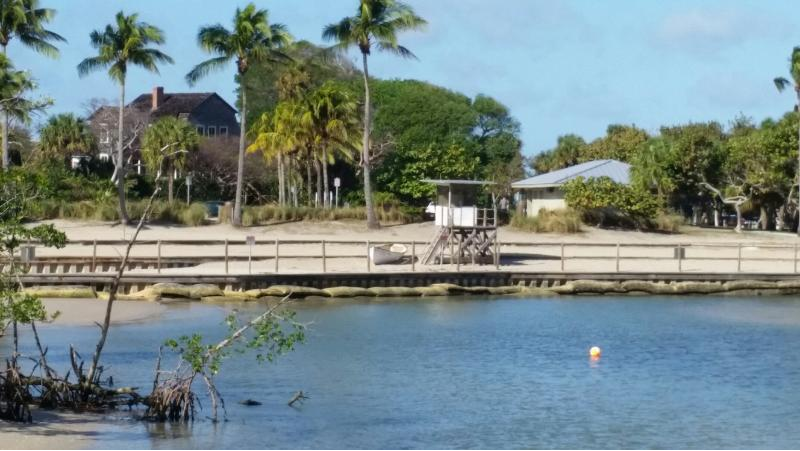
Beach at Jupiter Inlet
Photos by Joe D.

Joe D. sent me the following report and the pictures of Jupiter that are shown above and below.

I hit Jupiter inlet area today just before low tide as front came through! South of inlet much the same as your report today, and a previous report! Cliff was eroded by wind and people only, no water erosion to improve conditions! But for shallow water hunting, There was a nice trough and flat water! 

 Hunted beach area for about an hour and was getting sandblasted from West wind! With little luck due to new sand, opted to try a few other areas nearby that I have been wanting to try out! But without the wind, would be unbearable due to no-seeum's!

 Almost all my finds came from a tidal mangrove area that is very trashy; unlike beach, which is hunted regularly! I had to work for my finds as you can see! (Pic) Interestingly, nearly all the coins i found were from the 70's and looked like they had been there awhile! Also fits with the age progression of the pop tabs I dug! ( as you have said, trash can teach!) One tab was interesting because it had a root growing through it when dug!

 Also threw in a few other pics of the lighthouse, and Dubois house! Anyone looking at historical pics of the Dubois house would notice that the waterway ran nearly up to the house! Which not only sits on a large shell mound, but is also high up a bank near former location of inlet, which is to the south of it's current location! All the land and park in front of it was added when they rerouted the inlet! (Note: No detecting in Dubois Park due to "historical" nature; but not posted!)

Thanks much for the photos and report Joe!

Root Growing Through Pull Tab.
Photo by Joe D.


Finds From Recent Jupiter Hunt.
Photo by Joe D.

Dubois House
Photo by Joe D.

Jupiter Inlet Shipwreck Historic Marker.
Photo by Joe D.
Thanks again Joe!
---

On January 16 I did a post on memorable mistakes that I've made.  It was a popular post.  The mistakes that I mentioned fall into a few basic categories:  (1) not paying enough attention to a dug item in the field to get the significance of the item,  (2) not keeping an item when you don't know for sure what it is, (3) not digging carefully enough, (4) not being careful enough when you clean an item, and (5) not storing an item properly.

There  is at least one other category that probably should be included:  not digging a good item.  Of course, you don't know it at the time, but when you don't dig items you don't know what you left.  I'll bet a lot of what would have been your very best finds, were left in the ground.

The thing about the very best finds is that they are rare.  You don't expect to dig a Rolex watch or a 40 pound silver bar everyday.  It doesn't happen that often, and when you hear the signal, you probably won't know what it is until you dig it.  No detector that I know of has a reading "Rolex Watch" or "40 Pound Silver Bar."  Many detectorists miss great items like that simply because they do not dig items when they don't know what they are.

An eight reale can sound a bit like a tin can, so if you are accustomed to not digging things that sound too big to be a coin, there is a chance that you left something very good like that in the ground.  Things like that you won't regret not digging because you'll never know for sure what it was.

There might be some class of desirable items that you are not digging.  Early in my detecting, I wasn't getting small gold rings.  I've told this before, but I thought that women didn't lose as many rings as men.  Later I found out the that the reason that I was getting more men's rings than women's rings was because I was using discrimination and missed a lot of the more valuable small and valuable women's rings.  I was glad that it didn't take me too long to learn that.

It also took me a long time to find any shipwreck spikes.  I am certain that I would have found some sooner if I had not been skipping larger iron targets.  In those days I was targeting modern gold jewelry. The fact is that how you hunt will determine to some extent what you find, but it will also determine what you do not find.  Review your finds to see if there might be a reason you are not finding some of the types of thing you would really like to find.

---

Think about what I posted from Joe D.  Is there a spot near a beach that you regularly hunt that might contain more targets than the beach that you hunt on a regular basis?  That can be worth thinking about. Sometimes there are good areas that nobody hunts that are very close to heavily over-hunted areas.

---

The next few days we'll have more smooth west winds and smooth surf.  No change in beach conditions.

Happy hunting,
TreasureGuide@comcast.net


Friday, November 7, 2014

11/7/14 Report - Seven Metal Detecting Mistakes That I've Made That You Should Avoid. Catching An Asteroid.


Written by the TreasureGuide for the exclusive use of treasurebeachesreport.BlogSpot.com.

Asteroid Capture Apparatus
Source: YouTube Science Channel link posted here.


I've talked before about some of the possibilities for treasure hunting in outer space.  Here is a video showing how they hope to catch an asteroid - nothing like a hemerroid, although catching an asteroid might be a pain in the butt.


Here is the link for the full video.

https://www.youtube.com/watch?v=5oVAZytlfE8&index=6&list=UUvJiYiBUbw4tmpRSZT2r1Hw


----------------------------


I've made my share of mistakes. I think of some of them very frequently.  It might be that those are the ones that I've learned the most from.

I'm not sure the mistakes I remember the most are the most important.  Maybe I made some bigger mistakes, but probably those that I remember the most are those that I particularly regretted and made a mental note to avoid in the future.

Here are a few of the mistakes that I've made.  Maybe you can avoid them.

1. Discarding an item in the field when I didn't know exactly what it was.

One time that I often think of is when I dug a twisted piece of metal and then close by a nearly rectangular piece of flint.  That was probably thirty or more years ago but I still remember it very well.   I realized later that the piece of metal was a piece of a musket cock and the flint was the musket flint. 

Now I wish I had kept it.  And by not recognizing what it was at the time, I probably did not hunt the immediate area as well as I should have. 

2.  Not digging an item carefully enough.

Not too far from where the unidentified musket flint was dug, I detected a very nice artifact, but I wasn't careful when digging it.  It was very brittle and completely crumbled as it was dug. 

I guess that hunt was a very memorable hunt for me - both good and bad.  At the time it was mostly good, because I hadn't yet realized the significance of my mistakes yet, and it was the first time I hunted a centuries old battle site.  I remember most of that hunt very well, not just the mistakes.

Most people have probably damaged a coin or something while digging it.  It is a common and sometimes costly mistake.

3.  Not labeling a find with all the important information, including among other things, when and where it was found. 

You will forget some things.   It is good to be able to go back and refer to good detailed notes or labels when you want them.

4.  Losing track of a nice find.  If you are not careful you can lose track of a valued find after you take it home. I suppose everybody loses track of things once in a while. 

A good organized system for keeping finds will help you find that special item when you want it.

5.  Not checking equipment before going out for a hunt and not taking back up batteries and the like.

You can save a disappointing and wasteful trip by checking your equipment first.

6.  Destroying an item through improper cleaning.

Muriatic acid can be used to clean some things, but it will ruin other things. 

Don't tumble things that might be valuable.

I once tumbled a nice guilded pendant that was hundreds of years old.  It was encrusted and I just assumed it was a coin.  It wasn't, and I damaged it.

Try to find out what something is and what it is made of before starting to clean it.  Learn how to best clean an item before doing anything that could damage it.

When something could possibly be valuable, do your research first and then chose the most cautious method of cleaning to begin with. 

You can clean things in steps, using the most cautious methods first.  That can help avoid more costly mistakes.  Those first steps could reveal something about the item or material that will help you decide how to continue.

7.  Putting a find in a pocket that has a hole in it. 

I mentioned the other day how a nice gold chain slipped through a shirt pocket and I had to walk back a mile or more to find it again.

Check your pockets and goody bags.  Chains will quickly slip through a very small hole easier than you might think.

There are seven mistakes that I've learned from.  I can think of others, but don't have time for them all today.  You might already know these, but even if that is so, this will be a good reminder.  We all get lax from time to time.

Maybe you can avoid making the these mistakes.  I hope so.


Happy and mistake free detecting,
TreasureGuide@Comcast.net

Saturday, June 18, 2011

6/18/11 Report - Silver Disk & Three Big Detecting Mistakes


Silver Disk Discovered Years Ago On a South Treasure Coast Beach.

The disk is about two inches across and is from the Weller Collection. I'd like to find out the name of the book that this image was published in, so if you know, please send me an email.


Yesterday this blog had over 1000 hits. That is the second time that has happened this year. The reason this time, I found out, is that the blog was mentioned as a resource in an internet article.

This site has a lot of daily readers who are dedicated and experienced detectorists. One of my surveys proved that. A lot of this blog's readers have over ten years of experience. I suspect that some of those that came to this blog as a result of the travel article are completely new to the hobby.

Not only does this blog promote the benefits of the metal detecting, but it also helps educate people about archaeological and historic resources and promotes tourism. A large number of daily readers are from up north and travel to vacation and detect in Florida.

I very much believe that metal detecting is a good way to interest young people in varied subjects such as history, archaeology, geography, numismatics, electronics, etc., but it also keeps many older people active, both physically and mentally.

Discussing metal detecting just yesterday with a world record holding power lifter and owner of a World Gym, he said he thought of metal detecting as being very good exercise. And indeed it is. It can be as rigorous or as easy as you like. But different people focus on different aspects of the activity.

From the comments left on one web site in response to an article about metal detecting, it is evident that a lot of people that have never tried metal detecting have a lot of misconceptions about the hobby. That is natural, but unfortunate. People have impressions about things that they know little about and often those impressions are wrong.

A small portion of the misguided and uninformed archaeological community has been successful in labeling detectorists as grave robbers or looters when nothing could be farther from the truth. As we know, the treasure salvers in Florida work with the State archaeologists to explore archaeological resources under professional supervision and are responsible for a large part of the State's archaeological collection. They make a huge contribution not to mention paving the way for the field of underwater archaeology.

According to fleur-de-coin.com, There is approximately $8 billion worth of coins circulating in the US today. The U.S. Mint produces nearly 30 billion coins for general circulation each year (28 billion in 2000 and 21 billion in 2001). Many coins are replaced because they are worn out, but many are lost.

I often wished I could figure out how many coins were lost every year, but I've never been able to do that.

Here is an interesting fact provided by the same web site. Every year Virgin Atlantic Airways discovered that it takes in an average of 18 cents per passenger per flight in loose change found in the plane's seats. If that figure holds for the approximate 320 million people who fly from one country to another worldwide each year, the total is about $58 million. Lost coins on domestic flights don't amount to much, however. Chicago O'Hare cleaning crews said they found only about 6 cents per flight. It is suggested that more travelers to other countries "accidentally" leave foreign coins behind to avoid dealing with them once they get home.

(If you want to check out that along with many other interesting coin facts, here is the link to that fun web site. http://www.fleur-de-coin.com/coinfacts/unitedstates_3.asp)

I don't know about leaving coins behind, I suspect that international travelers loose a lot more coins because they squirm around trying to get comfortable and sleep in their seats. But you can figure that if $58 million in coins is lost on airliners every year, it seems likely that as many or more would be lost on the beaches and in the shallow waters of the world.

How many times have you received, change for a purchase and looking at the change you could tell that one or more of the coins had been dug up by a detectorist? Its not that hard to recognize some of those dug coins, and there are a lot of the obvious ones still in circulation.

From my years of experience, I can truly say that detectorists are generally some of the finest most trust-worthy,hard-working, inventive, accomplished people you would ever meet. They almost always have another job or source of income. Detecting isn't how most detectorists make a living. You would have a hard time finding a single professional full-time detectorist without another source of income. Most just like the activity and have fun doing it.

I've personally found and returned many items - from eye-glasses lost in the ocean by tourists far from home on vacation, to house and car keys, to valuable pieces of jewelry, and all without any expectation of any reward. And that is common. Some detectorists spend hours and hours of their own time to find the owner so they can return lost items.

Although I could go on about this for much longer, I'll stop there for now.

I was thinking the other day that it always takes a while for me to get to like a new detector. It seems like the first few times out with a new detector, I never like it very much. It isn't until I really learn to use a detector well that I begin to like it.

I guess I start with some very high expectations. I've used a lot of very good detectors, and they've become old friends. It must be even more difficult for a new detectorist to get used to his or her first detector.

While detectors are generally relatively simple to use, there is more to learning to use a detector than you might think. Even if there are only two or three knobs to fiddle with, that gives you a lot of different combinations. Yet that isn't the biggest problem.

The big obstacle to becoming comfortable with a new or different detector, is learning what it will do, learning to know what the detector is telling you, and learning how to use it best under different circumstances. That takes a little time.
But until you do that you simply won't have a lot of confidence in your detector, and you need to have that.

I've recently discussed the best thing to do with a new detector - experiment, experiment and experiment with a variety of test objects in a relatively clean environment.

You will get off to a faster start if you have someone that can how you how to use a new detector. For new detectorists especially, I recommend not buying via mail order. It is much better if you have a sales person that will thoroughly demonstrate the new detector for you.

If you are lucky enough to have someone who is able and willing teach you how to use a new detector or you want to teach someone else, either remove the headphones so both of you can hear the signals, or get a Y splitter so each of you can listen to the signals on your own headphones.

Of course that wouldn't be possible with some detectors, such as submersibles.


Here are what I consider to be three of the biggest mistakes made by detectorists in general.

1. Not experimenting with test objects to learn the best settings for your detector.

2. Not experimenting with test objects to learn to recognize what your detector is telling you.

3. Using way too much discrimination or depending too much upon target ID.


Treasure Coast Beach Forecast and Conditions.

There is still no activity in the tropics. The wind is out of the southwest and the ocean is calm and if the predictions are correct will remain calm for another week. Of course, that means no change in beach detecting conditions.

My best bets would still be to hunt the tourist beaches, shallow water, and for something a little more challenging, hunt the banks of rivers, ponds and lakes while he water level is low.

My beach TCTBDC Rating is still a one (poor).

The blog survey is proving out my ratings over the past few years. I'll discuss that more when the survey is complete.


Happy hunting,
TreasureGuide@comcast.net