Showing posts with label portable. Show all posts

Thursday, March 21, 2019

3/21/19 Report - Lot of Detectorists On The Treasure Coast Today. One More Day of Good Surf.


Written by the TreasureGuide for the exclusive use of treasurebeachesreport.blogspot.com.

Big Hole Being Dug This Afternoon by the Seagrape Beach Access.
Smile - You were favored by TreasureGuide Cam.

It was a beautiful sunny day today - the type I don't like.

I liked Monday.  So windy and rainy.  Monday was one of those days that reminded me of so many good metal detecting days of the past.  I don't like to go to the beach so much when it is sunny.  But I went today to look around.

Monday I met a few of the local metal detection experts that showed up a little while after I did.  Today there were a good number of people metal detecting the beaches, including some snow birds that were obviously new to the hobby.

I only visited two beaches today.  Turtle Trail and Seagrape Trail.  That reminds me, I need to recharge my detector batteries.  Neither of those beaches looked great, and there wasn't much digging going on.

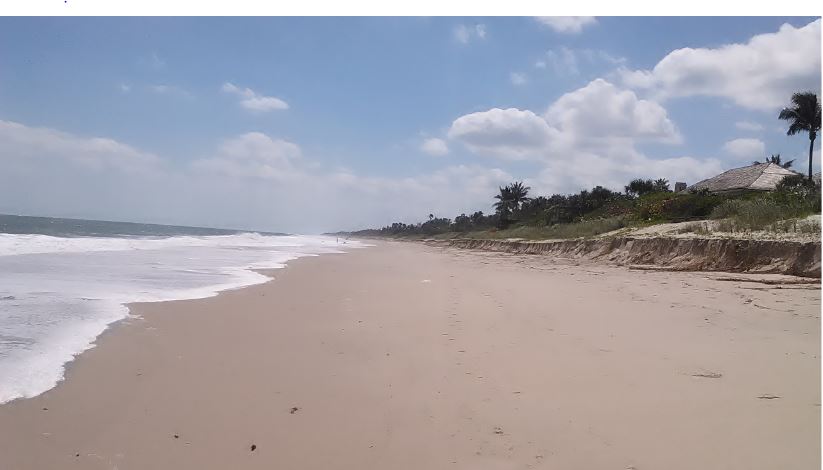
North of the Seagrape Access Looking South.

These beaches were filling a little again.

North of Seagrape Trail.
First I stopped at Turtle Trail and saw Warren leaving.  A couple other detectorists were behind him, and there were a couple beginners up by the beach access.

South of the Turtle Trail Access.

South of the Turtle Trail Access.

The higher surf of Thursday is supposed to be later.  We'll see how that goes.  Then the surf is supposed to start decreasing into the weekend.

I'm definitely at only a 2 on my TCTBDC rating scale now.  We have one more chance for things to improve a little tonight.  


Source: MagicSeaWeed.com.
Even where we had erosion this week, it wasn't getting into older layers of sand.  We had too much accumulation and too much renourishment sand out there.  In most places you could see a large protective sand bar in front of the beaches at low tide.

The things I found were mostly things that you expect to see near the surface, although a couple were fairly deep.

For example, this cookie.

Coin Enclosed in Sand Crust.
The sand crust makes up much of the bulk of this lump and gives it a lower total density.  Therefore, it "rides" higher than the coin would alone.  I still haven't settled on terminology to describe things that are more readily moved on a beach.  I'm thinking of "portable" and degrees of portability, although that just doesn't sound quite right to me for some reason.

I'm pretty sure there is a coin in that crust, although at this point I have no idea what type. 

Piece of Copper.
The copper also is more portable and rides high in the sand, but in this case it is mostly because of its shape.

Warren told me that Kellyco is going to have a close-out sale.  He thought it might be for items other than detectors.  I haven't looked up the details yet.  You might want to.

I have a lot more to talk about, but have just been keeping up with beach conditions lately.  When the surf decreases, I'll catch up on a lot of other things.

Happy hunting,
TreasureGuide@comcast.net

Wednesday, September 17, 2014

9/18/14 Report - How To Make A Very Portable Inexpensive Multi-purpose Sifter & Good Surfing This Morning


Written by the TreasureGuide for the exclusive use of treasurebeachesreport.blogspot.com

Basic Portable Sifter With
One of Two Removable Floats.

There are times when sifting is better than detecting.  For example when targets are packed so densely that it is a waste of time to pinpoint and dig each target individually.   Sifting is also good when you are hunting non-metallic items, such as shells, sea glass or fossils.

Another time when sifting can be good is when there is a lot of junk, shells or stones or something like that, which can make finding small targets in a scoop difficult.  Just dump the contents in the sifter so you can spread it all out.


I made the sifter shown in the photo and have used it on various occasions.

You'll see other articles giving instructions on how to make a sifter, but this one is a little different from most of those.  Most sifters that you'll see are heavy and rigid and can not be so easily modified for different situations.

I prefer a light-weight flexible sifter, rather than one of those heavy rigid jobs.  This one can easily be rolled up and easily carried a good distance along with your other equipment.

Another reason I prefer this one is I can hold the sides where the boards are and by repetitively pulling the boards apart in short bursts, the sifter bounce the material which will sift more quickly that way.

The floats aren't always needed but can easily be attached or removed depending upon your preferences and the situation.  The sifter will actually float without them.  It just depends upon how much flotation you want.

The floats can be easily attached, either above or below the boards, very quickly and easily by using three plastic slip ties.  Just clip them if you want to remove them again.

A simple rope can be used to tie the sifter to a tree or some other stationary object while you detect or dig.

As you can see, I simply got some 1/4 inch chicken wire.  Cut it into a square.   Then put a small board above and below the edge of the wire, and nailed the boards together to hold the wire, and did the same thing on the opposite side.

I only did this on two sides because that allows me to roll up the sifter, and it also gives me more control over the sifter and how I use it.

I found a couple of those floats along the road one day.   I could cut them to the exact length of the boards but didn't find that necessary.

When working in very shallow water, the floats just get in the way.

The sifter can be used by one person, but if you have a partner and make it a two-person operation you'll seldom need the floats.

If you use the floats, attach them either above or below the boards, depending upon how high you want the sifter to float.  The boards make good handles.

If you plan on dumping a shovel full of heavy material onto the sifter all at once or are working alone in deep water, you'll probably want to use the floats and add boards to the two open ends

But if you are working shallow water, which is where I was the last time, you won't need that.

I'll should make a video or at least take a few pictures of the sifter in operation.


Well, it didn't look to me like we got the predicted 4 - 6 foot surf yesterday, but I found some good swells and waves this morning.  The waves were forming nicely and there were a lot of surfers.  The beaches were awful mushy though.   Very poor detecting where I was.   It seems the northern end of the Treasure Coast got more surf than the southern end, but I didn't see that.

I did see a nice old piece of shipwreck wood down by where an anchor was found either last year or the year before.  I'll have a picture of that for you by tomorrow.

There aren't any storms to watch now.

The surf is supposed to decrease the next two days.  And the tides are pretty flat now.  They aren't going down very much.

I'll have to get out to check some more beaches to see if I can find any of the effects of today's slightly higher surf.

I also need to get around to taking some more find photos.

There is one big project that I can't wait to show you, but I can't talk about it yet.  Really fun and amazing.  Someday I'll be able to show you all of those finds.

Happy hunting,
TreasureGuide@Comcast.net