Showing posts with label water hunting. Show all posts

Tuesday, July 21, 2015

7/21/15 Report - Something You Need To Know For Water Hunting. Treasure Coast Waterways Cleanup. Junkyard Car Museum.


Written by the TreasureGuide for the exclusive use of treasurebeachesreport.blogspot.com.


See link below for details.
I have been looking at lot of very extensive studies concerning the movement of beach sand.  Some involve institutions such as Woods Hole and the Department of Defense.  Some involve laying fields of state of the art sensors, both in the beach and out into the water.  Some of the studies cost hundreds of thousands of dollars and the reports are full of technical jargon and mathematical formulas.  Those studies are only concerned with the movement of sand.  While I am interested in the flow of sand, I am also interested in how other objects such as coins move, and those studies to not address that, although I can draw some conclusions about that from what they do find.  A lot of the studies found nothing much beyond what I've learned through personal observation, which pretty much amazes me.

If you use the following link and browse around that site, you'll be able to find some of those studies.

Here is a link to a nice animation of that site.   When you get to the site, click on the multimedia section to view the animation showing the moving sandbar.  You might want to repeat it a several times.

http://www.whoi.edu/main/topic/changing-shorelines-erosion

 (Animation by Jack Cook, Woods Hole Oceanographic Institution)

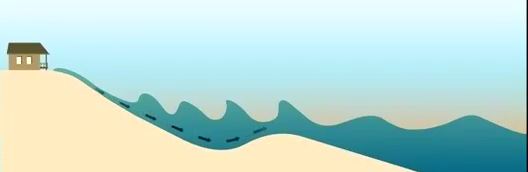
The location of sandbars can protect or endanger the face of the beach. As undertow drives sandbars away from the shoreline and further out to sea, waves break further from the shore. When sandbars are pushed closer to shore, waves break closer and run further up the beach. (From the Woods Hole site.)

I took some clips from the animation and added some things.  I added the two vertical lines so you could better estimate the position of the moving sand.  Orange dots illustrate coins.

In the first clip shown below, the sand bar is out and the currents are moving the sand in, but not the coins.  The arrows indicate the direction the sand is moving.


When the sand bar moves in, but the water velocity is not sufficient to move objects such as coins, the coins that were originally lost on the bar when it was out end up in deeper water (see below).  Objects lost in the dip in front of the sand bar (above) get buried, as shown below.


Compare the second picture to the first and note the relative position of the coins.  There are also times when the coins will move as well as the sand, but that isn't the situation illustrated here.  It is about trigger and drop points again.  Water force can be sufficient to move just sand or strong enough to move both sand and other objects.  Sand and coins can move at different times, and at the same time but at different speeds.

Sand bars are generally moving, sometimes very slowly.  As I've said before, items lost on the eroding side will be uncovered if they were previously covered, while items recently lost on the other side of the bar will get buried when the sand is moving in that direction.

Here are a couple more clips from the animation.  These show situations where the undertow moves the sand out.


When there is sufficient undertow, items as well as sand can be dragged out.  The clip below shows the bar moved out.  The bar has flattened some (below).  It could continue to move out until it looks very much like that shown in the first clip. When the velocity of the water drops the sand drops out of transport and piles up.


If you are aware of the sands position and how it is moving, that is a big step towards knowing where you'll find objects when you are metal detecting in shallow water.  Sometimes objects get uncovered and sometimes buried, and sometimes the objects are moved too.

Whichever way the sand is moving, objects are moving in some relation to that, again depending upon the trigger points and drop points of the sand and objects.

I hope the illustrations are clear and helpful.  I had a hard time getting them fixed the way I wanted, and still didn't get it exactly like I wanted.

----

The Treasure Coast waterway cleanup will take place July 25.  I hope you will support this.  Anyone can volunteer.  It would be a great thing for clubs.

Here is the link for all the information.

http://www.tcwaterwaycleanup.com/

---

 Nestled in a north Georgia forest, over 4,000 classic cars decorate 32 acres that have been turned into a junkyard museum. Owner Walter Dean Lewis' parents started the business in 1931 as a general store that also sold auto parts. Lewis grew the collection, which had just 40 cars in the '70s, over time...


Lewis stopped selling parts about six years ago, soon after realizing he could sustain the business more as a museum, charging $15 for visitors just looking, and $25 for photographers. He estimates that 95 percent of the people who come through the six miles of trails are photographers...
Here is the link for the rest of the story.  Sorta neat.
http://www.aol.com/article/2015/07/20/ap-photos-in-rural-georgia-a-junkyard-of-classic-cars/21211215/

--

I can't believe it.  That little two foot bump in the Treasure Coast surf predictions for next week has disappeared.  We're back to one foot for who knows how long.

Happy hunting.
TreasureGuide@comcast.net

Friday, July 10, 2015

7/10/15 Report - Water Hunting Compared to Beach Hunting. Mint Versus Well Worn Finds.


Written by the TreasureGuide for the exclusive use of treasurebeachesreport.blogspot.com.


Intricate Gold Ear Ring Find.

I hear from all kinds of people.  I hear from a variety of top level experts, and I hear from people that are just thinking about giving metal detecting a try.  That makes it difficult to write for all of those kinds of people.  I mostly write about whatever is on my mind, and that can be far ranging, but sometimes I want to take time to develop a topic before writing.


Today I was thinking about the differences between water hunting and hunting the beach or dry land.  The differences are considerable.  I started detecting when I lived in South Florida.  The transition from hunting dry land to hunting shallow water was easy.  Then I spent a lot of time in the water - more than on land.

10K Mark.
That wasn't easy to see without magnification.

On the Treasure Coast a lot of the shallow water is off limits to metal detecting because of the salvage and exploration leases.  And the swimming beaches are not as busy as down south.  Down south you also have more big shallow water swimming areas where the water is pretty calm much of the year.  You also have all the big resorts and hotels.  Furthermore, the culture is very different, which is no small thing.

But comparing water hunting to dry land, water hunting is more difficult.  Of course you need water proof equipment, which is more expensive.  You have to deal with swells and waves.  Sometimes the water is so rough that it is simply impossible to hunt in shallow water - not only for safety but also to protect your equipment.

Digging a target can be difficult in shallow water, especially in rough water and when there are currents.  The holes can refill as quickly than you can dig them, and the currents can wash sand and items out of your scoop as you lift the scoop.  Visibility can be zero.

There are those annoying waves that slap you at the most annoying times almost like they know when that is.  Just staying put over the hole can be a challenge.

I enjoy rough water hunting, but it takes more skill and better rigged equipment.  With a little experience you can learn to comfortably hunt in very rough water.  In the past I've talked about some of my favorite techniques for doing that.

One thing that is very different is running a search pattern in rough water.  You can not control your coil as easily.  It can be difficult to execute a tight grid pattern with waves pushing you and your coil one way and then the other.  You can, however, learn to use the currents move your coil for you.

In the water your sweep speed will be slower.  On land you can whip a detector as fast as you want to.  In the water, you have the water resistance.  Compared to hunting on land it can feel like you are doing resistance training as you push a detector through water.

I've talked about finding the optimal sweep speed for your detector.  Your sweep speed will naturally be slower in water.  You might want to switch from a motion mode to a non-motion or pinpoint mode id your sweep speed is slowed too much.  You have to know how sweep speed affects your detector in order to know when it might be a good idea to make the switch.  

Those are some of the differences.  There are many more, but those are the ones I was thinking about today.

---

Another topic.

The most valuable coins are usually those in the best condition.  And those in the best condition are those that have never been used.  They are in "mint" condition.

For me no coin is prettier than an old coin that has been well handled, smoothed by fingers over the years as it passed from one person to another and with a touch of patina in the depressions.

Coins in mint condition just don't have it.  All you see is metal on metal - sharp angles, and the same monotonous overall shiny surface.

I've noticed that my personal preferences and standards are less and less defined by others and less defined by estimates of value.  I like what I like, and sometimes what I like isn't worth much to the rest of the world.  

I would be surprised to find a mint or near mint condition coin.  The rarity of that would make it a little exciting, and the value might add some excitement, but it would not have the touch that I really like.  It wouldn't show the wear of daily use by men, women or children in their daily lives.

Beach finds don't show a lot of that most of the time.  The sand blasting and salt corrosion does away with a lot of that, but on rare occasions you can find something, maybe a religious medallion or gold crucifix, that shows how soft flesh with time and devotion wore down hard metal.  That is the type of thing I really like to see.  It is almost like shaking hands with those from another time.  Their touch was recorded.  And so is yours.

----

On the Treasure Coast we have another day with a one to two foot surf.  If you have a place where you can work the shallow water, you might find slightly deeper water a little easier than working inside the breaking waves where you have a lot of bottom current.

The challenge of deeper water will be staying in place when the swells roll by.  That isn't all that difficult though, especially with the small swells and waves we've been having recently.  Learn to ride the swells rather than fighting them.  I've talked about how to do that in the past.

Happy hunting,
TreasureGuide@comcast.net

Wednesday, September 17, 2014

9/18/14 Report - How To Make A Very Portable Inexpensive Multi-purpose Sifter & Good Surfing This Morning


Written by the TreasureGuide for the exclusive use of treasurebeachesreport.blogspot.com

Basic Portable Sifter With
One of Two Removable Floats.

There are times when sifting is better than detecting.  For example when targets are packed so densely that it is a waste of time to pinpoint and dig each target individually.   Sifting is also good when you are hunting non-metallic items, such as shells, sea glass or fossils.

Another time when sifting can be good is when there is a lot of junk, shells or stones or something like that, which can make finding small targets in a scoop difficult.  Just dump the contents in the sifter so you can spread it all out.


I made the sifter shown in the photo and have used it on various occasions.

You'll see other articles giving instructions on how to make a sifter, but this one is a little different from most of those.  Most sifters that you'll see are heavy and rigid and can not be so easily modified for different situations.

I prefer a light-weight flexible sifter, rather than one of those heavy rigid jobs.  This one can easily be rolled up and easily carried a good distance along with your other equipment.

Another reason I prefer this one is I can hold the sides where the boards are and by repetitively pulling the boards apart in short bursts, the sifter bounce the material which will sift more quickly that way.

The floats aren't always needed but can easily be attached or removed depending upon your preferences and the situation.  The sifter will actually float without them.  It just depends upon how much flotation you want.

The floats can be easily attached, either above or below the boards, very quickly and easily by using three plastic slip ties.  Just clip them if you want to remove them again.

A simple rope can be used to tie the sifter to a tree or some other stationary object while you detect or dig.

As you can see, I simply got some 1/4 inch chicken wire.  Cut it into a square.   Then put a small board above and below the edge of the wire, and nailed the boards together to hold the wire, and did the same thing on the opposite side.

I only did this on two sides because that allows me to roll up the sifter, and it also gives me more control over the sifter and how I use it.

I found a couple of those floats along the road one day.   I could cut them to the exact length of the boards but didn't find that necessary.

When working in very shallow water, the floats just get in the way.

The sifter can be used by one person, but if you have a partner and make it a two-person operation you'll seldom need the floats.

If you use the floats, attach them either above or below the boards, depending upon how high you want the sifter to float.  The boards make good handles.

If you plan on dumping a shovel full of heavy material onto the sifter all at once or are working alone in deep water, you'll probably want to use the floats and add boards to the two open ends

But if you are working shallow water, which is where I was the last time, you won't need that.

I'll should make a video or at least take a few pictures of the sifter in operation.


Well, it didn't look to me like we got the predicted 4 - 6 foot surf yesterday, but I found some good swells and waves this morning.  The waves were forming nicely and there were a lot of surfers.  The beaches were awful mushy though.   Very poor detecting where I was.   It seems the northern end of the Treasure Coast got more surf than the southern end, but I didn't see that.

I did see a nice old piece of shipwreck wood down by where an anchor was found either last year or the year before.  I'll have a picture of that for you by tomorrow.

There aren't any storms to watch now.

The surf is supposed to decrease the next two days.  And the tides are pretty flat now.  They aren't going down very much.

I'll have to get out to check some more beaches to see if I can find any of the effects of today's slightly higher surf.

I also need to get around to taking some more find photos.

There is one big project that I can't wait to show you, but I can't talk about it yet.  Really fun and amazing.  Someday I'll be able to show you all of those finds.

Happy hunting,
TreasureGuide@Comcast.net


Wednesday, March 16, 2011

3/16/11 Report - Underwater Gold & Be Grateful


Galley Brick From El Rubi Wreck.

I like to post photos of things you might find on a beach but which you might easily overlook as being either junk or just plain insignificant. This galley brick is for sale on eBay and listed with a starting bid price of $500.

I've found old bricks on the Treasure Coast beaches that could be from wrecks. This particular galley brick is broad and not very thick. It is only about an inch thick.

Here is a link to more information on the El Rubi.

http://www.flheritage.com/archaeology/underwater/galleontrail/shipwreckpages/10_Capitana.cfm

I believe that a detectorist should learn to identify different types of artifacts. Even if not valuable in an economic sense, they can indicate the possible presence of a nearby wreck. One item like this should also remind you to keep your eyes open for other non-metallic items.

I've been receiving a lot of interesting email lately thanks to the readers of this blog.

Does anyone know where I can find an older topographical map of the Treasure Coast area online? I'm thinking 1950s or earlier might do the job. It could help one blog reader solve a local history problem. Thanks.

I've heard from some readers, including one who collects colonial American artifacts, and the consensus seem to be that the lead item that I recently showed is indeed a lead stylus. When I picked it up that possibility didn't occur to me. I didn't think of that possibility until later when I vaguely remembered that I might have seen pictures of something like that before. That is why I post things like bricks for you to look at. I've thrown away things before I knew what they were and then regretted it later - sometimes years later. Several come to mind right now.

Don't be too quick to throw away unidentified items.


Starting off on my general beach and shallow water hunting topic, the first and most general thing to know is that if you want to find a lot of modern era gold, a lot more is found in the water than on land. I once had the ratio calculated from the detailed records that I kept. Although I don't remember what the exact numbers were now, off hand I would say that you will find something like about seven times the amount of gold in the water than on land. Of course that depends upon a lot of variables, but on the average, if my memory serves me, that is about the ratio that I discovered. Even if the number is wrong, I do know that the number of gold items found per time period in the water is several times higher than found on land.

You might ask why then would you spend any time detecting on land. The obvious answer is that sometimes it is very difficult or impossible to detect in the water, and the second reason is that sometimes there are nice productive holes found on the beach. Conditions change in the water as well as on the beach. For best success, adapt to the prevailing conditions.

You will find rings, chains and things in the dry sand and the wet sand, but you will find much more gold per hour of hunting in the water. That of course means that you will need a good submersible detector. Don't bother with target ID or discrimination. That is even less important in the water than on land. Just get a detector that will detect small pieces of gold at good depth.

I won't recommend a detector here because the very best are custom made and cost a lot, and it is not that easy to find a dealer of custom made machines that is good to deal with. Some will hold you for an arm and a leg if you need repairs. You won't really need a custom detector anyway and I won't recommend one, so don't ask.


Effort, knowledge and skill will pay off in the long run, but sometimes luck does come into play, especially when it comes to those exceptional once-in-a-lifetime finds.

I remember once when I had a few minutes to detect and couldn't decide if I should even bother to try. After I drove to a spot that I felt compelled to go to, I really didn't have more than a few minutes left to detect. I got on my wet suit, jumped in the water and bang. There it was. A real eye-popping find. I got out and drove home happy and glad that I went with my feelings even though it seemed like I didn't have enough time to really do anything.

I call that luck. There was some small amount of specialized knowledge involved, but it seemed as if there was something more than that.

I don't know if you believe in intuition, or whatever you might to call it, (I want to talk about that more some other time.)but it could be just plain stupid dumb luck.

Balancing out those kinds of special times, there are those other times when you hunt and hunt and don't find a single thing when it really seems like you should. So where is the intuition then?

People want to take credit for their successes. When things go well, they claim that it was their special knowledge or skill that earned their success. Failure, on the other hand, is usually blamed on bad luck.

People who feel cheated in life are quick to give blame, while those who think they did well, are quick to take credit. That is the way it is.

I believe there is a mixture of luck and skill involved a lot of the time, but sometimes there is a lot of luck involved, especially when you make one of those once-in-a-lifetime finds. Yes, some people will try to promote themselves and use such finds as compelling evidence of their superior skill, but truth be known, the most exceptional finds are often largely accidental.

Sometime I'll have to tell you about a chest of old silver coins that was discovered, and how one guy found some nice old Spanish tumbaga bars. Now those are some real treasure finds. But I'll tell you more about that some other time.

I know of one lady that found a gold escudo the first time she ever went detecting. She could have written a book and spent the rest of her life promoting herself as the greatest natural treasure hunter on earth, but the way I see it, that was luck.

And even though there might be a lot more behind the story than you usually hear, those good ole boys that were supposedly out lobster hunting when they found the Fort Capron payroll treasure, if the story is as it is often told, that was luck.

And how about the life guard that was out for his morning swim who looked down and saw the freshly uncovered site of the Jupiter wreck? Luck! He wasn't even looking for the wreck site, but there it was.

Those are a few examples, but I think you see what I am saying. Sometimes there is a large element of luck involved in those types of finds. Sometimes there is good luck, but also sometimes bad.

You'll never know what you missed when you turned left rather than right on a big empty beach. Maybe it is good that you don't know what all you missed. It could be disheartening.

No matter what your past luck has been, over time if you are persistent, do your research and spend a lot of time on task, you will eventually have good finds. But don't brag too much when it finally happens. Remember, you never know what all you missed. And you have to count yourself fortunate just to be able to get out in the air and sunshine to pursue your hobby. Be glad that God will never embarrass you by saying, "That is a nice find there, but you don't know how hard it was for Me to get you to finally stumble onto it, and just look at what all you missed in the process.

Treasure hunting is very much like life in general. You never know how much you missed.

When things are going well, be grateful, not proud, arrogant or boastful.


Forecast and Conditions.

A mild cool front will be coming through. The wind has shifted and is now coming out of the southwest. That, of course, means relatively calm seas. On the Treasure Coast we'll be getting two and three foot seas for a few days. Although conditions for hunting cobs remains poor, as I recently showed, there are still a few artifacts to be found on the front beaches. Targets are often fairly deep and the digging not so easy to layers of shell under the sand. You might need a heavy duty scoop or shovel.

West winds generally mean calm seas for water hunting. As I've been mentioning the Spring Break season has started and there are a lot of tourist and beach-goers out in the beautiful weather.

I have a lot more to write about but that's it for now.

Don't forget to do the survey on the main page of this blog.


Happy hunting,
TreasureGuide@comcast.net