Showing posts with label rosary. Show all posts

Wednesday, July 31, 2019

7/31/19 Report - Latest 1715 Fleet Treasures Found by Salvage Crews on the Treasure Coast.


Written by the TreasureGuide for the exclusive use of treasurebeachesreport.blogspot.com.

Intricate Gold Pieces of Rosary Found by Sea Trepid at Corrigans.

I just received an update on the salvage season from JaminJackUSA today.  The Salvage Crews are making amazing finds.

All the treasure shown today was found in the last few weeks.

You've heard people say that it has all been found.  Here is proof how wrong that is!

All of these photos were submitted by JaminJack.  Thanks much for sharing!

Levin Shavers on the Sea Trepid with Beautiful Gold Pieces.

Silver Bowl Found by SeaTrepid at Corrigans.
John Brandon and Jimmy Parker With Reason to Smile.


Mike Perna on Mighty Mo Showing GRAT Gold Coin Find


More Ornate Gold Rosary Parts Found by Sea Reaper at Corrigans.

Gold Nuggets Found by Hitting Bottom at Rio Mar.

Three Figures Found by Capitana at Corrigans.


Congratulations guys!

If that doesn't get your juices going nothing will.

I'll let the pictures speak for themselves today.

We do have a tropical wave moving in our direction, but it probably won't be much.  I'll report on that tomorrow.  Nothing urgent.

Happy hunting,
Treasureguide@comcast.net

Tuesday, July 2, 2019

7/2/19 Report - Part of Rosary Found Off Shore by Sea Reaper. Lead Shot Found. Revolutionary War Records Free. Spear Point.


Written by the TreasureGuide for the exclusive use of treasurebeachesreport.blogspot.com.

Salvage Boat and Tender Working North of John Brooks Monday Afternoon.
The salvage season has started well.  The weather has been good for salvage work, and most of the crews have found some gold, along with other items.

For the beach detectorist, things have not been so encouraging.

John Brooks Beach Monday Aftternoon.
There was just a faint strip of shells along the waterline.

Wherever there were people at the beach, there were people in the water seeking relief from the heat.

John Brooks Beach Monday Afternoon.

Most of the salvage vessels on the Treasure Coast have already found some gold this year. I already talked about one piece - a probably religious item. More recently, part of a gold rosary was found by captain Josh Fisher-Abt and the crew of the Sea Reaper. That item was farther from shore than most, and it was speculated that it may have been from a passenger that went overboard before the ship  broke up

---

Musket Balls, Lead Shot and Melted Lead From Turtle Trail Area.
Most of those shown above, as well as other pieces not shown. came from just a few feet north of the Turtle Trail beach access a few years ago.

Among the items are a lot of small caliber bullets that look like they were shot into the dunes or sand.  As well as on the beach, I've found them sliding down the cliff in front of the dunes.  There are more than those shown.  I always wondered if someone was shooting birds or just doing target practice.  They are flattened out and look almost like buttons.

There are a few musket balls in the mix.  One larger one and a few smaller ones.  Note also the melted lead bits at the bottom.  Also there are a few larger caliber bullets.

---

Here is something you might find interesting.  Ancestry.com is giving free access to Revolutionary War records for a limited time.

Here is the link you can use to register.

https://go.fold3.com/revolutionary-war?xid=2388&utm_source=content&utm_medium=email&utm_campaign=odp-revwar-july2019

I've found at least six ancestors that served in the Revolutionary War through my wife's research, beginning with Nehemiah Day who served in New York and New Jersey to Captain John Wetzel, on the Western Front.

---

Putin's net worth shows how socialism solves the wealth inequality problem. 

https://www.foxbusiness.com/features/what-is-russian-president-vladimir-putins-net-worth


---

I'd like to see photos of Native American artifacts found on Treasure Coast beaches.  If you have any points or other finds. send them in and I'll post a good selection if I get enough.

Here is one to start you off. It is a broken spear point.

Broken Spear Point.
 ---

No change in Treasure Coast beach conditions is predicted for the rest of the week.

Happy hunting,
TreasureGuide@comcast.net

Thursday, May 16, 2019

5/16/19 Report - One Way To Accelerate Your Learning Curve. Beaches Where You Can Find Fossils. Finds. Trash and Treasure.


Written by the TreasureGuide for the exclusive use of treasurebeachesreport.blogspot.com.

Fossil Finds by DJ
Photo by DJ.

I received these photos and message from DJ about his first fossil hunt.  The photo above shows the finds of DJ's first fossil hunting trip.

I had read some past blogs on fossil hunting and Peace River. Saw some finds you posted from Bill and Dan.

I went with a guide since I believe if time is limited, that may be a good way to find things until you learn the ropes.

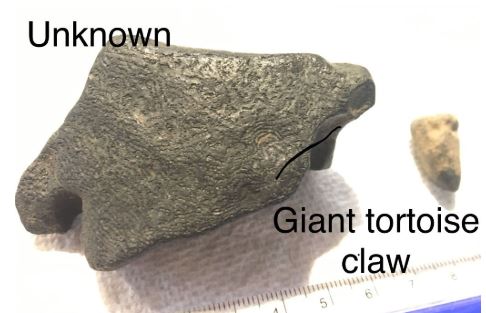
Our guide was very sharp and explained a lot of things, in the picture you can see many shark teeth, part of a broken mammoth tooth, several DuoGong rib bones, fossilized shell ‘molds’, stingray teeth plates and a claw from a giant tortoise.

Others found parts of Megladon teeth, horse teeth.

I like to hear the explanations and hunting techniques.

Like you have said, the story behind the find is fascinating, there is always something to find and most importantly (for me) don’t throw anything away until you get an ID.

And the places to look have to be learned, gravel holds the smaller stuff and deeper gravel holds larger better finds. Some people use a golf club with the head cut off as a probe to see how deep the gravel is. And the gravel moves and builds up over time like sand on the beach!

Learning where not to hunt is important as well, people have to throw out the stuff from their screens and it is easy to find yourself digging in someones spoil pile.

Here are a couple closer views of some of his finds.


Photos by DJ


Can anyone identify the unidentified bone?

I went with a paid fossil hunting guide on my first trip to the Peace River too.  It does save time on the learning curve.  They put you on some good spots so you don't waste hours trying to figure out where to hunt.  If you go with a guide, you will definitely find some fossils.  In my opinion, it is definitely worth the money if you are interested in fossils.

You'll do some sifting.  That might be a good introduction to a technique that can be used for other things.

Guides for some other types of treasure hunting and other locations may not be such a good idea, but for Peace River fossil hunting, I think you'll find it worth the money.

It is a lot like metal detecting.  It helps to know where to look and how to identify the good spots.  Find identification adds to the fun.

Nice finds DJ.  Thanks for sharing about your trip.

You can sometimes find fossils on Treasure Coast beaches, but it depends upon beach conditions.  There was a time a few years ago when they were plentiful.  One area was very rich with fossils, but they can be found form time to time all along the coast.  I've seen them at Ambersands, Wabasso, Seagrape Trail, Turtle Trail and along South Hutchinson Island down as far as Jensen Beach, and probably farther.  I also have seen some found at Rio Mar.  Some of the Indian River spoil islands also have fossils on them.

After some very high rough seas there were some large fossil bones, from mammoths, whales, etc. on the beaches.  Fossils have been scarce on the beaches for the last few years.

Native American artifacts can also be found on the beaches at times too.  They are more common when the fossils can be found, and I've seen them at some of the same beaches.

---

As part of RR Auction's The Fine Autographs and Artifacts Featuring JFK’ collection, the rosary beads used by Father James Thompson on the fateful day of President Kennedy's death were sold for $13,401.25...

https://spiritdaily.org/blog/news/rosary-beads-used-in-jfks-last-rites-auctioned-for-over-13k

---


On the deepest dive ever executed into the Mariana Trench, an American investor-turned-explorer discovered what appeared to be plastic bag and other litter nearly seven miles below the surface of the Pacific Ocean.

Victor Vescovo, a retired naval officer from Texas, broke the record for the deepest dive into a part of the Mariana Trench known as Challenger Deep, the deepest known point in the Earth’s seabed. His dive went 52 feet lower than a 1960 dive to the bottom of the Mariana Trench completed by U.S. Navy lieutenant Don Walsh and Swiss engineer Jacques Piccard in a vessel called the bathyscaphe Trieste...


https://www.foxnews.com/science/plastic-litter-discovered-deepest-dive-pacifics-mariana-trench

We all know how much junk there is out there.  We can all remove a little of it.

Removing junk metal can help you find good targets, and removing old worthless bottles can help you find good bottles.

I remember way back to high school when one day our gym teacher sent us out to pick up the junk on the football field.  I found a dollar under the bleachers.  Guess I liked eye-balling way back then.

---

The surf will be slowly increasing over the next few days.

Happy hunting,
TreasureGuide@comcast.net

Monday, July 3, 2017

7/3/17 Report - State of Treasure Coast Beaches. JFK's Rosary. Musket Ball.


Written by the TreasureGuide for the exclusive use of treasurebeachesreport.blogspot.com.

Fort Pierce Area Beach This Morning Before Low Tide.

I went out to one Fort Pierce area swimming beach this morning to see what was going on.  I checked the dry sand first.  I could tell it had been heavily hunted, as has been the case for at least the past couple of years.  It is detected frequently and thoroughly - probably multiple times a day. Of the targets in the dry sand the vast majority were bottle caps, although they were relatively few.  Some detectorists at that beach are in the habit of removing the trash, and overall it is pretty clean.  

I did find one big spill of coins (couple dollars worth) in the dry sand and one small 9K band that was hidden under three bottle caps.

I could tell that there were a lot of people at the beach this weekend.  You could see where the crowds were.  They covered the beach farther north and south than usual.

If you want to detect the dry sand at the popular swimming beaches this summer, you might want to go when the crowds are just beginning to leave.  If you wait too long, most things will already be picked up by other detectorists.

The coins I found in the dry sand were all really recent drops - still nice and shiny.  Even the coins I found in the wet sand were still nice and shiny.  

As you might expect, the shallow water conditions were not good.  Neither were conditions for finding old things.  Sand has been accumulating in the shallow water and on the beach fronts for months now.

Fort Pierce Area Beach This Morning Before Low Tide.

There is one tropical disturbance way out in the ocean to keep track of.

Source: nhc.noa.gov
On the Treasure Coast don't expect any changes real soon. A one foot surf is predicted for several more days.

---

The late president John F Kennedy’s rosary beads – valued at up to $400,000 (€356,000) – failed to sell at auction in New York last month.

In this centenary year of his birth, mementoes associated with JFK continue to attract intense interest but, for once, bidders baulked at the steep estimate ($300,000-$400,000). The rosary, described by auctioneers Christie’s as “one of the most important and personal possessions” of America’s first Catholic president, had “impeccable providence”, having been later given by JFK “to his best friend and special assistant, David Powers”.

Following his death, his family discovered a hidden cache of mementoes

The rosary beads are made of onyx (a black, semi-precious stone) and are attached to a silver crucifix with the name “John F Kennedy” engraved on the reverse. The decade beads are connected to the antiphon beads by a silver circle containing an image of the Holy Spirit inside of a triangle...


It might have done better if it showed heavy wear from use or there was a photo of him with it.  

Here is the link for more about that.

https://www.irishtimes.com/life-and-style/homes-and-property/fine-art-antiques/no-buyer-for-jfk-s-rosary-beads-in-ny-sale-1.3135589

---

Archaeologists take musket ball of evidence that they are digging in a Revolutionary War trench.

Here is the link.

http://www.postandcourier.com/news/tiny-lead-ball-confirms-archaeologists-are-digging-in-right-place/article_4e92c066-5d02-11e7-b92a-47d8da82a83c.html

---

Yesterday I added a new post to the blog.  It will help us get an idea of how many people depend a lot upon intuition, which was also the subject of my post yesterday.

I hope you'll take the time to respond to the post.

Be careful with the driving and fireworks.

Happy hunting,
TreasureGuide@comcast.net


Friday, May 5, 2017

5/5/17 Report - Valuable Four-Escudo. Spiders and Snakes. Belaying Pin? $72,000 Atocha Rosary.


Written by the TreasureGuide for the exclusive use of treasurebeachesreport.blogspot.com.

Highest Price Gold Cob In The First Session of the 5/3/17 -/5/4/17  Sedwick Auction.
Source: See Sedwick link below.
What is more valuable and eight-escudo or a four-escudo?  Of course it depends upon the specific cob.

The 1697 Lima four-escudo brought the highest price of the gold cobs on the first day of the current Sedwick Coins auction.

It has several things going for it.  It is in great condition, encapsulated, is an over-date, and the only one of its kind known.

It brought a winning bid of $27,000.  With the buyers premium included, the total was over $31,000.

There were four other gold cobs that had bids over $20,000.  All of those others were 8-escudos.

The lowest winning bid for a gold cob in yesterday's auction was $450 for a Seville 1-escudo.

Here is the link.

http://auction.sedwickcoins.com/Treasure-World-U-S-Coin-and-Paper-Money-Auction-21_as47081?p=1&ps=50&ca=860000&so=1&q=&hi=0&vm=1

---

I wasn't thinking of this type of thing when I posted what I called a puzzle yesterday.  I asked what equipment you would want and how you would proceed if you wanted to detect under a house or deck or something where you only had a small space to crawl into.  The thing I hadn't thought about was safety.  And that is very important thing.  You might want to think about spiders, snakes, broken glass, rusty nails and safety in general.  That means wearing protective gear, such as gloves and long sleeves and taking other precautions.  Here is a link that Duane C. supplied.

https://www.hunker.com/12289692/how-to-use-moth-balls-as-spider-repellents

Thanks Duane.

---

Concerning the mystery object I posted yesterday, here is what John L. had to say.

My first guess would be that it is a spoke to a ship's wheel due to the identical shape of the "handle" to almost all ships wheels whether made of wood or metal.

This shape is also identical to the handle of a belaying pin, though admittedly, most of these where made of wood.

Thanks John!

After I looked at the picture of the object again, I looked at what Wikipedia had to say about belaying pins.  Here is one paragraph from the Wikipedia article.

A belaying pin is a solid metal or wooden device used on traditionally rigged sailing vessels to secure lines of running rigging.  Largely replaced on most modern vessels by cleats, they are still used, particularly on square rigged ships.

Thanks John.

---

The Sedwick auction concluded yesterday (Thursday).

The largest winning bid of the auction was for the gold and red-coral rosary from the Atocha.  The winning bid was $72,000.  A $12,687.50 buyer's premium was added to that.

---
I hope you'll take the time to answer the blog poll.

It looks like we are supposed to have a one foot surf along the Treasure Coast for a few days.

Happy hunting,
TreasureGuide@comcast.net


Sunday, August 14, 2016

8/15/16 Report - Flintlock Pistol From Treasure Coast Beach. Thoughts On Religious Relics. World Wide Web 25 Years Old This Month.


Written by the TreasureGuide for the exclusive use of treasurebeachesreport.blogspot.com.

Flintlock Pistol Found After Hurricanes of 2004.
Photo submitted by Darrel Strickland.
Lately I've been showing some noteworthy treasures that were found a few years ago, especially after the hurricanes of 2004, which was some of the best hunting we've had since the legendary Thanksgiving Storm of 1984.  A lot of treasure was found by a lot of people after Francis and Jeanne. You've never heard of most of it, and I'm only showing a few pieces.

The flintlock pistol shown above was found by Tom K., who found the pistol "at Wabasso Beach going north towards Golden Sands in the wet sand near the water's edge."  Thanks for sending the photo and email Darrel.

I don't know if Tom ever got the pistol cleaned up or not, but he wasn't in a hurry to clean it at the time because he thought it might be damaged in the process.

Tom also found some rings that day.

Here is charm or rosary piece found back then too.

Photo submitted by Darrel S.
I've shown some of the famous religious pieces found by the salvage divers, and Laura Strolia has provided authoritative research on some of the most fascinating ones. Click the following link to go back to a post containing some of Laura's research on the Pelican of Piety.

  http://treasurebeachesreport.blogspot.com/search?q=pelican+piety

Before Laura's research was published, the gold Pelican of Piety was often mistakenly referred to as a reliquary.  A reliquary is meant to contain a relic.

I recently found an article about first-class relics being sold on the internet.  A first-class relic is an item or piece of an item directly associated with event's of Christ's life or the physical remains of a saint, for example bone or hair.

One person wrote an article about selling first class relics and wants the practice stopped. The author of that article, Ryan Scheel, had the following to say.

The listing of first class relics “is incredibly insensitive to the Catholic faith in way I doubt would be tolerated for other religions,” Scheel said. 

“But also...common decency should tell eBay that profiting off of the sale of body parts is ghastly and unethical, no matter who the remains belonged to in life.”
That's why Scheel decided to launch a petition calling for eBay to remove the listings of the first class relics. He hopes to obtain signatures from at least 25,000 Catholics in order to alert the site of the illicit sales.

Here is the link to that article.

http://www.ewtnnews.com/catholic-news/US.php?id=14075

---

Did you know that August 5 was the 25th anniversary of the first web site.  That web site described the WorldWideWeb project and said the following.

"The WorldWideWeb (W3) is a wide-area hypermedia information retrieval initiative aiming to give universal access to a large universe of documents," the world's first public website reads, going on to explain how others can also create their own web pages.

"The project started with the philosophy that much academic information should be freely available to anyone."

I found that information on thehackernews.com, which is a good site for those who want to stay informed about computer security.

Many large corporations have been hacked by China.  Google admitted they were hacked.   If Google, who has all of those bright computer scientists, couldn't prevent being hacked, who can?  If you don't maintain the finest security practices and if you have anything that the major players might want on your computer, you probably have been hacked, whether you know it or not.

Computer security isn't all technical.  A lot of it is behavioral.  Hackers take advantage of natural and naive human behavior.

On a side note, the Stuxnet super-virus was created to damage Iran's nuclear centrifuges, and it did its job fairly well even though the controllers were isolated.  Somebody had to use a USB or some other portable storage device to install it the virus.   More powerful versions are now being developed.

I started this post talking about a centuries old flintlock pistol, and ended it with cyber warfare.  How things have changed!

---

Here is one note on old rings that appear large enough to be worn by a giant or on a big toe.  They were made to be worn over a glove.

---

There are no storms right now, and the surf will run around one or two feet for the next several days.

Happy hunting,
TreasureGuide@comcast.net

Friday, July 18, 2014

7/18/14 Report - Which Is Most Important: Search Strategy or Detector Capabilities? How Beach Detecting Is Similar To Detecting In The Mountains. Crucifix & Large Cent.


Written by the TreasureGuide for the exclusive use of treasurebeachesreport.blogspot.com.


1823 Large Cent Find

A few days ago I did a post about some views concerning metal detecting and metal detectors.  At the time I said I would talk more about strategies in the future.  I'll do that some today.  

Yesterday I told how I used an inexpensive metal detector in an old yard and in a woods and found a few wheat cents, an 1829 Large Cent, a brass relic and a ring in a few hours of detecting with a brand new detector that I had never used before. 

It is important to know your metal detector very well and metal detecting experience can be a big help. My previous experience with other metal detectors helped me quickly learn how to use the new detector fairly effectively.  I am still a relative novice when it comes to knowing this new detector.  It takes a while to learn all the ins and outs of any detector.

What helped me most, I believe, is my search strategy.  You might find it surprising that there is a lot about hunting a beach that can be directly applied to detecting a heavily wooded mountain.  Those two types of environments are very different, yet there are some commonalities when it comes to search strategies.

As you might know if you've been reading this blog very long, I do not put much emphasis on the detector I use.  I put more emphasis on search strategies than any thing else.  If you are in the wrong spot, your detector, no matter how good it is, can't do much for you.  I believe that the most important thing is to find the right spot to spend your time and avoid spending a lot of time in the wrong spots.  You can not do that with 100% accuracy, but it really makes a big difference if you spend your time in the most promising spots whether it is on a beach or a wooded wilderness.  Both present huge expanses that will be highly unproductive.

On a beach there is the wet sand area where the water comes and goes and sifts and sorts things.  On a beach, heavier items tend to get buried deeper in some areas and get uncovered in others.  There are also areas where things get covered or uncovered on a wooded hillside.

I like to eye-ball.  I've talked about that before.  To find old things by eye-balling, you have to find things that have been completely uncovered.  You have to find those areas where old things, instead of sinking, either remain on the surface or have been uncovered. 

Of course eye-balling is more difficult, because even if you find an area where things are being uncovered, a lot of items will still be under a layer of dust or under a little earth.   But if you do enough eye-balling to learn to find old things that way, you have probably learned to find and identify those good areas.  Eye-balling provides a good test of your ability to identify the most promising detecting spots.

On a beach, there are areas where the sand accumulates and older and heavier items are too deep to be detected.  In a woods, there isn't sand, but there are areas, usually flat areas or slight depressions, where leaves accumulate and the cover items quickly.  The soil quickly builds in those areas and old items are quickly buried.  Pull tabs and other similar light junk will stay in the top layers of humus or leaves just like light junk is often found in the top layers of accumulated sand.  There are a lot of similarities.

On the other hand, in the mountains there are streams and run-off areas on the hills where erosion occurs and where old items remain near the surface or are uncovered.  In the future I'll show you a very steep hillside where old things were found near the surface.  I'll do that as soon as I can ge my pictures transferred to this computer.  Right now the devices are not working.

I've given this analogy before.   I'd bet on an old Indian with a bow and arrow who knows how to track game and knows where game can be found over a city slicker with the best gun ever made.  Metal detecting is much like that.  I believe search skills are more important than detector capabilities.  That is one reason I showed what could be done with a relatively inexpensive detector.  It seems people tend to think they need a better detector if they aren't finding much.  In my opinion, that is seldom the biggest part of the problem.

Whether you are hunting a beach or a wooded mountain, there are good areas and poor areas for hunting and you can learn to find the good areas where old items will be near the surface.  I'll give more tips on that in the future.

If you learn to identify those good areas, you'll be able to find old things that do not require you to detect real deep and you won't have to dig big deep holes.  Talk about a time saver!


Here are two views of a broken crucifix from 17th Century Newfoundland believed to be a part of a rosary.  You can see extensive wear from rubbing, which suggests that it could be from a rosary.

Here is the link for more of that story and the source of the photos.

http://www.thetelegram.com/News/Local/2014-07-10/article-3794329/17th-century-crucifix-unearthed-in-Ferryland/1


The Large Cent has a diameter of between 27mm and 29mm. The first official mintage of the large cent was in 1793.  Production continued until 1857, when it was replaced by the much smaller penny.

When I dug the one shown above it was covered with mud and when I first saw it, from the size I thought it might be a half dollar.  After rubbing off some mud, I saw the faint image on the front of the coin and knew it was from an older era.  I was eventually surprised to see One Cent shown on the other side.

All Large Cents were minted in Philadelphia.

People complained that they were too big for pocket change.

While Spanish shipwreck cobs will be much older than a Large Cent, for a US coin, it is one of the oldest US coins that you will find.

Treasure Coast beach conditions haven't changed yet.

Hopefully I'll get more find pictures uploaded soon.

Happy hunting,
Treasureguide@comcast.net