Showing posts with label trash. Show all posts

Sunday, February 16, 2020

2/16/20 Report - Mucking Through Heavy Trash With a Metal Detector. Last Hutchinson Island Black Bears.


Written by the TreasureGuide for the exclusive use of treasurebeaches report.

Broken Old Salter's Eye Lotion Bottle.

That would be a bottle I'd like to have if it wasn't so badly damaged.

Can anyone provide any information on Salter's Eye Lotion?

If you want a challenge or you want to learn to understand your metal detector a little better, here is a recommendation: visit the banks of the Indian River Lagoon where you can get to the river without passing on private property, find an area where the surface trash covers the ground and try to pick out any good targets that might be hiding between the trash.  That isn't easy.  First of all there isn't a lot of good metal targets down there.  And secondly, the trash is horrendous.  You might find something interesting, and if you don't, you'll still improve your detecting skills.  I don't think I really have to tell you that the exercise will require a ton of patience.

As sad as it is to say, the shallow water and banks on the west side of the river are virtual trash pits.  Before garbage pickup, many residents just dumped their garbage over the hill.  Much of it is still there, appearing and disappearing with the storms, weather and whatever.  You'll see the remains of everything and anything; wrecked cars, model T parts, wrecked boats, tires, cans, bottles and glass, old commodes, pressure tanks, etc. etc. etc.

Trashy Area Along the West Bank of the Indian River.
Some of the residents have tried to clean up the areas in front of their property, but it is a seemingly unending task.  One day it will look good but eventually the trash will show up again.

Recently I took a metal detector down to the edge of the river and gave it a try.  I quickly found out that many of the bottle tops gave a coin tone and a conductivity number to match.

You might want to focus on a particular tone or conductivity number for a while.  After digging enough of those, change it up and focus on another range of targets for a while. 

It won't take long to get to know link signals with target types.  And there is no end to the number of targets that you can quickly sample.

You might find to pick good targets out of the trash.  It isn't easy because of the amount of trash.  The trash can be so dense that you are almost always over more than one target.

It isn't likely that you will find many coins, but there are some to be found.  On my trip, I found a few.  One was a 1982 penny that had lost one third of its weight to corrosion.

It is like reading any beach bur different too.  There are signs that will tell you where coins are more likely, and where they are highly unlikely.

The sand on the west side of the river is about six feet deep.  That is what I was told by a fellow that builds docks.  Like on the ocean beach, there are places where coins will be closer to the surface.  The penny was found in an area where weeds had been growing in past years, and even though they weren't there now there was still a dense patch of organic material where the roots were.  That is the reason the penny did not get buried more deeply, and the organic material caused it to quickly corrode.

It is not likely you'll find many coins and it will be difficult to find quality coins, but that is the challenge.  There is a good chance, however that you will find some older things of interest in the process if you keep your eyes pealed.  The bottle at the top of this post was found when I was mucking with my metal detector through the trash.

When picking through such dense trash, you'll be forced to go slow enough that you'll have a good chance of making a sight find of some sort.


Side Rail of Houseboat That Sank In The River During the 2004 Storms.

There are some old shipwrecks in the river too, as well as more recent ones.  I've mentioned some in the past.

Metal detecting in the river will test your patience.

An occasional fossil can also be found in the river.  In fact, almost anything can be found in the river.

---

DJ sent me a link to the story of the last black bear killed on Hutchinson Island.  Interesting local history that you might find interesting and maybe sad.


Thursday, September 26, 2019

9/26/19 Report - Karen Turns Our Way. Software Update for Equinox. Metal Detector Maintenance.


Written by the TreasureGuide for the exclusive use of treasurebeachesreport.blogspot.com.

Tropical Storm Karen and Hurricane Lorenzo
Source: nhc.noaa.gov
We have two systems in the Atlantic to watch now, although neither is likely to affect us much, but they weren't sure about Dorian and Karen has already made a turn.

Projected Path of Karen.
Source: nhc.noaa.gov

Karen, which was heading north/northeast, has made a turn and is now heading west towards the Bahamas.  They are still saying she isn't anything for us to worry about.  That doesn't necessarily mean she won't eventually send us some nice surf.

Predicted Surf for the Fort Pierce Area.
Source: MagicSeaWeed.com.
As you can see the surf is supposed to increase next week.  Unfortunately I'm not seeing any north winds to go along with it.

---

Several people notified me of the 2.0 software update for the Equinox detectors.  I'll include the note from Joe D. because he added some other useful information, including his experience with the update.

Here is what Joe said.

   I hit Carlin Park today after a quick look, just before low tide! I really liked what i saw, and hunted multiple lines from dune cut to water line! And also amongst the rocks! I love hunting here when this much is exposed by the weather! Although there were some mushy spots, there was plenty of areas to search!  
    On the not to love side, there were few good targets! A lot of minute can slaw, and probably 50 pull and pop tabs! I was mostly aware of what the targets were, but dug everything anyway to reinforce 

sound differences! I pulled a few coins in the rocks that were near cemented in, and had to work to get out! But nothing old! Still and all, l still like it there!

     I got a notification from Minelab of a new software update! This was the first update since I've owned this machine! The process was fairly quick once i figured out where to find it on the site! It was listed under the specific detector, not the main page! 

    I also took the time to disassemble and clean my detector! I've used it a lot lately so the need was there to check out all the parts! I had noticed that the plastic arm cuff was creaking a lot when detecting, and i thought it may break a few times today! (Really the only cheap part) I added a temporary fix until i get a new aluminum Jeff Herke cuff from Steves Detector Rods; that i ordered today! I've emailed Steve several times in the last several days, and he was extremely helpful, and accommodating for the order!

     I also checked the silicone seal that i installed a few months ago in the handle, and cleaned before reinstalling! Its doing a great job keeping water and sand out of that area! Well worth the money! 

    The cleaning process reminds me a lot of cleaning my rifles!  I got nailed by a few carbon fiber strands from inside the shaft sections, but now I'm ready to go again! 

     Also, i pull the coil cover off and wash the coil out after every beach run! It can build up a lot of sand there, as well as the lower section of the shaft, which can clog and hold water and sand! Some people hate coil covers, but i would not hunt without one! Or my coil would be destroyed by now!

    I will send a few pics, as always!


 Joe D.

Thanks Joe, and thanks to all of those who took the time to notify me of the update.

Here is what Minelab describes as the benefits of the update.

Difficult ferrous targets — the common enemy for all detectorists. That is until EQUINOX. Hit the download on our EQUINOX update to make those pesky bottle caps, rusty nails and other falsing targets a thing of the past. Fire up the Minelab Update Utility and you’re on your way. It’s simple. You’ll experience the enhanced Iron Bias feature, improved EQUINOX 600 backlight and much more.

Improved Iron Bias

Iron Bias has been enhanced with the addition of a new Iron Bias settings profile. The original EQUINOX Iron Bias 'FE' settings will still be available, but there is now the option to switch to the new Iron Bias 'F2' settings, which have an improved capability to reject a much wider range of difficult iron targets, including bottle caps.

EQUINOX 600 Backlight Brightness

The EQUINOX 600 now has the ability to adjust the backlight brightness to an additional 'Low' setting that matches the minimum setting on the EQUINOX 800. This 'Low' brightness is ideal for detecting at night and in low light conditions.
And here is the link for the update.

https://www.minelab.com/usa/equinox-software-update-2-0?fbclid=IwAR3QcyFBFqKsq-uzIG0tAhWewoMFjvKAP2DCuqhRGGIrzB7cR2GZG9i4L9g

I really didn't have much trouble with iron or other trash using the Equinox 600.  I've discussed the reasons for that in the past.  It is more the possibility of skipping gold than hitting trash that bothers me.  There are a variety of ways of staying away from or identifying iron.  Sometimes you don't want to skip it though.

I think I'll quit there today.

Happy hunting,
TreasureGuide@comcast.net


Saturday, September 21, 2019

9/21/19 Report - Pocket Watch Finds. Hurricane Jerry, Weather and Beach Conditions.


Written by the TreasureGuide for the exclusive use of treasurebeachesreport.blogspot.com.

Recent Watch Find by Joe D. After Cleaning.
Photo by Joe D.
After cleaning this pocket watch, Joe did some successful internet research on his watch and had fund doing it.  The internet makes research so much easier than it used to be.

Joe was able to get all the necessary information off the watch and locate the detailed specifications online.  He enjoyed the internet research.

I've often said that a lot of the fun comes after the find.

---

Sebastian Steve offered the following comments relative to pocket watch finds.

So far as Joes's pocket watch "Congratulations Joe!."  __Like Things Attract__ and it should not be too long before you find another!  The pattern looks quite old, maybe not quite Victorian.  I remember finding my first gold watch... only the little ring on top for the chain was sticking out of the debris pile.  I thought I was reaching for a gold man's wedding band, but when as I tugged and tugged, finally out came this heavy gold pocket watch circa 1850 !!!  WoW!!!  Like things attract?  Not five minutes had passed since I reached for a beautiful English Sovereign.  The size and weight of our $5 gold piece.  These Sovereigns were very common in U.S. Commerce in and around the Civil War era.  The Sovereign was a known and trusted coin the world over, and Britain had been minting them since the 1830's I believe.  You were far more likely to find a Sovereign than a $5 U.S.  On an amazing ratio of 20 to 1....Sovereigns to U.S. $5.  Amazing, it really was.  The Sovereign is a beautiful coin, loaded with intricate detail, not at all easily forfeited.  


Now listen up Joe... I'm sure at this point, the last thing on your mind is selling it.  But if and when that day comes, when gold hits $5,000, __and it will__ know this...these gold outer watch cases bring -Big Dollars- just in scrap.  __Don't let anybody cheat you.__


I recall selling two of mine for a little folding money, and being handed $1400.00.  Yes, that zero is in the correct place.  When you get it open, with soaking with lots of running warm water, and plain ole dishwashing soap (lubricant) over and over, --do not rush it-- the hinge will gradually open for you.  Don't break it...you will hate yourself.  


Inside the lid, once you have cleaned it well, you should see the "jeweler"s hallmark."  It will be a very little box, like 1/16th "x 1/16th with the karat weight.  You should see a little "14" or even an "18" in this box if old enough.  By law...somewhere on that case you will find the assayers mark!  Almost all of the old Victorian jewelry was 18 Karat.  And a heavy watch case will amaze you with the layers of gold!  Also you may see little notations scratched in by jewelers, as was the custom in the old days, to signify repairs that they performed and when.  Just initials and like the month digits and last 2 year digits.  You can often get a good idea of the age of the watch from this.   


Maybe there is more there?  Remember...LIKE THINGS ATTRACT.  I found a beautiful pair of a man's and woman's hand crafted matching pocket watches with elaborate etchings carved in by hand, oh how many hours of craftsmanship?  A hundred hours for the pair?  Easy.  Both these from out the same steamer trunk.  Sad..this loving couple most likely went down with the ship, as their pouch of gold was still nestled in with the watches.  Hopes and Dreams... now dashed upon the proverbial rocks.  Who is to know such things?  Which ship to take, which to avoid?  Is a calm sunny day always your safest time to travel?  Words to Ponder...


God Help the Perishing Mariner Tonight


We Fear the Pall of Darkness


Shall be the Precursor of their Doom. 

---

Joe was indeed able to find all the identifying information.

By the way, where he found it, the ground was littered with broken glass and trash.

Here is the photo.

Littered Ground Where Pocket Watch Was Found.
Photo by Joe d.

---

By the way, the photo at the top of yesterday's post showed a lot of erosion at Jupiter.  That was all renourishment sand that got washed into the surf.  That, along with the east swells, is why we are getting much old stuff being uncovered on the beach.

The erosion is not getting down to the older sand in most areas, and the old stuff in front of the beach is being covered by old renourishment sand that was washed into the surf.

---

Source: nhc.noaa.gov

There is still a lot of weather to watch and still a chance for us to actually get some better beach conditions.

Jerry is still on the north/northeast path, but there are two other systems out there that could develop and eventually affect us.

The surf is expected to decrease now for a few days.  That could be an opportunity to detect out a little farther than has been possible lately.

I got in some detecting time the past two days and dug a lot of targets.  I was interested in testing the Equinox, but tried not to stress my back.  I was most happy with the fact that my back held up.   I was also learning more about the Equinox, which I'll study more and report on at a later date.

I'll have to go back and research some of my pocket watch finds, which, for some reason, I never really looked at much.  I guess I never opened them up.

Happy hunting,
TreasureGuide@comcast.net

Thursday, May 16, 2019

5/16/19 Report - One Way To Accelerate Your Learning Curve. Beaches Where You Can Find Fossils. Finds. Trash and Treasure.


Written by the TreasureGuide for the exclusive use of treasurebeachesreport.blogspot.com.

Fossil Finds by DJ
Photo by DJ.

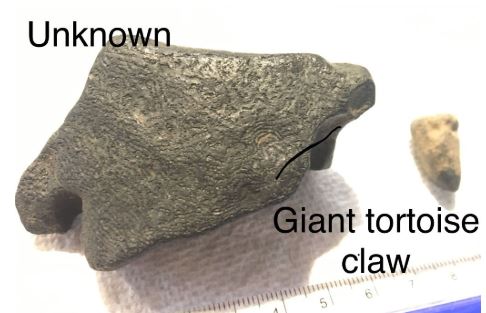
I received these photos and message from DJ about his first fossil hunt.  The photo above shows the finds of DJ's first fossil hunting trip.

I had read some past blogs on fossil hunting and Peace River. Saw some finds you posted from Bill and Dan.

I went with a guide since I believe if time is limited, that may be a good way to find things until you learn the ropes.

Our guide was very sharp and explained a lot of things, in the picture you can see many shark teeth, part of a broken mammoth tooth, several DuoGong rib bones, fossilized shell ‘molds’, stingray teeth plates and a claw from a giant tortoise.

Others found parts of Megladon teeth, horse teeth.

I like to hear the explanations and hunting techniques.

Like you have said, the story behind the find is fascinating, there is always something to find and most importantly (for me) don’t throw anything away until you get an ID.

And the places to look have to be learned, gravel holds the smaller stuff and deeper gravel holds larger better finds. Some people use a golf club with the head cut off as a probe to see how deep the gravel is. And the gravel moves and builds up over time like sand on the beach!

Learning where not to hunt is important as well, people have to throw out the stuff from their screens and it is easy to find yourself digging in someones spoil pile.

Here are a couple closer views of some of his finds.


Photos by DJ


Can anyone identify the unidentified bone?

I went with a paid fossil hunting guide on my first trip to the Peace River too.  It does save time on the learning curve.  They put you on some good spots so you don't waste hours trying to figure out where to hunt.  If you go with a guide, you will definitely find some fossils.  In my opinion, it is definitely worth the money if you are interested in fossils.

You'll do some sifting.  That might be a good introduction to a technique that can be used for other things.

Guides for some other types of treasure hunting and other locations may not be such a good idea, but for Peace River fossil hunting, I think you'll find it worth the money.

It is a lot like metal detecting.  It helps to know where to look and how to identify the good spots.  Find identification adds to the fun.

Nice finds DJ.  Thanks for sharing about your trip.

You can sometimes find fossils on Treasure Coast beaches, but it depends upon beach conditions.  There was a time a few years ago when they were plentiful.  One area was very rich with fossils, but they can be found form time to time all along the coast.  I've seen them at Ambersands, Wabasso, Seagrape Trail, Turtle Trail and along South Hutchinson Island down as far as Jensen Beach, and probably farther.  I also have seen some found at Rio Mar.  Some of the Indian River spoil islands also have fossils on them.

After some very high rough seas there were some large fossil bones, from mammoths, whales, etc. on the beaches.  Fossils have been scarce on the beaches for the last few years.

Native American artifacts can also be found on the beaches at times too.  They are more common when the fossils can be found, and I've seen them at some of the same beaches.

---

As part of RR Auction's The Fine Autographs and Artifacts Featuring JFK’ collection, the rosary beads used by Father James Thompson on the fateful day of President Kennedy's death were sold for $13,401.25...

https://spiritdaily.org/blog/news/rosary-beads-used-in-jfks-last-rites-auctioned-for-over-13k

---


On the deepest dive ever executed into the Mariana Trench, an American investor-turned-explorer discovered what appeared to be plastic bag and other litter nearly seven miles below the surface of the Pacific Ocean.

Victor Vescovo, a retired naval officer from Texas, broke the record for the deepest dive into a part of the Mariana Trench known as Challenger Deep, the deepest known point in the Earth’s seabed. His dive went 52 feet lower than a 1960 dive to the bottom of the Mariana Trench completed by U.S. Navy lieutenant Don Walsh and Swiss engineer Jacques Piccard in a vessel called the bathyscaphe Trieste...


https://www.foxnews.com/science/plastic-litter-discovered-deepest-dive-pacifics-mariana-trench

We all know how much junk there is out there.  We can all remove a little of it.

Removing junk metal can help you find good targets, and removing old worthless bottles can help you find good bottles.

I remember way back to high school when one day our gym teacher sent us out to pick up the junk on the football field.  I found a dollar under the bleachers.  Guess I liked eye-balling way back then.

---

The surf will be slowly increasing over the next few days.

Happy hunting,
TreasureGuide@comcast.net

Monday, November 19, 2018

11/19/18 Report - Checking Your Metal Detecting Thoroughness and Coverage. Marx Lecture Enjoyed. Archaeo Trashing in CO.


Written by the TreasureGuide for the exclusive use of treasurebeaches report blogspot.com.

Two Possible Patterns of Coil Coverage As You Metal Detect.

When you metal detect you walk ahead while swinging your coil from side to side.  You might think that you are getting complete coverage, as shown by the illustration on the right.  There might even be some overlap on each sweep.  That gives you more complete ground coverage, and since your coil sensitivity might be greater near the center of your coil, overlap can help you get greater overall depth.

If you are walking ahead at a quicker pace, your actual coverage might be more like that shown on the left, which leaves some ground uncovered.  That pattern leaves more uncovered ground near the end of each sweep.

Some detectorists, when they see that the footprints of another detectorist are far apart, will go over the same ground figuring that the first detectorist will have missed things.

The first time I learned how much I was missing was not too long after I began detecting.  Someone on the beach asked if I could detect their watch.  I said yes, and they told me to turn around and they buried the watch on the beach.  I then started detecting and passed over it without detecting it.  I was shocked to learn that I missed it.  It was not my detector's fault, it was my fault.  My pattern was like that shown above on the left and I was skipping more area than I realized.

After that experience, I would occasionally check myself.   At the beach I would throw a coin out  in front of me without looking.  I would then detect in the direction that I threw the coin and detect exactly as before but without looking at the ground so I would not see where the coin landed.  If I missed it or if the signal was not very good, I knew some changes were in order.  That self-test is good for checking your sweep pattern and also your sweep speed.  If your coil passes over the object but you don't get a good signal, it could be because of your settings or sweep speed.

You might want to repeat the self-test several times.

It is not always necessary to use a good tight pattern.  There can be times when you are doing a quick scan and just want to sample some ground, but you should be aware that you are skipping ground and find that acceptable.  Be aware, and be strategic.

It is easy to get in a hurry and just think about covering ground without realizing what you could be missing.

If you want to get maximum depth and are using a coil that is more sensitive near the center of the coil, you might want to overlap your sweeps more to get that maximum depth.

I recommend testing yourself occasionally.  It is important that you do not know where the target is and do not look.  If you know where the target is, the results will not tell you much because you will alter your technique unconsciously very subtly but significantly.  Try to keep your sweep pattern and rhythm normal.

I also advise testing your coil so you know where the sweet spot is and how the sensitivity varies under different areas of the coil.

---

Roberto S. saw the notice of the Marx lecture in my blog and decided to go.  Here is what he said about it.

I just wanted to say thank you for posting information about the lecture given by Sir Robert Marx. He provided interesting information and specially personal experiences ...


Enjoyed the lecture very much and also the return to the school where I received my associates degree in Oceanographic Technology in 1973, that was very special, although I never practiced the field and went on to a different career. 


Glad you enjoyed the lecture Alberto. Thanks for the report.

---

COLORADO SPRINGS, Colo. - The adage "one man's trash is another man's treasure" was especially true at Garden of the Gods Thursday morning as archaeologists dug for remnants that were tossed out of the estate of Colorado Springs Founder Gen. William Jackson Palmer.

Yes, there was an archaeological dig underway inside the park for trash from more than 100 years ago...


Here is the link.


---

We might get some nice post-turkey surf on the Treasure Coast.


The weather this year made it seem like we went from 90 degree August weather right into the holiday season.  Seemed really quick.

Happy hunting,
TreasureGuide@comcast.net


Saturday, November 17, 2018

11/17/18 Report - Remnants of Old Dock Near Fort Anne. Indian River Lagoon History. Trash and Treasure. Lucky Penny.


Written by the TreasureGuide for the exclusive use of treasurebeachesreport.blogspot.com.

Source: See KayakingKSC.com link below.

You've heard it said that one man's trash is another man's treasure.  That is especially true if you hunt old bottles or are an archaeologist, but it is true for many others too.

I was reading a post on an archaeology web site and the author mentioned that it was odd that at one archaeological site the owner of the homestead stored his trash on his land instead of having it hauled away.  I can only assume that that was written by a millennial or younger person who never lived in the country.  Where I grew up we always buried our garbage on our property.  Everybody had a trash pile.  Most dug a hole so that what remained after the trash was burned was buried.  Rural areas didn't have garbage pickup and neither did the Treasure Coast at one time.

I didn't find out when trash pickup began on the Treasure Coast, but from what I've seen along the Indian River lagoon, it wasn't until maybe the fifties or sixties along there.  Maybe someone can tell me when it was.

If you walk along the banks of the Indian River today, you'll find a lot of old bottles (many more than would have simply been thrown away by boaters or travelers).  You will also find the remains of old trash or burn piles.  Some are still very evident and continue to get washed out whenever there is erosion.

I've talked before about the signs of treasure.  Some of the first signs that you'll often see are pot shards, which tend to remain visible on top of the ground for decades or centuries.

Trash can be one very promising sign of the possible presence of treasure.  The treasure we dig today is what was left behind by the peoples of the past.  Discarded or lost bits can tell you a lot.

When people talk about the history of Florida, they usually only go back a few centuries, but Florida has a very ancient and important past.  I found one very good post about the history of the Indian River Lagoon, including the photo above, on the Kayaking the Kennedy Space Center web site.  Here is the link.

https://www.kayakingksc.com/History-of-the-Indian-River-Lagoon.html

Not only does that post show the remnants of a dock near the Seminar War Fort Anne and the old blockhouse, but it also provides information about the even older history of the lagoon.  Here are a few facts from the KayakingKSC post that demonstrate why the ancient history of the lagoon area is so important.


Jaw dropping facts:

**168 individuals recovered from the mortuary pond. Latest dating is between 7,210 years and 7,320 years “before present”

**Woven fabrics- the oldest-known in the world.

**Brain matter in skulls- DNA was extracted

**DNA results: Rare Haplogroup X –

X is one of the five haplogroups found in the indigenous peoples of the Americas.

Now that is some pretty impressive history.


Here are a few interesting facts on the history of trash from garbagemanday.org (full link below).

3000 B.C. – The first landfill is developed when Knossos, Crete digs large holes for refuse. Garbage is dumped and filled with dirt at various levels.

1388 – The English Parliament bans dumping of waste in ditches and public waterways.

1551 – The first recorded use of packaging: German papermaker Andreas Bernhart begins placing his paper in wrappers labeled with his name and address.

Around 1757 Ben Franklin started the first street cleaning service and encouraged the public to dig pits to dispose of their waste. We were even smart enough to melt down a statue of King George III and use it as ammunition against his armies.

In 1885 America built its first incinerator on Governors Island, New York. The Big Apple also developed the nations first comprehensive system for garbage management. We even tried Austria’s waste reduction plants which compress organic grease, oils and by-products from waste. Although, they were quickly vetoed due to nasty odors.

For more about garbage: http://www.garbagemanday.org/history-of-the-garbage-man/

---
Mounted 1958 Wheat Penny Find.

This is not exactly a holed coin, but close to it.  The mounting is minimal, and I couldn't find anything special about the coin.  I looked closely at both sides to find anything special and it just looks like a regular wheat penny.  It is in very nice condition except for the discolouring, but I had to wonder why someone would mount it.  It is nicely, although inexpensively, mounted.  Perhaps the date was significant, or it was a lucky penny, or a gift.

---

On the Treasure Coast the tides are flat.  From the look of the wind this morning, I would suspect that there are some scallops and perhaps some very small cuts on some of the beaches.

Here are the surf predictions for the next few days.


Happy hunting,
TreasureGuide@comcast.net

Thursday, August 2, 2018

8/2/18 Report - $47,000 Kennedy Half. Shipwrecks and Climate Change. Metal Detecting Strategy.


Written by the TreasureGuide for the exclusive use of treasurebeachesreport.blogspot.com.

1964 Kennedy Half Dollar.
The coin shown is in exceptional condition for a dug coin.  The melt value is about $5.50, but being in at least fine condition would probably be worth over $7.00.

Last year a 1964 Kennedy half sold for $47,000 at auction.  It was a rare special mint set (SMS) coin.  Only 12 are known and their origin is a mystery.  It isn't an error coin or variety and is not easy to identify.

The 1964 SMS Kennedy half dollar has a satin-textured surface.  Salmon-orange rim toning kisses the upper obverse and lower reverse surfaces of the coin with ambient white-gray coloration across the fields and devices. Surface marks on the lower obverse that mimic dark fingerprints are described by Heritage as “carbon-gray flecks.”
---

Shipwrecks aren’t necessarily barren, static things, vanished and abandoned to the deep water and the recesses of someone’s foggy memory. They may be moldering, but, like the Vamar, they’re often active places—part cultural heritage site, part dynamic ecosystem. They’re constantly in flux, and they’ll be impacted as climate change affects the water that holds them.

For years archaeologists have mainly been concerned with what climate change might do to places where the land meets the water. They’ve examined ways to stave off rising tides by buffering sites that will be swamped, hauling things to higher ground or documenting whatever they can in the water’s path. For these sites that are not yet damp, water is a threat—sometimes a distant one, sometimes one that’s gaining ground—but for the wrecks, it’s a foregone conclusion. That ship has sailed—and sunk.

With climate change, “sea-level rise is the most obvious thing people are used to hearing about, and the most easily dismissed with submerged sites,” says Jeneva Wright, an underwater archaeologist and research fellow at East Carolina University. Sea-level rise is far from the only climate-related threat facing submerged sites, though: Wright outlined a handful of others in a 2016 paper in the Journal of Maritime Archaeology written when she was working as an archaeologist in the National Parks Services’ Submerged Resources Center.

Across the field, there’s admittedly little data about some of these risks, and Wright says that archaeologists would do well to collaborate with biologists, ecologists, oceanographers, and other scientists who have amassed much more information about what a changing climate will do to parts of these ecosystems. For now, Wright describes her reading of these risks as “theoretical, hypothetical, and logical,” meaning that though there’s fairly limited research within archaeology, these forecasts square with projections that researchers in other fields have arrived at, after starting to scrutinize the future effects of climate change on, for instance, ocean chemistry, reefs, and other marine life....

I added the underlining.


Here is the link for the rest of the article.

https://www.atlasobscura.com/articles/how-climate-change-will-affect-shipwrecks

Thanks to TekLord Doug for the link.

Shipwrecks are definitely not static things, but some shipwrecks are definitely more vulnerable than others.  There is little data on this stuff, and the hysteria is not based upon anything scientific.

Nothing has failed like the Critical Thinking Movement in education.

---


Wen you get a signal it might be trash or treasure.  You might try to distinguish between the two by using a meter or different tones, but it is never a perfect process.  Mistakes can be made.  You never know when you make a mistake and leave something good in the ground.

The table is simplified.  There are also times when signals might be due to ground mineralization or electrical interference or other things when there is no metal item to dig.  Different targets also have different values.

What this table makes clear is two types of mistakes and two ways that you can be correct.  You can correctly identify treasure or trash and you can be mistaken about each.  When you decrease the probability of one type of mistake, you can increase the probability of another type of mistake.

For example, when you only dig very good signals, you miss more good targets along with the trash you eliminate.  What you should consider is when you decide to dig less trash, does the gain in saved time and effort make the loss in some good targets acceptable.  That is a very difficult evaluation because you never find out the value of what you left in the ground.

Many people just can't tolerate digging trash.  That is something they "feel" every time they do it.  If they similarly experienced the disappointment of treasures left in the ground, they might feel very differently about how much trash they are willing to dig.

I also know that some people think they don't miss any good targets.  And they'll never know any differently.

---

No storms to watch and no big change in beach conditions.

Happy hunting,
TreasureGuide@comcast.net